

US October CPI Preview: Inflation Growth May Slow, How Will US Stocks, Dollar and Gold React?
 I'm LongbridgeAI, I can summarize articles.
TradingKey - On Tuesday (Nov. 10) Eastern Time, the U.S. will release the October Consumer Price Index (CPI), a key inflation reading ahead of the Federal Reserve's December interest rate decision. The U.S. Bureau of Labor Statistics confirmed that the report will be released at 8:30 a.m. ET. Markets expect that, driven by a slowdown in gasoline price gains, October headline inflation may cool from September, though core inflation remains somewhat sticky. This data will influence market expectations regarding whether the Fed will continue raising interest rates in December, and could trigger, across U.S. stocks, the U.S. dollar, and gold (XAUUSD), a new round of market moves.
October CPI May Cool as Core Inflation Remains Key
According to a FactSet survey, economists expect headline CPI to rise 0.24% month-over-month in October, down from 0.6% in September, while core CPI is expected to increase 0.2% month-over-month, also slowing from 0.3% in September. However, institutional forecasts diverge somewhat: RBC expects both headline and core CPI to rise 0.3% month-over-month, while Bank of America projects headline CPI to increase by 0.4% and core CPI by 0.3%.
Notably, because October CPI data could not be collected normally during the 2025 U.S. government shutdown, the BLS will not release year-over-year percentage changes for most CPI subcomponents this time. Consequently, the market will focus more closely on month-over-month changes in headline and core CPI, as well as the specific performance of shelter, goods, and services prices.
From the perspective of inflation components, a moderation in gasoline price gains was likely the primary driver behind the cooling in October headline CPI. UBS analysts estimate that the contribution of energy prices to headline inflation may have dropped from 0.39 percentage points in September to 0.04 percentage points in October. Meanwhile, declines in new and used vehicle prices could also alleviate some inflationary pressure.
However, core inflation will not necessarily improve in tandem. RBC economists noted that prices of imported goods such as apparel, footwear, toys, and information technology equipment are accelerating, with tariff costs likely passing through to consumers gradually. In addition, shelter prices and core services inflation remain sticky, signaling that underlying U.S. inflationary pressures have not yet fully subsided.
Federal Reserve policy expectations have also drawn heightened attention to this CPI release. The Fed held the federal funds rate unchanged at 3.75%-4.00% at its October meeting, but recent employment data has remained resilient, and inflation stays above the 2% policy target. According to futures market pricing, the probability of another 25-basis-point rate hike in December has climbed to approximately 80%, up significantly from 67% previously.
Morningstar cited Christopher Hodge, chief U.S. economist at Natixis, as noting that even if October inflation moderates, the Fed may still need to hike rates further in December as long as price gains remain sticky and the labor market stays stable. Therefore, even if this CPI print meets market expectations, it may not be sufficient to alter the current hawkish policy pricing.
Impact on US Stocks, US Dollar and Gold
For US equities, if October core CPI holds at 0.2% month-over-month or lower, the market may perceive that underlying inflationary pressures have eased, potentially reducing expectations for a Fed rate hike in December. A retreat in US Treasury yields would favor a rebound across high-valuation sectors such as the Nasdaq, AI, and semiconductors. Conversely, if core CPI reaches 0.3% or higher, especially with prices for both goods and services rising simultaneously, the market may further reinforce rate-hike expectations and push US Treasury yields higher, weighing on tech growth stocks. Notably, if higher headline CPI is driven primarily by energy while core inflation remains moderate, the negative impact on US stocks may be relatively limited.
For the US dollar, its performance will primarily hinge on whether the CPI data alters expectations for the Fed's December policy meeting. If both headline and core CPI exceed expectations, sticky inflation will reinforce the likelihood of US interest rates staying higher for longer or even being raised further, potentially providing fresh upward momentum for the greenback. If core CPI comes in below expectations and the market trims the probability of a December rate hike, falling US Treasury yields could undermine the dollar's rate advantage, leaving the US Dollar Index vulnerable to a temporary pullback. However, if only headline CPI is elevated due to higher energy prices, upside for the US dollar may be limited.
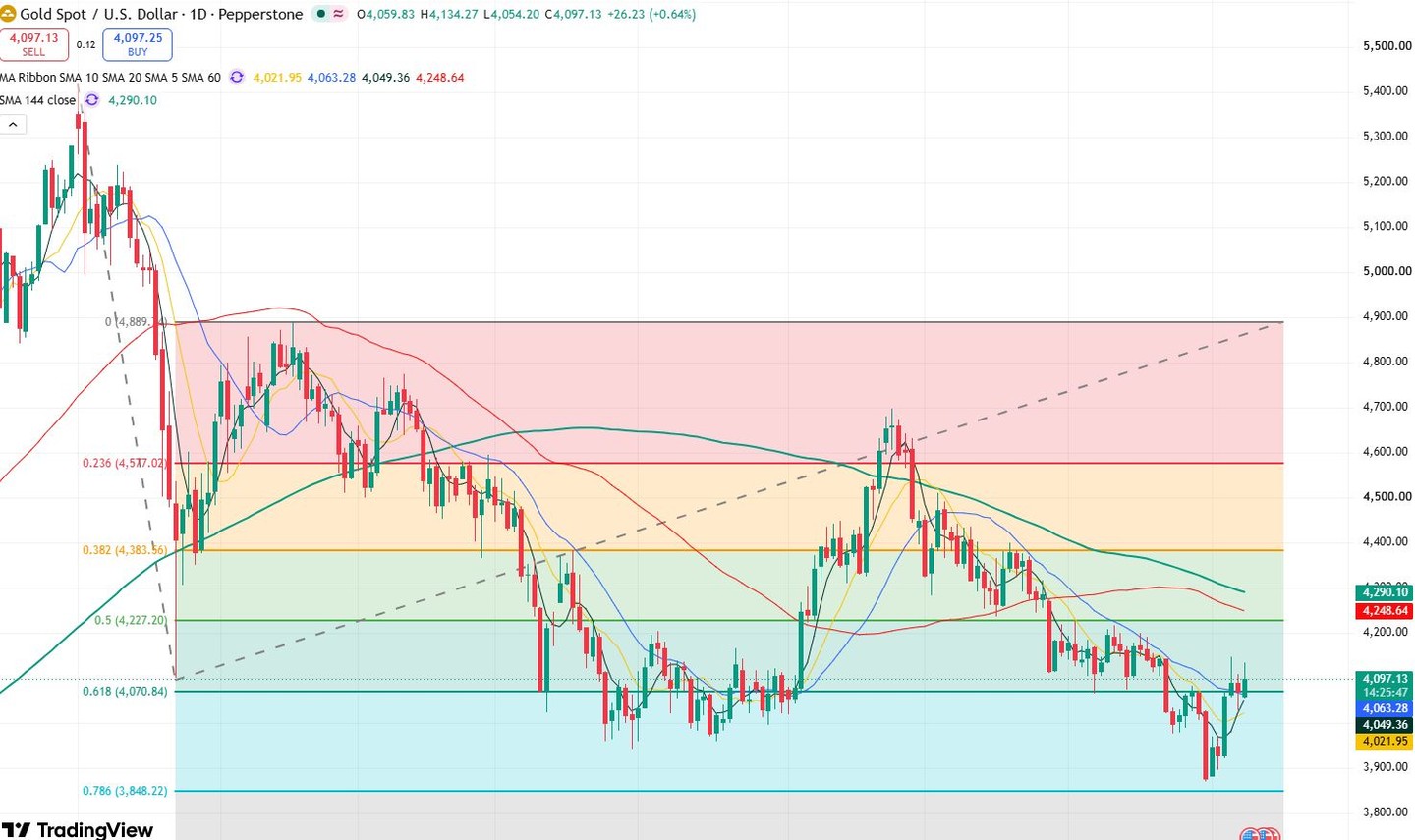
Gold Price Daily Chart, Source: TradingView
For gold, if core CPI exceeds expectations, heightened Fed rate-hike expectations could push the US dollar and US Treasury yields higher, increasing the opportunity cost of holding gold. Gold prices could remain under pressure, potentially testing support around $4,050 or even sliding toward the $4,000 mark. Conversely, if core CPI falls short of expectations, bets on a December rate hike decline, and the US dollar and Treasury yields retreat in tandem, gold could stage a rebound and test resistance in the $4,200-$4,230 range.