
 I'm LongbridgeAI, I can summarize articles.
According to Zhitong Finance APP, thanks to the booming trend in the field of artificial intelligence, the market for electricity demand from the largest power grid system in the United States is expected to grow rapidly. It is anticipated that over the next decade, the increase in demand will be equivalent to the installation of two new New England power grid systems. The exponential expansion of high-energy-consuming AI data centers, driven by the fierce demand for AI computing power infrastructure, is fundamentally reliant on electricity supply, which is the origin of the market view that "the end of AI is electricity."
According to a data report released on Friday, PJM Interconnection LLC, which manages the power systems of 13 states from Washington D.C. to Illinois, recently projected that by 2035, summer peak electricity demand will increase by nearly 58 gigawatts (approximately a 38% increase) from last year's historical high, reaching about 210 gigawatts. Statistically, this expected increase in electricity demand will be more than double the historical highest demand of the New England power grid.
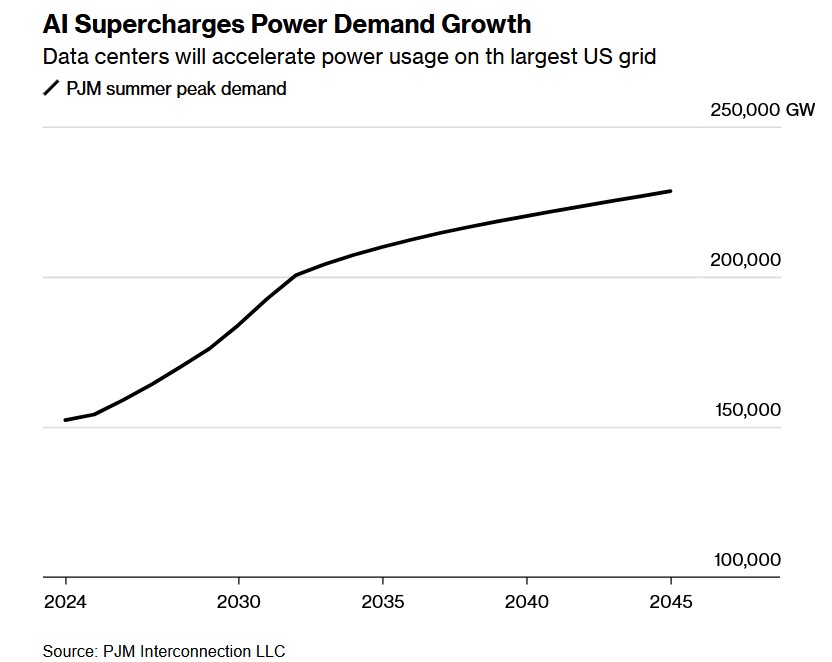
AI Drives Electricity Demand Growth—Data Centers Will Accelerate Power Consumption of the Largest Power Grid in the U.S.
With the rapid increase in the number and scale of large data centers used to run artificial intelligence, it is expected that over the next decade, electricity consumption in PJM and the U.S. as a whole will rise significantly at an unprecedented rate. Predictive data indicates that some planned power infrastructure could consume enough energy to supply an entire city's electricity needs.
Although both the Biden administration and the U.S. government led by former President Donald Trump have claimed the need to intensify the deployment of AI infrastructure to maintain national security and economic interests, Wall Street analysts generally expect that the significant increase in electricity demand is likely to put immense pressure on the aging U.S. power infrastructure and supply scale year by year. This is why, since 2024, Wall Street funds have significantly flowed into power stocks like Vistra Energy (VST.US).
At last week's Davos Forum, Trump stated that large power plants need to be built in sync with data centers to avoid large-scale delays or reliability issues in AI applications caused by connecting to an increasingly strained and aging power grid system.
Last week, OpenAI and SoftBank, in collaboration with Oracle, announced a super-scale AI infrastructure construction plan called "Stargate," with an initial investment of $100 billion, which could expand to $500 billion within four years, focusing on the construction and expansion of AI data centers. The $500 billion investment plan for "Stargate" far exceeds market expectations and has even been hailed by some media as "the Manhattan Project of the new era." Returning to the White House, President Trump stated that the U.S. government would provide all conveniences for the "Stargate" plan through an emergency declaration, especially to meet all necessary electricity supply and the underlying energy demands, as well as urgently needed land/building permits With the global surge of artificial intelligence applications like ChatGPT, the energy demand from data centers worldwide has become so immense that since 2024, some long-neglected power supply utility stocks have entered the sights of top investment institutions on Wall Street. The demand for AI computing power, closely linked to AI training/inference, is accelerating, and the already "power-hungry" data centers are expected to see a continued surge in their demand for electricity in the coming years.
According to forecasts from Boston Consulting Group, the share of electricity consumption accounted for by data centers in the United States is expected to double, increasing from 126 terawatt-hours in 2022 to 390 terawatt-hours by 2030. Terawatt-hours are used to describe the largest levels of electricity, typically used in national energy statistics and the planning and assessment of large energy projects. Large industrial facilities, such as super steel mills, may consume less than 10 terawatt-hours of electricity in a year. According to forecasts from the International Energy Agency (IEA), in the next three years, the electricity demand from global data centers and high-energy-consuming industries like cryptocurrency could at least double, equivalent to the total electricity demand of Germany, the largest economy in Europe.
The independent power giant Vistra Energy is the best-performing stock in the S&P 500 index for 2024, with a surge of 265%, even surpassing Nvidia's 170% increase in 2024. The even stronger-performing Palantir was only added to the S&P 500 index in September. Notably, according to congressional statistics, U.S. Congress member Nancy Pelosi, known as the "stock market guru of Capitol Hill," added Vistra Energy to her portfolio at the end of last year and the beginning of this year.
Vistra and its utility peer Constellation Energy Corp (CEG.US) have shown particularly strong growth among U.S. utility companies, as they are positioned as independent power producers, meaning they sell electricity at market prices, which is starkly different from some government-regulated utility companies in the U.S.
Vistra's revenue scale and total market value have significantly increased since 2024 due to the massive electricity consumption of data centers. With some government agencies and U.S. tech giants committing to invest larger amounts of money in the AI field next year, especially in building and expanding power-hungry data centers, the outlook for power systems and other utility infrastructure providers looks very optimistic. Data centers are indeed the core large infrastructure projects of the AI era, crucial for the efficient operation of generative AI applications like ChatGPT and the iterative updates of large AI models like GPT-4o