
 I'm LongbridgeAI, I can summarize articles.
According to the Zhitong Finance APP, TrendForce reports that in January 2025, upstream prices in the photovoltaic industry chain have shown signs of recovery, with component prices remaining stable, and market competition continues. In January, there were few domestic photovoltaic contracts, projects started, or projects put into production; however, the industry's development has not stagnated. Domestic photovoltaic companies are gradually moving away from blind expansion and are instead focusing on technological innovation, with new technologies such as BC, HJT, and perovskite accelerating their penetration. Overseas, India has become a hotbed for photovoltaic expansion due to policy incentives and strong demand, with local production capacity expanding rapidly.
Contracted/Planned Projects
Titanium ore industry accelerates layout, overseas photovoltaic expansion focuses on India
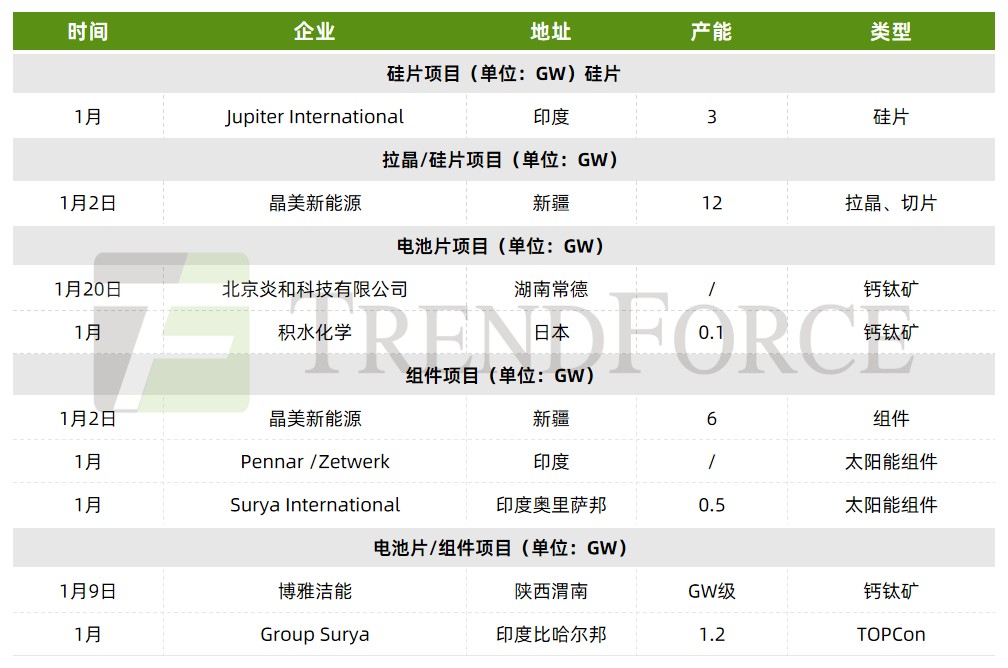
According to incomplete statistics from TrendForce, there are 9 photovoltaic contracted/planned projects in January 2025, of which 4 are domestic contracted/planned projects with a scale of approximately 19 GW, and 5 are overseas planned projects with a scale of approximately 4.8 GW. From the perspective of specific segments, the silicon wafer segment plans 3 GW, the crystal pulling and silicon wafer segment plans 12 GW, the battery cell segment has contracted/planned approximately 100 MW, the component segment has contracted/planned 6.5 GW, and the battery cell and component segment has contracted/planned approximately 2.2 GW.
Silicon Wafer Segment: In January, Indian photovoltaic manufacturing and EPC company Jupiter International announced the addition of 3 GW of silicon wafer production capacity.
Crystal Pulling and Silicon Wafer Segment: Only one contracted project in January, Jingmei New Energy expands production against the trend. On January 2, Jingmei New Energy (Tacheng) launched a monocrystalline silicon rod slicing project, with the first phase to build factories and supporting facilities, creating a production line with 12 GW of crystal pulling, slicing, and 6 GW of component capacity.
Battery Cell Segment: Two perovskite projects were finalized in January, accelerating industrial layout. On January 20, Beijing Yanhe Technology signed an agreement with the Changde High-tech Zone Management Committee for a perovskite new material production base project, focusing on the production of perovskite photovoltaic cells. Additionally, Japanese plastic manufacturer Sekisui Chemical announced plans to start a 100 MW perovskite solar cell production line in 2027, aiming to achieve GW-level capacity by 2030.
Component Segment: Three contracted/planned projects in January, Jingmei New Energy's 6 GW component project settles in Xinjiang. On January 2, Jingmei New Energy's 12 GW crystal pulling, slicing, and 6 GW photovoltaic component project was established in Xinjiang; Pennar Industries and Zetwerk Manufacturing announced the establishment of a joint venture for solar component manufacturing in India, planning to build a photovoltaic component factory at an undisclosed location; Surya International announced plans to build a 500 MW solar component manufacturing factory in Odisha.
Battery Cell and Component Segment: GW-level battery components established, accelerating the mass production process of perovskite. On January 9, Boya Clean Energy's GW-level perovskite battery component project was signed and established in Huazhou District, Weinan City; Indian photovoltaic company Group Surya announced the construction of a 1.2 GW TOPCon technology solar cell and component factory in the Sasaram area of Bihar Figure: Photovoltaic Contracted/Planned Projects in January 2025
Commenced Projects
Concentrated in the battery cell and module segments, Runma Photovoltaics has a commencement scale of 20GW
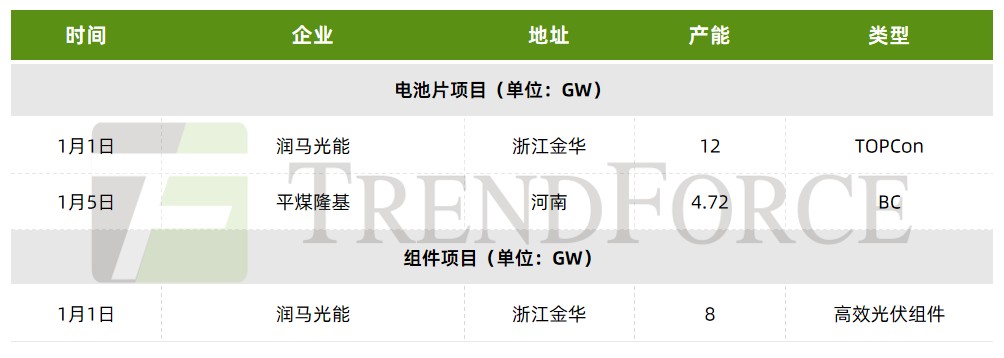
According to incomplete statistics from TrendForce, in January 2025, only 3 domestic photovoltaic projects commenced, with a commencement scale of 16.72GW in the battery cell segment and 8GW in the module segment.
Battery Cell Segment: All commenced projects are N-type capacity, with the BC camp poised for action. On January 1, Runma Photovoltaics held a commencement ceremony for its second phase project in Jinhua, Zhejiang, which will produce 12GW of high-efficiency photovoltaic cells and 8GW of high-efficiency photovoltaic modules annually; on January 5, the Pingmei Longi BC battery technology upgrade project held its commencement ceremony, with a designed annual capacity of 4.72GW.
Module Segment: On January 1, the Runma Photovoltaics second phase project of 12GW battery and 8GW module commenced.
Figure: Photovoltaic Commenced Projects in January 2025
Commissioned Projects
Diverse technological routes compete, with N-type capacity accounting for 75.8%
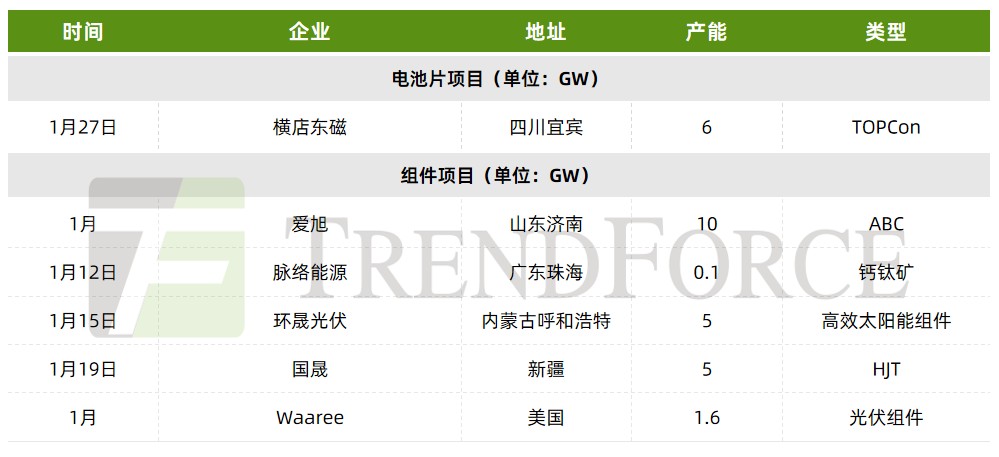
According to incomplete statistics from TrendForce, there are 6 photovoltaic projects commissioned in January 2025, covering diverse technological routes such as TOPCon, HJT, XBC, and perovskite, with N-type capacity accounting for approximately 75.8%. In terms of specific segments, the commissioned scale in the battery cell segment is 6GW, and in the module segment, it is 21.7GW.
Battery Cell Segment: On January 27, Hengdian Dongci announced that its wholly-owned subsidiary's new high-efficiency battery project with an annual production capacity of 12GW (phase 2, 6GW) has been commissioned, utilizing advanced TOPCon technology.
Module Segment: Aiko's first 10GW ABC module is commissioned in Jinan, and Guosheng's first 5GW HJT module is offline. In January, Aiko's first phase 10GW module project in Jinan saw its first module offline, officially commencing production of high-efficiency N-type ABC modules; on January 12, the 100MW perovskite photovoltaic module production line of Maike Energy successfully went offline; on January 15, the product mass production offline ceremony for Huansheng's 10GW smart factory phase 1 (5GW) was held in Hohhot, Saihan District, Jinshan High-tech Zone; on January 19, Guosheng's (Ruoqiang) dual-carbon silicon-based industrial park successfully saw its first 5GW high-efficiency heterojunction module offline; in addition, Indian photovoltaic giant Waaree's 1.6GW module factory in the U.S. has been commissioned Figure: Photovoltaic Projects Commissioned in January 2025
Other Project Progress
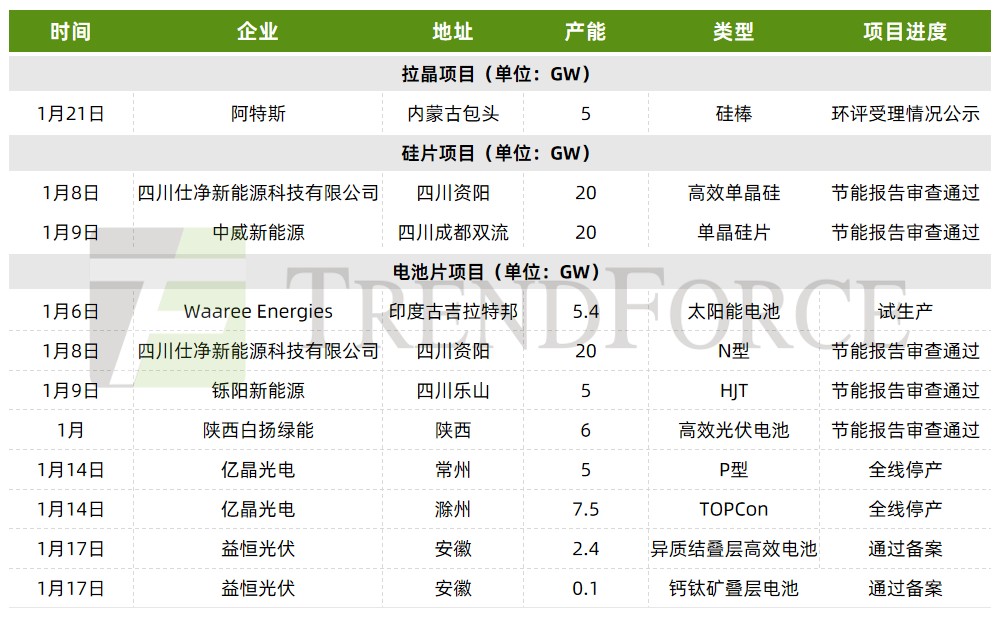
Crystal Growth Stage: On January 21, the environmental assessment acceptance of the 5GW semi-monthly silicon rod project by Baotou Canadian Solar was publicly announced.
Wafer Stage: On January 8, the energy-saving report review for the high-efficiency solar cell manufacturing base of Sichuan Shijing New Energy Technology Co., Ltd. was approved, which will build 20 N-type crystalline silicon cell production lines in two phases, with an annual output of 20GW high-efficiency monocrystalline wafers (intermediate product, phase one 10GW) and 20GW high-efficiency solar cells (phase one 10GW); on January 9, the energy-saving report review for the 20GW photovoltaic monocrystalline wafer project by Zhongwei New Energy was approved.
Cell Stage: On January 6, Waaree Energies' 5.4GW cell factory in Gujarat began trial production; in January, the energy-saving report review for the high-efficiency solar cell manufacturing base of Sichuan Shijing New Energy Technology Co., Ltd., the 10GW high-efficiency heterojunction cell project (phase one 5GW) by Shuangyang New Energy in Leshan High-tech Zone, and the 6GW high-efficiency photovoltaic cell project by Shaanxi Baiyang Green Energy were approved; on January 14, Yijing Optoelectronics disclosed that the 5GW P-type cell capacity at the Changzhou base and the 7.5GW N-type TOPCon cell capacity at the Chuzhou base have been completely shut down; on January 17, the research and trial production line project for the perovskite-heterojunction stacked high-efficiency battery by Huainan Yiheng passed the filing.
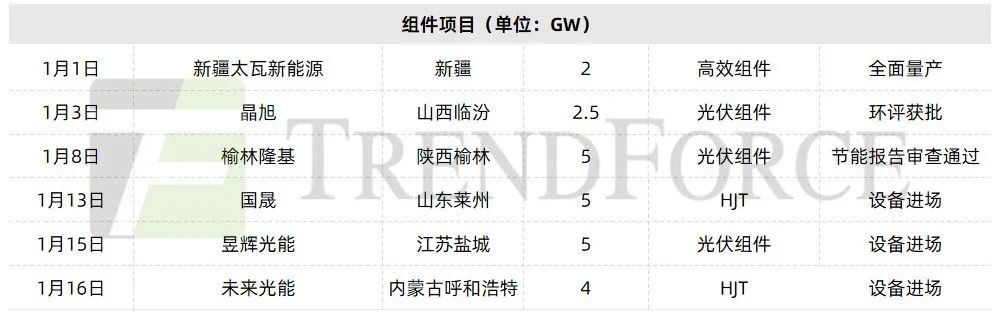
Module Stage: On January 1, the 2GW module production line project of Xinjiang Taiwa New Energy officially entered full-scale production; on January 3, the environmental assessment for the 2.5 million kilowatt photovoltaic module project by Jingxu was approved; on January 8, the energy-saving report review for the 5GW photovoltaic module factory project by Yulin Longi Photovoltaic Technology Co., Ltd. was approved; additionally, in January, the equipment for the 5GW high-efficiency heterojunction photovoltaic module project of Guosheng (Laizhou) Heterojunction Dual Carbon Industrial Park, the 4GW heterojunction module project of Future Solar Energy in Hohhot, and the phase one 5GW photovoltaic module project of Yuhui Solar Energy in Yancheng was delivered.
Figure: Other Photovoltaic Project Progress in January 2025
Overall, in January 2025, domestic photovoltaic project signing, commencement, and commissioning have cooled down, while domestic photovoltaic companies are focusing on new technologies to seize market opportunities. In terms of perovskite, GW-level battery modules and multiple projects have been launched, accelerating the industrialization process of perovskite; in terms of BC technology, the BC battery technological transformation project by Pingmei Longi has commenced, and the first ABC cell of Aiko in Jinan with a capacity of 10GW has been put into production, with the BC camp poised for action; In terms of HJT technology, Guosheng Ruoqiang's first 5GW HJT unit has come off the production line, and multiple project equipment has entered the site, accelerating HJT mass production. In the overseas market, India is rapidly expanding its local photovoltaic capacity driven by strong market demand and policies such as ALMM, PLI, and DCR