
 I'm LongbridgeAI, I can summarize articles.
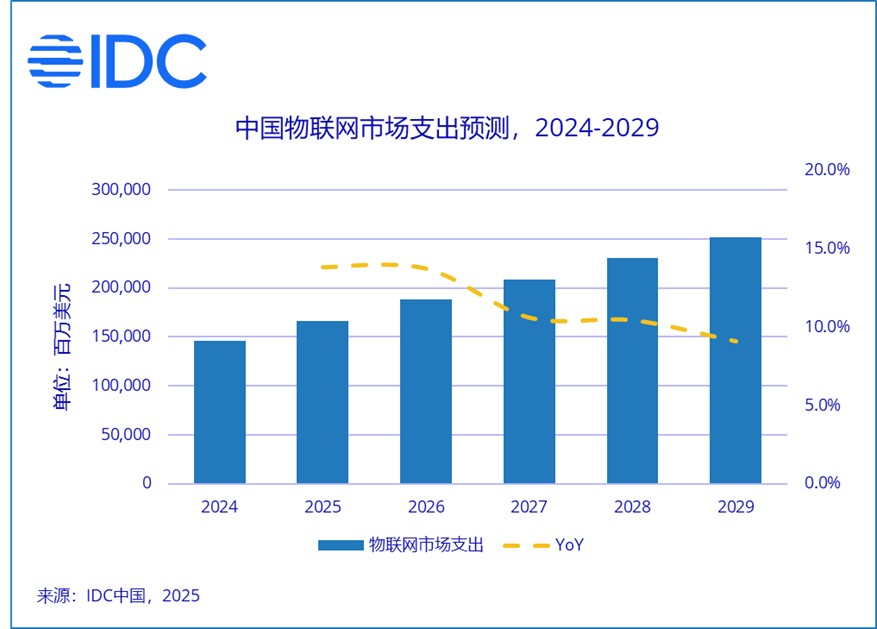
According to IDC data, China's Internet of Things (IoT) spending is expected to reach USD 165.86 billion by 2025, an increase of 13.7% from 2023. Supported by strong policy backing, enormous market demand, and the integration of new technologies, the IoT will continue to develop in the future, accelerating the digital transformation and intelligent reform processes across various industries, injecting lasting momentum into industrial upgrades. IDC predicts that China's IoT investment will be approximately USD 251.51 billion by 2029, with a compound annual growth rate (CAGR) of 11.5% from 2025 to 2029.
Technological Trends
From a technological perspective, IDC data shows that hardware and services account for the first (69.4%) and second (20.7%) largest shares of spending, respectively. Additionally, software spending is expected to achieve a CAGR of 11.5% over the next five years, becoming a rapidly growing technological field. The IoT technology system is divided into the perception layer, network layer (transmission layer), platform layer, and application layer. Among these, the application layer and platform layer contribute the most added value. The integration of 5G technology and edge computing enables high-speed, low-latency data transmission, creating conditions for real-time control applications. With the popularization of communication technologies such as 5G and NB-IoT, and the maturity of hardware devices, the importance of IoT platforms and software solutions has significantly increased. Enterprises are no longer satisfied with connecting single devices but are pursuing the full-chain capability of "connection + data + intelligence."
Industry Trends
From an industry perspective, over the next five years, spending in manufacturing, government, information services, retail, and public utilities will account for 70% of total spending. The demand from various industries to enhance operational efficiency, optimize user experience, and reduce costs creates vast market space for the IoT. In the agricultural sector, the IoT aids in achieving precision agriculture by using sensors to monitor soil moisture, weather conditions, and crop growth in real-time, enabling precise irrigation, fertilization, and pest control, thereby improving agricultural productivity and ensuring the safety of agricultural product quality. In the energy sector, the IoT promotes energy construction, achieving intelligent management of energy production, transmission, storage, and consumption, enhancing energy utilization efficiency, and promoting sustainable energy development.
Application Scenarios
The value of the IoT is shifting from "connectivity" to "business empowerment." Key areas such as smart manufacturing, smart energy, smart transportation, smart cities, and smart agriculture have established typical application cases for the IoT. For example, in smart factories, leveraging 5G and edge computing, equipment can process production data in real-time, quickly adjust production parameters, and achieve precise control of the production process. The deep integration of artificial intelligence and the IoT endows devices with "intelligence." The massive data collected by IoT devices can be analyzed and processed using artificial intelligence algorithms to enable intelligent decision-making and accurate forecasting In warehouse management, intelligent warehousing systems can automatically adjust warehouse layouts based on inventory dynamics, improving warehouse space utilization. IDC data shows that video analytics, inventory intelligence, and quality and compliance are the largest application scenarios for IoT investment