
 I'm LongbridgeAI, I can summarize articles.
On August 18 this year, LUZHU BIOTECH-B (02480) announced that its core product LZ901 demonstrated superior cellular immunogenicity and better safety in a head-to-head clinical trial against GlaxoSmithKline's (GSK) Shingrix® for adults aged 50 and above.
The positive key clinical data of LUZHU BIOTECH's core product directly stimulated market sentiment. On August 18 and 19, LUZHU BIOTECH's stock rose for two consecutive trading days, increasing by over 8%, with the highest stock price reaching HKD 28, setting a new high for the company's stock price in nearly 15 months.
However, despite this, the market trading situation for LUZHU BIOTECH remains sluggish. According to Zhitong Finance APP, since the beginning of 2024, the liquidity of LUZHU BIOTECH's stock has experienced a cliff-like decline. As of now, there have been 11 months within the past 21 months where the monthly trading volume did not exceed 200,000 shares.
Even with the significant positive news regarding the company's core product, LUZHU BIOTECH's single-day trading volume on August 19 was only 69,600 shares, which is also the highest single-day trading volume since August. Since August, there have only been 8 trading days where the trading volume exceeded 20,000 shares, with the lowest single-day trading volume even dropping to just 400 shares. In terms of trading volume, LUZHU BIOTECH still appears to be on the edge of being forgotten by the market.
Multiple financial indicators decline, core product becomes a "lifeline"
For Hong Kong stock 18A companies, the most suitable shortcut to provide market liquidity is naturally "inclusion in the Connect," but the market capitalization calculation method for "inclusion in the Connect" has changed from the average market capitalization at the end of the month during the review period to the average daily market capitalization during the review period, raising the inclusion threshold for small-cap stocks to over HKD 9 billion. Although LUZHU BIOTECH's market capitalization has increased this year, it is currently only about HKD 5 billion, far below the "inclusion in the Connect" threshold, so the company can only rely on its fundamentals to attract market attention.
According to LUZHU BIOTECH's latest disclosed semi-annual report for 2025, the company still has no products commercialized, and the main business revenue remains at 0; other income is HKD 4.85 million, a decrease of 50.2% compared to HKD 9.73 million in the same period of 2024, mainly due to reduced government subsidies; at the same time, other expenses increased from HKD 190,000 to HKD 590,000, an increase of 209.5%. However, the company's net loss for the period continued to narrow to HKD 77.57 million, a year-on-year decrease of 29.4%, with R&D investment decreasing by 37.5% year-on-year to HKD 50.273 million.
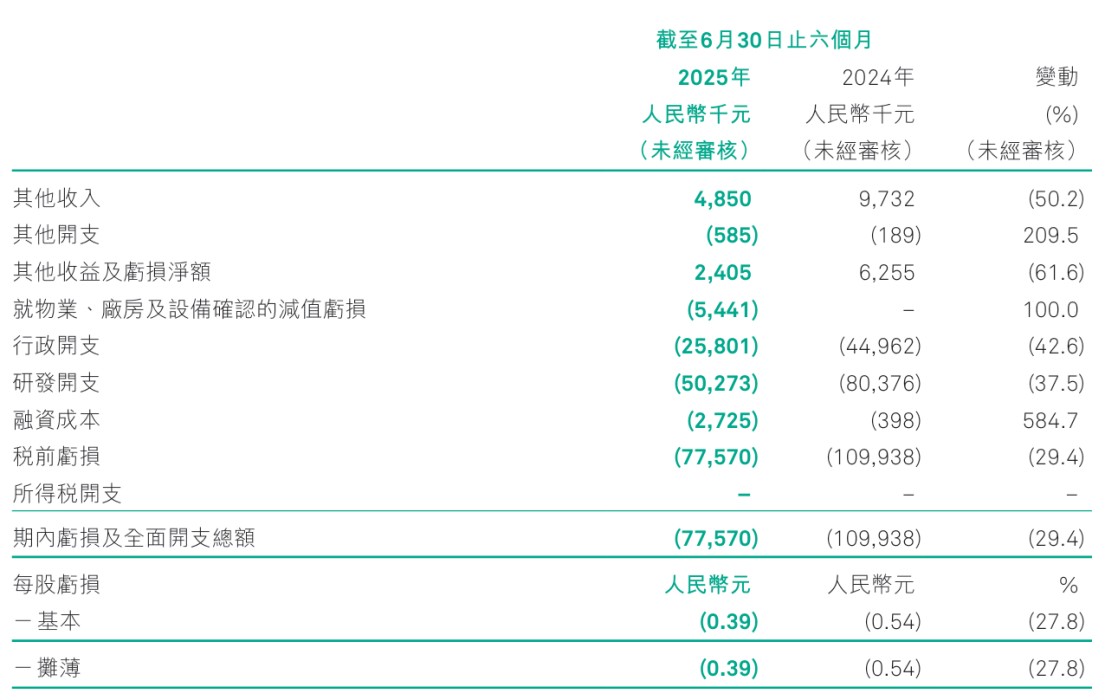
The continuous decline in R&D investment reflects, on one hand, that the R&D of the company's core product has entered the later stage, and on the other hand, it indicates that the company's cash reserves may no longer support its continued expansion of cash-burning R&D.
The financial report shows that LUZHU BIOTECH's cash and cash equivalents totaled HKD 99.219 million, a year-on-year decrease of 29.20%. To stabilize the company's daily R&D and operational cash flow, the company has also increased financing during the period, with bank loans reaching HKD 196 million, a significant increase of 269% It can be seen that before commercialization, the fundamentals of LUZHU BIOTECH were lackluster, which is why its core shingles product has always been highly anticipated. During the reporting period, the head-to-head clinical data readout of LZ901 against GlaxoSmithKline's Shingrix® is considered the key to unlocking the commercialization market for LUZHU BIOTECH.
According to Zhito Finance APP, from a mechanism of action perspective, LUZHU BIOTECH's LZ901 employs innovative recombinant protein technology with antigen molecular structure, forming a complementary and competitive technological route with GlaxoSmithKline (GSK)'s Shingrix® (recombinant protein technology + adjuvant innovation) and Baike Biotech's GanweiTM (live attenuated technology).
In the comparative trial with Shingrix®, LZ901 significantly outperformed Shingrix® in terms of CD4⁺ T cell response rate and CD8⁺ T cell response rate, with rates of 83.0% and 46.8%, respectively, compared to Shingrix®'s 58.1% and 8.8%; in terms of safety data, the adverse reaction incidence rate of LZ901 was only 41.1%, far lower than Shingrix®'s 87.9%, with grade 3 adverse reaction incidence at only 0.7%, while Shingrix® was 6.0%.
The above data indicate that LZ901 has significant advantages in cellular immunity levels and safety. High safety is expected to greatly reduce the AEFI reporting rate after the product is launched, making it more favored in the end market and significantly improving vaccination compliance. Previously, the market judged that since Shingrix® could quickly replace Zostavax with better clinical performance, LZ901 is undoubtedly expected to accelerate the domestic replacement of Shingrix after its launch. However, the biggest issue for LZ901's commercialization may lie in the blue ocean market that still requires market education.
Could "Market Education" Costs Become the Biggest Roadblock?
One key factor that investors have previously viewed positively about the shingles vaccine is the treatment characteristics of this indication and the growing number of patients.
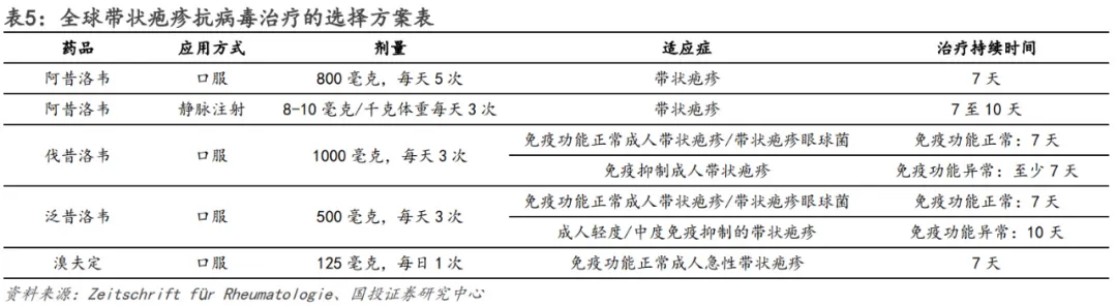
According to Zhito Finance APP, the current treatment for shingles mainly relies on antiviral and analgesic medications, with no specific drugs targeting shingles. Common antiviral medications for shingles globally include acyclovir, valacyclovir, famciclovir, and bromovinyldeoxyuridine, with acyclovir being the first choice. The treatment duration for these medications is relatively long, requiring continuous use for 7-10 days, during which patients must endure prolonged suffering, and the medications may not completely eliminate complications. Vaccination remains the most effective and feasible preventive measure.
On the other hand, according to data from BMJ Journals, the incidence of shingles varies with age in different countries, showing a similar trend. The annual incidence of shingles in the general global population is approximately 3-5‰, with a sharp increase in incidence after the age of 50, rising to 6-8‰ in the 60-year-old population and reaching as high as 8-12‰ in the 80-year-old population Driven by factors such as the continuous aging population, the increasing number of shingles cases, and the rising public awareness of vaccination, the global shingles vaccine market is expected to grow to $12.6 billion by 2030.
According to data from the CDC, the vaccination rate for shingles vaccines among adults aged 60 and older in the United States rose from 6.7% in 2008 to 33.4% in 2016. After Shingrix received FDA approval in 2017, the vaccination rate experienced a stable period before rising again, reaching 41.10% in 2021. In 2023, Shingrix sales have reached £3.446 billion, with a compound annual growth rate of 17%.
The market penetration rate is the biggest challenge faced by domestic shingles vaccine companies. Due to the relatively weak vaccination awareness among the middle-aged and elderly population in China, the need to improve awareness of the vaccine, and the high price of the vaccine, the penetration rate of this product in China is extremely low. This issue has persisted to this day.
Data shows that in the second quarter of 2025, there were no batch approvals for domestic shingles vaccines (compared to 1 batch in the same period last year). In the first half of the year, the total number of batch approvals for domestic shingles vaccines was only 6, a significant decrease of 77% year-on-year. Furthermore, all of the approved products were GSK's recombinant shingles vaccine (Shingrix), which represents an 88% year-on-year decline. In contrast, Baike Bio's live attenuated vaccine had no batch approvals in the first half of this year. This indicates that the shingles vaccine market is still dominated by GSK, and the overall supply of domestic shingles vaccines has significantly contracted compared to the same period last year.
To further open up the market and improve its commercialization level, LUZHU BIOTECH needs to increase market promotion efforts in collaboration with peers such as Baike and GSK after the launch of LZ901. This may even involve passing on profits to consumers with certain purchasing power who are relatively price-sensitive, thereby increasing the price acceptance in the end market. Currently, GSK's Shingrix® is priced at approximately RMB 1,600 per dose in China, requiring two doses for a total price of about RMB 3,200; Baike's Ganwei is priced at RMB 1,369 per dose, requiring only one dose.
According to LUZHU's previous prospectus, the retail price of LZ901 is expected to be around RMB 500 to 800 per dose, requiring a total of two doses for a total price of RMB 1,000 to 1,600. If LUZHU intends to compete with Shingrix in the existing market, the pricing of LZ901 may lean more towards the lower end of the range, which may further compress the company's initial commercialization profits