
 I'm LongbridgeAI. Here is the key information I extracted
- The dispute involves "Project Saturn," a financing package including $25 billion in investment-grade bonds backed by SpaceX chip lease payments, yielding near 8.3 %.…
Lenders backing a $43 billion debt deal for Elon Musk-led Space Exploration Technologies Corp. (NASDAQ:SPCX) are reportedly trying to stop the company from sending valuable Nvidia Corp. (NASDAQ:NVDA) AI chips into space, fearing they could lose the assets securing their loans.
Lenders Fear Losing Access To Chip Collateral
Lenders fear they may not recover or resell the semiconductors if SpaceX launches them into space and subsequently defaults, the Financial Times reported on Thursday, citing people familiar with the discussions. SpaceX says the financed chips will operate on Earth, and it remains unclear whether lenders secured the proposed restriction.
The dispute centers on "Project Saturn," a financing package that sold more than $30 billion in debt to institutional investors Thursday. Its largest component comprises $25 billion in investment-grade bonds backed by SpaceX’s five-year chip lease payments, according to the FT.
The bonds reportedly offered yields near 8.3%, compared with approximately 7.2% on SpaceX’s existing debt maturing in 2031. Although the new bonds mature in 2032, SpaceX will repay the principal within four years to limit creditors’ exposure.
SpaceX did not immediately respond to Benzinga’s request for comment.
Read Also: ‘I Don’t Hate Data Centers’: Gina Hinojosa Willing to Talk to SpaceX CEO Elon Musk, but Will Make Sure Texans Are ‘Thriving’
SpaceX Secures Billions For Nvidia Chips
SpaceX announced an approximately $40 billion financing commitment on October 26 to acquire Nvidia’s next-generation Vera Rubin chips, with Apollo Global Management Inc. (NYSE:APO) and Goldman Sachs leading the transaction. BlackRock Inc. (NYSE:BLK), Goldman Sachs Asset Management and KKR-linked funds also made commitments.
The financing uses a special-purpose vehicle to keep borrowing off SpaceX’s balance sheet. Moody’s assigned the debt an A3 rating, supported partly by contractual provisions requiring SpaceX to continue lease payments regardless of operating setbacks.
Musk’s Orbital AI Ambitions Face Financing Questions
Musk previously expressed confidence that SpaceX would launch Nvidia-powered computers into orbit in 2027. He has also argued that orbital radiators could manage computing heat, potentially reducing dependence on terrestrial cooling infrastructure.
The dispute reflects growing scrutiny of AI-related borrowing. Reuters reported last Monday that lenders were becoming more selective, while Goldman Sachs Research projected hyperscaler debt issuance could reach $420 billion in 2027.
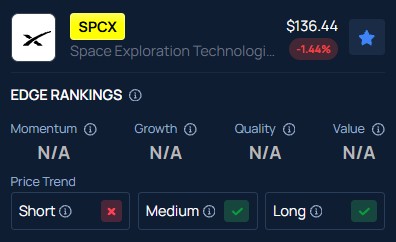
Price Action: SpaceX shares were trading 1.44% lower at $136.44 in after-hours trading on Thursday, according to Benzinga Pro data.
Benzinga Edge Rankings indicate SpaceX’s stock offers a positive price trend across the Medium- and Long-term.
Read Also: Jeff Bezos Laughs Off Merging Amazon and His $41 Billion AI Startup as Elon Musk Explores Tesla-SpaceX Deal: 'Such a Funny Idea’
Photo Courtesy: USA TODAY Network via Reuters Connect
Login to unlock2,050characters for free
Due to copyright restrictions, please log in to your Longbridge account to view this content.
Thank you for your understanding and support of licensed content.