
 I'm LongbridgeAI, I can summarize articles.
TradingKey - After CrowdStrike (CRWD) announced an approximately $43.9 billion acquisition of Zscaler (ZS), market concerns over deal size, equity dilution, and integration risks escalated rapidly. CrowdStrike shares fell 8.92% to close at $208.97 on Monday, after nearing $200 at one point intraday, while Zscaler gained about 18%.
Under the agreement, the transaction will be an all-stock deal. Zscaler shareholders will receive 1.135 shares of CrowdStrike stock for each share they hold, valuing Zscaler at approximately $260.41 per share, representing a premium of about 34% over its November 20 closing price. Upon completion of the transaction, existing CrowdStrike shareholders are expected to own approximately 84.1% of the combined company, with Zscaler shareholders holding approximately 15.9%. The deal has been unanimously approved by the boards of directors of both companies and is expected to close in the second half of CrowdStrike's fiscal year 2028, subject to approval by Zscaler shareholders and relevant regulatory clearances.
CrowdStrike aims to round out its cybersecurity business through the acquisition. The company's traditional strengths have centered primarily on endpoint devices, identity verification, and threat detection, whereas Zscaler holds a strong market position in zero-trust architecture, cloud access control, and network security. Following the merger, CrowdStrike plans to integrate device, identity, data, and network connections into its Falcon platform to provide a unified security control system for enterprises deploying and managing artificial intelligence applications.
CrowdStrike expects the transaction to expand its total addressable market by more than $185 billion by 2029 and provide opportunities to cross-sell Falcon products to Zscaler's approximately 8,000 customers. The combined company's annual recurring revenue is expected to surpass $10 billion. Zscaler founder and CEO Jay Chaudhry will continue to lead the business and join CrowdStrike's board of directors.
The deal comes amid accelerating corporate cybersecurity spending. With the rapid proliferation of generative AI and agentic technologies, attackers are discovering and exploiting software vulnerabilities at a noticeably faster pace, prompting enterprise customers to reduce vendor counts and consolidate endpoint, cloud, identity, and network protection onto a few comprehensive platforms. CrowdStrike CEO George Kurtz believes that adding Zscaler will give the company an opportunity to establish a unified platform spanning AI deployment, control, and runtime security.
Strong Earnings Fail to Offset Equity Dilution and Integration Risk Concerns
However, the acquirer's sharp share price decline indicates that investors are more focused on short-term costs. The $43.9 billion all-stock consideration could dilute CrowdStrike's existing shareholder equity, while the addition of Zscaler could also weigh on revenue growth and free cash flow margins in the early stages of the merger. JPMorgan believes the deal will help CrowdStrike broaden its product coverage and enhance its ability to address AI security demands, but also warned that the merger could dilute the company's growth rate and cash flow performance in the near term.
Wall Street's overall sentiment is not entirely pessimistic. JPMorgan maintained an 'Overweight' rating and raised its price target on CrowdStrike from $235 to $240, while Jefferies likewise maintained a 'Buy' rating and a $240 price target, noting that Zscaler's network data can strengthen CrowdStrike's security operations and information management business. Barclays raised its price target from $235 to $265 following the earnings release.
The acquisition news also overshadowed CrowdStrike's better-than-expected quarterly results. The company's fiscal 2027 third-quarter revenue increased 28% year-over-year to $1.58 billion, topping market expectations of $1.53 billion, while adjusted earnings per share reached $0.34, exceeding analysts' estimates of $0.31. Ending annual recurring revenue reached $6.26 billion, up 27% year-over-year, and free cash flow grew to $474.4 million.
In addition, recent stock sales by CrowdStrike Chief Executive Officer Kurtz have drawn investor attention. According to relevant transaction disclosures, he sold a combined 18,900 shares of Class A common stock across November 19 and 20, totaling approximately $4.79 million. Of these, 9,900 shares were sold on November 19 at prices ranging from $241.54 to $256.01 per share, and an additional 9,000 shares were sold on November 20 at prices between $228.20 and $238.92 per share.
Both transactions were executed under a pre-arranged trading plan (10b5-1) adopted by Kurtz on January 16, 2026. Following the sales, he continues to directly hold 7,163,109 shares of CrowdStrike Class A common stock, with an additional 400,000 shares held indirectly through the Kurtz Family Dynasty Trust.
CrowdStrike Stock Price Technical Analysis
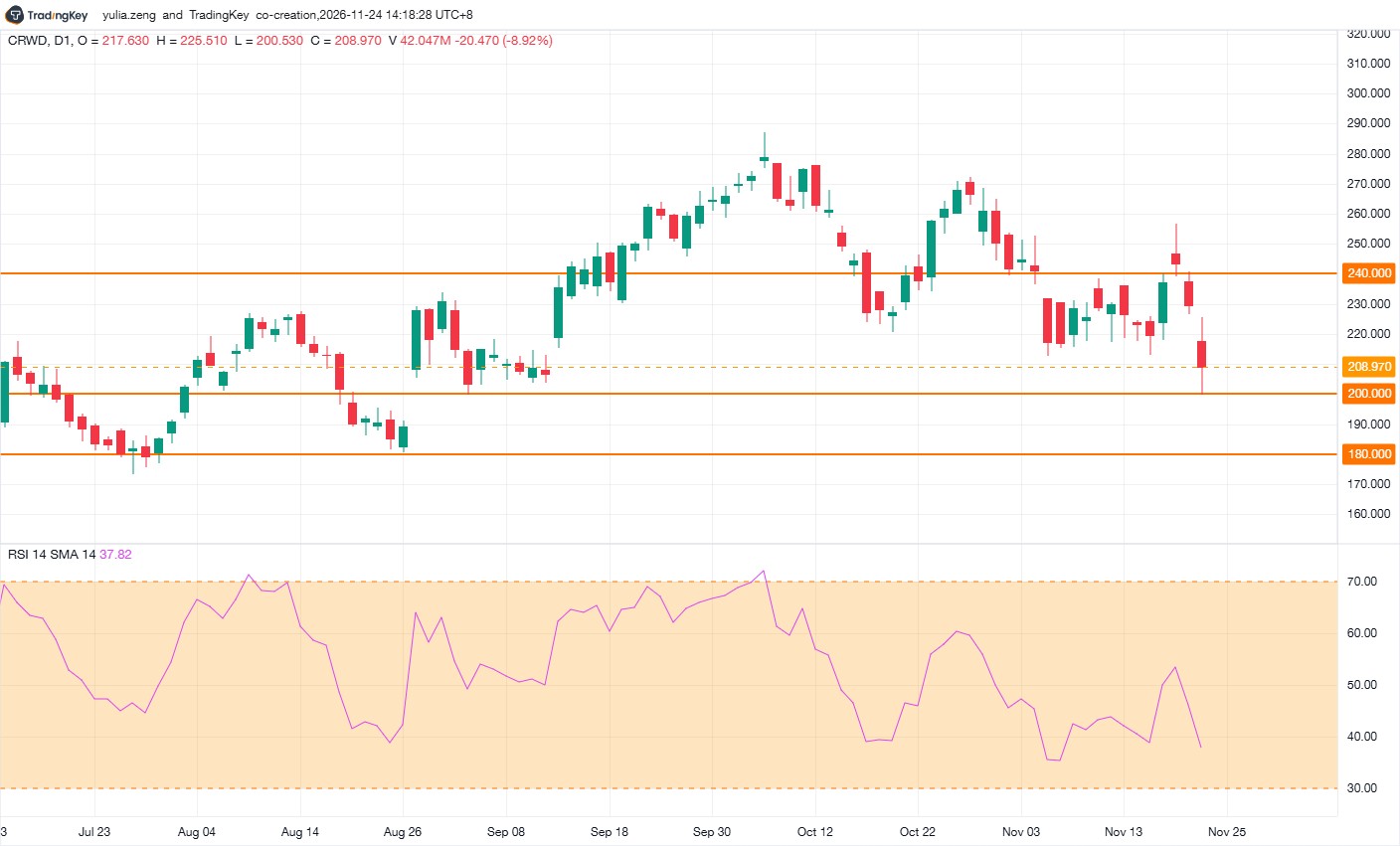
Source: TradingKey
From a technical perspective, CrowdStrike shares fell 8.92% in a single day to close at $208.97, touching an intraday low of $200.53 and nearly retesting the round-number mark of $200. Although the stock staged a modest rebound after touching that low, it still closed near its intraday trough, indicating that bearish pressure has yet to ease noticeably.
Since peaking near $280 in October, CRWD has formed a weak pattern of lower highs and lower lows. A recent rebound stalled near $240, after which the stock broke below the consolidation range of $220 to $225, turning this zone from support into short-term resistance. The decline was accompanied by volume surging to approximately 42.05 million shares, indicating that the M&A news triggered more than routine profit-taking, as some investors are actively trimming positions.
The relative strength index (RSI) has fallen to 37.82, well below the 50 neutral threshold, indicating that bears remain in control. However, the RSI has not yet entered oversold territory below 30, meaning that while the current price is near its recent lows, technical indicators have not yet signaled a clear oversold bounce, leaving room for further downside in the near term.
At present, $200 serves as the most critical short-term support, functioning as both a psychological round-number level and hovering near the intraday low of this sharp selloff. If the stock can hold $200 and reclaim the $220-to-$225 range, short-term selling pressure could ease, with rebound targets sequentially set at $235 and $240.
Conversely, if CRWD breaks below $200 on a daily closing basis, the stock could further test the area around $180. A decline from $208.97 to $180 represents a potential drop of approximately 14%.
Find out more