
 I'm LongbridgeAI. Here is the key information I extracted
- The company raised its full-year AI server revenue guidance to $78.0 billion and increased overall revenue and EPS projections for the upcoming quarter, driven by robust infrastructure demand and higher average selling configurations.…
Dell Technologies (DELL) released its FY27 Q3 results (quarter ended Oct 2026) in the U.S. after-hours on Nov 25 Beijing time: $Dell Tech.US
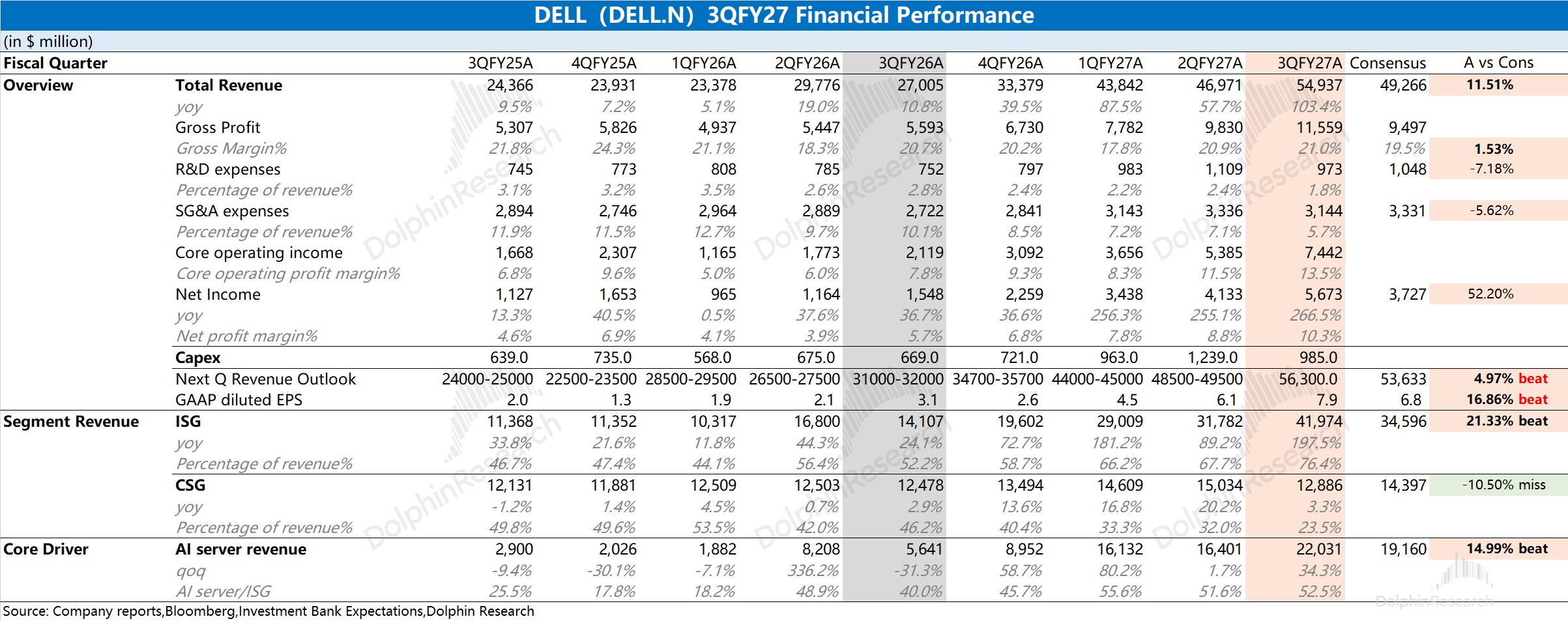
1. AI revenue: AI server revenue was approx. $22.0bn this quarter, up $5.6bn QoQ and beating the Street (~$19.2bn).
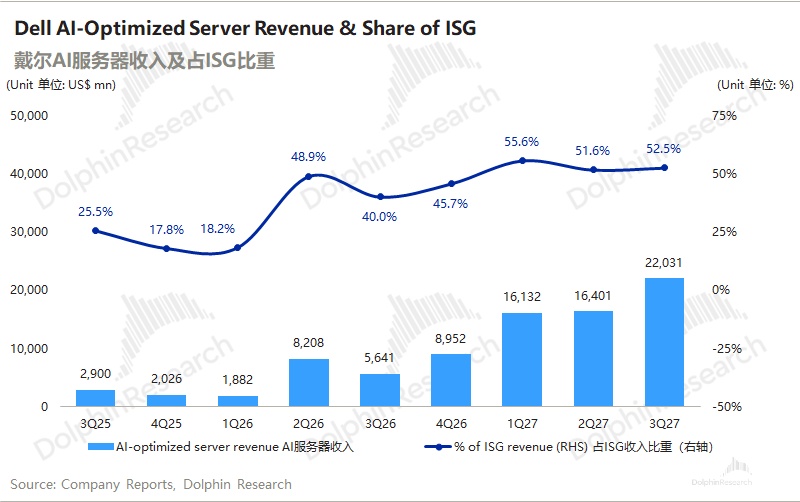
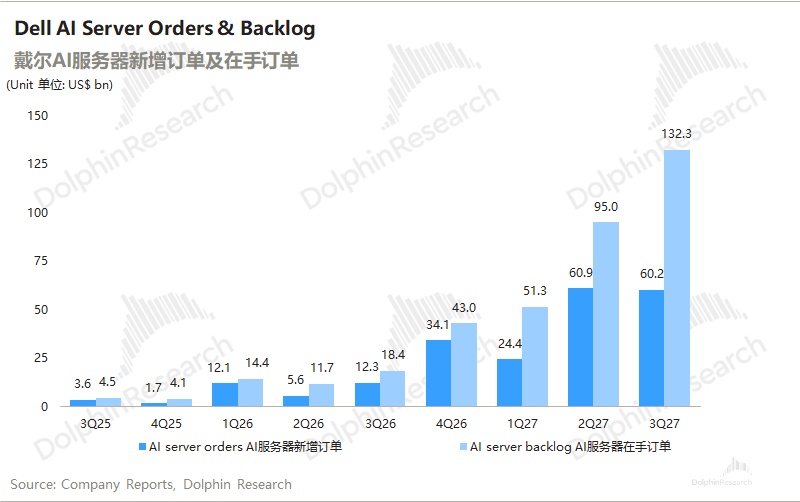
New AI orders were $60.2bn (vs. $60.9bn in Q2), and AI backlog rose to $132.3bn (+$37.3bn QoQ). The company guided next-quarter AI server revenue to approx. $23.5bn, slightly above the Street (~$23.2bn).
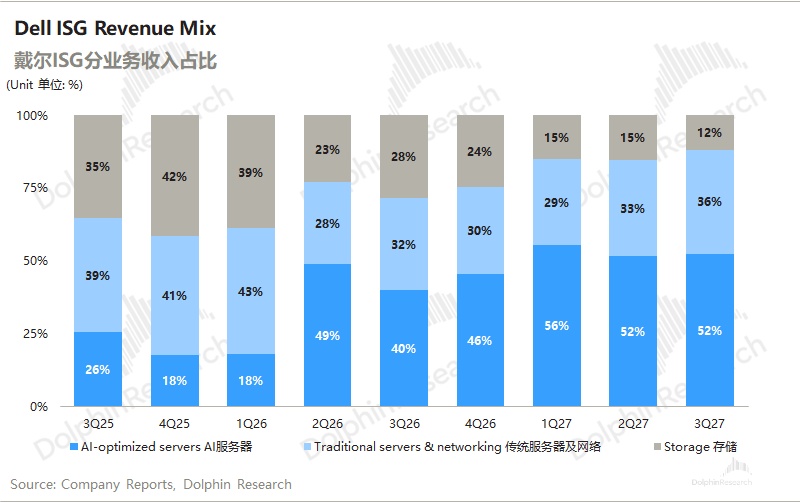
AI servers accounted for 40% of total revenue. New orders topped $60bn for a second straight quarter, with book-to-bill at ~2.7x.
2. Guidance: Q4 FY27 revenue guided to $56.25bn (±$0.5bn), above the Street (~$53.5bn).
Next-quarter non-GAAP EPS is guided to $8.40 (±$0.10), ahead of the Street (~$7.48). FY27 AI server revenue guidance was raised to $78.0bn (from $74.0bn).
By segment, Q4 ISG revenue is guided to grow ~120% YoY, with AI servers up QoQ to ~$23.5bn and traditional servers up ~137% YoY. QoQ, traditional servers are expected to decline ~7–8% as wafers reallocated from PCs to servers in H2 landed in Oct and were recognized in Q3. Storage is guided to grow low double digits YoY, and CSG revenue to be roughly flat YoY.
For FY28, management did not provide quantitative guidance but sounded constructive. AI server demand is still accelerating. PC shipments remain weak, and the supply-demand gap in calendar 2027 will be wider than in 2026.
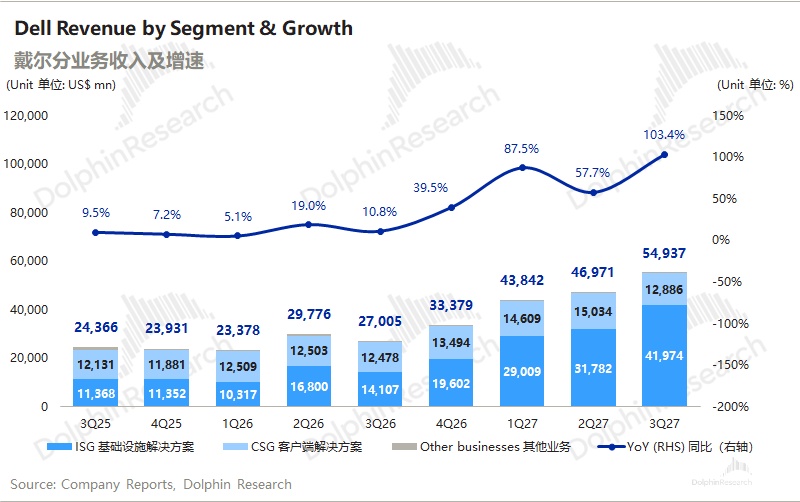
3. Ops metrics: Revenue was $54.9bn, beating the Street (~$49.3bn). Revenue rose $8.0bn QoQ, driven by ISG (AI + traditional servers), while CSG fell $2.2bn QoQ.
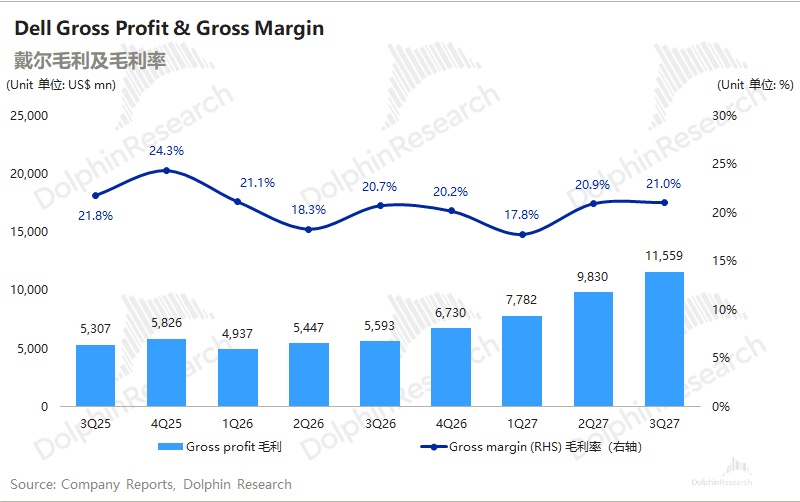
GAAP GPM was 21.0%, roughly flat QoQ and above the Street (~19.5%). Management attributed margin gains to scale, a better North America mix, and a higher share of Dell IP storage.
North America mix benefits normalize in Q4, with OPM guided to ~12.3%, down from 14.2% in Q3.
4. ISG (Infrastructure Solutions): includes traditional servers, AI servers, and storage
ISG revenue was $42.0bn, up $10.2bn QoQ, beating the Street (~$34.8bn). QoQ gains came mainly from AI servers (+$5.6bn) and traditional servers (+$4.5bn), while storage was roughly flat (+2%).
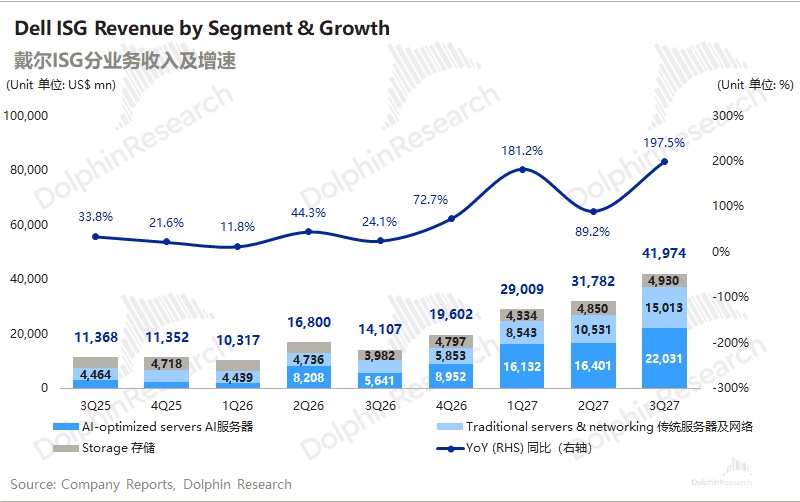
Traditional servers were the biggest surprise at $15.0bn, well above the Street (~$11.0bn). Drivers included (i) data center modernization and refresh, (ii) CPU server demand from inference and agent workloads, and (iii) upgrades driven by security and resiliency needs.
On volume vs. mix, server units are declining, especially entry models below $3,000 that have largely disappeared. However, cores per server and DRAM/NAND content per box are rising sharply.
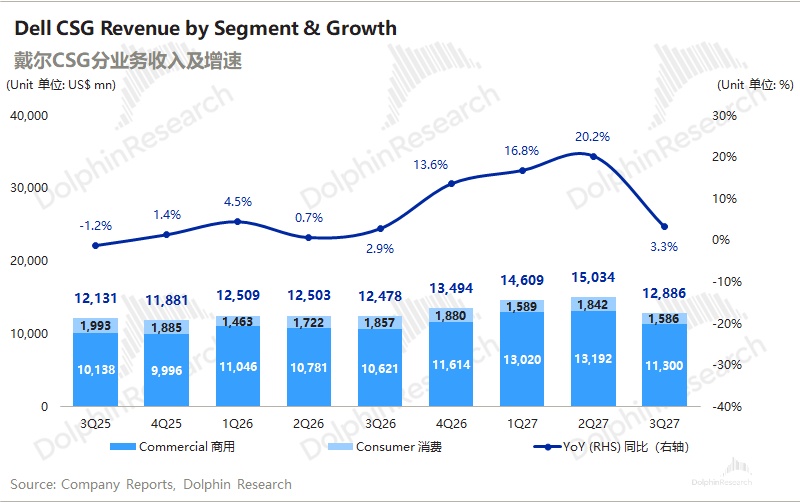
5. CSG (Client Solutions): revenue was $12.9bn, +3% YoY, below the Street (~$14.4bn). Growth was price-led, while units remained under pressure.
Commercial revenue was $11.3bn, +6% YoY. Consumer revenue was $1.6bn, -15% YoY.
Dell earnings call transcript: 'Dell (Trans): AI backlog at $132.3bn, gap to widen next year'
Dolphin Research view: Orders held; 8x PE prices in peak earnings
Results beat overall, but the upside was driven mainly by traditional servers. Traditional server growth came from richer configs per box rather than units, with some revenue pulled forward.
The key relief was that AI orders did not fall despite tighter funding for new cloud providers. The twin-engine thesis of 'AI + traditional server refresh' still holds. With full-year guidance raised and a new buyback authorization, this print eases concerns tied to the NVIDIA episode and spillover risks from neoclouds.
One risk flag: next-quarter AI revenue growth slows notably, and order-to-revenue conversion is decelerating again. Management still has not disclosed the neocloud share of orders and backlog, so conversion timing hinges on delivery pace over the next few quarters.
The market is also watching the following:
1) AI servers: NVIDIA and neocloud
Backlog includes mixed Grace Blackwell and Vera Rubin, with new orders skewed to Rubin. AMD MI455X/Helios racks will ship from Q4 via Dell, HPE, Lenovo, and Supermicro.
Dell's AI server customer base is centered on second-tier neoclouds, with sovereign and enterprise customers growing the fastest. Hyperscalers directly account for a small share, so the concern is less about 'AI demand' and more about 'funding for neoclouds'.
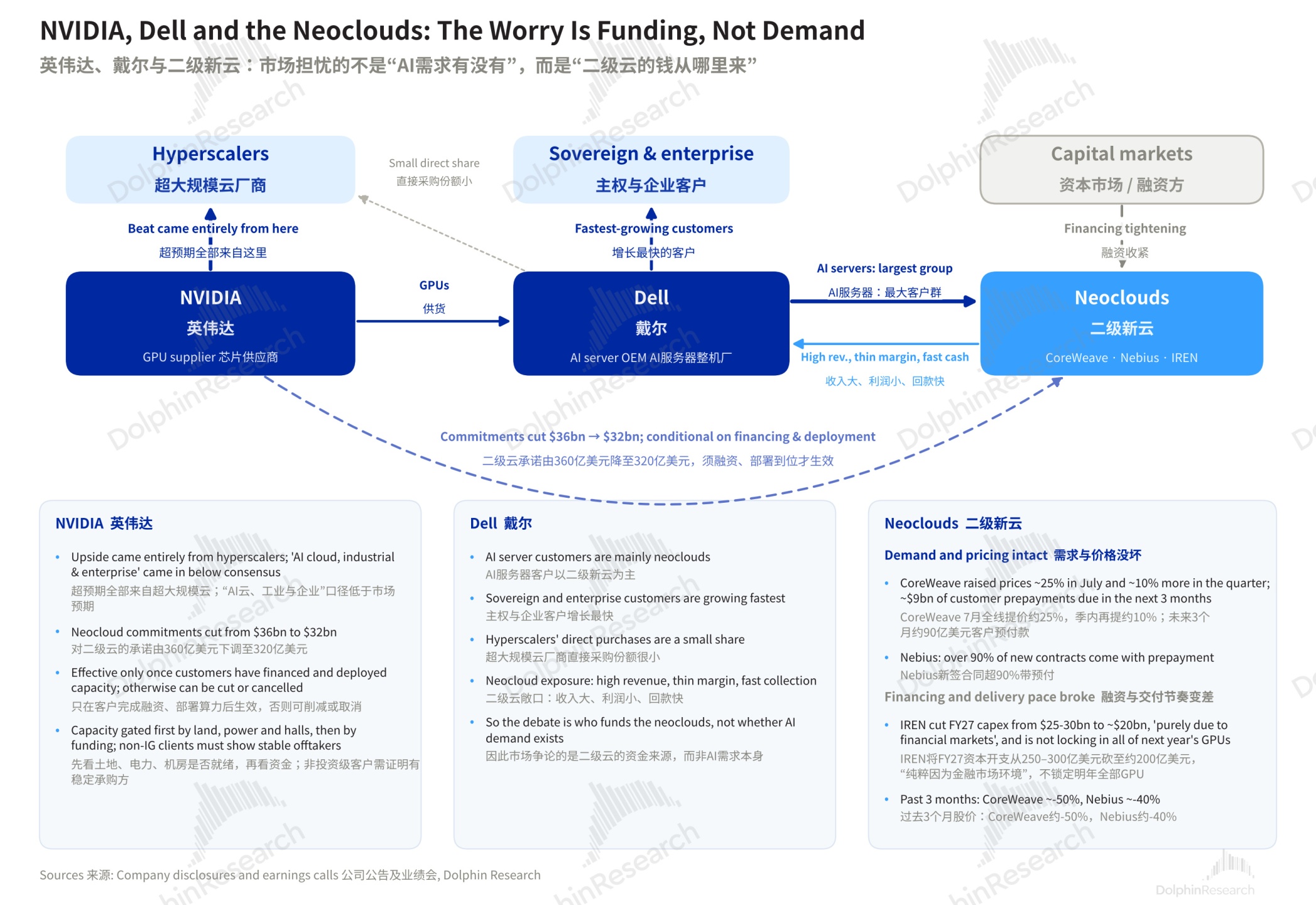
Management addressed neocloud risk head-on:
(i) Credit vetting: each AI order goes through risk review, assessing client financials and end-user contracts.
(ii) Neocloud selectivity: Dell is highly selective about partners and their end customers.
(iii) DFS (Dell Financial Services): offered to a small set of clients and only for short-term bridge financing from order to cluster go-live. Financing receivables rose by only about $0.5bn QoQ, while AI server shipments reached $22.0bn (+$5.6bn QoQ).
(iv) Rubin: new orders are Rubin-led, and pricing has been set with customers based on expected delivery windows tied to site and power readiness.
2) CSG (PC)
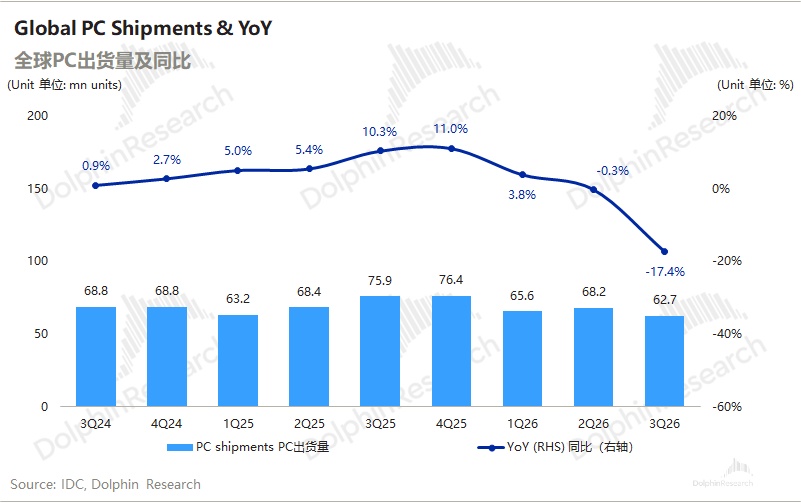
With storage price hikes, the PC market deteriorated: global PC shipments were ~62.7mn units in Q3 2026, -~17% YoY. Dell shipped ~7.6mn units, -25% YoY.
Management acknowledged PC weakness: the industry is adapting to higher price bands, and budget-constrained customers are prioritizing servers and storage over PCs. Dell reallocated some wafers from PCs to servers in H2, and expects PC shipments to remain soft next year.
Market expectations for storage pricing have shifted. TrendForce sees overall NAND Flash contract prices turning down from Q1 2027 as some CSPs cut orders sharply and consumer demand slows, with declines likely widening QoQ.
Earlier storage price declines cut both ways for Dell: they could help revive consumer demand such as PCs, but also signal delayed AI build-outs or capex cuts.
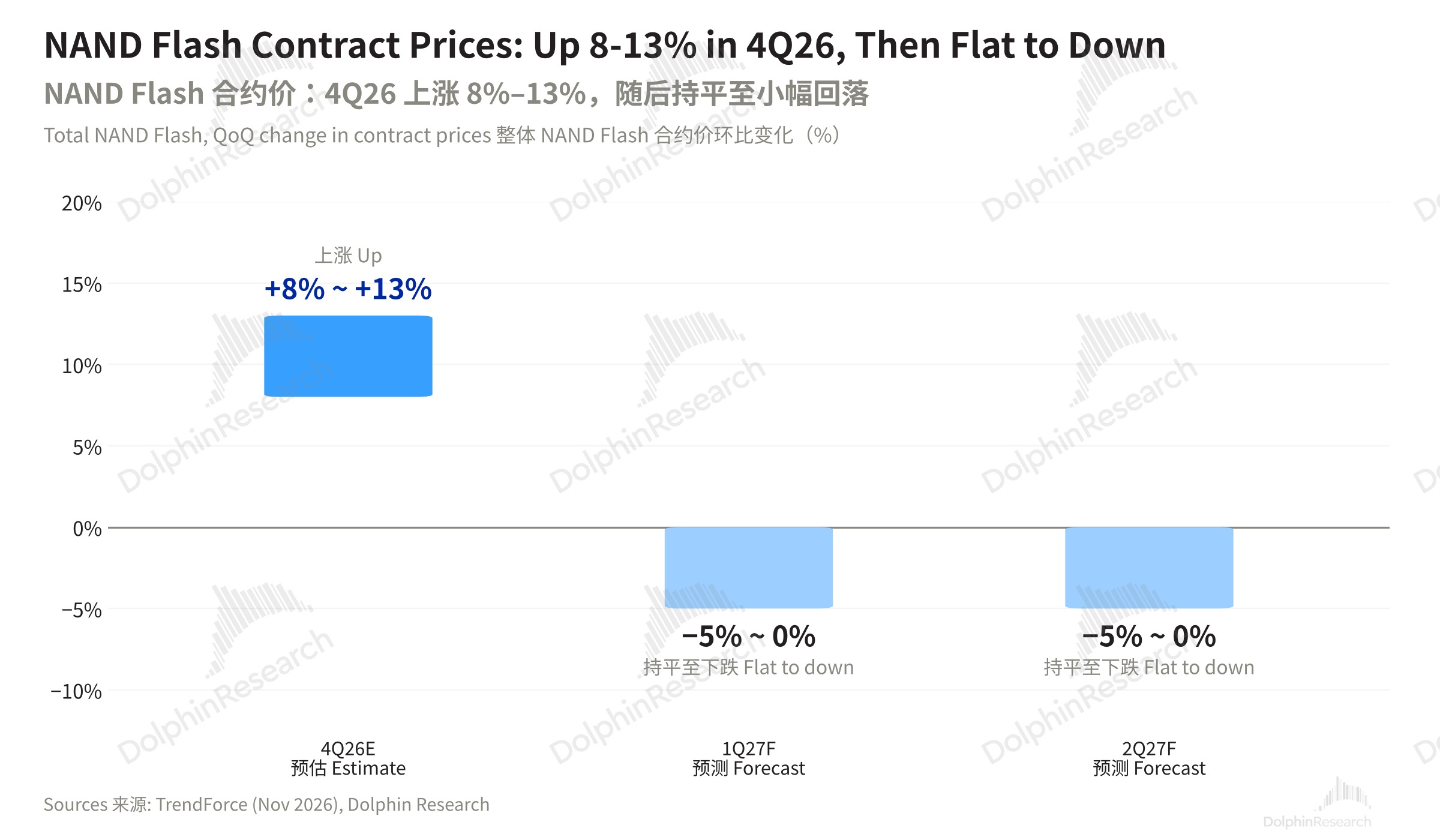
Server storage pricing outlook: on supply, there is no sign of price relief for enterprise-grade NAND and DRAM used in servers, and tightness will clearly persist into 2027. The pace of increases should be slower than in 2026, and server buyers are not pausing for price, while PCs are.
Dell's market cap is $187.7bn, implying ~8x PE on FY28 (calendar 2027) after-tax core OP under assumptions of 50% two-year revenue growth, 18.5% GPM, and 18% tax. Historically, the multiple ranged 8–20x, with the current level near the low end.
Dell has sold off more than most AI chain names in this correction: the stock fell from $595 to $274 (-54%). Street FY28 EPS estimates have not been cut materially.
Previously, backlog was Dell's 'moat'. The market now fears neocloud orders in backlog could slip or turn bad debts, with financing risk being discounted into the multiple.
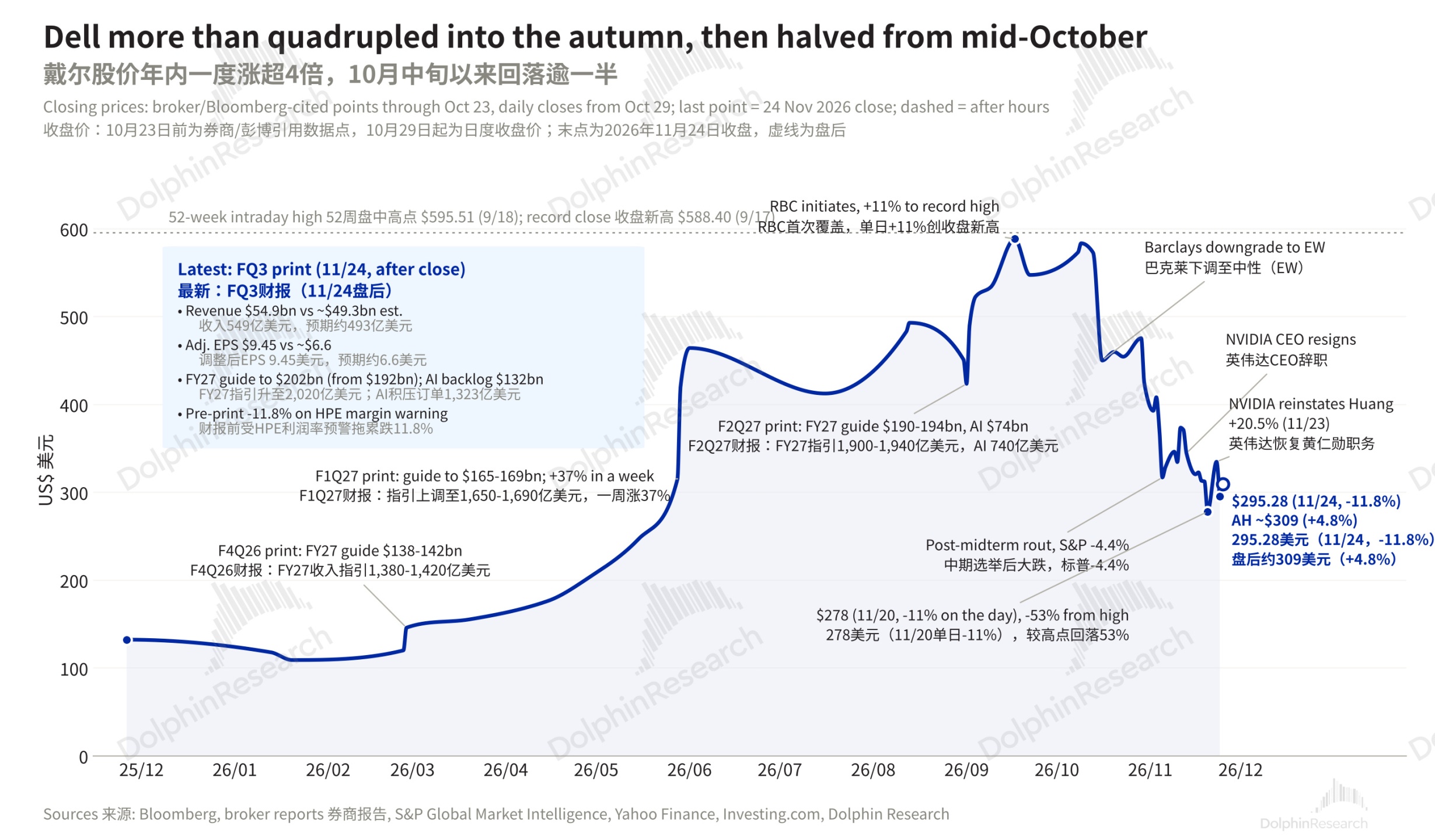
Two focal points for this print: (i) quality of orders and backlog amid tighter neocloud funding and reduced NVIDIA backstops, including whether new orders slowed materially or any cancellations/deferrals emerged. (ii) Whether Q4 and FY28 guidance can anchor earnings, and whether management offers its first view on FY28.
Overall, management addressed both:
(i) Orders/backlog: new AI orders were $60.2bn and backlog rose to $132.3bn, with no customer rescheduling per management. Tighter neocloud funding has not yet flowed through to orders or the balance sheet.
(ii) Guidance: full-year revenue was raised by $10bn to $202.0bn and EPS to $29.68. Note that Q3 GPM benefited from transient North America mix, implying a Q4 pullback, while no explicit FY28 guidance was provided.
Dell has tangible earnings and orders, unlike many story stocks. At ~8x FY28 PE, the market is already pricing 'peak earnings + neocloud credit risk'.
Even at a sub-10x PE, if neoclouds hit the brakes and new orders fall sharply, re-rating will be difficult. Future stock performance would rely more on delivery and capital returns.
On shareholder returns, management targets are: 'return at least 80% of Adj. FCF to shareholders' and 'Adj. FCF at least 100% of net income'. Dolphin Research estimates FY28 payouts (dividends + buybacks) at ~$18.4bn, implying a ~10% yield.
From a risk-averse stance, some see calendar 2027 as the peak. A ~10% yield is not compelling versus peers (cf. NVIDIA ~6.5%, memory makers ~10%).
Even with rising backlog, given neocloud risk, a 12% return to shareholders would be more attractive, implying a $241 share price (~6x FY28 PE).
<End here>
Related reads on Dell (DELL):
Earnings
Sep 2, 2026 call 'Dell (Trans): AI backlog $95.0bn, no growth guide for next year yet'
Sep 2, 2026 take 'NVIDIA ramp? Dell: the good times can get better!'
May 29, 2026 call 'Dell (Trans): demand > supply, pipeline multiples of backlog'
May 29, 2026 take 'Dell: AI surges, tradition warms, the veteran is 'fired up''
Feb 27, 2026 call 'Dell (Trans): Rubin not in AI orders; traditional stays positive'
Feb 27, 2026 take 'Dell: can a doubling AI path ease 'storage tightness'?'
Nov 26, 2025 call 'Dell (Trans): value lies in L11+ integrated solutions'
Nov 26, 2025 take 'Dell: storage hikes a headache? AI guide holds up'
Risk disclosure and statement: Dolphin Research disclaimer and general disclosure