
 I'm LongbridgeAI. Here is the key information I extracted
- Despite the Nasdaq 100 plunging up to 4.7% intraday before recovering to close down 0.64%, investor concerns over AI credit risks spiked as credit default swaps for companies like CoreWeave and Oracle reached record highs.…
Today is November 26, 2026, Singapore time. Dolphin君 takes you through the global markets at a glance!

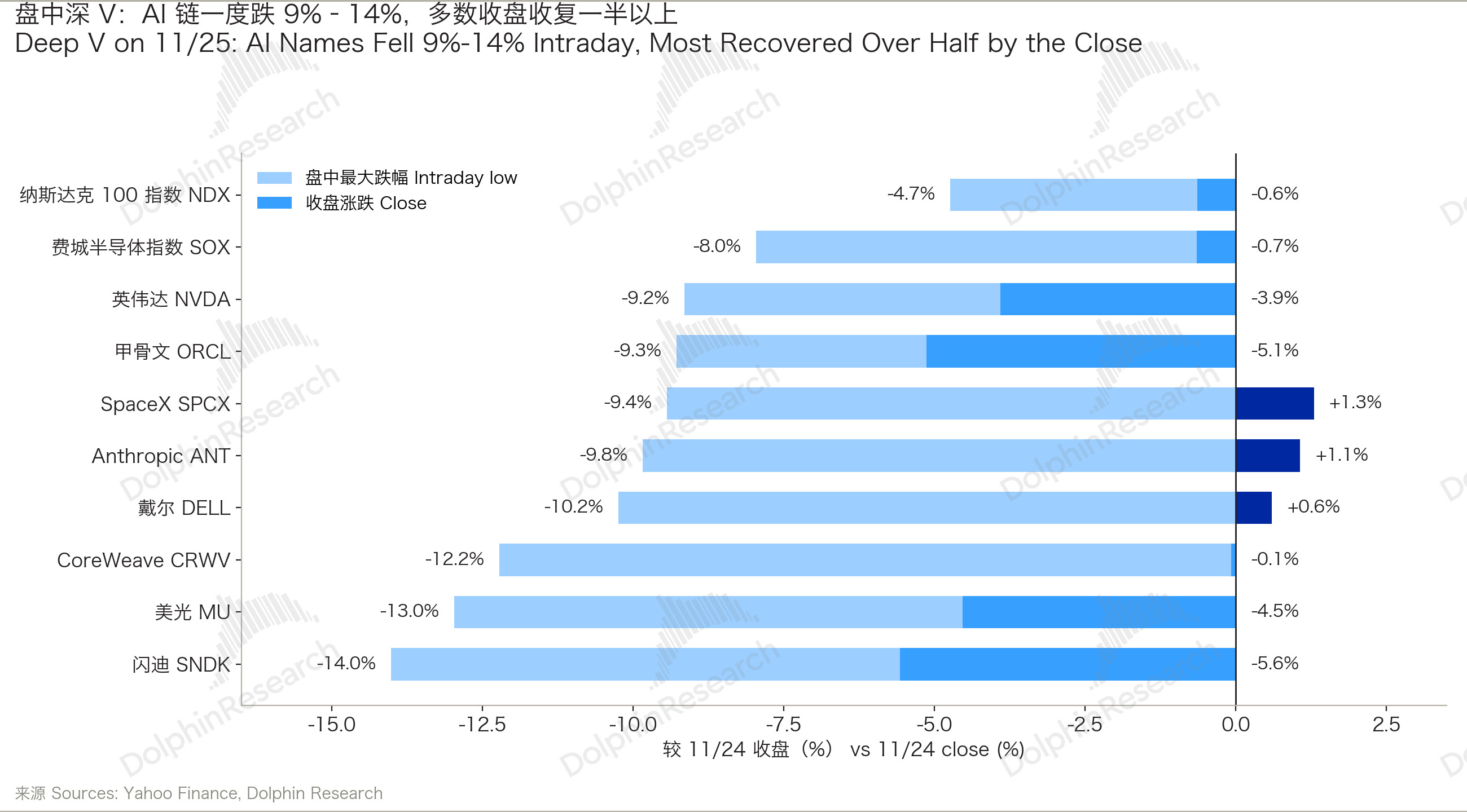
Trading Highlights: AI selling pressure eased during the session. The NASDAQ-100 narrowed its decline from 4.7% to 0.64%. NVIDIA fell 9.2% intraday and closed down 3.9%.
However, S&P placed NVIDIA on negative credit watch, and CoreWeave's five-year CDS saw its largest single-day jump, indicating that credit sentiment did not rebound alongside the stock price.
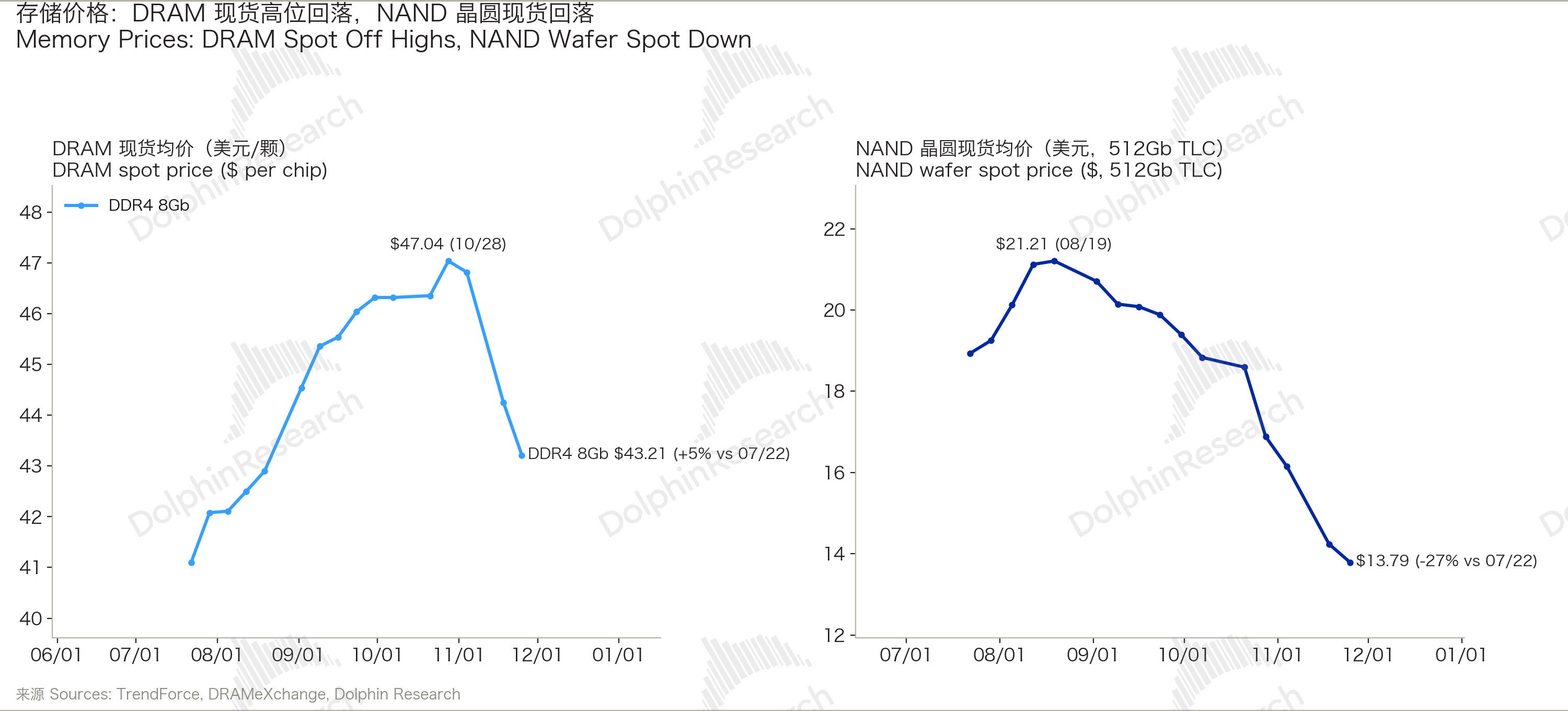
TrendForce lowered its forecast for next year's DRAM contract price increases. Sandisk and Micron Tech fell 4.5%–5.6%; the Token Spending Index dropped 22.7% over the past seven days.
Macro Sentiment: October core PCE rose 0.3% month-over-month; year-over-year it was 3.3%, higher than expected. Q3 GDP was revised up to 4.3%, making a December rate hike nearly certain. The 10-year US Treasury yield instead fell about 8 basis points to 4.85%, hitting a new low for over two months.
Another Round of Tariffs: The White House proposed imposing Section 301 tariffs on 14 trade partners: 20% on China (potentially rising to 40%), and up to 25% on Taiwan and South Korea.
Key Movers: Oracle fell 5.1%, Amazon fell 3.1%, and Alphabet fell 2.1%. Meta Platforms bucked the trend, rising 3.4% on news of talks with Amazon regarding Muse shopping integration. Li Auto rose 11.0%, and Kanzhun rose 12.6%.
Short-Term Focus:
Today: US markets closed for Thanksgiving.
Friday: US markets half-day session; Black Friday.
Next Week: On 12/1, Jensen Huang faces closed-door questioning in the House of Representatives; Marvell reports earnings. On 12/2, Salesforce reports earnings. On 12/3, Jensen Huang testifies publicly before the Senate.

$ NVIDIA.US , $ Coreweave.US , $ Oracle.US , $ Micron Tech.US , $ Sandisk.US , $ SK Hynix.US , $ Meta Platforms.US , $ Alphabet.US , $ Amazon.US , $ Microsoft.US , $ Dell Tech.US , $ SpaceX.US , $ Anthropic.US , $ Li Auto.US , $ LI AUTO-W.HK , $ Kanzhun.US , $ BOSS ZHIPIN-W.HK , $ S&P 500.US , $ NASDAQ-100.US , $ Invesco PHLX Semiconductor ETF.US , $ Hang Seng TECH Index.HK
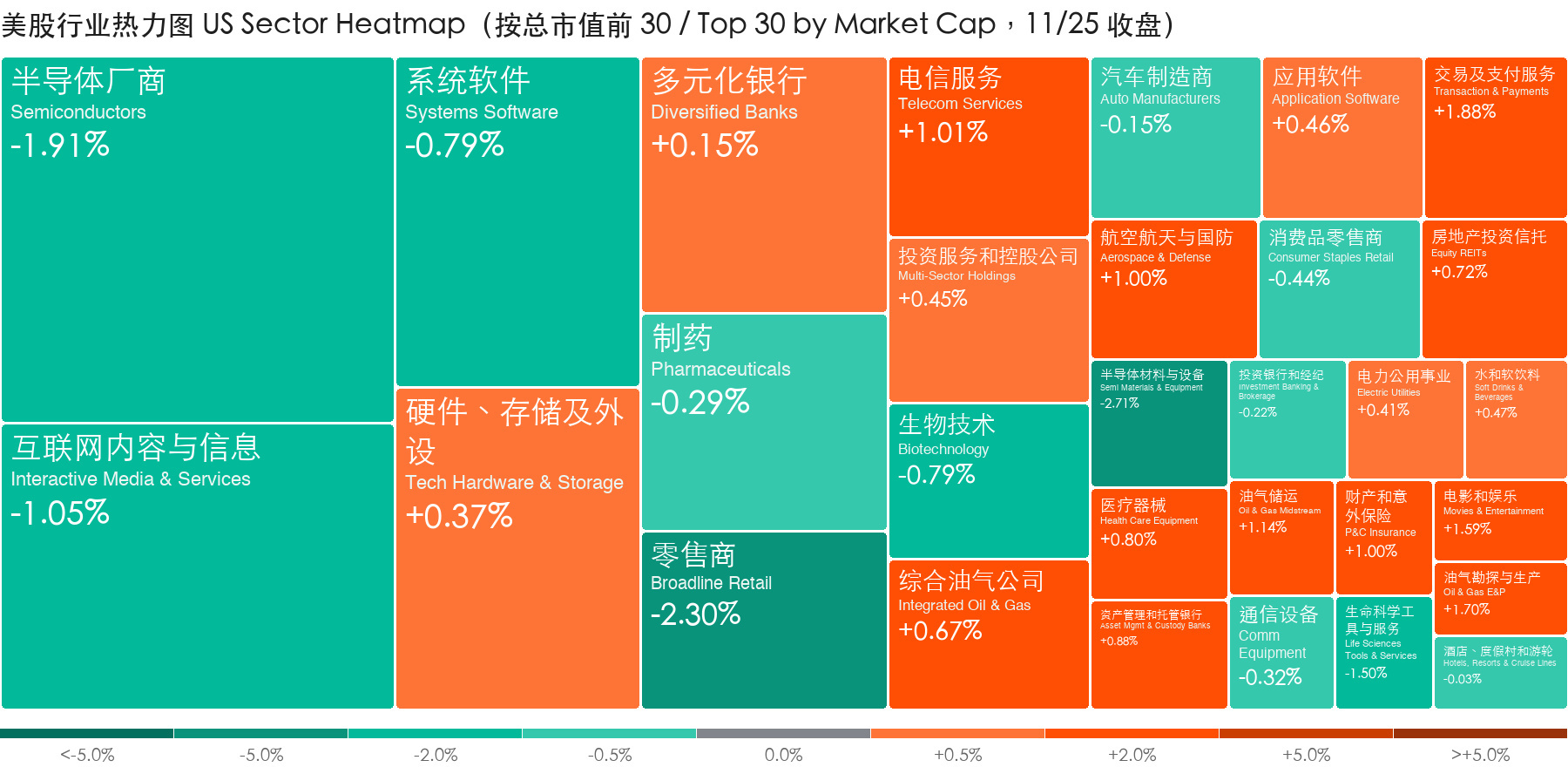

1. Intraday Deep V: AI Positions Drop to Two-Year Low, 4.7% Decline Reversed to 0.6%
SpaceX +1.3% (Intraday -9.4%) / Anthropic +1.1% (Intraday -9.8%) / HPE +1.6% (Intraday -7.8%)
Performance: The NASDAQ-100 fell as much as 4.74% intraday, closing down 0.64%; the Philadelphia Semiconductor Index fell nearly 8% intraday, closing down 0.65%.
The S&P 500 closed down 0.25%, the Dow Jones rose 0.33%, and the Russell 2000 rose 0.45%.
Nationwide trading volume reached 21.79 billion shares, higher than the year-to-date daily average of 18.63 billion shares; the VIX rose 7% to 28.2.
Who is Selling: According to foreign trading desks, neither the decline nor the rebound was driven by clear news. The dominant force was "top-down net exposure management" via ETFs. ETFs accounted for 37% of trading volume, a new high for the year. Thin liquidity at the best bid/ask levels amplified two-way volatility.
Overall trading desk activity was only at a level of 2 out of 10. There were still sell orders for semiconductors and hyperscale cloud stocks in the early session, with very few buy orders except for Anthropic.
Rebound Trigger: Rumors suggested the turning point came after the US FCC approved SpaceX's deployment of its "Starmind" space data center constellation of 1 million satellites. Others attributed it to Burry stating he had sold his remaining NASDAQ-100 put options.
Burry Turns Bullish: Burry stated his portfolio has "more longs than it has in some time." Aside from put options on Palantir and MetLife, it is almost entirely long positions, with cash comprising about 25%. He still holds NVIDIA call options and plans to short again at $200.
Anthropic: Fell as much as 9.8% intraday, but closed up 1.1% at $82.79, still slightly below the $83 IPO price.
It was included in an index for the first time at close, with trading desks buying over 2 million shares for various clients.
2. NVIDIA: S&P Watches Rating, B300 Floods Secondary Market
NVIDIA -3.9% (Intraday -9.2%) / AMD -1.8%
Rating Watch: S&P Global Ratings placed NVIDIA's "AA" rating on "CreditWatch Negative," with a potential one-notch downgrade within 90 days. The reason cited is increased management and governance risk: the board initially sought a successor, then reinstated Jensen Huang, while an independent director investigation is ongoing.
NVIDIA's five-year CDS hit a record high.
Political Aspect: US Vice President Vance stated that Jensen Huang is "not under any investigation" and does not need a pardon. According to Reuters, Attorney General Branch cleared him based on investigations into AMD and Megaspeed.
According to The Washington Post, Secretary of Defense Hegseth and others discussed using the Defense Production Act to pressure the board to reinstate Jensen Huang.
Barclays believes that his reinstatement has instead strengthened the bipartisan coalition pushing for chip export control legislation, increasing the likelihood that four proposals will be attached to the FY2027 National Defense Authorization Act.
B300 Secondary Supply: According to CNBC, after the US restricted Chinese companies' remote access to US AI computing power, an unusually large number of NVIDIA GPUs appeared on the market, including thousands of B300 units, with dealers seeking new buyers.
Communications suggest that Southeast Asian computing power accounts for about 12%–13% of NVIDIA's revenue and will be directly affected next year. Gray channels can make up for at most a quarter of the loss. Subleasing in Australia and France involves single entities of only 100–200MW. This week's drop in B300 rental prices mainly stems from redundant computing capacity in Southeast Asia.
Rental Price Divergence: Trading desks stated that SemiAnalysis lowered its chip rental pricing expectations. There was also a hot topic on X about "SpaceX lowering Blackwell rental prices."
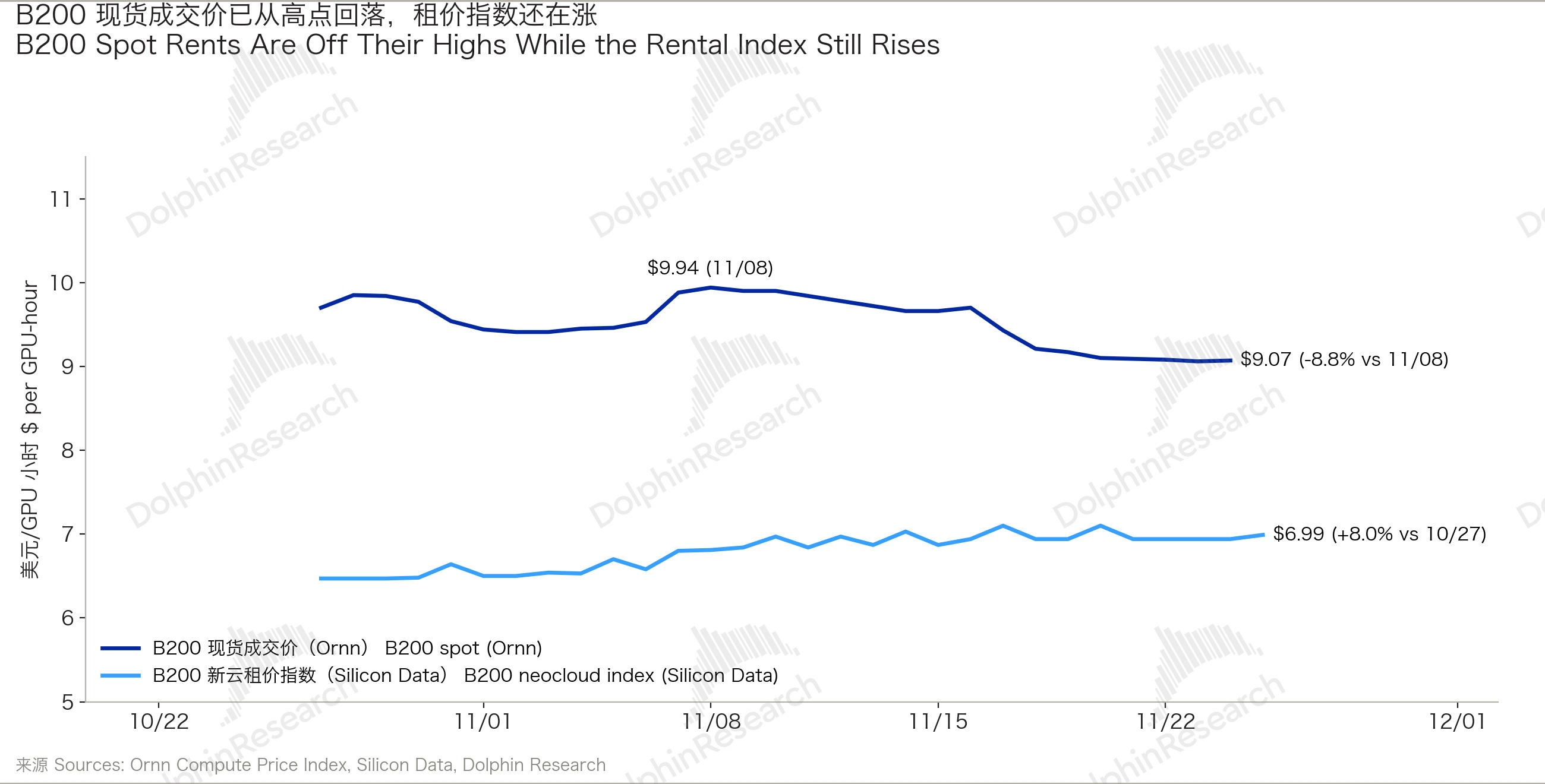
However, Silicon Data's new cloud rental price index showed no month-over-month drop for B300 on 11/25 (including futures rental weightings). But spot prices have actually loosened: Ornn's B200 spot transaction price on 11/24 was $9.07/hour, down 8.8% from the 11/08 high of $9.94.
Some investors pointed out that to distinguish between generational price drops and oversupply, one must compare quotes for the same model, region, and lease term, and then look at renewals and new orders.
3. AI Credit Cracks: CDS Hits Record Highs, But Stocks Are Bottom-Fishing
Oracle -5.1% (Intraday -9.3%) / CoreWeave -0.1% (Intraday -12.2%)
CDS: CoreWeave's five-year CDS rose by 2.09 percentage points on Wednesday, the largest single-day increase in history, reaching 15.34 percentage points annually. The swap market prices the probability of its default within five years at over 70%.
CDS for NVIDIA, Alphabet, Oracle, and SpaceX also hit record highs on the same day.
Oracle's five-year CDS spread widened to 316 basis points, implying a default probability of about 23%, compared to just 6% a year ago.
Tightening Financing: BlackRock and the IFM consortium are revaluing Stack Infrastructure's Asia-Pacific data center assets, considering lowering the equity consideration corresponding to an enterprise value of approximately $20–25 billion, and linking part of the payment to project delivery.
According to Bloomberg, US chip restrictions have stalled billions of dollars in data center loans related to ByteDance, Alibaba, and Tencent. Some lenders have delayed Bridge Data Centres' $6.6 billion loan.
4. Memory: TrendForce Lowers Next Year's Contract Prices
Sandisk -5.6% / Micron Tech -4.5% / Seagate -2.1% / Western Digital -0.5% / Kioxia +4.6% (Open) / SK Hynix +1.7% (Open) / Samsung Electronics +1.0% (Open)
Downgrade: On 11/25, TrendForce lowered its forecast for 2027 DRAM contract price increases: Chinese cloud vendors reduced some server DRAM demand, and US data center policies and geopolitics added uncertainty. Spot buying was weak, and consumer DRAM demand next year may be weaker than expected.
TrendForce Weekly Report: DDR4 8Gb spot prices fell 1.61% week-over-week to $43.32, and 512Gb TLC wafers fell 3.18% week-over-week to $13.786. DDR4 and DDR3 were hit hardest by weakening consumer demand.
Huawei HBM: Huawei will showcase its self-developed HBM at ISSCC 2027, with 4,096 data interfaces and a bit width twice that of the HBM4 standard, using 5-layer wafer-on-wafer hybrid bonding.
Korean Stock Support: Goldman Sachs stated that Korean semiconductor stock valuations have priced in an extreme scenario of a 70% downward revision in forward earnings, with the price-to-book ratio dropping to 0.7 times the 2028 book value. The Korean government is exploring expanding the 10 trillion KRW stock market stabilization fund.

1. PCE Runs Hot, GDP Revised Up, December Rate Hike Nearly Certain
PCE: October overall PCE rose 0.3% month-over-month and 3.8% year-over-year, in line with expectations, marking the highest level since May 2023.
Core PCE rose 0.29% month-over-month (expected 0.30%) and 3.3% year-over-year (higher than the expected 3.2%), marking the highest level since November 2023.
Inflation Entrenched: Service prices excluding housing are at highs not seen since December 2024. Non-cyclical inflation has surpassed cyclical inflation, with price pressures spreading from demand-sensitive areas to harder-to-dispel segments.
Growth: Q3 GDP annualized quarter-over-quarter was revised up to 4.3% (+0.9 percentage points), with private sector real final sales increasing by 5.8%.
However, corporate profit increments dropped from $384 billion in Q2 to $206 billion. October durable goods orders rose 0.2% month-over-month, below the expected 0.7%.
Consumption: Income growth was the fastest since January, spending slowed, and the savings rate rebounded from a four-year low.
Fed Path: The market continues to fully price in a 25 basis point rate hike in December.
Goldman Sachs calculates that financial conditions have tightened by about 104 basis points this year, equivalent to four rate hikes. It still believes a December hike is "nearly certain," with another in March next year. However, if the unwinding of AI trades triggers further stock market declines, it might accomplish tightening for the Fed.
Treasuries and Dollar: Despite hot data, the 10-year US Treasury yield fell about 8 basis points intraday to around 4.85%, hitting a new low for over two months. The 2-year yield fell about 4 basis points to 4.64%, flattening the curve.
The US Dollar Index retreated from a 19-month high to 103.7.
Tariffs: The White House proposed imposing new tariffs under Section 301 on 14 trade partners, replacing the IEEPA tariffs ruled illegal by the Supreme Court in February.
China: 20%, potentially rising to 40%; Vietnam: up to 35%; Taiwan, South Korea, India, Malaysia, Thailand, etc.: up to 25%.
Tariff Impact: When the news broke, the NASDAQ-100's decline widened to 2.9% at one point.
2. Volatile Assets (11/25)
VIX +7% to 28.2: Remained higher after the intraday deep V, with hedging demand undiminished before the holiday.
Brent Crude +3.5% to $94.61/barrel: Houthi drone attacks on Saudi Arabia's largest refinery, Ras Tanura, and threats to Red Sea ports pushed prices up nearly 4% intraday, closing at a new high for over a week.
Silver -1.7% to $40.05/oz: Hit a new low for nearly 15 months; COMEX Gold fell 0.7% to $3,534.7, dropping nearly 4% intraday.
Bitcoin +2.6% to ~$61,000: Rebounded over 5% after breaking below $58,000 intraday.
3. Computing Power and Storage Prices (11/25)
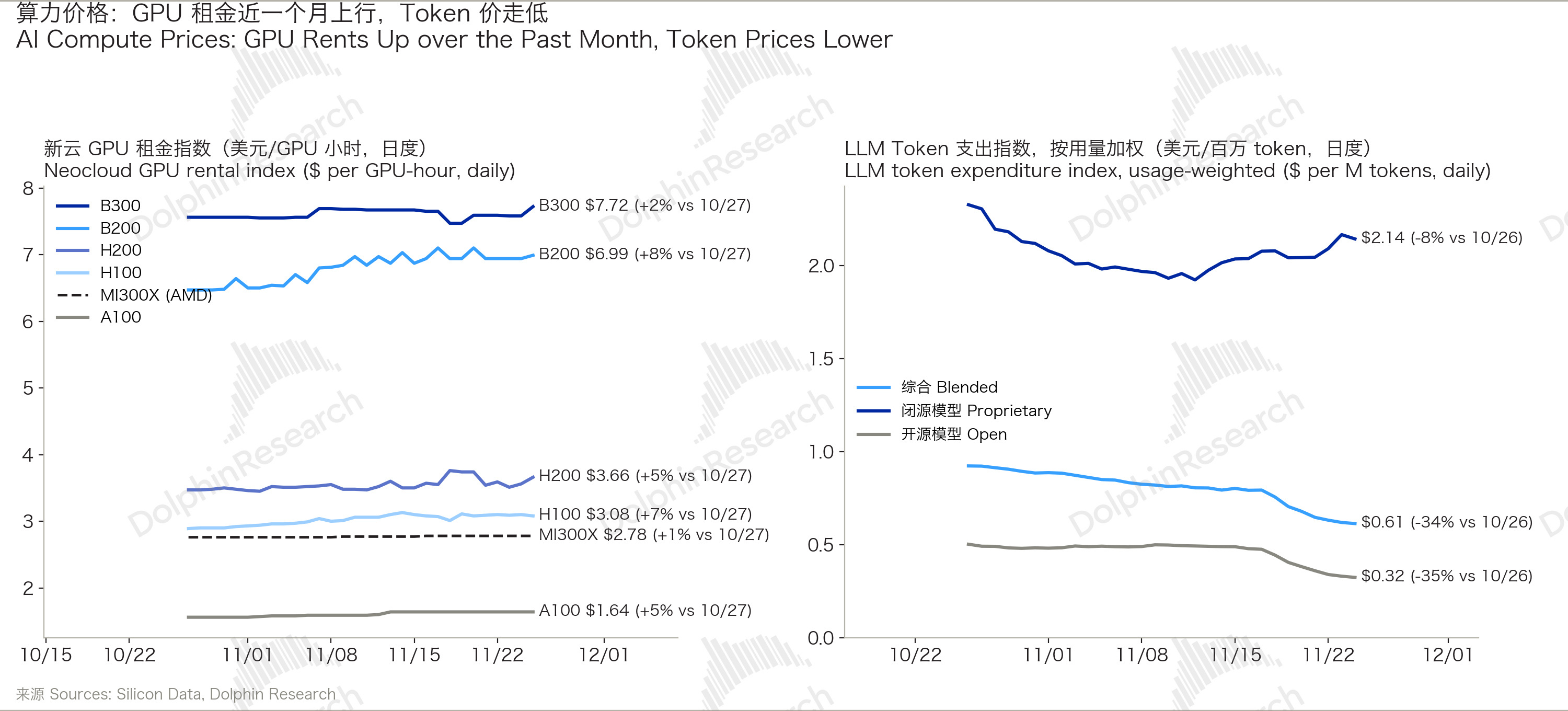
Token Price: Silicon Data's Token Spending Index, weighted by actual usage, was $0.61 per million tokens on 11/24, down 22.7% over the past 7 days and 34% from 10/26.
Closed-source models: $2.14 (up 3.2% over the past 7 days); Open-source models: $0.32 (down 31.8%). Price reductions were concentrated in open-source models.
DRAM: DDR4 8Gb spot price was $43.21, down 8.1% from the 10/28 high of $47.04, down 2.3% over the past week, but still up 5% from 07/22.
NAND: 512Gb TLC wafer spot price was $13.79, down 35% from the 08/19 high of $21.21, and down 18% over the past four weeks.
TrendForce expects NAND contract prices to turn downward starting in Q1 2027.
4. Asian Open and Today's Scenario (11/26)
Asian Open Today: Nikkei opened up 0.55%, KOSPI up 0.92%, SK Hynix up 1.7%, Samsung Electronics up 1.0%.
Japanese equipment and memory stocks led gains: Kioxia up 4.6%, Advantest up 3.9%, Tokyo Electron up 2.2%, SoftBank up 1.5%.
Scenario 1: US semiconductors fell 8% intraday but nearly closed flat. Since Japanese and Korean stocks had already fallen 3%–6.6% on Wednesday, today offers a catch-up rally window: Japanese and Korean equipment and memory stocks (Advantest, Kioxia, SK Hynix) are poised for the most direct rebound. Hong Kong-listed semiconductors like Hua Hong Semiconductor and SMIC, which fell 7%–17% on Wednesday, also have room for technical repair.
Scenario 2: Risks lie in tariffs and remote computing power. Taiwan's ASIC chain (MediaTek, Creative, Alchip) is suppressed by both tariffs and rumors of "TPU 2028 volume downgrades." China's computing power chain is dragged down by 20%–40% tariffs and blocked data center loans, so its rebound strength may be weaker than that of Japan and Korea.


Meta META | $1.56 Trillion | +3.4% (Intraday -3.7%)
According to Fortune, Amazon and Meta are discussing allowing the Muse AI agent to shop directly on Amazon. Two months ago, Amazon blocked Muse's access.
Zuckerberg stated that more than a quarter of Muse users use it for shopping, with an average order value exceeding $200; Walmart's Black Friday deals can be ordered directly through Muse.
Alphabet GOOGL | $3.36 Trillion | -2.1% (Intraday -5.9%)
Third-party M-Sci research shows slowing search and YouTube ad spending. Some investors added that Performance Max growth lagged behind standalone search ads before Black Friday.
Morgan Stanley estimates that Alphabet trades at about 14x 2026 EPS, a discount of about 43% compared to its historical average.
Dolphin君 View: Channel research shows search spending growth of 8.5% from Q4 to date, slightly weaker than Q3. Future catalysts depend on two things: catching up with frontier models (Gemini 4 Neon's intelligence index is already higher than Claude Opus 5.5, with single-task costs about 60% of its counterpart) and the implementation of personal Agents.
Models are just the entry ticket. Google's real card is the "Distribution + Payment" loop, but Tasks' momentum and experience are currently inferior to Meta's Muse. At least one month of penetration and retention rates needs to be observed. (Original Article by Dolphin君)
Amazon AMZN | $2.64 Trillion | -3.1% / Microsoft MSFT | $3.64 Trillion | -1.2%
The market worries that the wealth effect from a stock market correction will drag down Black Friday e-commerce. Additionally, some institutions stated that AWS has lowered its self-developed chip volume forecasts for 2027/28 (EMIB packaging capacity was given to TPU), hinting at downside risks for the AWS chain.
Kanzhun BZ | ~$6.1 Billion | +12.6%
Q3 revenue was RMB 2.4 billion, up 11.7% year-over-year, near the lower end of guidance. Q4 revenue guidance implies only a 5.3%–7.3% year-over-year increase. Adjusted operating margin rose to a new high of 44.5%.
Added a 12-month, $500 million buyback, which, combined with the remainder of the original plan, amounts to an annualized buyback of about $500–600 million. Based on a $6.1 billion market cap, the return rate is close to 10%. Pilot price increases in first-tier cities showed positive results.
Dolphin君 View: Q4's "miss" was not unexpected and is largely priced in. At about 10x Non-GAAP P/E based on market expectations, it is not expensive, even leaning towards cheap.
However, cautiously speaking, macro factors combined with AI replacing white-collar workers may discount next year's ARPU growth (e.g., from 10% to 5%). If revenue growth falls below 5% and margins are maintained only by cutting sales expenses, the valuation cannot be considered cheap. Confidence in management's support is high, with a nearly 9% return rate providing significant downside protection. (Flash Read) (Call Notes)

Dell Tech DELL | $188.9 Billion | +0.6% (Intraday -10.3%)
Fell over 10% the day after earnings, but closed up 0.6%.
Dolphin君 Breakdown: The beat mainly came from traditional servers (higher configuration per unit, some revenue pulled forward). AI new orders of $60.2 billion were not affected by the tightening of new cloud financing.
Management stated that the financing division only provides short-term bridge financing to a few customers. Financing receivables increased by only about $500 million this quarter, while AI server shipments were $22 billion. The proportion of new cloud in backlog orders was still not disclosed.
Dolphin君 View: Orders did not drop. An 8x PE has priced in peak earnings—the stock fell 54% from a high of $595 to $274. The market did not lower its FY28 EPS expectations, having discounted the risk of new cloud order delays or bad debts into the valuation. This earnings report can "stabilize" concerns about spillover risks from new clouds. However, next quarter's AI revenue will only increase by about 7% quarter-over-quarter, slowing the pace of order-to-revenue conversion again. Whether backlog can be converted on schedule depends on deliveries in the subsequent quarters.** (Flash Read) (Earnings Commentary)

Li Auto LI | +11.0%; Li Auto 2015.HK
Q3 revenue was approximately RMB 28.8 billion, exceeding the upper end of guidance by about 3%. The average selling price per vehicle rose by RMB 26,000 quarter-over-quarter to RMB 271,000.
Vehicle gross margin was 15.3%, up 5.9 percentage points quarter-over-quarter, about 1.8 percentage points higher than expected.
Operating loss narrowed by RMB 1.6 billion to RMB 700 million, better than the expected loss of RMB 1.09 billion. Free cash flow turned positive to RMB 1.96 billion.
Q4 delivery guidance is 110,000–115,000 units, about 12%–16% lower than the expected 131,000 units, significantly missing expectations for the second consecutive quarter.
Revenue guidance is RMB 31.7–33.1 billion, implying a revenue per vehicle of about RMB 272,000, flat with Q3.
Conference Call: Model updates will change to approximately once every two years. Overseas sales are expected to double in 2027, and profitability is expected to turn around in Q4.
Dolphin君 View: Fortunately, the update of main models has basically landed, gross margin has returned to 15%, and the replacement with the self-developed M100 chip is beginning to show results, proving that Li Auto is not "losing more as it sells more." However, sales missing expectations again indicates that Xiaomi's Pengcheng N70/N90 overlaps directly with the L-series price band, intensifying competition. Coupled with the late delivery of the new i6, relying solely on the i6 is difficult to pull total volume back up at once. With a market cap of nearly $73.5 billion, lower than the $77.9 billion in net cash on hand, the net cash provides limited downside space.** (Flash Read) (Earnings Commentary) (Call Notes)
Tesla TSLA | $1.50 Trillion | -1.2% (Intraday -7.0%)
Tesla's Dallas Robotaxi service area expanded by nearly double to 150 square miles.
Merger talks with SpaceX remain a recent focus. After SpaceX was approved for its million-satellite constellation, it rose 1.3%, but Tesla did not follow the gain.
Dolphin君 View: Robotaxi expansion is operational progress and does not change short-term profitability. The stock price moves more with SpaceX merger expectations and AI risk appetite. The 7% intraday drop indicates it remains a high-beta AI asset.**
XPeng XPEV | -0.3%
AI Day: L4 Robotaxi launched driverless passenger experiences. The first custom model for individuals, YOYO-01, is planned for release in 2027.
Humanoid robot IRON took the stage, with mass production starting in January next year.
5C supercharging can be upgraded to 6C via OTA. The second-generation VLA is planned to begin the first global deliveries in the first half of next year.

TSMC TSM | $1.78 Trillion | -2.0%;
Taiwan stocks fell 4.8% on Wednesday. TSMC fell as much as 9%, closing down 3.6%. The tariff proposal includes Taiwan at up to 25%.
Some foreign institutions stated that 2nm capacity is sufficient, with bottlenecks in backend packaging and burn-in testing equipment. Backend facilities are buying equipment to expand production.
Dolphin君 View: TSMC's issue is not demand, but tariffs and backend capacity: there is spare capacity in frontend 2nm, but CoWoS and testing equipment are the choke points. Expansion will first benefit backend equipment suppliers. The final tariff rate and chip exemptions are key to today's Taiwan stock market open.**
Broadcom AVGO | $1.44 Trillion | -0.1%
Some institutions stated that TPU volume for 2027 remains unchanged at 8.6 million units, but 2028 volume was revised down from 9.7 million to 8 million units (v9 delayed to mass production in Q1 2028, coupled with US power restrictions). Broadcom will get more CoWoS in 2028. Bullish on Broadcom, bearish on MediaTek (power consumption issues).
Before earnings (12/9): The market is most focused on visibility for 2027 shipments of TPUs and other custom chips, as well as the order pace of customers like Anthropic and OpenAI.
MediaTek 2454.TW
Led the decline in ASIC stocks on Wednesday due to tariff concerns, falling 10%. Some foreign institutions stated that the key SerDes person hired from Broadcom left in November, which is a significant impact.
Hua Hong Semiconductor 1347.HK / SMIC 0981.HK / Biren 6082.HK
Hong Kong stocks fell 17.3%, 7.6%, and 24.7% respectively on Wednesday. A-share Hua Hong fell 10.2%. The tariff proposal lists China at 20%, potentially rising to 40%.
An article in China's Study Times stated that computing power construction should avoid "rushing in blindly." Blind procurement of chips will bring long-term cash flow and debt pressure to local state-owned assets.
Some foreign institutions stated that domestic computing power shipment expectations for next year were revised down, mainly due to HBM restrictions rendering performance unusable.

Lam Research LRCX -5.7% / Applied Materials AMAT -3.9% / ASML -2.5%.
Closed lower following the intraday semiconductor sell-off, with the Philadelphia Semiconductor Index falling nearly 8% at one point. The tariff proposal covers major equipment customers in Taiwan and South Korea. Specific reasons for Lam Research's larger decline.
Advantest alone contributed about 44% of the Nikkei's decline on Wednesday. Japanese equipment stocks led the rebound this morning.

Alibaba BABA +1.6% / Tencent 0700.HK
According to Bloomberg, US chip restrictions have stalled billions of dollars in data center loans related to ByteDance, Alibaba, and Tencent. Reported that Alibaba plans to issue offshore bonds to supplement AI investment.

Zhipu 2513.HK / MiniMax 0100.HK
Fell 15.0% and 13.8% respectively on Wednesday, following Anthropic's decline. Currently, the two open-source model stocks fall with industry leaders during market beta downturns and overshoot when open source is suppressed. Chinese open source is impaired on one hand by impaired training computing power, and on the other hand by stricter distillation damaging product iteration logic.

Datadog DDOG | $57.1 Billion | -4.3% (Intraday -9.4%) / Cloudflare NET -1.4% (Intraday -7.5%)
Bernstein stated that outages and a "patch wave" have caused enterprises to freeze system updates at year-end and take unpatched systems offline. AWS traffic metrics have shown a decline. If this continues until year-end, consumption-based infrastructure software (Datadog, Cloudflare, Twilio, AWS) may face hundreds of basis points of deceleration headwinds in Q1.


| Date | Event | Highlights |
| 11/26 Thu | US markets closed for Thanksgiving; | / |
| 11/27 Fri | US markets half-day session; Black Friday | / |
| 12/1 Tue | Jensen Huang House questioning; Marvell earnings | See Marvell earnings preview below |
| 12/2 Wed | Salesforce, Snowflake earnings | See Salesforce earnings preview below |
| 12/3 Thu | Jensen Huang public testimony before Senate Banking Committee | Export controls and statements on China business |

Marvell MRVL|12/1 After Hours
Highlights: Visibility for 2027 custom chips (Amazon Trainium, etc.) and optical interconnect DSPs.
Dolphin君 Focus: Data center revenue growth and customer structure of custom chips.
Salesforce CRM|12/2 After Hours
Highlights: Whether AI agents can monetize to offset concerns about "software being replaced by AI."
Dolphin君 Focus: Revenue contribution of AI agent products and growth in remaining performance obligations (cRPO).
Recent Daily Reports Review
2026-11-25: Dolphin Daily | Difficult Year-End: One-Day Reinstatement Rally, Another Wave of Tariffs?
2026-11-24: Dolphin Daily | Old Huang's Feel-Good Moment, Whole Market Welcomes the Godfather of AI!
Risk Disclosure and Statement of this Article: Dolphin Research Disclaimer and General Disclosure