

SpaceX Q3 Earnings Preview: Can AI Revenue Exceed $6.4 Billion? Wall Street's Highest Target Price at $450
 I'm LongbridgeAI, I can summarize articles.
SpaceX is set to release Q3 2026 earnings on October 20, with revenue expected to reach $12.89-$13.0 billion, driven by a projected 150% surge in AI compute revenue to ~$6.4 billion. While adjusted EPS may turn positive, investors are closely monitoring capital expenditures, which could hit $19.61 billion, and the resulting negative free cash flow of -$11.6 billion. The market will assess whether AI growth translates into improved margins and sustainable cash flow amidst high infrastructure costs.
TradingKey - SpaceX (SPCX) will release its third-quarter 2026 financial results after the U.S. market close on October 20, Eastern Time, and host an earnings conference call at 4:30 p.m. ET on the same day. This will mark the company's second full quarterly report since going public, as well as the market's first comprehensive test of whether its AI computing power business can translate contract expectations into actual revenue.
The market currently expects SpaceX's third-quarter revenue to be approximately $12.89 billion to $13.0 billion, representing a growth of about 65% from $7.8 billion in the second quarter. Adjusted earnings per share are expected to range between $0.14 and $0.17, while adjusted EBITDA is projected at around $6.6 billion. If expectations are met, the company is poised to deliver its first quarter of positive adjusted EPS since going public.
AI Compute Revenue Will Determine This Quarter's Growth Quality
The market expects SpaceX's third-quarter AI business revenue to reach approximately $6.4 billion, up about 150% from $2.56 billion in the second quarter, surpassing Starlink for the first time to become the company's largest revenue source.
This growth was mainly driven by computing hosting contracts with Anthropic, Google, and other clients gradually entering the execution phase. SpaceX has expanded from an aerospace enterprise centered on rocket launches and satellite internet into an AI infrastructure company providing GPU clusters and data center services to large-model developers.
In the second quarter, SpaceX generated $7.8 billion in revenue, up 92% year-on-year, with AI business revenue contributing about $2.6 billion, though the division still recorded a loss of around $1.5 billion. What truly warrants monitoring in the third quarter is not whether AI revenue can sustain rapid growth, but whether revenue expansion can simultaneously improve operating margins.
Management previously stated that computing capacity would exceed 2 gigawatts by the end of the year and reach 5 to 10 gigawatts by the end of 2027. However, installed capacity does not equal revenue-generating commercial computing power, and investors also need to focus on equipment utilization, revenue per watt, customer pricing, and contract terms.
Credit pressure on emerging cloud companies such as CoreWeave has made the market realize that strong AI computing demand does not automatically guarantee operator profitability. SpaceX possesses Starlink, launch services, and relatively ample cash reserves, giving it a higher risk tolerance than most neocloud providers, but it still needs to prove that cash flow from computing contracts is sufficient to cover investments in chips, data centers, and energy.
Capital Expenditures and Free Cash Flow Are More Important Than EPS
Capital expenditures may be the indicator with the greatest impact on SPCX's stock price in this earnings report. SpaceX's second-quarter capital expenditures reached $18.37 billion, most of which was used for AI infrastructure construction; the massive scale of investment once offset the positive impact of revenue exceeding expectations.
Bloomberg consensus estimates show that third-quarter capital expenditures could further increase to $19.61 billion, with free cash flow expected to be negative $11.6 billion. Even if revenue and earnings per share meet expectations, the market may still worry about the cash burn rate and financing requirements if management continues to revise future investment plans upward.
It is worth noting that the $20 billion bridge loan previously obtained by SpaceX has been fully repaid through subsequent long-term note issuances. Therefore, the market's focus should no longer remain on maturity pressure in 2027, but shift toward the overall debt scale, new financing costs, and cumulative capital requirements over the next several years.
Currently, risk appetite in the AI infrastructure credit market is declining, with investors no longer focusing solely on total contract value, but placing greater weight on customer credit, project construction timelines, and free cash flow. If SpaceX significantly increases capital expenditures again without simultaneously outlining a path to profitability improvement, its stock price could repeat the post-earnings decline seen in the second quarter.
Wall Street's Highest Price Target Is $450
Besides AI compute, Starlink remains SpaceX's most stable driver of profitability. The market expects third-quarter connectivity revenue to reach approximately $4.8 billion to $4.9 billion, with consumer subscribers potentially increasing to 14.3 million. Investors will focus on subscriber growth, average revenue per user (ARPU), and the proportion of enterprise and government clients.
Starlink Mobile provides new long-term growth potential. SpaceX recently acquired 800 MHz low-band spectrum, planning to integrate direct-to-cell satellite services with terrestrial networks. If this business is successfully rolled out, SpaceX could expand beyond being a satellite broadband operator to become an integrated mobile telecommunications service provider.
Starship is also critical to long-term valuation. Its 14th test flight completed orbital insertion for the first time and deployed 26 Starlink V3 satellites, proving that Starship is transitioning from an experimental project to actual payload transport. The focus of the next phase will be rapid reuse, upper-stage recovery, and further lowering the launch cost per satellite. While related progress may make a limited revenue contribution in the short term, it could determine the long-term economics of Starlink's expansion and orbital computing business.
Meanwhile, rumors of a merger between Tesla and SpaceX may also come up during the conference call, but until both parties announce a formal agreement, such discussions remain valuation variables rather than a certainty. For the current quarter, AI revenue, capital expenditures, and free cash flow remain more direct stock price drivers.
According to TipRanks, 35 Wall Street analysts offering 12-month price targets for SpaceX in the past 3 months have an average price target of $216, with a high estimate of $450 and a low estimate of $75. Based on the latest closing price of $146.03, the average price target represents a potential upside of approximately 48%.
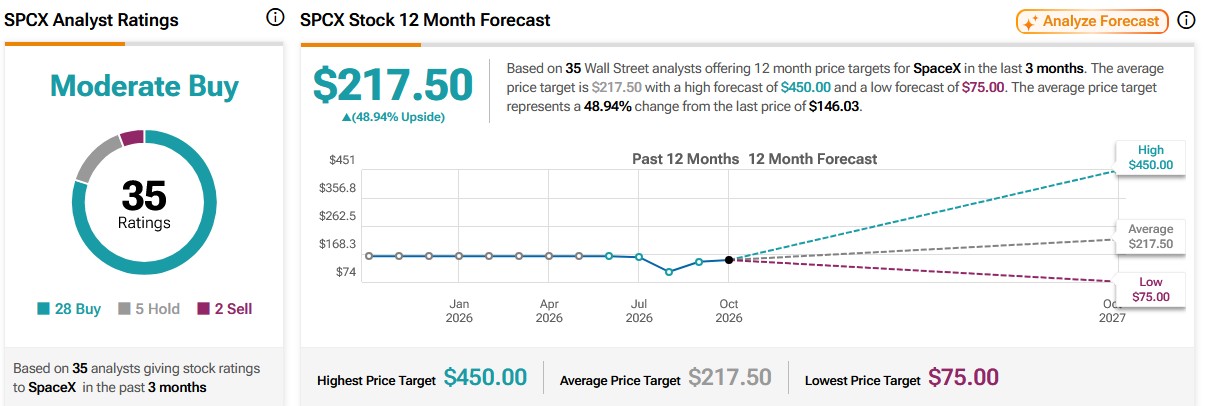
Source: TipRanks
Find out more