

Kioxia Drops Over 15% to Six-Month Low Without Dragging Down US Memory Stocks: Micron, SanDisk Up Over 2% Pre-Market, SK Hynix Gains Nearly 5%
 I'm LongbridgeAI. Here is the key information I extracted
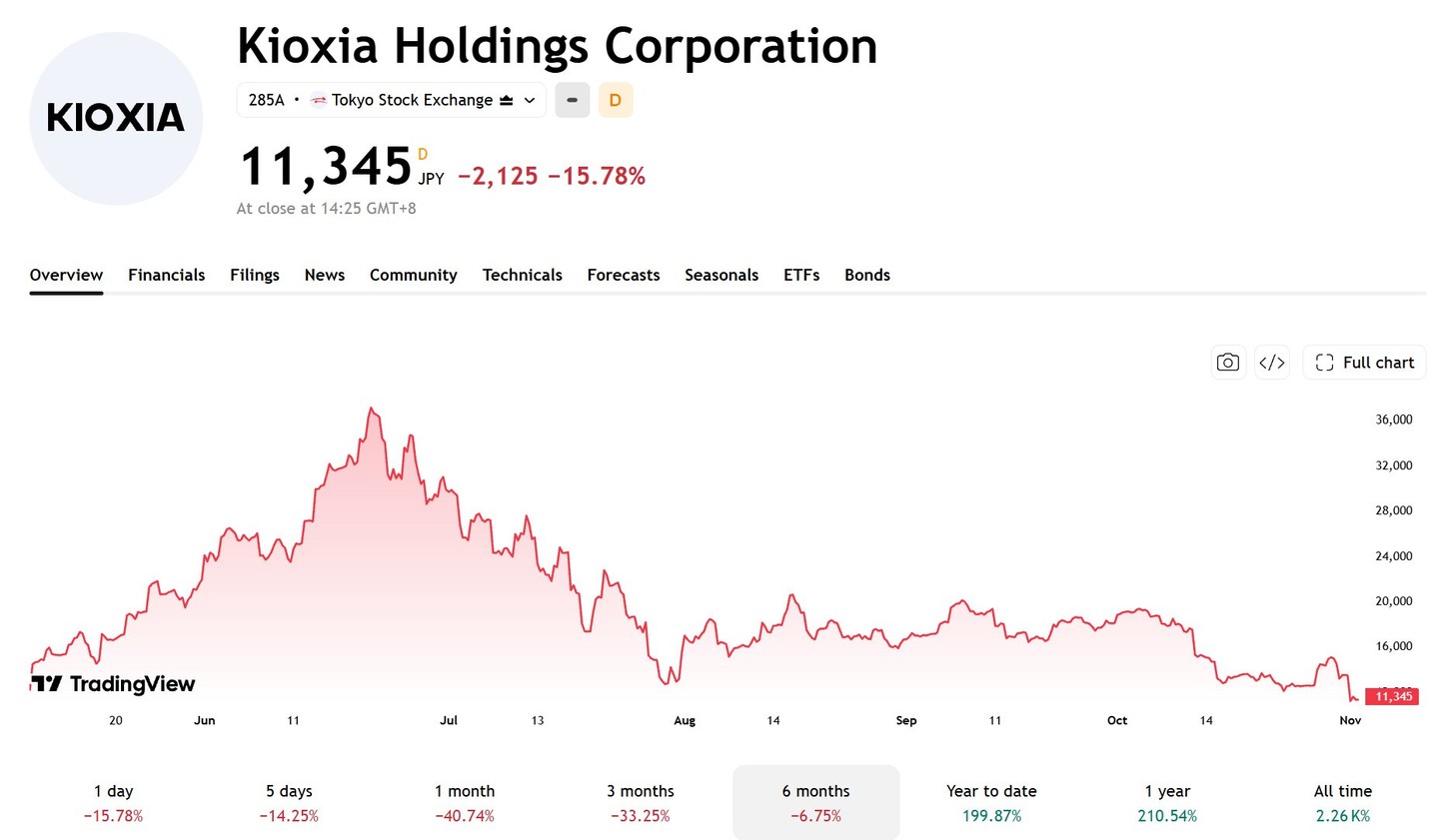
TradingKey - On November 2 ET, memory chip stocks showed divergent performance. Japanese memory chip maker Kioxia closed down approximately 15.8% in Tokyo, while memory stocks rallied across the board in subsequent US pre-market trading. As of press time, Micron Technology (MU) rose over 2%, SanDisk (SNDK) gained over 3%, the DRAM ETF (DRAM) advanced over 4%, and SK Hynix (SKHY) climbed nearly 5%.
The sharp decline in Kioxia's stock price was mainly due to its weaker-than-expected earnings guidance for the next quarter. Meanwhile, the pre-market rebound in US memory stocks was also driven by a market recovery following a sharp drop in tech stocks in the previous trading session.
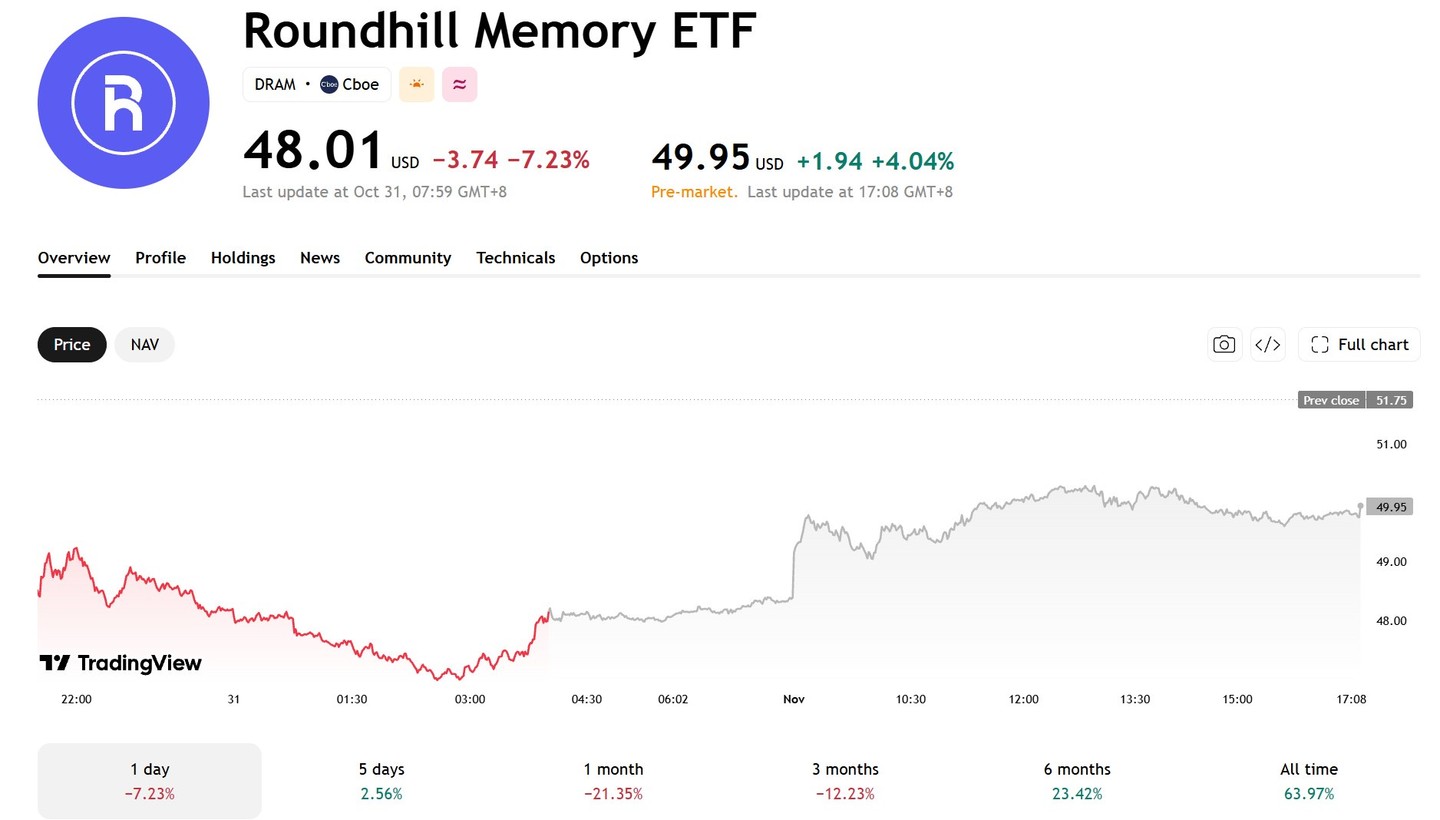
[Source: TradingView]
Kioxia Shares Drop Over 15% as Earnings Guidance Misses Expectations
 [Source: TradingView]
Kioxia's stock price fell sharply, mainly impacted by its earnings guidance for the next quarter coming in below market expectations.
The company expects adjusted operating profit for the October–December 2026 quarter to be around 2 trillion yen, missing market expectations of 2.32 trillion to 2.35 trillion yen and remaining virtually flat compared to the previous quarter.
The slowing profit growth was mainly attributable to narrowing NAND price increases. In the previous quarter, Kioxia's NAND average selling price (ASP) rose by approximately 20% to 25% quarter-on-quarter, down from a gain of about 70% in the preceding quarter.
The company expects the average selling price in the next quarter to grow by only a low-single-digit percentage quarter-on-quarter, with shipments remaining roughly flat.
In addition, the pull-forward of some orders into the previous quarter and the postponement of certain enterprise storage orders to the quarter ending March 2027 also impacted performance expectations for the upcoming quarter.
Despite short-term earnings pressure, Kioxia remains optimistic about AI data center demand. The company stated that its planned capacity for 2027 is largely covered by orders, and long-term agreements have been signed for more than half of its expected shipments in 2028.
Micron, SanDisk, SK Hynix Differ in Business Structure
Both Kioxia and SanDisk focus core operations on NAND flash memory, leaving their performance susceptible to changes in NAND prices, shipments, and customer demand. However, due to differences in specific orders and guidance, their stock performance may diverge.
Meanwhile, Micron and SK Hynix maintain portfolios across DRAM, HBM, and NAND, enabling them to benefit from growing demand for high-bandwidth memory and server DRAM driven by AI servers.
On October 28, SK Hynix reported record third-quarter results, with revenue surging 328% year-over-year to 104.62 trillion won and operating profit jumping 632% year-over-year to 83.33 trillion won.
The company noted that sales of HBM4 and high-value-added server products increased, and it has secured long-term supply agreements with 14 major customers covering more than half of its total capacity for 2027 to 2028, helping enhance future earnings visibility.
SanDisk's first-quarter fiscal 2027 revenue rose 378% year-over-year to $11.031 billion, with second-quarter revenue guidance projected at $12.2 billion to $12.6 billion. Nevertheless, its stock fell about 13.5% on October 30 amid market concerns over slowing revenue growth, margin sustainability, and the industry impact of moderating NAND price increases.
NAND Price Trends Remain in Focus
Supply and demand dynamics vary across the DRAM, HBM, and NAND markets. AI server demand continues to support the HBM and server DRAM markets, while the NAND market exhibits divergence, with robust demand for enterprise SSDs and relatively weak demand for consumer products.
TrendForce projects that NAND flash contract prices will rise 15% to 20% quarter-over-quarter in the fourth quarter of 2026, with enterprise SSD prices expected to see even higher gains. This indicates that the slowing growth in Kioxia's own NAND average selling price (ASP) does not mean demand across the broader NAND market has weakened.
Going forward, investors need to monitor changes in NAND prices, enterprise SSD orders, and vendor shipment volumes, while watching whether Micron, SK Hynix, and SanDisk can sustain their current earnings growth.
Price trends and demand shifts across different memory products will serve as key indicators for determining whether the industry's momentum can be sustained.
Find out more