

Why Elon Musk Wants to Merge SpaceX and Tesla: 5 Things Investors Need to Watch
 I'm LongbridgeAI, I can summarize articles.
Elon Musk announced that SpaceX and Tesla have formed a special committee to evaluate a potential merger, sparking stock gains for both companies. Key factors include synergies in AI, robotics, and chips, alongside SpaceX's surging Super Intelligence revenue. Major hurdles involve resolving conflicts of interest, securing shareholder approval with high thresholds, and determining valuation and financing structures amid significant capital expenditures.
TradingKey - On October 20 Eastern Time, Elon Musk revealed during SpaceX's (SPCX) third-quarter earnings call that SpaceX and Tesla (TSLA) have established a special committee composed of independent directors to evaluate a potential merger.
Following the announcement, SpaceX rose over 8% in after-hours trading, while Tesla gained 1.76%. As of press time, SpaceX jumped 9.24% in overnight trading to $161.56.
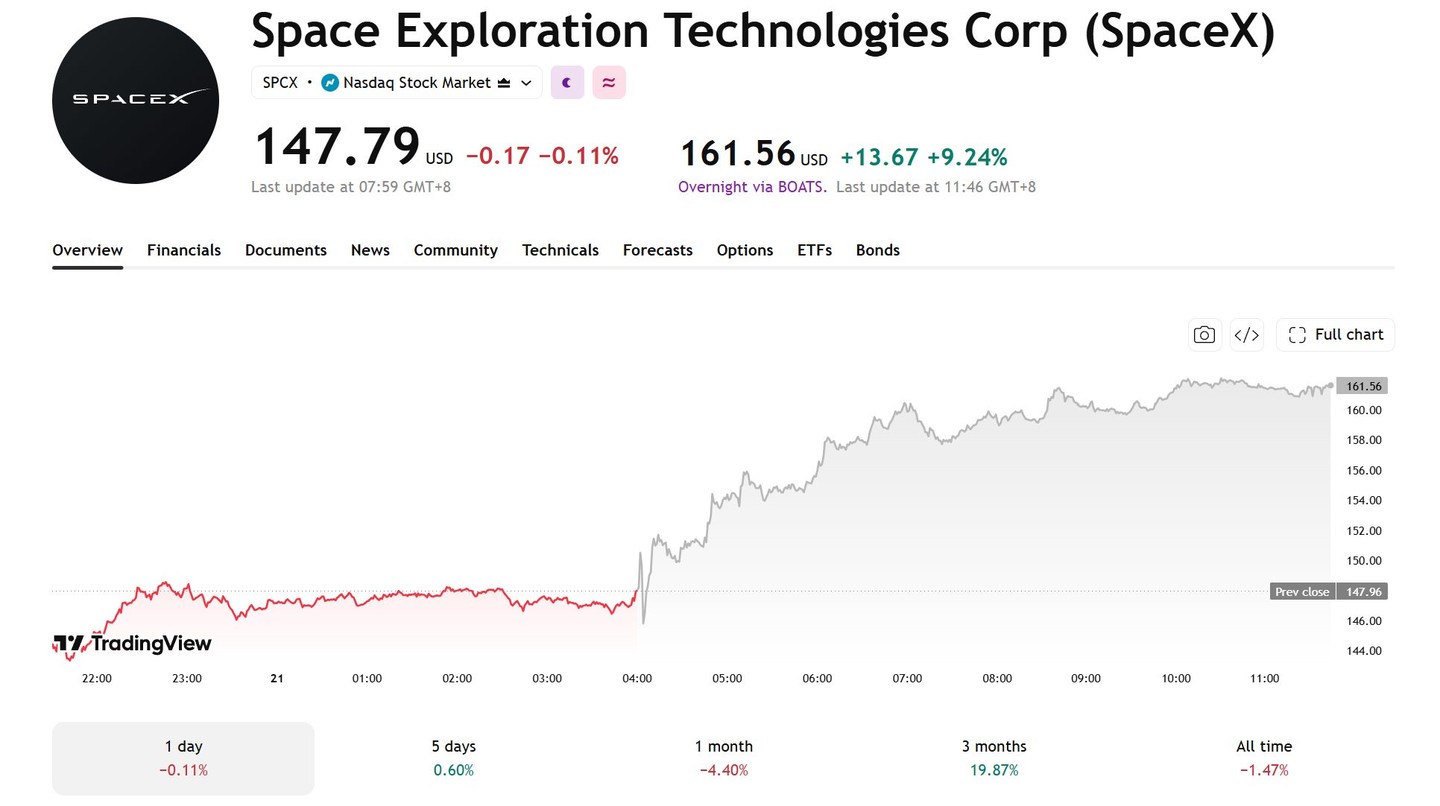
[Source: TradingView]
Musk believes there is collaborative value between the two parties in fields such as superintelligent software, but the two companies have not yet agreed on specific transaction terms, and whether the merger will proceed remains uncertain.
AI Business Is a Key Consideration in Potential Merger
Tesla operates automotive, energy, autonomous driving, and robotics businesses, while SpaceX is expanding its superintelligence business and building related computing power and data center infrastructure. The two companies have potential synergies in areas such as AI software, chips, computing power, and satellite communications, but there is currently no formal business integration plan.
If the transaction moves forward, the two parties may share certain R&D, computing power, and manufacturing resources, but the actual benefits will still depend on technology integration, product commercialization, and capital allocation efficiency.
2. SpaceX Q3 Earnings Report Heightens Market Attention
SpaceX's third-quarter revenue increased 161% year-over-year to $14.58 billion, with net profit reaching approximately $4.4 billion. Revenue from its Super Intelligence business reached $7.56 billion, up about 830% year-over-year, becoming the company's largest revenue source for the first time; operating profit from its connectivity business was around $2.37 billion, remaining SpaceX's primary source of profit.
Rapid revenue growth in the Super Intelligence business has begun reshaping SpaceX's revenue structure. If Tesla and SpaceX undergo further integration, the market may focus on whether Tesla's capital, manufacturing, and application capabilities can support SpaceX in expanding its AI business.
However, SpaceX's third-quarter capital expenditures reached approximately $19.6 billion, with around $16.4 billion directed toward the Super Intelligence business. Whether the AI business can generate stable cash flows sufficient to support capital expenditures such as computing power and data centers remains to be verified in subsequent quarters.
3. Robotics and Autonomous Driving May Become Areas of Cooperation
Tesla is advancing its autonomous driving, Robotaxi, and humanoid robotics businesses, while SpaceX has built up capabilities in rockets, satellite internet, and AI data centers.
The market is watching whether the two companies can establish tangible cooperation in areas such as robotics, vehicle connectivity, AI software, and chip R&D.
The two companies have previously collaborated on certain technology and product projects, including the AI and chip project Terafab, as well as the use of SpaceX technology in Tesla's new Roadster.
However, these collaborations do not indicate that the two sides have agreed on a merger. Whether a potential transaction can improve R&D and product development efficiency still depends on whether the two parties can clarify the division of R&D labor, intellectual property ownership, and commercialization arrangements.
4. Conflicts of Interest and Shareholder Approval Are Key Hurdles
Musk serves as CEO of both companies and holds substantial stakes in both, giving rise to potential conflicts of interest. He has stated that he will not participate in the discussions of the special committee, which is composed of independent directors and tasked with evaluating the potential merger.
According to Musk, Tesla needs to secure support representing 50% of all outstanding shares, rather than merely obtaining a majority vote among shareholders who actually participate in voting.
This means that even if a majority of shareholders who vote support the deal, the transaction may still fail to proceed as long as the supporting shares do not reach 50% of all outstanding shares. The final approval threshold remains subject to formal transaction documents and applicable laws.
5. Valuation, Financing and Equity Dilution Remain to Be Resolved
Based on a simple addition of current market valuations, SpaceX is worth approximately $2 trillion and Tesla around $1.5 trillion, bringing the combined value of the two companies to about $3.5 trillion. However, this figure is not a formal transaction valuation, transaction consideration, or share swap ratio.
Both parties still need to negotiate the share swap ratio, financing arrangements, governance structure, and shareholder approval plans. If the transaction uses new share issuances or share swaps as consideration, existing shareholders may face equity dilution, the extent of which will depend on the transaction structure and issuance size.
If the combined company continues to expand investments in infrastructure such as AI and data centers after the merger, investors will also need to monitor how capital expenditures and financing responsibilities are allocated.
Could a SpaceX and Tesla Merger Materialize?
SpaceX and Tesla share certain synergies in AI software, chips, robotics, autonomous driving, and satellite communications, but this potential value has yet to be validated through a formal transaction plan.
Whether the special committee can propose specific arrangements still depends on the outcome of negotiations between both parties regarding valuation, share-swap ratios, financing responsibilities, and governance structure.
Going forward, investors should focus on three key developments: the formal transaction plan and share-swap ratio, approvals from Tesla shareholders and regulatory authorities, and how post-merger capital expenditures and cash flow responsibilities will be allocated.
Find out more