

Intel Drags Down CPU Rivals. Is it a Buying Opportunity for AMD and Arm?
 I'm LongbridgeAI. Here is the key information I extracted
Intel's (INTC -28.58%) third-quarter earnings report set off a bloodbath in the semiconductor sector. The chip giant had its worst day since 1974, plunging 29% and dragging the VanEck Semiconductor ETF down 7%.
Intel's third-quarter results were solid, with revenue up 21% to $16.5 billion, and adjusted earnings per share more than doubled from $0.23 to $0.52, showing its turnaround efforts are paying off.
However, Intel's fourth-quarter guidance sent investors fleeing, calling for a sequential decline in revenue and a 600-point decline in gross margins due to a slowdown in the PC market triggered by memory shortages. While Intel's data center and foundry businesses are growing rapidly, its client computing business, which is mostly made up of PCs, is still its biggest segment by revenue. The company forecast revenue of $15 billion-$16 billion, well below the consensus at $17.1 billion, and adjusted earnings per share of just $0.25, compared to expectations at $0.44.

Image source: Getty Images.
Why Intel's peers also fell
Intel stock has soared over the last year in part because confidence has increased in its turnaround strategy and its foundry business, but also because CPU demand is expected to soar due to agentic AI, which includes products like Meta's Muse personal AI agent.
Along with Intel, AMD (AMD -10.88%) and Arm (ARM -9.97%) have also significant exposure to the exposure market, and all three of those stocks are up big this year, as the chart below shows.
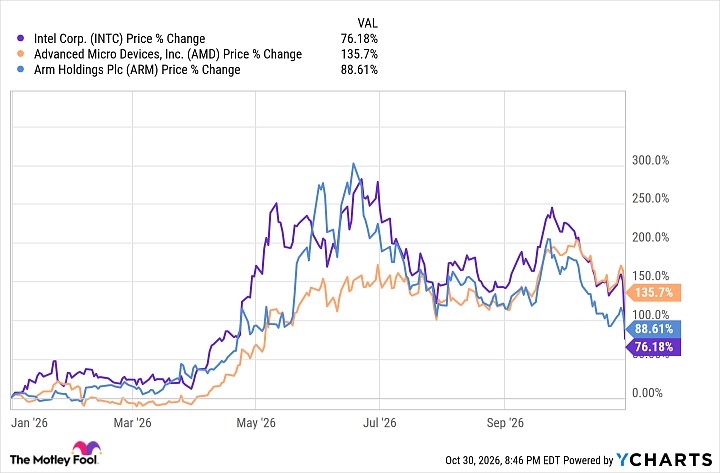
INTC data by YCharts
You can also see that AMD and Arm both fell sharply in sympathy with Intel, as AMD lost 11% and Arm finished down 10%.
However, the sell-off in those two stocks has as much to do with investor sentiment as it does with the implications of Intel's report.
AMD and Arm don't have as much PC exposure as Intel does, and also don't own their own foundry, meaning they aren't exposed to the capital expenditures and risk that come with it.
AMD hasn't reported third-quarter results, but in its second quarter, data center revenue made up $6.7 billion out of $11.5 billion of its revenue, while it got $3.1 billion from the client segment. Weakness in PCs will impact AMD as well, but not to the extent that it will with Intel. AMD also posted 107% growth in the data center segment in the second quarter, and there's a good chance that accelerated in the third quarter, given the massive capex spending by the hyperscalers.
Arm, whose CPU architecture differs from the x86 used by Intel and AMD, has limited exposure to the PC market but holds dominant market share in smartphones, which are experiencing the same challenges with rising memory prices.
Arm doesn't break out revenue by segment like its peers do, but it did say that data center royalties doubled year-over-year in its most recent quarter, indicating it is experiencing similarly strong growth to AMD in that category.
Should you buy the dip on AMD and Arm?
AMD and Arm have soared this year on expectations related to AI, so as the AI rally fades, it makes sense that these stocks would pull back as well. While a double-digit sell-off in tandem with Intel's weak earnings seems extreme, the stocks have been moving on sentiment for much of the year.
Arm launched its new AGI CPU, staking its claim to agentic AI, while AMD is finally being seen as a winner from the data center boom as it's signed contracts with many of the top hyperscalers. Both stocks have benefited from the increasing potential for CPUs in agentic AI.
That potential is still very much there, but high expectations are already baked into these stocks. We'll learn more when these stocks report earnings next week, but given the rough earnings season for AI stocks thus far, investors may want to wait for sentiment to stabilize before buying these CPU stocks.