

Macroeconomic headwinds cause Bitcoin's rebound to fail; is the market repricing?
 I'm LongbridgeAI, I can summarize articles.
Bitcoin's upward momentum faltered over the weekend, dropping below $68,000, while Ethereum also saw declines. A total of $336 million in positions were liquidated, primarily in long positions. The geopolitical tensions with Iran and inflationary pressures have increased volatility in the macroeconomic environment, impacting risk assets including cryptocurrencies. The market is now pricing in potential interest rate hikes by the Federal Reserve, further hindering the rise of cryptocurrencies. Additionally, the situation in the Middle East has escalated, shifting market expectations from a quick resolution to a prolonged standoff.
Shaw, Jinse Finance
Bitcoin's upward momentum faltered over the weekend, showing a volatile downward trend. Early this morning, Bitcoin briefly fell below $68,000, touching $67,360.1, a drop of over 3% in 24 hours; Ethereum briefly touched $2,025.75 in the early morning, a drop of over 4% in 24 hours.
Coinglass data shows that, in the past 24 hours, a total of $336 million in positions were liquidated across the network, including $242 million in long positions and $94.4383 million in short positions, with long positions being the primary target. Specifically, $98.9338 million in BTC liquidations and $79.1798 million in ETH liquidations.
Over the weekend, tensions with Iran escalated again. With the Strait of Hormuz remaining effectively blocked, Israel's direct strikes on Iran's core energy facilities exacerbated the impact on global energy markets. The volatile situation and energy shocks further intensified the volatility of major global financial assets, increasing uncertainty in the macroeconomic environment. Renewed inflationary pressures, the Federal Reserve's pause in quantitative easing, and the market's shift towards pricing in the possibility of interest rate hikes significantly hampered the rise of risk assets, including cryptocurrencies. I. Crypto Market Rebound Fails, Global Major Asset Volatility Increases Bitcoin's upward momentum faltered over the weekend, exhibiting a downward trend. Early this morning, Bitcoin briefly dipped below $68,000, touching $67,360.1, a 24-hour drop of over 3%; Ethereum briefly touched $2,025.75, narrowly holding above the $2,000 mark, a 24-hour drop of over 4%. Other major cryptocurrencies also experienced volatile declines. As of press time, Bitcoin is currently trading at $68,296.87, down 1.4% in the last 24 hours; Ethereum is currently trading at $2,063.45, down 1.8% in the last 24 hours. According to Coinglass data, $336 million in positions were liquidated across the entire network in the past 24 hours, including $242 million in long positions and $94.4383 million in short positions, with long positions being the primary target. Specifically, $98.9338 million in BTC positions were liquidated and $79.1798 million in ETH positions were liquidated. In the past 24 hours, over 173,000 people across the network have been liquidated, with the largest single liquidation occurring in HTX - ETH - USDT, valued at $5.8304 million. Meanwhile, spot gold fell to $4,320.30 an ounce on Monday—less than a dollar higher than at the end of last year, almost erasing all of this year's gains. Crude oil prices initially surged, with WTI crude briefly returning above $100, but subsequently retreating from its opening high; Brent crude also declined slightly from Friday's high. US stock futures fell significantly. Over the weekend, tensions with Iran escalated again, with Trump threatening to strike and destroy power plants in Iran or face consequences within 48 hours, to which Iran responded strongly. This volatile situation exacerbated the global energy shock, primarily driven by oil, keeping oil prices high and reinforcing inflationary pressures. The market, facing a rapidly deteriorating macroeconomic environment, began to re-price the possibility of a Federal Reserve interest rate hike. These unfavorable factors increased volatility in risk assets and hindered the rise of cryptocurrencies and other assets. II. Tensions with Iran Escalate Again, Market Conflict Expectations Remain Shifting The geopolitical situation in the Middle East, centered on the conflict with Iran, suddenly escalated over the weekend. On March 21, local time, US President Trump posted on the social media platform "Real Social," demanding that Iran fully open the Strait of Hormuz within 48 hours, or the US would strike and destroy all types of power plants in Iran, "the largest one will be the first to be hit." Subsequently, the Central Command of the Iranian Armed Forces, under the command of Khatham Anbia, warned in the early hours of March 22 that, according to previous warnings, if Iran's fuel and energy infrastructure were attacked, all energy infrastructure, information technology systems, and desalination facilities of the US and its allies in the region would become targets. In addition, when asked about the situation in Iran and whether Trump intended to de-escalate the situation during an interview on the 22nd, US Treasury Secretary Bessenter stated that the US is destroying various Iranian facilities and that sometimes "escalation is necessary before de-escalation." He also explicitly stated that "all options are under consideration," including sending US troops to control Kharg Island, Iran's oil hub. As the situation evolves, market expectations for the end of the conflict have shifted from an initial "quick resolution" to a current "long-term standoff." According to Polymarket's betting odds, the market's expectation of an end to the conflict in March has decreased from 78% on February 28th to 4% on March 20th, with the highest probability (44%) currently expected between April 1st and May 15th.
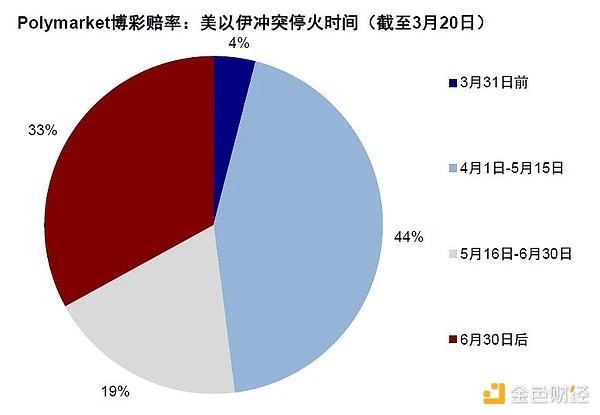
Source: Polymarket, CICC
As expectations continue to be postponed, the focus of trading will gradually shift from short-term emotional shocks to longer-term secondary impacts, such as the negative impact of market liquidity on major assets and the inflationary pressures that energy shocks may bring. Due to the potential inflation triggered by the energy crisis, the market is repricing the possibility of the Federal Reserve restarting interest rate hikes.
III. Inflationary Pressures Reemerge, Fed Rate Hike Possibility Repriced
The escalating situation in Iran, coupled with the oil and energy shock triggering inflation concerns, has led the market to reprice the "risk of a Fed rate hike." During this period, all risk assets have corrected, but the core issue is not so much market panic, but rather changes in the macroeconomic environment. The persistently high oil prices and rising inflation expectations are the most damaging factors in the current market. Without the Iranian situation, US inflation would have peaked at 2.8% in the second quarter before declining, and the Fed's baseline scenario would still allow and require 2-3 rate cuts. A $100 oil price is a "watershed," pushing the inflation peak from 2.8% to 3.5%, comparable to the current federal funds rate (3.5-3.75%), meaning the Fed would find it difficult to cut rates in the short term. If oil prices remain above $100 for an extended period, it will push the US core inflation rate above 3.5%, in which case the Federal Reserve is likely to resume interest rate hikes. More importantly, influenced by changing circumstances and the macroeconomic environment, the market has begun to trade on the possibility of rate hikes again, rather than rate cuts. The latest CME FedWatch data shows that the probability of a 25 basis point rate hike by the Fed in April is 12.4%, while the probability of keeping rates unchanged is 87.6%. The probability of a cumulative 25 basis point rate hike by June is 21.9%, and the probability of a cumulative 50 basis point rate hike is 1.6%, but keeping rates unchanged remains the mainstream, with a probability of 76.5%. Furthermore, Polymarket data shows that the probability of betting on whether the Fed will raise interest rates in 2026 has risen to 25%. The market's expectations for future Federal Reserve interest rates indicate that while rate hikes are not the main theme, they have shifted from being "unexpected" to a "risk that needs to be priced in." Once the market begins pricing in rate hikes, the valuation of risky assets, especially the Nasdaq, tech stocks, AI concept stocks, and crypto assets, will be directly suppressed. Furthermore, another point that investors easily overlook is the policy path after the new Federal Reserve chairman takes office. The new Federal Reserve Chairman will not take office until after June, and even with a change in leadership, it doesn't mean an immediate shift to interest rate cuts. Monetary policy is never decided by one person, but rather by the consensus of the entire Federal Reserve system over a long period. The surge in energy prices has made the already difficult transition of power within the Federal Reserve even more challenging.
IV. Resolv Labs Suffers Vulnerability Attack, Another "Black Swan" Effect?
In addition to the geopolitical tensions in the macro environment mentioned above, the sudden vulnerability attack on Resolv Labs last weekend has become a "black swan" event in the crypto market. On March 22, a vulnerability was detected in the Resolv Labs stablecoin USR. An address used 100,000 USDC to mint 50,000,000 USR, causing USR to briefly de-peg by 93.72%, plummeting to $0.053. Resolv attackers used 200,000 USDC to mint 80 million USR. They then converted the USR to wstUSR, and then back to USDC and USDT. Resolv Labs subsequently confirmed the vulnerability attack on its X platform, stating that attackers exploited the vulnerability to mint 50 million uncollateralized USR stablecoins. All protocol functions have been suspended to prevent further malicious activity, and recovery efforts are underway. Resolv Labs stated that the collateral pool remains intact, the underlying assets have not suffered any loss, and the issue is limited to the USR issuance mechanism. Today, Resolv Labs released an update on the attack, disclosing that its protocol infrastructure was maliciously compromised due to a compromised private key. The attackers minted approximately $80 million worth of uncollateralized USR, and the relevant smart contracts were immediately suspended. The incident stemmed from a cyberattack targeting the infrastructure and unauthorized actions by a third party; the underlying collateral assets of the protocol were not directly damaged. **Approximately 9 million USR tokens held by the attackers have been destroyed to mitigate potential impact. The current protocol asset size is approximately $141 million, with confirmed actual losses of approximately $500,000 (redemptions completed before the suspension).** The current total USR supply includes approximately 102 million USR tokens issued before the incident and approximately 71 million illegally minted tokens. The official recovery process has been initiated, with plans to prioritize opening redemption channels for pre-incident USR to whitelisted users starting March 23, 2026. Affected users should coordinate with Resolv Digital Assets through official channels. While this attack was merely a minor incident within the crypto industry, somewhat insignificant compared to the negative impact of the current macroeconomic environment and geopolitical tensions, it did contribute to the weak performance of the crypto market over the weekend. V. Market Analysis and Interpretation Under the dual pressures of a headwind macroeconomic environment and escalating tensions with Iran, the market is repricing the direction of major global assets and policies. What will the future hold? Will the Federal Reserve restart interest rate hikes? When will risk assets, including cryptocurrencies, rebound? Let's look at the main market analyses and interpretations. 1. Nick Timiraos, a Wall Street Journal reporter and often referred to as the "Federal Reserve mouthpiece," stated that soaring energy prices have made the already difficult transition of power at the Federal Reserve even more challenging. This process was already quite complex. Kevin Warsh's nomination stalled due to a Justice Department investigation and obstruction from Tillis. Furthermore, unlike previous Fed chairs since Volcker, Warsh pledged a complete break with his predecessors, rather than continuing their policies. With markets now anticipating a 50/50 chance of rate hikes and cuts this year, Warsh faces a dilemma: nominating a president on one hand, and leading his new committee on the other. In 2008, after a period of aggressive rate cuts, oil prices suddenly surged. At that time, Warsh strongly argued that inflation risk was "the main risk" and recommended that the Fed's next move should be a rate hike. Trump's expectations are the opposite. Goldman Sachs trader Shreeti Kapa stated that the market has begun to reflect the inflationary risks from this short-term energy shock, but has not yet truly reflected the downside risks to growth from a long-term shock. This contrasts sharply with the 2022 energy shock, where the market currently tends to believe that wars and energy disruptions will be relatively short-lived. The current market assumption is that the war and the resulting energy supply disruptions will be relatively short-lived. If this assessment is proven false, and energy price increases are more persistent than expected, the market will have to reprice for a larger downward revision of global growth and corporate profits, and global stock markets will face more significant pullback pressure. Bloomberg macro strategist Michael Ball points out that rising energy costs have an inflationary effect, equivalent to simultaneously taxing consumers, corporate profit margins, and market confidence. This also explains why major central banks have released stronger signals this week—the market quickly priced in tightening expectations from the ECB and the Bank of England, erasing all expectations of a Fed rate cut this year, and even seeing bets on a Fed rate hike at one point.
4. The Kobeissi Letter stated, "Oil prices are no longer the biggest threat to the market. It is becoming increasingly clear that the bond market will determine how long Trump can continue to pressure Iran regarding the war. Since the outbreak of the war on February 28, the 10-year US Treasury yield has risen by about 45 basis points. This is consistent with the rapid surge that occurred around 'Liberation Day' in April 2025. In April 2025, when the 10-year US Treasury yield broke through 4.50%, Trump began to hint at a possible suspension of additional tariffs. And when the 10-year yield rose above 4.60%, Trump officially announced on April 9, 2025, a 90-day suspension of the reciprocal tariff policy." The 10-year US Treasury yield has now risen to 4.40%, and we believe the 4.50%–4.60% range will once again become a key warning line. The US economy cannot afford for the 10-year US Treasury yield to rise to 5%. A report released by Goldman Sachs analysts, including Daan Struyven, states that the high concentration of global production and spare capacity may drive a more persistent risk premium in oil prices. Analysts say this dynamic is expected to encourage governments and market participants to increase strategic reserves, thereby increasing upward pressure on long-term crude oil prices. Goldman Sachs analysts wrote: “The largest oil supply shock in history may make policymakers and markets realize the structural risks posed by the high concentration of production and spare capacity in the Middle East and the fragility of energy infrastructure.” Taking these changes into account, they expect the average Brent crude oil price in 2026 to be $85 per barrel, higher than the previous forecast of $77 per barrel; at the same time, they raised their full-year average WTI crude oil price forecast from $72 per barrel to $79 per barrel. 6. Capital.com analyst Kyle Rhoda stated that rising oil prices since the outbreak of the conflict have increased inflation risks and reduced the likelihood of the Federal Reserve and other central banks cutting interest rates in the near term. This is a negative factor for gold, which has fallen for eight consecutive trading days and just recorded its biggest weekly drop since 1983. Due to technical reasons, "gold is expected to rebound in the short term," which largely depends on "whether Trump can deliver on his threat to strike Iranian power plants." 7. Skybridge Capital founder Anthony Scaramucci stated that institutional investor participation and inflows into Bitcoin exchange-traded funds (ETFs) have, to some extent, mitigated the volatility of Bitcoin's four-year cycle, making its performance "somewhat moderated." However, this change in market structure has not completely eliminated Bitcoin's traditional cyclical patterns. He stated, “We are still in a four-year cycle, and some traditional whales and early gamblers (OGs) still believe in this cycle. And what often happens in life is that when you believe in something, it often becomes a self-fulfilling prophecy.” He added that Bitcoin prices are likely to continue fluctuating for most of this year until the fourth quarter of 2026, when they will begin to rise with the start of a new bull market cycle. 8. Strategy Executive Chairman Michael Saylor hinted that despite the market crash last weekend causing a 10% loss on the company's Bitcoin investments, the company still increased its Bitcoin holdings. “The orange march continues,” Saylor wrote in a post on the X platform on Sunday, along with a chart showing that Strategy has purchased approximately $52 billion worth of Bitcoin since August 2020. 9. Analyst Alessio Rastani stated that Bitcoin's recent rebound is insufficient to confirm a sustained upward trend, and warned that Bitcoin could still fall again, even below $60,000, before a true bottom is formed. 10. Cryptoquant analyst Darkfost wrote that altcoin trading volume in the crypto market continues to decline, indicating a significant decrease in investor interest. Against the backdrop of a bear market and geopolitical uncertainty, altcoins have consistently underperformed Bitcoin, with a significant contraction in risk appetite. Analysis points out that historically, peak trading volume often corresponds to market tops and the release of FOMO (fear of missing out), and the current sluggish trading environment also means that potential opportunities typically emerge during periods of lowest market attention.