

SK Hynix Drops Below $149 Offering Price as ADR Premium Tops 40%, Widening Over 37% Since Pricing: What Risks Should Investors Watch Out For?
 I'm LongbridgeAI, I can summarize articles.
SK Hynix (SKHY) shares dropped below their $149 IPO price, trading at $142.62, yet maintain a ~40% ADR premium over Korean domestic shares. Investors face risks from potential narrowing of this premium alongside fundamental pressures like memory chip supply-demand cycles and AI capex shifts. Upcoming Q3 earnings on October 28 will be critical; weak results or guidance could exacerbate losses if the ADR premium also contracts.
TradingKey - SK Hynix (SKHY) has experienced a sharp pullback recently. As of October 26, SKHY closed at $142.62, about 4.3% below its offer price of $149 and down approximately 25.5% from its closing price of $191.56 on September 25.
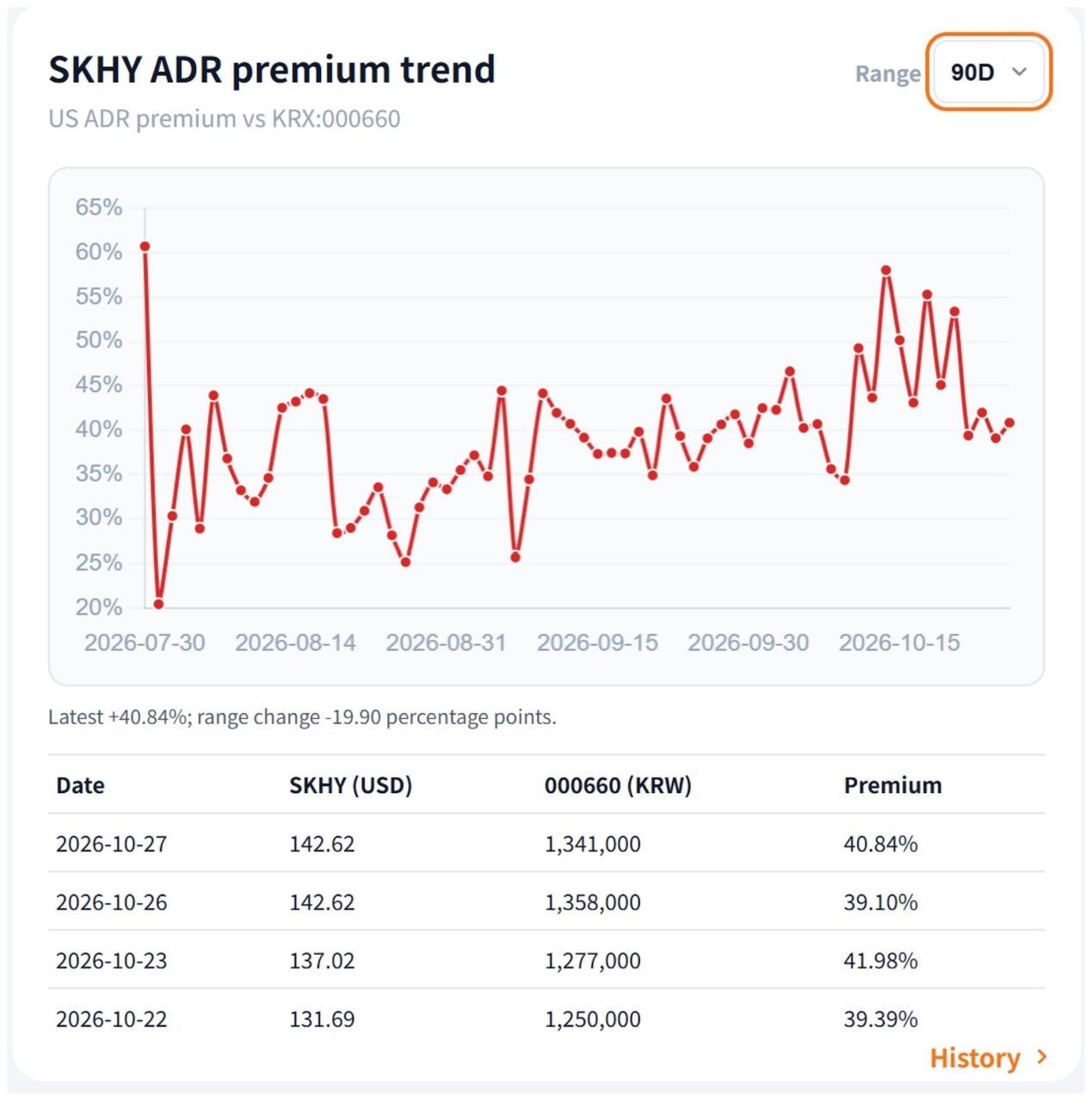
Although the stock price has fallen below its offer price, as of press time, SKHY still trades at a premium of about 40.84% relative to its domestic Korean common shares.
Meanwhile, SK Hynix went public on July 10 at $149 per ADS, with the offer price representing a premium of approximately 3.1% over the converted closing price of its domestic Korean shares on the previous trading day. SKHY closed at $168.01 on its first day of trading, with an ADR premium of about 15.76%.
This means that in addition to focusing on SK Hynix's earnings prospects, investors must also bear the additional risk of a narrowing ADR premium.
[Source: skhypremium]
Why ADR Premiums Matter: Narrowing Spreads May Amplify Losses
SK Hynix issued its ADSs in July 2026 at a price of $149 per ADS, with each ADS representing 0.1 South Korean common share. When comparing stock prices across the two markets, the price of the South Korean common stock needs to be adjusted by the depositary ratio and converted into US dollars based on the USD/KRW exchange rate.
The ADR premium reflects that the ADS price in the US market is higher than the converted USD value of the South Korean common shares. Trading hours, market supply and demand, exchange rates, and depositary conversion arrangements in both markets can all affect the price spread; therefore, a high premium does not necessarily mean the stock price will fall.
For SKHY investors, a high premium means that stock price performance depends not only on changes in SK Hynix's underlying stock price, but is also influenced by changes in the price spread between the two markets.
If the price of the South Korean common stock remains stable while the ADR premium narrows, SKHY could still decline; if the local stock price falls at the same time, investors may suffer losses from both the falling stock price and the narrowing premium.
What Other Risks Should SKHY Investors Watch Out For?
Shifts in memory chip supply and demand. SK Hynix benefits from growing demand for high-bandwidth memory (HBM) driven by AI servers, but DRAM and NAND remain subject to supply and demand cycles. If supply growth exceeds demand, or if customer procurement slows down, prices and profit margins for related products could come under pressure. For the HBM business, attention should also be paid to the mass production progress of next-generation products, customer qualification, and shipment performance.
AI capital expenditures falling short of expectations. Ongoing construction of AI data centers by major cloud service providers such as Microsoft (MSFT) and Google (GOOGL) is a key driver of HBM demand. If revenue from AI applications fails to support continued expansion in infrastructure spending, cloud providers may adjust their investment plans, and the market could lower future earnings expectations for SK Hynix.
Results falling below market expectations. Even if company profits continue to grow, if third-quarter results or fourth-quarter guidance fall below expectations, the stock price could still come under pressure despite sustained profit growth. For SKHY, which trades at a high ADR premium, if domestic South Korean share prices fall while the U.S. market premium narrows, the magnitude of any pullback could expand further.
October 28 Earnings Will Test Market Expectations
SK Hynix plans to announce its third-quarter results on October 28. Investors should focus on HBM shipments and pricing, DRAM and NAND price trends, fourth-quarter earnings guidance, as well as the production schedule for new capacity and shareholder return plans.
If the results and subsequent guidance are stronger than market expectations, domestic share prices in South Korea may receive support, but SKHY's performance will also depend on changes in the ADR premium. Conversely, if earnings expectations are revised downward and the premium narrows, SKHY could be affected by both fundamentals and changes in cross-market spreads.
For SKHY investors, two risks need to be evaluated separately: first, whether SK Hynix's earnings growth can be sustained, and second, whether the current ADR premium can be maintained. While growth in AI memory demand provides opportunities for the company, stock price trends cannot be judged solely on industry demand.