

Amazon Generated $202 Billion in Quarterly Sales. Most of Its Operating Profit Came From Just 1 Business.
 I'm LongbridgeAI. Here is the key information I extracted
- AWS achieves an operating margin of about 38% by renting out computing power and storage, outperforming the lower-margin e-commerce business, which is burdened by high logistics and labor costs.…
Take a moment and think about the last time you used Amazon (AMZN +4.15%). Did you buy something? Pay for something to watch on Amazon Prime? Maybe you checked on the status of a package? All of these services make it easy to think of Amazon as an e-commerce business.
However, the company's latest results reveal something many people may not fully grasp: Most of its profit comes from a segment many people never knowingly use. It's Amazon Web Services (AWS), and it deserves a place in the sun.

Image source: Getty Images.
Amazon rents the technology other businesses need
Explaining AWS and what it does can get complicated, so think of it this way: AWS rents out the computing power and storage businesses need to run online services. By renting, businesses can save money by avoiding the cost of building and maintaining the expensive equipment and facilities needed to run websites, store customer data, or support applications.
In addition, as artificial intelligence (AI) grows, AWS is becoming increasingly important. Organizations are scaling up their use of AI, and AWS provides much of the technological muscle to meet the surging demand. This raises an interesting question: How important is AWS to Amazon?
AMZN - Amazon
NASDAQ · As of 10:36 AM ET 11/09/26
 Moneyball Superscore88/100
Key data points
A smaller share of sales produces most of the operating profit
The answer is very important. AWS comprises about 23% of Amazon's revenue, but it contributes 63% of Amazon's operating profit. Therefore, AWS is a central concern for Amazon investors. When one segment drives roughly two-thirds of a company's profitability, investors scrutinize that segment's health.
One reason AWS stands out is the nature of Amazon's overall business. Its e-commerce segment drives a staggering amount of revenue, roughly $650 billion. However, historically, it hasn't been very profitable. Even with a recent widening, it generates an operating margin of about 8%. AWS, in contrast, has always been lucrative. Its operating margin stands at about 38%.
The reason is simple: Cloud computing benefits from enormous economies of scale. Once a data center is operational, it can take on many new clients. Those customers often sign enterprise subscription agreements with Amazon, delivering steady, highly profitable revenue. E-commerce, in contrast, is less profitable because of logistics, physical labor, and fuel costs.
Growing this business comes with a very large bill
However, AWS has a downside: its cost. Adding new facilities and equipment to fuel AWS's growth is expensive -- extremely expensive. It requires construction of enormous buildings, electrical systems, state-of-the-art equipment, and research. In the end, it means hundreds of billions of dollars -- $220 billion for 2026 -- in capital expenditures for the company.
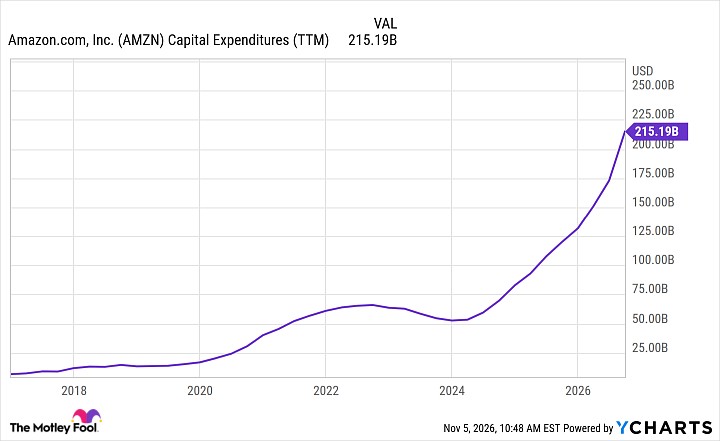
AMZN Capital Expenditures (TTM) data by YCharts.
The point is that Amazon hopes to recoup this money many times over as the demand for AWS's services continues to grow, but, in the short term, markets are increasingly concerned that Amazon could be overspending.
Amazon's valuation is nearing multi-year lows
While Wall Street might fret over the size of Amazon's capital investments in AWS, its stock valuation could be a signal to investors. It currently trades at a price-to-earnings (P/E) multiple of 21.6. That's well below its three-year average of 39.3, and it's approaching its all-time-low P/E multiple of 18.2.
In other words, Amazon's giant investment spree could present long-term investors with a historic opportunity, or its low P/E multiple could be a warning sign. We simply don't know.
Buying Amazon stock today is a bet on AWS's future
When someone buys Amazon stock, they're not just buying an e-commerce company. Indeed, as Amazon's latest capital investments prove, the company is betting big on AWS. Amazon is as much a technology services supplier as it is a retailer. Buying Amazon stock now means believing in the company's vision: that its colossal investments in AWS will not only pay for themselves, but also lay the groundwork for decades of profits to come.