

HUT
----
C
Aug 31 at 12:57 PM
Barclays: Why Hyperscalers Are Defensive Growth
 I'm LongbridgeAI, I can summarize articles.
A report has been widely circulated over the weekend: a significant portion of the revenue cloud providers earn from AI is unrelated to GPUs.
You can think of AI model companies as stores located within a shopping mall.
They don't build their own buildings; they rent space in the mall to operate. This "mall" refers to cloud giants like Microsoft, Amazon, and Google. For every deal an AI company closes, it must pay a fee to the mall because its models run on the mall's infrastructure.
Barclays conducted a calculation showing that for every $100 an AI company collects, between $35 and $41 goes to the mall.
$35 to $41 is no small amount—roughly 40% of gross revenue.
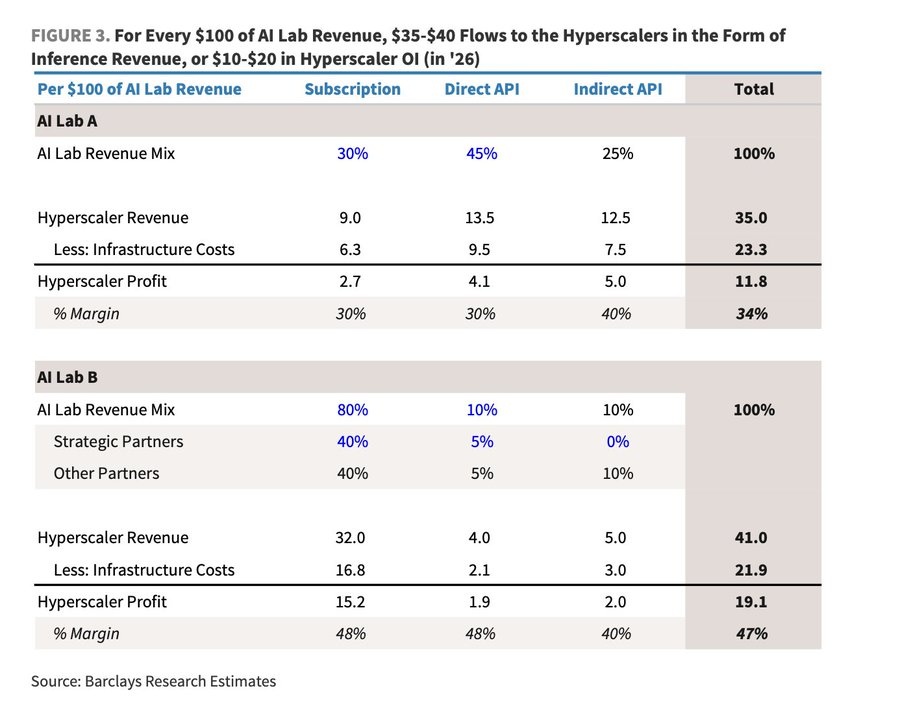
First, what does this table show?
Barclays modeled how the $100 collected by an AI (model) lab is distributed. They didn't name specific companies, using only Lab A and Lab B.
Lab A focuses on wholesale. 70% of its revenue comes from APIs, where developers integrate its models into their products and pay based on usage.
Lab B focuses on retail, similar to ChatGPT Plus, where users pay a monthly subscription (e.g., $20) for unlimited access. This accounts for 80% of its revenue.
With the same $100 in revenue, the mall takes $35 from Lab A and $41 from Lab B.
The extra $6 is understandable, given the higher usage volume in the retail model.
The real difference lies in the next step.
How much did the "mall" actually keep?
Revenue collected doesn't equal profit. The "model mall" incurs costs: buying GPUs, running servers, and paying electricity bills.
From the $35 taken from Lab A, the mall spends over $23, keeping $12.
From the $41 taken from Lab B, the mall spends less than $22, keeping $19.
The mall's cost base for Lab B is lower than for Lab A.
Lower costs, higher profits—a 62% increase.
Why does Model B generate 62% more profit?
Because Lab B has a special arrangement.
80% of its revenue comes from subscriptions, half of which were signed under agreements with the mall that year. The terms are simple: in addition to standard rent, Lab B must share an additional 20% of this subscription revenue with the mall.
Why agree? Because the mall invested heavily in Lab B earlier. It was a condition.
Thus, the $41 paid by Lab B consists of two parts.
One part is rent, after which the mall buys chips and runs machines, working hard to earn a ~30% margin.
The other part is an extra profit share of $8.
This $8 requires no additional effort from the mall: no extra GPUs, no extra servers, no extra electricity. Just sign the contract, and the money comes in. Combining these two streams results in a 47% profit margin for the mall on Lab B's business.
This explains why tech giants are willing to invest massive capital expenditures (CapEx) in AI. Regardless of who wins, the landlords get paid. No matter how fiercely AI companies compete, whether users pay monthly subscriptions or per-use fees, the money flows through cloud providers (35–40% gross margin).
(1) Fundamentally, it provides strong support for servers, liquid cooling, power supply, connectivity upgrades, and chip procurement.
(2) Hyperscalers providing underlying GPU clusters, cloud deployment optimization, and power infrastructure (such as Microsoft) can achieve highly deterministic earnings conversion.
The investment theme for AI is also shifting:
Physical hardware constraints (compute/capacity shortages)
→ Enterprise AI deployment (CSPs/software - bringing AI into production environments)
→ Vertical industries (controlling entry points for workflows like marketing)
Sector ETFs:$Magnificent Seven ETF - Roundhill(MAGS.US)$Roundhill Daily 2X Lon Mag Sev ETF(MAGX.US)$iShares Expanded Tech Software Sector ETF(IGV.US)
Major Cloud Providers:$Microsoft(MSFT.US)$Alphabet - C(GOOG.US)$Amazon(AMZN.US)$Meta Platforms(META.US)
Secondary Cloud Players:$Coreweave(CRWV.US)$Nebius(NBIS.US)$IREN(IREN.US)$Hut 8 Mining(HUT.US)$Oracle(ORCL.US)
China's Top Three:$TENCENT(00700.HK)$BABA-W(09988.HK)$BIDU-W(09888.HK)
Fractional shares from $1 — flexible positioning.
Recurring buys — steady investing in any market.
Which hyperscaler do you prefer?
Single choice
12 voted in PollsPoll ended

Magnificent Seven ETF - Roundhill
USMAGS

iShares Expanded Tech Software Sector ETF
USIGV

Roundhill Daily 2X Lon Mag Sev ETF
USMAGX

Microsoft
USMSFT

Nebius
USNBIS

Amazon
USAMZN

IREN
USIREN

Oracle
USORCL

ORACLE CORP DEPOSITARY SH REP 1/2000TH PFD SER D
USORCL-D

Alphabet - C
USGOOG

GOOGL
USGOOGL

GOOGN
USGOOGN

META
USMETA

HUT
USHUT

09988
HK09988

89988
HK89988

HBBD
SGHBBD

BABA
USBABA

09888
HK09888

89888
HK89888

HBUD
SGHBUD

BIDU
USBIDU
The copyright of this article belongs to the original author/organization.
The views expressed herein are solely those of the author and do not reflect the stance of the platform. The content is intended for investment reference purposes only and shall not be considered as investment advice. Please contact us if you have any questions or suggestions regarding the content services provided by the platform.