

Meet the Only "Magnificent Seven" Stock That's Outperforming the S&P 500 and Nasdaq This Year (Hint: It's Not Nvidia)
 I'm LongbridgeAI. Here is the key information I extracted
- Unlike its peers that face negative free cash flow due to heavy artificial intelligence capital expenditures, Apple generates massive free cash flow and treats artificial intelligence as a product enhancement rather than a core infrastructure burden.…
The "Magnificent Seven" was popularized in 2023 by Bank of America analyst Michael Hartnett as a term for seven rapidly appreciating tech-focused growth companies. In 2023, Apple (AAPL -1.90%), Nvidia (NVDA +2.29%), Microsoft (MSFT +2.73%), Alphabet (GOOG +0.08%) (GOOGL +0.37%), Amazon (AMZN +2.06%), Meta Platforms (META +2.36%), and Tesla (TSLA -1.32%) were instrumental in driving the Nasdaq Composite's (^IXIC +0.83%) monster 43.4% gain -- with all seven companies posting even bigger returns.
Big gains followed in 2024, with every Magnificent Seven stock except for Microsoft outperforming the Nasdaq and S&P 500 (^GSPC +0.36%). But in 2025, only Nvidia and Alphabet outperformed both indexes. And after last week's sell-off, the only Magnificent Seven stock left standing above the indexes is Apple, which surpassed Nvidia as the world's most valuable company on Oct. 30.
Here's what separates Apple from its Magnificent Seven stock peers, and if the tech stock is a buy now.

Image source: Getty Images.
Apple generated $31.9 billion in trailing 12-month free cash flow
Apple is up 26.8% year-to-date, outpacing the major indexes, the broader tech sector, and its Magnificent Seven peers.
|
Index/Company |
2023 |
2024 |
2025 |
2026 (as of Oct. 30) |
|---|---|---|---|---|
|
S&P 500 |
24.2% |
23.3% |
16.4% |
10.7% |
|
Nasdaq Composite |
43.4% |
28.6% |
20.4% |
9.4% |
|
Apple |
48.2% |
30.1% |
8.6% |
26.8% |
|
Nvidia |
238.9% |
171.2% |
38.9% |
9.7% |
|
Microsoft |
56.8% |
12.1% |
14.7% |
7.9% |
|
Alphabet |
58.3% |
35.5% |
65.4% |
(10.6%) |
|
Amazon |
80.9% |
44.4% |
5.2% |
4.1% |
|
Meta Platforms |
194.1% |
65.4% |
12.7% |
(6.8%) |
|
Tesla |
101.7% |
62.5% |
11.4% |
(11.1%) |
Data source: YCharts.
Apple is unique because artificial intelligence (AI) capital expenditures (capex) don't make or break its investment thesis. By comparison, Amazon, Alphabet, Microsoft, Meta Platforms, and Tesla continue to ramp up their AI spending. And although Nvidia has low capex, its major customers are the hyperscalers, so it needs them to see a return on their chip and associated AI infrastructure investments to justify future spending.
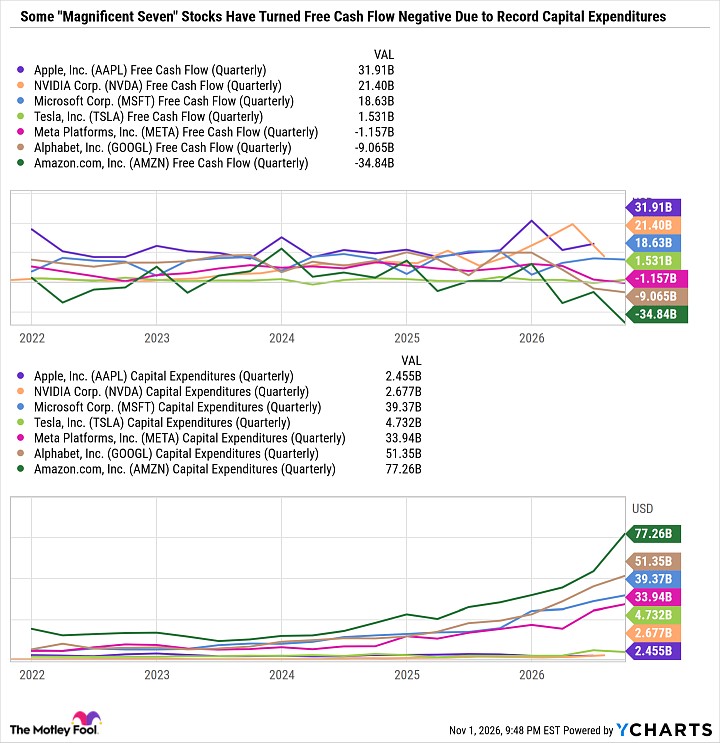
AAPL Free Cash Flow (Quarterly) data by YCharts
At the beginning of the AI ramp-up, cash-cow companies like Amazon and Alphabet were able to support higher spending with free cash flow (FCF) alone. But spending has grown so massive that Amazon, Alphabet, and Meta Platforms are now FCF-negative.
Alphabet is taking on debt, diluting shareholders by issuing stock, and is guiding for even higher spending in 2027. Investors are losing patience, with Alphabet experiencing a record $505 billion market cap plunge in a single session and plummeting around a 52-week low. Apple is the exact opposite narrative.
AAPL - Apple
NASDAQ · As of 4:00 PM ET 11/03/26
 Moneyball Superscore87/100
Key data points
AI enhances Apple's investment thesis rather than defining it
Apple's balance sheet is in impeccable shape. It continues to generate gobs of FCF that it can use to reinvest in the business or return to shareholders through buybacks and dividends.
Apple isn't spending record capex to build data centers. Rather, its focus is on providing products that allow consumers and enterprises to interact with AI, such as the first touchscreen MacBook Pro, its first foldable iPhone Duo, its smart home system HomeView, smart glasses, an AI-powered pendant, and more. Apple is also directly passing along higher memory chip costs to customers through price increases. To help bridge the affordability gap, it is offering a new leasing program facilitated by Klarna, in addition to the multi-year service contracts already offered by carriers.
Apple doesn't need to spend a lot on AI capex because new product updates and AI features on its devices are manageable costs. Developers depend on Apple App Store downloads to gain traction, all the while funneling more revenue to Apple in fees.
What makes Apple particularly appealing is that it is exposed to virtually all of the benefits of AI adoption with very few of the cons. Whereas frontier models like Anthropic's Claude, OpenAI's ChatGPT, and Alphabet's Gemini are all competing for user engagement. Amazon, Microsoft, and Alphabet are racing to attract cloud spend. By comparison, Apple is a catch-all way to bet on AI innovation and productivity improvements.
Outside of AI, Apple has evolved into a modern-day consumer staples company more than a tech stock. Its integrated ecosystem of products and services is essential for many users. And demand has proven incredibly sticky despite inflationary and cost-of-living pressures.
Apple has a 39.5 price-to-earnings ratio
Apple is hovering around an all-time high because AI acts as a cherry on top of its investment thesis rather than the entire sundae. If there were a cyclical slowdown in AI spending or an AI-driven stock market correction, Apple would be one of the best-positioned tech stocks to weather it.
The problem with buying the stock now is that Apple trades at 39.5 times earnings and 36.1 times forward earnings -- which is a significant premium compared to its 10-year median price-to-earnings (P/E) ratio of 27.6. However, Apple's valuation is digestible for investors who truly view Apple as a recession-proof, consumer staples/tech hybrid. Especially when compared to recession-resistant companies like Walmart (WMT -2.22%) and Costco Wholesale (COST -2.05%), which are even more expensive than Apple. Walmart fetches a 42.8 forward P/E, and Costco's is 44.4.
Investors willing to pay a premium price for a safe stock may want to consider buying Apple, even around an all-time high. But investors who believe that AI spending will eventually pay off for hyperscalers will find stocks like Alphabet and Amazon at far more attractive valuations.