

Meta Announces Stock Split as Earnings Beat Drives Stock Back to $700 Level
 I'm LongbridgeAI, I can summarize articles.
Meta reported Q3 2026 earnings beating expectations, with revenue at $64.6 billion and EPS of $3.83. The company announced a 2-for-1 stock split and introduced non-voting Class C shares to facilitate future AI investments without diluting Mark Zuckerberg's control. Despite significant legal charges, core profitability remains strong. Meta's stock rebounded to the $700 level following the announcement.
TradingKey - Meta (META) reported its third-quarter 2026 financial results after market close on Wednesday, while announcing the creation of non-voting Class C common stock and a 2-for-1 stock split executed as a stock dividend. This unique equity arrangement provides Meta with a new financing tool for future artificial intelligence investments without diluting Chief Executive Officer Mark Zuckerberg's control over the company.
Under the plan, holders of Meta's Class A or Class B shares will receive one Class C share for each share held, with the new shares expected to begin trading on January 19, 2027. Because Class C shares carry no voting rights, the split will not alter the voting structure among existing shareholders, allowing Zuckerberg to maintain control over the company's strategic direction through his high-voting Class B shares.
This arrangement will not generate immediate cash for Meta, nor will it change the company's overall market capitalization when it takes effect. Its true significance lies in enabling Meta to use Class C shares for equity financing, acquisitions, and employee compensation in the future, raising capital while avoiding the dilution of Zuckerberg's voting power. For a company planning long-term investments in data centers, chips, and frontier models, the new share class serves as a more flexible capital tool.
Meta also stated in regulatory filings that Zuckerberg may immediately sell up to 20% of his newly received non-voting shares. This could help him meet potential liquidity needs arising from California's proposed wealth tax, reducing the need to sell his high-voting stock. However, the stock split itself does not create extra wealth for investors. All else being equal, doubling the number of shares will result in a proportional adjustment to the share price on the effective date.
Released alongside the stock split announcement, Meta's overall third-quarter results beat expectations. Quarterly revenue reached $64.6 billion, up 26% year-over-year and above Wall Street's expectation of around $63.3 billion. Net income stood at $9.86 billion, with diluted earnings per share (EPS) of $3.83, topping market estimates of $3.56. In the same period last year, revenue was $51.24 billion, and EPS was $1.05.
Legal expenses were the largest drag on profit performance this quarter, with Meta recording approximately $9.89 billion in charges related to litigation settlements concerning youth mental health and social media impacts. Excluding this item, EPS was approximately $7.40, indicating that profitability across core platforms such as Facebook, Instagram, and WhatsApp remains strong.
Meanwhile, AI investments are beginning to yield initial returns.
Meta's personal AI assistant, Muse, has surpassed 10 million downloads. The company stated that roughly 25% of users use the product daily, with shopping being the most common use case. Meta aims to further build a network where numerous Muse agents collaborate, and to sell AI tools to enterprise customers.
However, Muse still faces challenges such as privacy controversies, external website restrictions, and an unproven business model, and it remains to be seen whether its revenue can cover rising computing power costs.
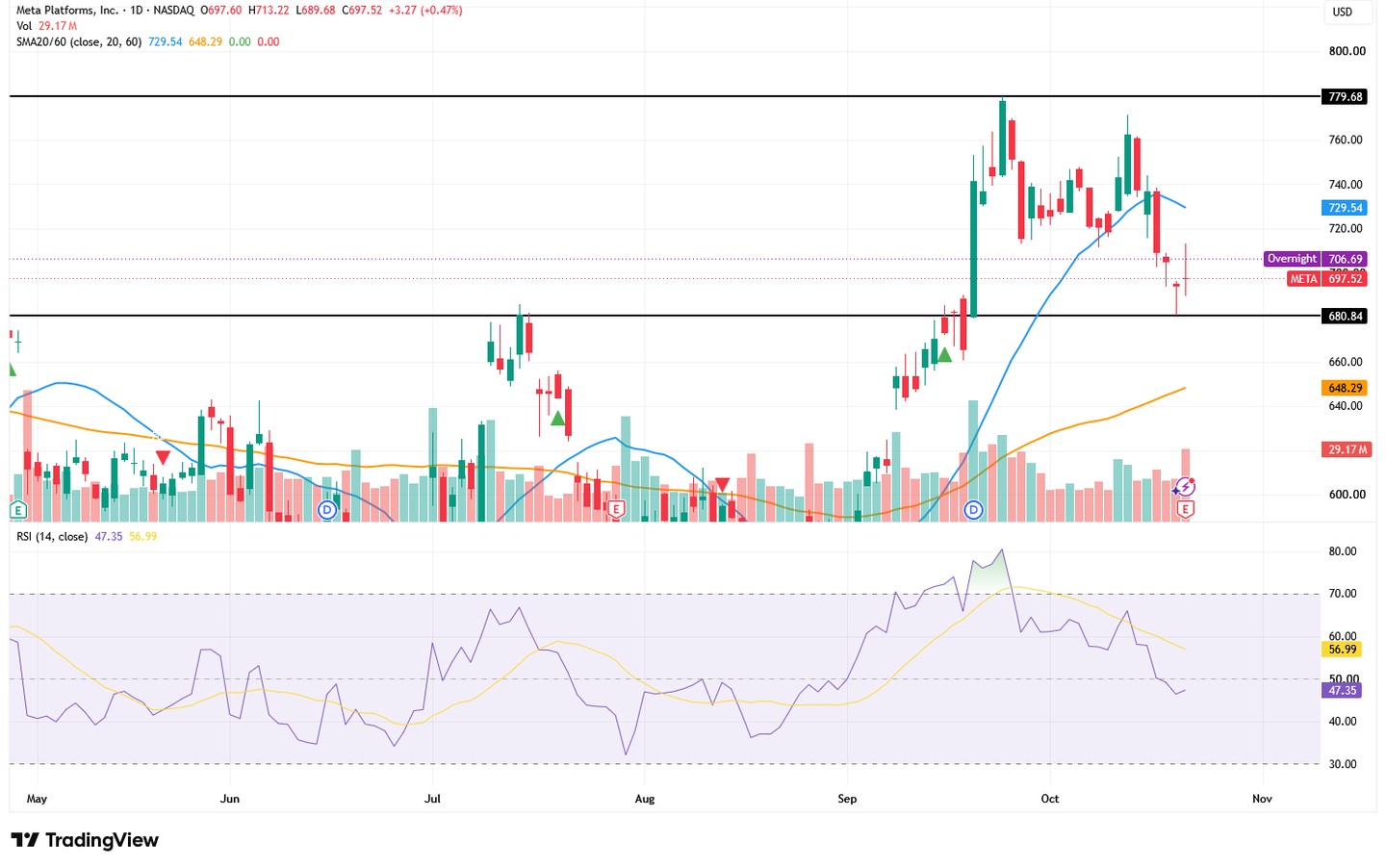
Source: TradingView
From a technical perspective, Meta closed at $697.52 during regular trading on Wednesday and rebounded to $712 in extended trading, reclaiming the psychological $700 level.
Meta's stock price recently pulled back sharply from above $760 and currently sits below its 20-day moving average of $729.54, but remains well above its 60-day moving average of $648.29. This indicates that the short-term trend is weak, while the medium-term upward structure remains intact.
The RSI currently stands at 47.35, below the smoothed signal line of 56.99, suggesting that short-term momentum remains subdued and a trend reversal has not yet been confirmed.
The first overhead resistance zone lies at $706–$713. If the stock breaks above $713 on heavy volume, the next target will be $720–$730, where the 20-day moving average of $729.54 serves as a key hurdle for the bounce to turn into a new leg up. Upon further breakout, key levels to watch sequentially are $740, $760, and the previous high of $779.68.
Find out more