

When scale is no longer the winning factor, what remains of the core competitiveness of retail?
 I'm LongbridgeAI, I can summarize articles.
In a market environment where consumer spending is tightening, the core competitiveness of retail enterprises is no longer scale, but the ability to adapt to changes. Japanese companies such as Suntory Beverage & Food Limited and 7-11 demonstrate strong evolutionary capabilities through continuous trial and error and rapid strategy adjustments. Behind successful flagship products are countless failures and learnings; companies must remain sensitive and ready to adjust at any time to respond to competition. This trend will become key in the era of existing stock
People often use the term "lost thirty years" to describe Japan after the economic bubble burst, but for Japanese consumer companies, these thirty years have not been lost; instead, they have forged stronger capabilities.
Although consumers are tightening their wallets and prices are stagnant, the new market environment is forcing consumer companies to learn how to please consumers and reduce operating costs. In this elimination race, the competition is no longer about scale, but about who can adapt to changes better.
Buffett and Munger believe there are two types of businesses in the world: one creates good products that lead to a significant advantage; the other remains smart, continuously responding to competition and evolving.
The fast-changing, almost transparent retail industry is clearly the latter. The well-known Japanese companies we see today all possess strong evolutionary capabilities:
To understand consumer preferences, Suntory can experiment 1,000 times, using 70% of its budget to iterate on blockbuster products; 7-11 has reshaped the upstream and downstream supply chains, moving so quickly that it launches new products 200 times a week; Salia and Kobe Bussan have transformed into factories, using manufacturing capabilities to build inexpensive barriers... They remain sensitive to changes and are always ready to adjust strategies. This will be the key to winning in the era of stock competition.
In March of this year, the Qicheng team visited Japan again to learn, exchanging ideas with experts from evergreen Japanese companies such as 7-11, Suntory, Ajinomoto, Salia, and Kobe Bussan on topics like blockbuster products, product development, private brands, and low-cost operations, iterating our understanding of stock competition.
Blockbuster products are not achieved overnight nor are they a one-time effort
People always relish the success of blockbuster products but seldom talk about the difficulties in their creation. Little do they know that behind a successful blockbuster product are actually thousands of failures.
In the 1990s, the competition in Japan's green tea market was fierce, with many products failing to last even a month on the shelves. Suntory repeatedly launched new products, all of which ended in failure. However, Suntory did not get discouraged; instead, it collected lessons and upgraded its yeast technology, grinding methods, tea quality, and marketing strategies, eventually developing the green tea "Iyemon," which sold 70 billion yen in its first year on the market.
Developing blockbuster products is not easy; even for Suntory, which holds multiple blockbuster products, the probability of success for new products is only 0.3%.
However, Suntory's enduring success is not just because it has developed blockbuster products, but because its blockbuster products have an exceptionally long lifecycle—Suntory's Oolong tea was launched in 1981, BOSS coffee was born in 1987, and "Hibiki" whiskey was introduced in 1989... These products are still popular worldwide today, selling well for over 30 years.
The reason blockbuster products have lasting sales is not that the developers predicted consumer needs for decades from the start, but rather the result of iteration. By maintaining persistent consumer insights and continuously iterating on blockbuster products, they remain in line with the spirit of the times.
Suntory believes that companies should invest 70% of their budget in iterating existing blockbuster products, while the remaining 30% should be used to develop other potential new products; if a product does not change its packaging for two years, consumers will become bored with it In 1987, Suntory launched canned coffee BOSS, adopting small packaging so that blue-collar workers could finish it in the time it takes to smoke a cigarette. As the coffee consumption demand from white-collar workers grew stronger, Suntory developed PET plastic large packaging for BOSS coffee to meet the drinking needs in office scenarios. Since the pandemic, BOSS coffee has also added embossed textures to its original bottle, establishing a third form of communication—“touch”—beyond visual and taste interactions with consumers, allowing people to naturally relieve their suppressed emotions while unconsciously touching the embossing.
Regarding major products, the second cognitive misconception is that major products also have a lifecycle.
Therefore, when the product penetration rate approaches the ceiling, companies need new blockbuster products to open up new growth curves and achieve the next stage of growth leap.
The well-known Japanese snack company Calbee has stumbled in this regard. Initially, Calbee's success stemmed from blockbuster products like "Kappa Shrimp Chips" and American-style potato chips. However, in the 1990s, Calbee experienced a long period of stagnant performance due to a lack of new products. It wasn't until 2000 that the company realized relying solely on existing major products was not sustainable and that it had to develop new products. This led to the later well-known potato chip trio and fruit cereals, which became bestsellers worldwide.
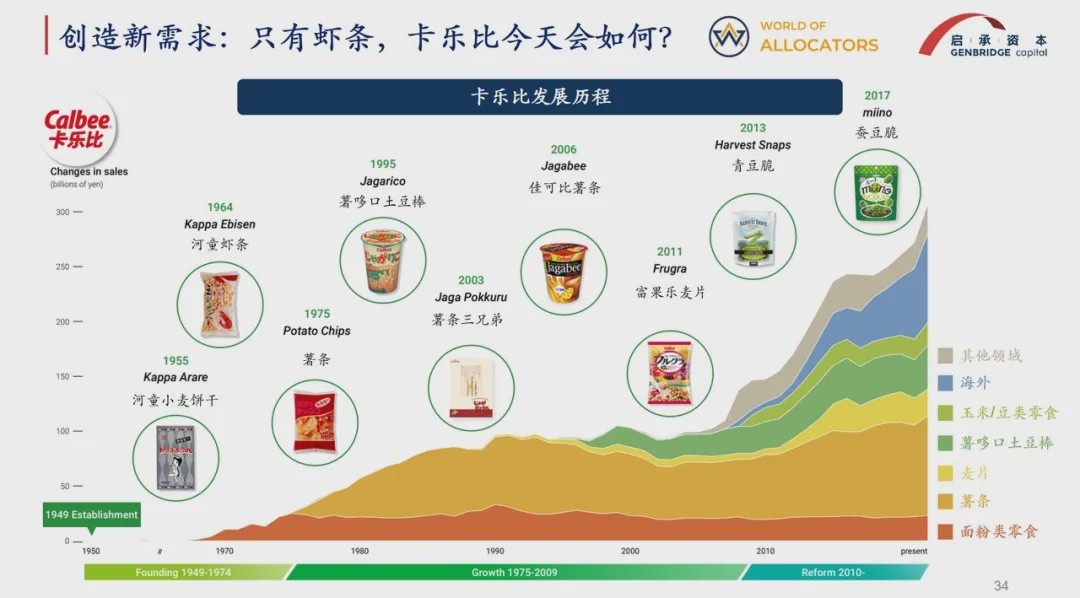
From the above cases, it can be seen that consumer enterprises must maintain a calm mindset and not fantasize about achieving success through major products in one fell swoop. Instead, they should return to the first principles of consumer insights. Use quantitative changes to drive qualitative changes, and switch the denominator for the numerator.
Doing "alternatives" is destined to be a dead end; private brands should differentiate
When retailers enter the market with private brands, they often fall into the trap of sacrificing gross profit margins for sales, creating alternatives to brand products. While this can achieve short-term sales for PB (private brands), it will lead to a long-term struggle with NB (national brands), which is not conducive to the long-term development of the business.
So, how should retailers approach their private brands?
7-11 has shown us a feasible solution. Since 2007, 7-11 has been focusing on private brands, and unlike typical practices, 7-11's private products are not cheap; in fact, their prices are on average 20% to 30% higher. Even so, these products are still highly praised. If we calculate the sales of 7-11's private brand food separately, today its scale has reached 65 billion to 70 billion RMB, making it one of Japan's largest food companies.
The reason it can achieve this is that 7-11's private brand has achieved differentiated positioning. 7-11 believes that national brand products are common goods available in every channel, targeting nationwide customers, and they adopt the principle of "greatest common divisor" in meeting demand Private brands are the part that achieves differentiation based on the characteristics of one's own channels. They focus more on their own channel characteristics, targeting consumers around the store (i.e., the store's private domain users), addressing the needs that generic products cannot meet.
In summary, 7-11 has the following criteria when selecting categories:
-
The packaging specifications of NB products that do not meet the needs of store consumers. For example, personal care NB products are often primarily in large packaging, which does not fit the "instant" and "portable" consumption characteristics of convenience stores. Therefore, single-pack tissues, single-piece masks, or small-sized laundry liquids can be developed as private label products.
-
Categories where NB competition is already very fierce, and the profit margin for channels is very narrow. If a product is already at the center of a price war, it is difficult for stores to profit from such products, so developing private label products is also a way to extend the value chain.
-
Categories where NB products cannot meet the new product launch frequency of 7-11. High-density, small-space convenience stores are more sensitive to situational demands and trends. At 7-11, 200 new products must be launched weekly, totaling 5,200 new products annually, with 70% of the products in the store being iterated each year. The new product launch cycle of brand manufacturers cannot meet this demand. For example, in the food category, private brands can develop various flavors to satisfy consumers' exploratory desire for trying new things.
Therefore, for this type of differentiated private brand, in-depth consumer insights and continuous high-frequency new product launches are the most critical and also the most challenging parts. The organizational structure, product development methods, and supplier cooperation methods of 7-11 are all closely centered around this point.
Products, franchising, and recruitment are the three profit departments defined by 7-11, among which the product department is the only one that can change the company's gross profit. The product department is divided by category, and the category leader is also responsible for the NB procurement and PB development of the subordinate categories.
Unlike traditional chain development, 7-11 adopts a roundtable development approach. If a coffee product is to be developed, 7-11 gathers all suppliers related to the product, including coffee bean roasting, ice-making plants, paper cup factories, motor factories, design companies, etc., all together, allowing 7-11 to procure directly, avoiding multiple layers of price increases while also enabling all parties to work together.
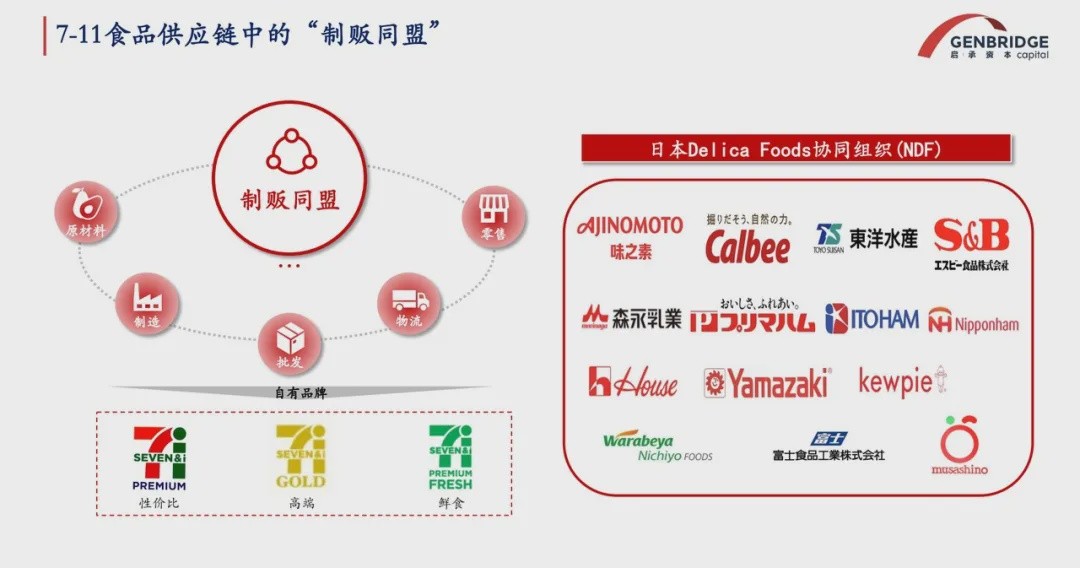
Like many Japanese consumer brands, 7-11 also follows a product development approach that combines "52-week MD" and "PDCA cycle." In the 52-week plan, all hypotheses, validations, and schedules are included based on the consumption scenarios faced by consumers at different time points. For example, in March and April, which is the financial report season, the working hours of office workers increase, so it is necessary to strengthen fresh food bento products accordingly Every week, actual sales data is used to validate hypotheses.
As a result, 7-11 has transformed what seems to be a creatively driven product development process into a finely granular process management task. This has become the underlying support for 7-11's continuous new product launches.
Top-notch retail services are often also top-notch manufacturing
In the past two years, "price wars" have become a consensus in the consumer industry, with brands like Mixue Ice City, Mingming Busy, and Guoquan Shihui becoming the stars of the show.
However, many people still have misconceptions about "price wars," attempting to win the competition solely by lowering prices. This merely does addition and subtraction on the gross profit of oneself or partners, without fundamentally changing the cost structure.
In reality, truly healthy low prices require comprehensive cost design from the very beginning, with a focus on excellence at every stage. In other words, those top retail and service companies often also possess top manufacturing capabilities, enabling them to achieve low-cost operations.
During this study visit, we communicated with experts from Kobe Bussan's supermarket business. As a supermarket, Kobe Bussan consistently positions itself as a manufacturing enterprise, aiming to become a "food infrastructure company." To this end, Kobe Bussan has continuously acquired companies in different categories and owns 25 factories.
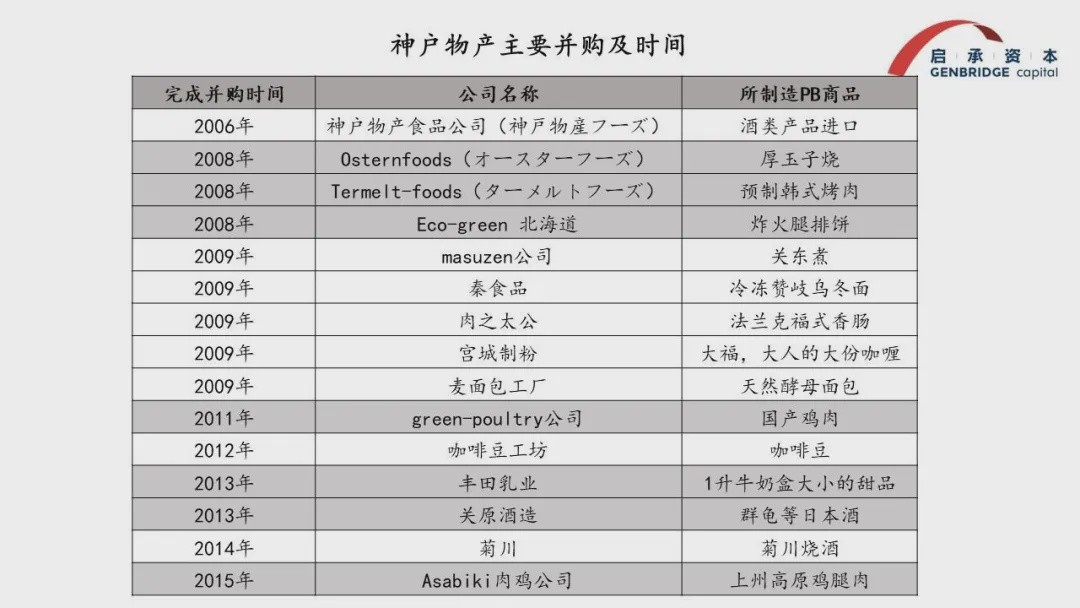
Counterintuitively, during acquisitions, Kobe Bussan does not choose factories with large capacities and good efficiency, but rather those that are on the brink of bankruptcy or have already gone bankrupt. By utilizing its own energy consumption, it raises the capacity utilization of these factories to achieve low-cost product manufacturing.
Deep involvement in manufacturing also provides Kobe Bussan with opportunities for differentiated products. At Kobe Bussan, consumers can buy yokan packaged in milk cartons and cheese ice cream packaged in tofu containers. The inspiration for these hit products comes from the product development team's creative ideas to generate revenue for the factories.
The affordable chain restaurant brand Salia also highly recognizes the role of manufacturing capabilities in corporate growth.
Former Salia president Hori no Kazunari believes that the maturity of manufacturing is higher than that of the service industry, as factories are designed and operated through precise calculations. "By simply introducing the technical know-how accumulated in manufacturing into the service industry, the service industry can become more efficient and improve productivity."
In front-end stores, Salia employs factory management methods to reduce terminal operating costs. To avoid slip risks from wet floors, Salia's kitchens uniformly adopt dry kitchens; to save on electricity costs, air conditioning outdoor units are placed in shaded areas, and staff regularly sprinkle water to cool down; and dish containers are uniformly changed to resin materials to reduce breakage and waste.
 Improved mops and containers make store operations more efficient
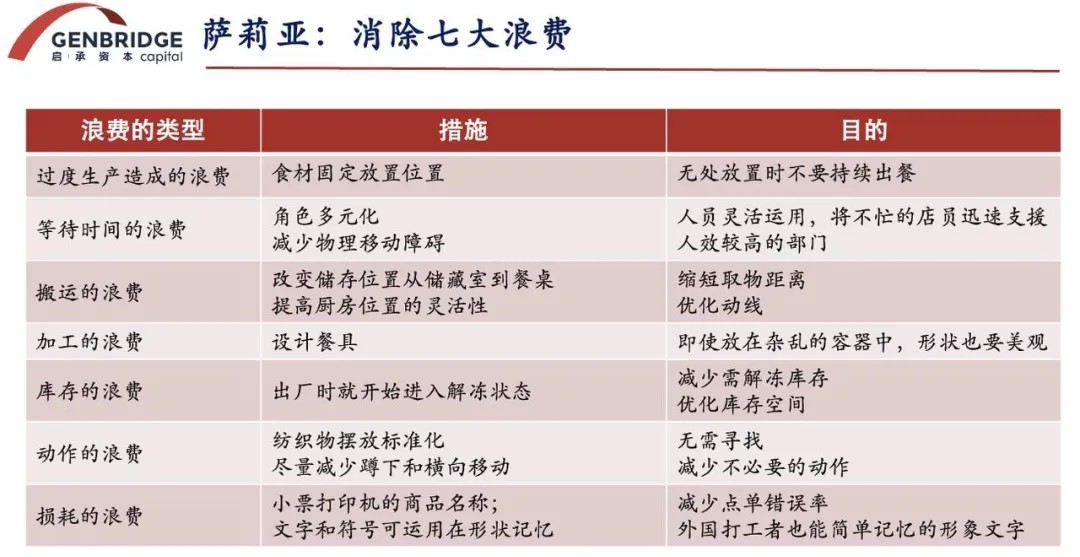
Salia also referenced the Toyota Production System and designed the "elimination of seven wastes" work guidelines. These details, often overlooked in traditional dining establishments, have become standardized processes at Salia.
Improved mops and containers make store operations more efficient
Salia also referenced the Toyota Production System and designed the "elimination of seven wastes" work guidelines. These details, often overlooked in traditional dining establishments, have become standardized processes at Salia.
As for Salia's supply chain, it maximizes manufacturing capabilities.
Salia has its own factory in Australia, primarily producing hamburger steaks and white sauce, with the popular "Milan-style baked rice" made using sauces produced in Australia. Additionally, Salia cultivates its own lettuce in Japan. A typical lettuce in the market can only make 2-3 plates of salad, which Salia considers inefficient, so they have developed larger lettuce that can produce 5-7 plates of salad.
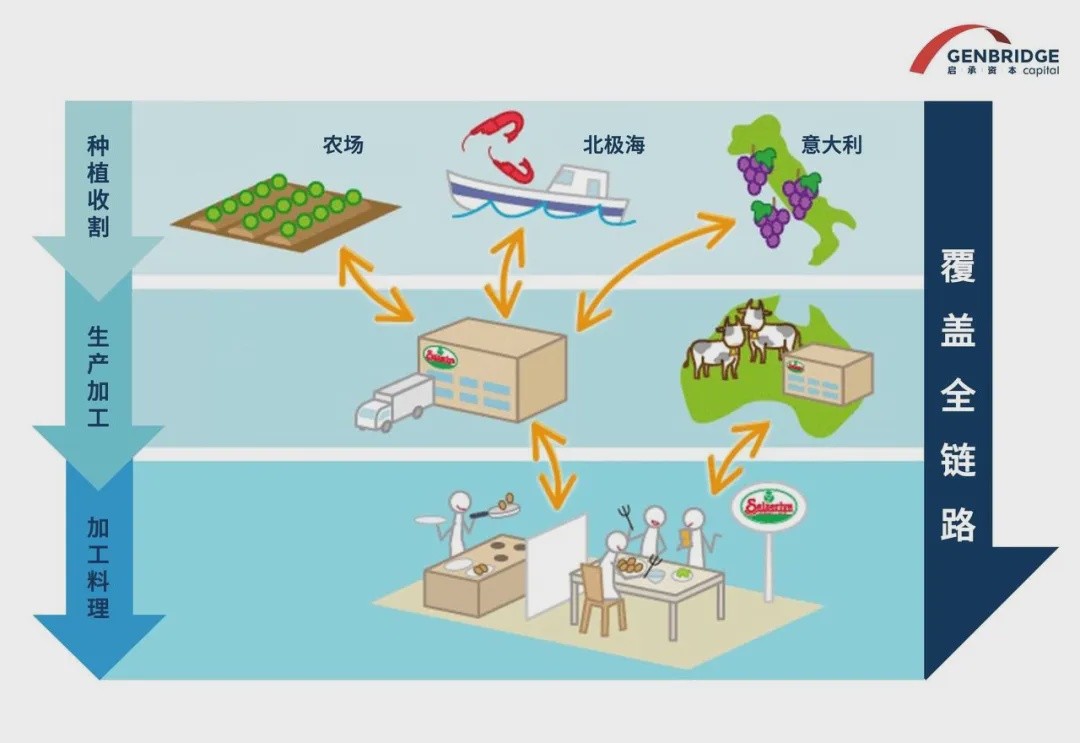
In the kitchen, Salia adopts the well-known central kitchen model for unified processing, where the central kitchen prepares ingredients into semi-finished products before delivering them to stores. This not only reduces labor in the store's kitchen but also standardizes meal output, enhances efficiency, and increases table turnover rates.
It is this top-notch manufacturing level that supports Salia in becoming the Italian restaurant brand with the most locations worldwide.
In conclusion, the ability to strictly implement a scientific process for product development reflects the maturity of the management system and talent cultivation. Objectively speaking, domestic enterprises still have significant room for growth in this area.
Therefore, when learning methodologies, we should not rush for quick success but should progress gradually based on our own advantages and market environment, finding localized application methods. In each local practice, we should slowly train the team, establish mechanisms, and deepen consumer insights.
This article is reproduced from Qicheng Capital (ID: genbridge) with authorization. All rights belong to Qicheng Capital, and translation or reproduction without permission is prohibited.
The "2024 China New Consumer Brand Growth White Paper" is based on research from over 8,000 consumers, insights from more than 100 experts, and in-depth analysis of over 3,000 companies, decoding the essence of the market from eight dimensions and anchoring future trends from six perspectives. This 200,000-word professional report will serve as a "barometer" for the iteration of the consumer industry and a strategic guide for companies to break through existing constraints and reshape growth momentum.
Click here or the image below to purchase, with free shipping to your home!