

SpaceX Starship Enters Orbit for the First Time and Deploys V3 Satellites: What Does It Mean for SPCX Stock Price?
 I'm LongbridgeAI, I can summarize articles.
SpaceX's Starship achieved its first orbital insertion and deployed 26 Starlink V3 satellites, marking a significant technical milestone despite an early engine shutdown. While the stock closed down 2.16% to $145.47, analysts remain bullish on long-term growth driven by Starlink's expanding capacity and subscriber base. Wall Street targets suggest substantial upside, though sustainable valuation increases depend on achieving full reusability and consistent launch reliability.
TradingKey - On September 28, Eastern Time, SpaceX (SPCX) Starship entered Earth orbit for the first time and deployed 26 Starlink V3 satellites into orbit.
During the ascent phase, one engine shut down early, and for safety reasons, the flight team subsequently shortened the originally planned 10-hour mission to about 3 hours. The spacecraft then left orbit, re-entered Earth's atmosphere, and splashed down in the Pacific Ocean north of Hawaii.
On that day, SpaceX closed down 2.16% at $145.47. Starship's first orbital entry and satellite deployment laid the foundation for future routine orbital launches, but failed to reverse the stock's decline alongside the broader U.S. market.
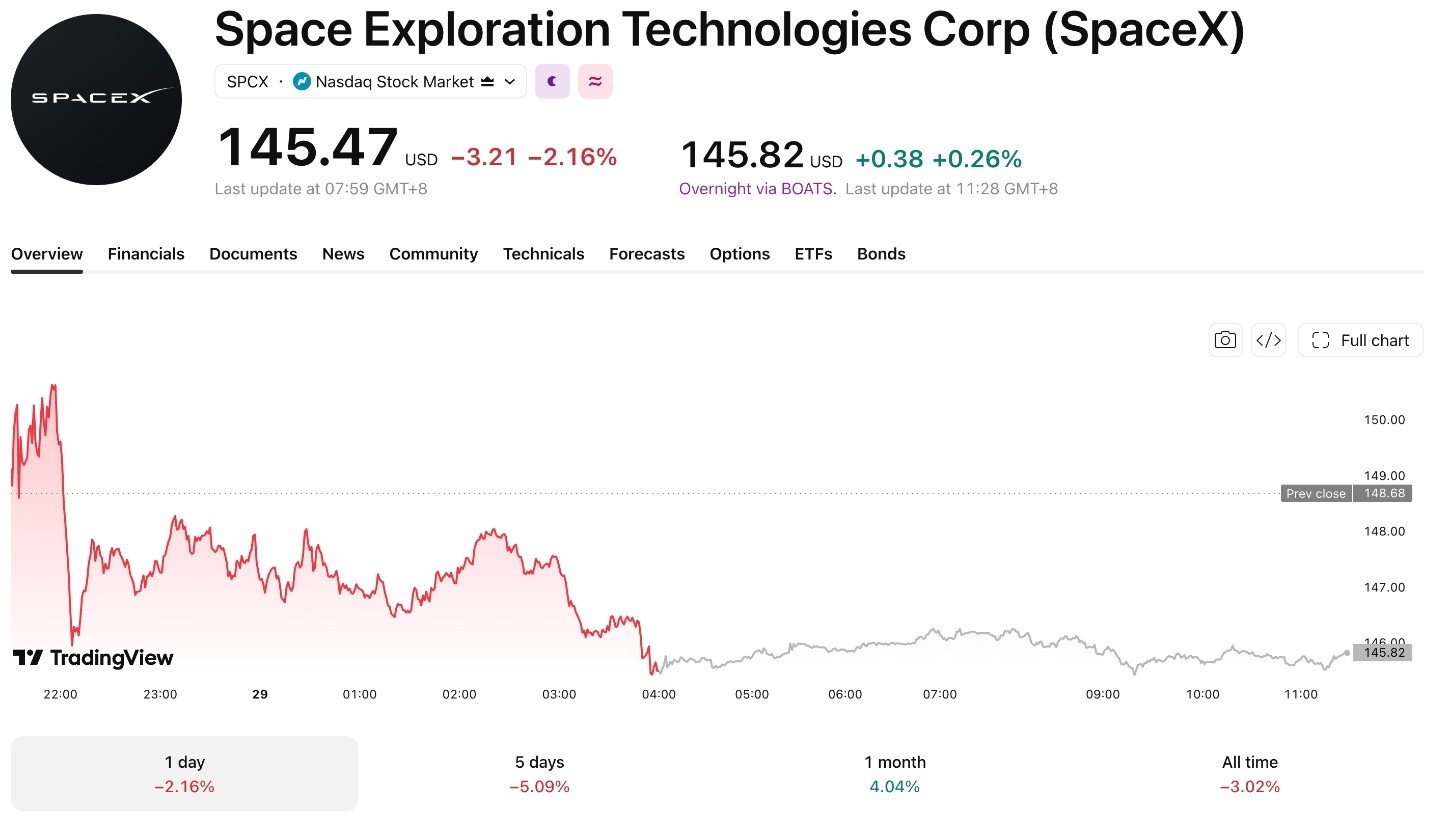
[Source: TradingView]
What Does Starship’s First Entry Into Orbit Mean for SpaceX?
This marks Starship's 14th integrated flight test and its first successful orbital insertion and in-orbit satellite deployment. The 13th test flight deployed 20 Starlink V3 satellites along a suborbital trajectory, whereas the 14th mission sent 26 V3 satellites into Earth orbit for the first time.
SpaceX stated that each V3 satellite can add approximately 1 Tbps of capacity to Starlink. Once the 26 satellites complete testing and enter operation, they can add around 26 Tbps of network capacity to Starlink, expanding user capacity and data transmission capabilities.
Starship remains in the flight testing phase and has yet to achieve full reusability. The 14th flight utilized an expendable mission profile, with no return of the spacecraft and booster to the launch site. Subsequent tests will continue to validate orbital flight, in-space propellant transfer, spacecraft recovery, and high-frequency reuse capabilities.
How Starship Drives Starlink Revenue Growth?
Starship can accelerate the expansion of the Starlink network by scaling up satellite deployment. Each V3 satellite has a designed downlink capacity of approximately 1 Tbps, about 10 times that of the V2 Mini.
SpaceX said that the network capacity added by a single Starship launch of V3 satellites could be more than 20 times that of a Falcon 9 launch of V2 satellites.
The boost in network capacity will enable Starlink to serve more consumer, enterprise, aviation, and maritime customers. If Starship achieves reliable launches and rapid reuse, satellite deployment will accelerate further, and transport costs per unit of network capacity are expected to fall.
As of the end of the second quarter of 2026, Starlink subscribers reached 12 million, doubling year-over-year, while quarterly consumer revenue rose 44% to $2.485 billion. Average monthly revenue per user declined 22.6% year-over-year to $66, with subscriber expansion serving as the primary driver of revenue growth.
According to Bernstein estimates, Starlink's broadband revenue from consumers and small businesses will reach approximately $64 billion by 2031. Starship launch frequency, V3 satellite deployment speed, subscriber growth, pricing levels, and network utilization will influence the realization of this growth target.
Can Starship’s First Orbital Flight Support a Long-Term SPCX Rally?
Starship completed its first orbital entry and in-orbit satellite deployment, reducing some of the technical risks facing Starlink's expansion. If subsequent flights can improve reliability, payload size, and reusability, it will accelerate V3 satellite deployment and support Starlink revenue growth.
Wall Street remains bullish on SpaceX's long-term growth. According to data from TipRanks, 34 analysts have an average 12-month price target of $233.03 for SPCX, which is approximately 60.19% higher than its September 28 closing price.
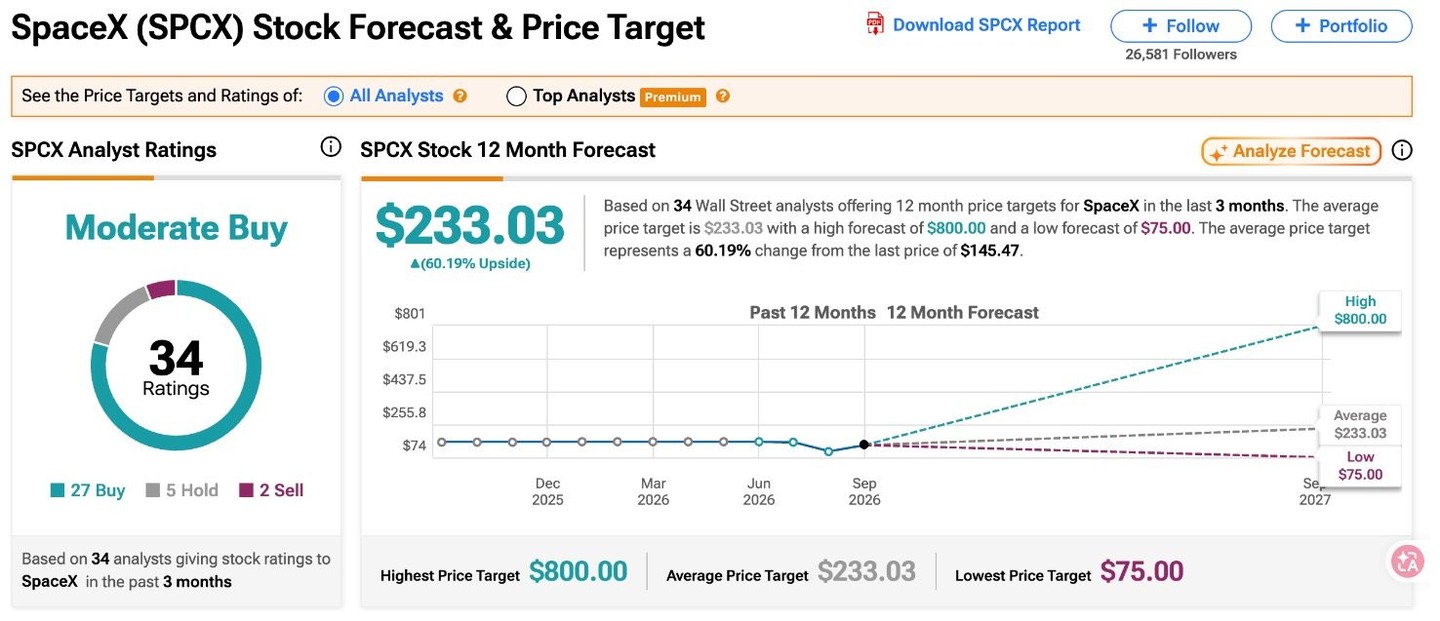
[Source: TipRanks]
Clear Street analyst Brian Dobson reaffirmed a "Buy" rating on SpaceX with a price target of $217, approximately 49% above its September 28 closing price. Dobson noted that Starship's first orbital entry and deployment of V3 satellites will help accelerate Starlink's expansion. Despite the premature engine shutdown, the mission achieved significant progress.
Bernstein analyst Douglas Harned reaffirmed an "Outperform" rating and a $248 price target, representing an upside of approximately 70%. The rationale is Starlink's strong growth prospects, with Starlink broadband subscribers nearly doubling annually over the past four years, a growth rate expected to continue through 2026.
SPCX's future performance will depend on Starlink subscriber growth, the rate of V3 satellite network deployment, Starship launch frequency, reusability progress, and capital expenditures. Engine reliability, spacecraft recovery, and regulatory approvals will also impact project progress.
The first orbital entry has improved SpaceX's long-term growth expectations, but a single mission is insufficient to sustainably push up valuations. Whether Starship can achieve stable launches and reusability will determine the pace at which technical progress translates into revenue and cash flow.
Find out more