

Trump's Diesel Threat Worked: G7 Dumps 100 Million Barrels As Europe's Energy Dependence Laid Bare
 I'm LongbridgeAI, I can summarize articles.
Under pressure from Trump, G7 nations agreed to release 100 million barrels of oil reserves over four months to address rising diesel prices and shortages. The move aims to alleviate immediate energy crises in the EU, which faces high costs due to structural issues like climate policies and dependency on foreign energy. While the IEA will monitor implementation, the article suggests this is a temporary fix for deeper economic and political challenges.
Submitted by Thomas Kolbe
In the end, Donald Trump’s threat to prohibit diesel exports apparently proved credible after all.
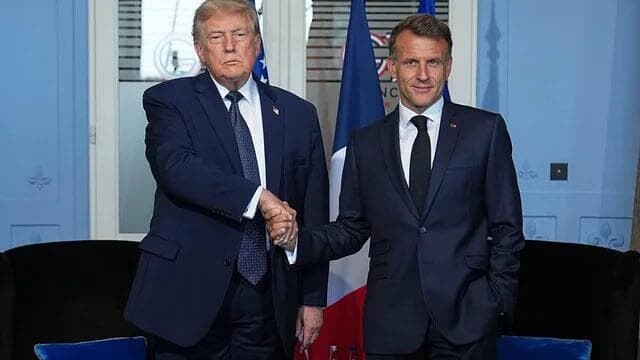
Faced with rapidly rising prices at the pump and an emerging acute shortage of middle distillates, from diesel and heating oil to aviation kerosene, the G7 heads of government decided on Friday, under pressure from the US president, to release their own oil reserves.
For the EU, the perfect storm is brewing: a rising dollar price, the visible control of the Strait of Hormuz by the US military, as well as rising interest rates in the bond markets amid the threat of a sovereign debt crisis, have made the pressure particularly tangible for the EU states: further rising energy prices will hit the fragile eurozone industrial economy considerably harder than the essentially energy-autonomous United States.
The problems of the EU Europeans are homegrown and not the result of American special interests: completely overstretched welfare states, a self-inflicted migration crisis that can no longer simply be wished away, an economy in an atmosphere of departure – though not at home, but fleeing EU regulation, excessive energy costs and the political raid of the Green Deal. They have laid a fuse to the fragile structure of the EU, lit it and are no longer willing to recognize that this powder keg could explode at any moment.
One miscalculation is piling on top of another. In Brussels, Berlin and Paris, they had counted on the Americans shouldering the lion’s share of forcing a regime change in Moscow – cheap access to the country’s energy and resources, possibly bargaining and pricing power, have by now become indispensable to keeping the EU’s economic model alive. Energy costs have to come down, as quickly as possible. From Washington to Brussels, from Moscow to Beijing, they all understand the EU Europeans’ strategic hopelessness. In the case of Russia, instead of a triumph, the result has recently been the destruction of Russian refinery capacity, ironically by partner Ukraine – the next setback in view of the EU’s energy problems.
So now comes the first step toward alleviating the energy price crisis, merely a fight against symptoms that will solve none of the EU’s structural problems.
French President Emmanuel Macron explained the strategy, which essentially consists of three steps:
- First, 100 million barrels will be released from strategic reserves in a coordinated manner over a period of four months. A substantial quantity of diesel is supposed to reach the market within the first 20 days.
- Second, the maintenance schedules of the refineries in the participating states are to be better coordinated. The aim is to prevent several facilities from being shut down at the same time – the throughput is above all intended to help reduce the diesel shortage. Where possible, refineries are to temporarily increase their utilization rates. Obviously, this does not resolve the contradiction of how, in the face of destructive climate policy, new refinery capacity could possibly be conjured up in Europe. These projects take long periods of time and, given CO2 certificates and climate regulation, are simply no longer profitable. In the CO2 frenzy, more than 20 percent of refinery capacity had already been destroyed in recent years. This madness is now coming back to haunt them.
- As a third measure, the G7 states committed themselves not to impose any export restrictions on energy and petroleum products among themselves. This is precisely where the geopolitical background to the release of these reserves becomes apparent: the conflict between Washington and the EU had recently shifted from trade policy issues to the energy market and has now reached a temporary climax with the release of the reserves.
In addition to the measures mentioned above, the International Energy Agency is to monitor their implementation and propose a further package of measures within 20 days.
All in all, the action was an act of desperation that is likely to lose its effect in the markets after a few weeks.
These weeks are exposing the economic-policy sins of a policy that was, on the one hand, driven by the understandable desire to achieve an energy-autonomous situation – Europe still obtains around 60 percent of its energy requirements from abroad. Added to the desire for autonomy were eco-socialist forces that saw their opportunity in the fight against fossil fuels not only to eliminate parts of refinery capacity and fossil energy production, but also to establish their own political center of power with the help of climate policy.
With overregulation, a CO2 extraction economy and a green patronage economy designed to enrich political friends, greater damage is being left behind than anyone is currently willing to admit.
Ultimately, it was trillions spent on the green transformation, on von der Leyen’s Green Deal, that were simply burned and produced no positive effect whatsoever.
A few have made themselves rich, while what remains are industrial wastelands and a slowly rotting continent in unchecked decline.
What awaits the EU Europeans who are still dreaming green is a brutally hard emptiness, delivered straight to their door by reality: The global economy still operates to 87 percent on the rails of fossil fuels and the resurgent power of nuclear energy. Everything else is propaganda.
* * *
About the author:Thomas Kolbe, a German graduate economist, has worked for over 25 years, he has worked as a journalist and media producer for clients from various industries and business associations. As a publicist, he focuses on economic processes and observes geopolitical events from the perspective of the capital markets. His publications follow a philosophy that focuses on the individual and their right to self-determination.