

Google Gains Over 2% After Unveiling World Model Genie 4 Ahead of Earnings, Poised to Expand Revenue Streams
 I'm LongbridgeAI, I can summarize articles.
Google unveiled Genie 4, a next-generation AI world model enabling real-time interactive virtual environments with synchronized audio and visuals. The stock rose over 2% to $323.41 following the announcement ahead of earnings. Genie 4 aims to expand revenue streams by enhancing Google AI Ultra subscriptions and developer tools via the Gemini API. While expected to lower game development prototyping costs, current applications focus on creative exploration rather than full production workflows.
TradingKey - Google (GOOGL) unveiled its next-generation AI world model, Genie 4, on the eve of its earnings report, enabling users to create and modify explorable virtual environments through text prompts, while synchronizing sound and visuals for the first time. As this technology is planned to be opened to paid subscribers and developers, market focus has shifted from what the model can generate to the commercial opportunities it can bring to Google.
On October 27 Eastern Time, Google DeepMind announced that Genie 4 is currently available as a research preview to a select group of invited testers, and access will expand over the coming weeks to Google AI Ultra subscribers as well as select developers using Google AI Studio and the Gemini API.
Following the announcement, Google's stock rose more than 2% to $323.41.
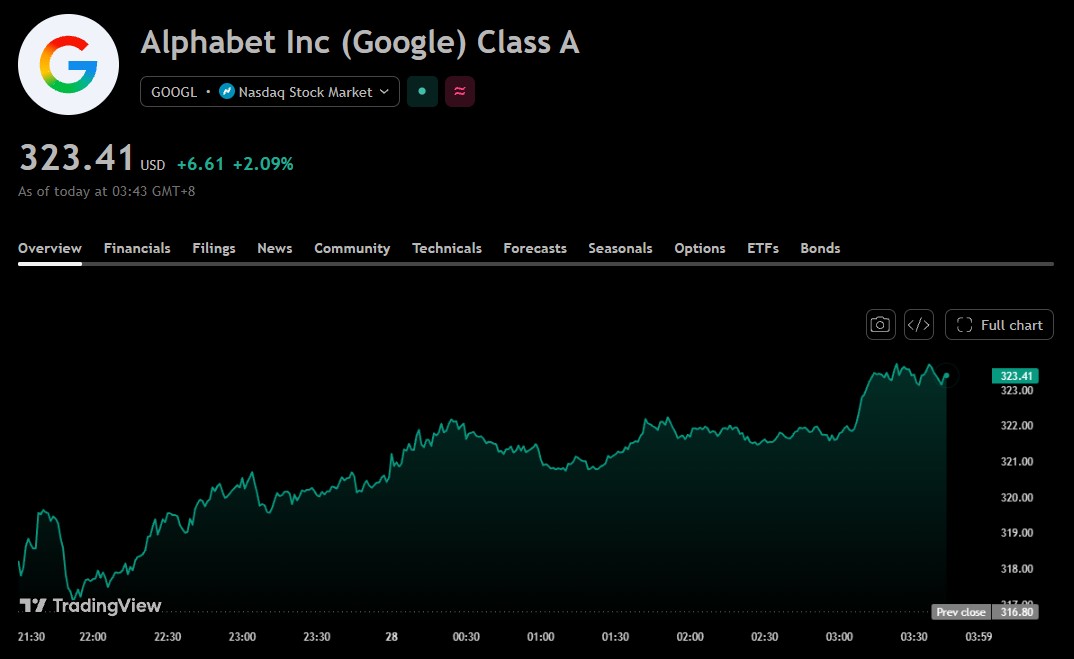
Google stock chart, Source: TradingView
Google Genie 4 Upgrades Real-Time Interaction, Expanding Applications for AI Ultra and Gemini API
Compared to models that primarily generate video clips, Genie 4 allows users to enter virtual scenes, explore environments via keyboard, and input commands during simulation runs to change weather, add characters, or adjust camera angles.
This upgrade extends the maximum simulation time to about two minutes, roughly double that of its predecessor, Genie 3, while adding ambient sound effects, music, and user-responsive dialogue. As a result, users can test different ideas within a continuously running scene without needing to regenerate standalone video clips each time.
This real-time interaction is facilitated by Gemini. Google stated that Gemini observes the generated visuals, understands user goals, breaks down requests into operational steps, and checks execution. The team had tested Gemini 4 Argon, but the real-time experience is actually powered by the lighter Gemini 3.8 Flash.
These capabilities primarily address creative needs. Currently, invited testers are trying to use Genie 4 to transform concepts into explorable prototypes or draft scenes for film and television production. Google is also exploring its potential for robotics training.
For Google, existing subscriptions and developer tools provide commercialization channels for these use cases. Adding Genie 4 to Google AI Ultra is expected to enhance the appeal of high-end subscriptions to creators, while making it available through the Gemini API and Google AI Studio allows developers to bring world models into their own applications, broadening the reach of Google's AI services.
In the face of competition from OpenAI and Anthropic, this also enables Google to leverage its technological strengths in images, audio, video, and real-time interaction to capture demand beyond text-based services.
AI World Model Genie 4 Expected to Cut Game Development Costs
As Google expands its creative tools, it is also reshaping how investors evaluate the gaming industry. In January this year, after the release of the Project Genie prototype powered by Genie 3, gaming-related stocks fell sharply amid market concerns that AI tools would reshape game production workflows.
Genie 4's enhancements to scene control and the addition of audio generation make this discussion more concrete: development teams can quickly build environments, adjust characters, and test ideas through text prompts, which is expected to lower the time and cost required for early-stage prototyping.
The impact varies across different segments of the industry value chain. Game production teams may improve their trial-and-error efficiency, while companies providing scene creation and related development tools face new competition and must adapt their products to AI-assisted workflows.
Currently, Genie 4's clearest applications remain focused on proof-of-concept and scene pre-visualization. Diego Rivas, product manager at Google DeepMind, stated that the company is working with partners to study how the technology can be integrated into existing workflows and determine its capabilities and boundaries.
The model's stability determines which tasks it can handle. Google acknowledged that objects and visual details may shift after running extended simulations, and complex physical interactions, text legibility, and scene consistency still need improvement. This keeps current applications focused more on rapid creative exploration, leaving a gap before it can handle full game production workflows.
Ahead of earnings, Genie 4 demonstrates another pathway for Google to integrate AI technology into its existing business: first using creative features to enhance the appeal of paid subscriptions, and then expanding use cases through development tools. For the gaming industry, the most direct impact is lowering certain prototyping costs and driving competition among development tools around new creative methods.
Find out more