
C
Jul 8 at 06:54 AM
SK Hynix Hits Nasdaq: The Difference Between an ADR and the Real Stock
 I'm LongbridgeAI, I can summarize articles.
Just in the past couple of days, SK Hynix is heading for the Nasdaq under the ticker $SK Hynix(SKHY.US). Per its public filing, the listing is set for July 10, raising close to $29.4 billion — and once that number lands, it surpasses the roughly $21.8 billion Alibaba set in New York in 2014, making it the largest ADR issuance on record.
But there's one point worth spelling out — the $SK Hynix(SKHY.US) you buy in your US brokerage account and the Hynix a Korean retail investor holds on the Seoul exchange (ticker 000660) are not the same share. Same company, two markets, two prices, even two fates.
This is where ADRs are easiest to mix up.
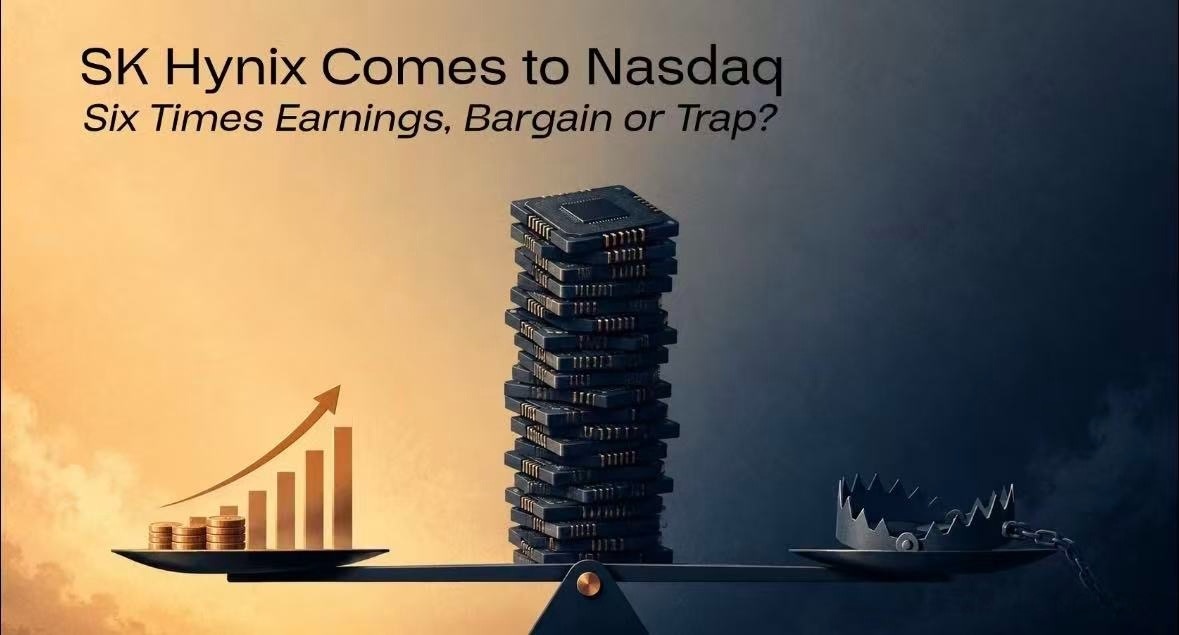
A "Depot Receipt"
First, what an ADR is. The full name is American Depositary Receipt. The name sounds intimidating; plainly put, it's just a receipt.
How does it come about? Roughly three steps. First, a US depositary bank goes to Korea, buys up the actual Hynix shares, and locks them into a custody account there. Second, this bank issues corresponding receipts in the US at a fixed ratio. Third, the receipts list on the Nasdaq, trade in US dollars, and when you and I click "buy" in a US brokerage account, that's what we get.
Here's an analogy. You store a case of wine in a liquor store's warehouse, and the store gives you a depot receipt. That slip can change hands freely at the storefront — whoever holds it has a claim on that case of wine. The ADR is that depot receipt; the underlying stock is the case of wine in the warehouse. What you trade, from start to finish, is the slip; the wine has been sitting in Seoul the whole time, untouched.
Why Bother With the Extra Step?
So here's the question: Hynix is already listed in Korea, so why can't Americans just go buy the Korean shares directly — why the whole detour?
For a US investor, buying Korean shares directly is more of a hassle than you'd think. You have to enable trading access for the Korean market, convert to won, stay up for Seoul's trading hours, and take on local settlement rules and tax filing. Stack up all that friction, and the vast majority of people just give up. What an ADR does is "translate" a foreign stock into a standard US stock: priced in dollars, on US trading hours, orderable through a US broker.
What Hynix Is After Isn't Just Money
This time Hynix isn't taking old shares to list — it's issuing 17.79 million new shares, making it a capital-raising ADR — letting US investors buy in while genuinely raising money to plow into the Yongin fab, Cheongju advanced packaging, and EUV lithography equipment.
But the fundraising is just the surface-level account. One layer deeper is valuation.
It holds nearly 60% of the HBM market (per public data as of early 2026) and is a supplier Nvidia can't get around, yet its share price on the Korean listing has long been cheaper than its US peer Micron — by media estimates, Micron has averaged about 30% more expensive over the past decade or so. Why? A big reason is that it carries the identity of a "Korean stock," so the pool of people who can buy it gets filtered down by the Korean market's barriers.
The ADR reshapes it from an "Asian stock" into a "US stock." Some argue that once it's in US markets, it qualifies to be included in indices like the Nasdaq 100, passive money tracking those indices has to allocate to it pro rata, and the buyer pool expands overnight from "people who can handle the Korean market" to global dollar capital. Interestingly, the prices of the ADR and the Korean underlying are linked, so if valuation really does get lifted, what gets lifted is all of Hynix — the Korean underlying benefits too. The goal was never for the ADR to be pricier than the underlying, but to enlarge the pool.
Same chips, same profits, listed somewhere else, and the valuation can be different. That, perhaps, is what Hynix really wants.
So How Does It Actually Differ From the Underlying?
Same company, but the difference between the ADR and the underlying hides in a few details that are easy to overlook.
First, the prices aren't equal. 1 ADR doesn't necessarily equal 1 underlying share; the depositary bank sets a ratio — 1 receipt might be worth half a share, or several shares. So you can't directly compare $SK Hynix(SKHY.US)'s dollar price against that won price in Seoul to see which is bigger; you have to convert first by ratio and exchange rate.
Second, the hidden door of FX. An ADR's value inherently wraps in a layer of exchange rate — in theory it's roughly "underlying price × depositary ratio × KRW/USD exchange rate." What does that mean? Even if Hynix in Seoul rises, as long as the won depreciates hard enough against the dollar, the $SK Hynix(SKHY.US) in your hands can fall instead of rise. That FX account is something underlying-stock investors don't have to worry about, but ADR investors must calculate.
Third, the spread and arbitrage. The two markets' trading hours aren't in sync — Seoul has already closed while New York has just opened — so a premium or discount briefly pops up between the ADR and the underlying. That's when arbitrageurs step in — through the ADR's "creation" and "cancellation" mechanisms, they pull the two prices back in line. So over the long run the two track closely, but that little intraday gap is always there.
There's also the matter of dividends. When Hynix pays a dividend, the money first has to pass through the depositary bank to be converted into dollars before it reaches you; the bank takes a custody fee, and Korea also withholds a tax up front at the foreign-investor rate — so the same dividend, landing in an ADR holder's pocket, is often a bit thinner than for the underlying holder.
And the last one — the one you never think about, but that's fatal when something actually goes wrong: cancellation risk. Because an ADR program is set up by the company and the depositary bank, in theory it can be terminated. When that day comes, the receipts in your hands are either forcibly converted into Korean underlying shares or settled in cash — and the choice isn't necessarily yours.
So back to the question at the very start: is the $SK Hynix(SKHY.US) you buy on the Nasdaq actually Hynix?
Yes, and not entirely. What you get is a depot receipt for Hynix — 80% of its ups and downs follow that case of "wine" in Seoul, but in between sit FX, a time difference, and layer after layer of depositary bank fees.
Once you see through this layer, you understand why one company can have two prices. Fundamentally, an ADR was never the underlying stock itself; it's just a path to the underlying. That path is convenient, but it isn't entirely free.








The copyright of this article belongs to the original author/organization.
The views expressed herein are solely those of the author and do not reflect the stance of the platform. The content is intended for investment reference purposes only and shall not be considered as investment advice. Please contact us if you have any questions or suggestions regarding the content services provided by the platform.