

Goldman Sachs: Innolight & Optical Modules
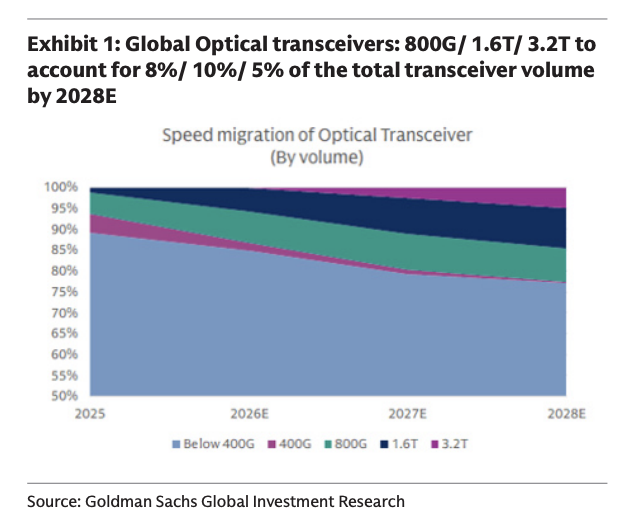
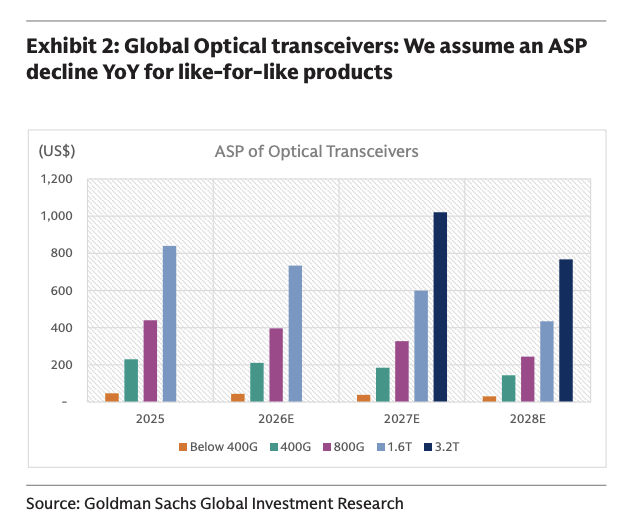
Market Trends and Technology Migration> Speed Evolution: The industry is aggressively migrating toward higher-speed optical modules. 1.6T modules are moving toward volume production as the next mainstream standard, while 3.2T optical modules are expected to begin volume ramp-up in 2027.> Silicon Photonics (SiPh) Dominance: Silicon photonics is increasingly displacing traditional EML-based solutions due to lower power consumption, superior performance, and simplified packaging.> Penetration Rates: By 2026, SiPh penetration is projected to reach 60% for 800G, 80% for 1.6T, and 100% for 3.2T products.> Revenue Share: Silicon photonics' share of total optical module revenue is expected to surge from 28% in 2025 to 62% by 2028.Innolight Shipment and Market Share Highlights> Leadership: Innolight is the leading supplier of 1.6T pluggable modules. It is projected to hold a 50–60% market share of 1.6T modules in 2026. Other industry reports indicate Innolight's market share for 1.6T modules may reach as high as 50–70%.1.6T and 3.2T Outlook:> 1.6T: Expected to become the "absolute mainstream" by 2027, with 45.72 million units projected to be shipped that year.> 3.2T: Following the ramp-up of 1.6T, 3.2T shipments are expected to double in 2028 compared to their initial volume ramp year in 2027.> Manufacturing & Capacity: To support this demand, Innolight planned a 155% year-on-year increase in capital expenditure for 2026 to expand production capacity.Market Dynamics: Volume, Revenue, and ASP> Speed Migration (Volume Mix): The market is shifting rapidly from legacy "Below 400G" speeds toward high-speed AI-focused modules. While "Below 400G" accounted for 89% of shipment volume in 2025, that share is projected to decline to 77% by 2028E. Conversely, high-speed modules are capturing significant volume: 1.6T modules are projected to grow from 1% of volume in 2025 to 10% by 2028E, and 3.2T modules are expected to reach 5% of total shipment volume by 2028E.> Average Selling Price (ASP) Trends: The report explicitly notes an assumed year-over-year (YoY) ASP decline for "like-for-like" products. For example, the ASP for 1.6T modules is expected to drop from $840 in 2025 to $435 by 2028E. The 3.2T module, which enters the market in 2027, has a high starting ASP of $1,023 in 2027E, which is then projected to decline to $768 by 2028E.Technological Shift: SiPh vs. EML> Silicon Photonics (SiPh) Adoption: The market is undergoing a significant transition from traditional EML-based materials to Silicon Photonics.SiPh revenue penetration is expected to increase from 28% in 2025 to 62% by 2028E.Correspondingly, the SiPh penetration rate (by volume) is projected to climb from 6% in 2025 to 18% by 2028E.Market Opportunity (TAM)> Total Addressable Market (TAM): The global optical module TAM is expected to grow from $34.2 billion in 2025 to a peak of $72.6 billion in 2027E, before moderating slightly to $69.1 billion in 2028E.> High-Speed Revenue Growth: The 1.6T and 3.2T segments represent the primary growth engines, with combined revenue for these categories projected to grow from $3.9 billion in 2025 to $44.9 billion in 2028E.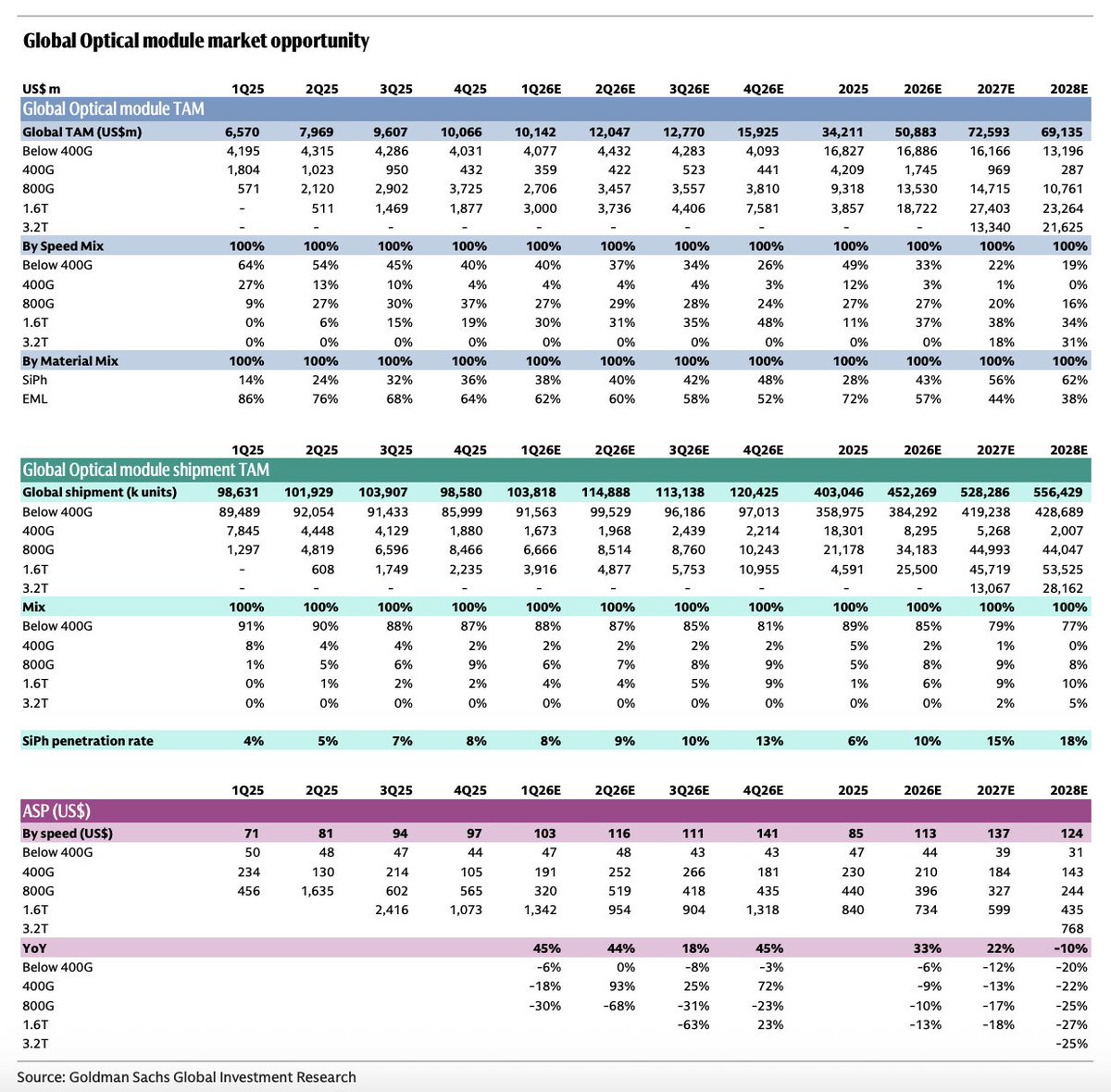
The copyright of this article belongs to the original author/organization.
The views expressed herein are solely those of the author and do not reflect the stance of the platform. The content is intended for investment reference purposes only and shall not be considered as investment advice. Please contact us if you have any questions or suggestions regarding the content services provided by the platform.
Post your comment

No Comments