
O

1 day ago, 01:43 AM
Beginner guide to catalyse for OCBC price changes due to issued bonds
 I'm LongbridgeAI, I can summarize articles.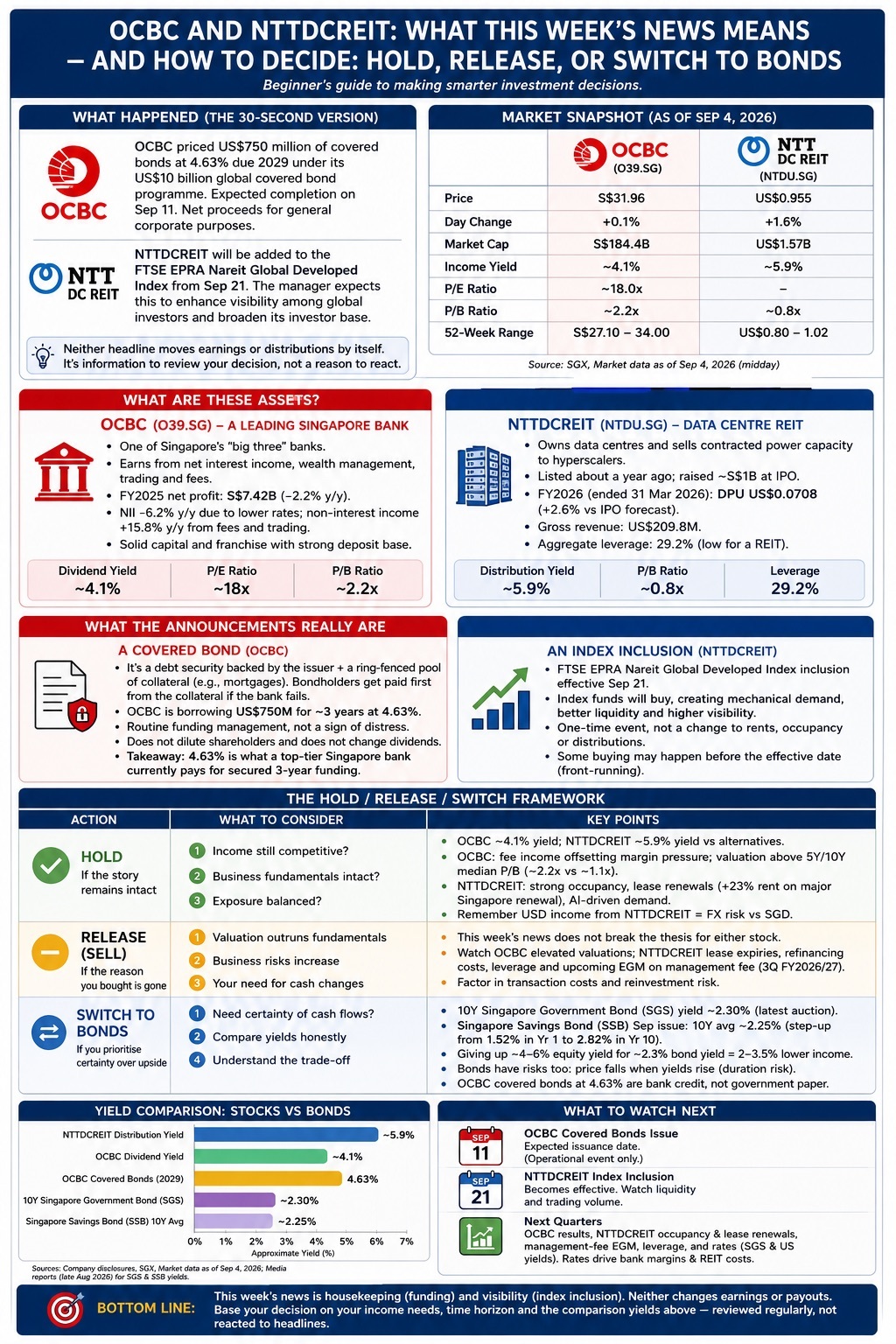
Both tickers resolved — OCBC (O39.SG) and NTT DC REIT (NTDU.SG, USD-quoted on SGX). Now pulling quotes, financials, and news on bothData so far is solid. Now verifying the two announcements' details and pulling OCBC's earnings trend plus Singapore bond yield context for the stocks-vs-bonds section.
The macro tool doesn't cover SGS bond yields, so I'll do two quick verification searches — one for the REIT's index-inclusion announcement, one for current Singapore bond yield context — then write the article.
Data verification complete — the covered-bond pricing and the index-inclusion date both check out. Here is the ~1,500-word guide.
The following is an informational analysis and does not constitute investment advice or a buy/sell recommendation. It is a framework to help you make (and review) your own decisions.
Beginner's guide: OCBC and NTTDCREIT — what this week's news means, and how to think about holding, selling, or switching to bonds
What happened (the 30-second version)
On Friday (Sep 4), two pieces of news crossed the wires. OCBC priced US$750 million of covered bonds at 4.63 per cent due 2029, under its US$10 billion global covered bond programme; the issue is expected to be completed on Sep 11, with net proceeds used for general corporate purposes. Separately, NTTDCREIT will be added to the FTSE EPRA Nareit Global Developed Index from Sep 21, a move its manager expects to "enhance our visibility among global institutional investors and broaden our investor base."
Neither headline is the kind that moves a share price by itself — OCBC closed Thursday at S$31.92 (+0.2 per cent) and NTTDCREIT units were flat at US$0.94 — yet both raise the question behind your note: do these change whether we hold, release, or switch into bonds? [citation 7][citation 12]
Part 1 — What these two assets actually are
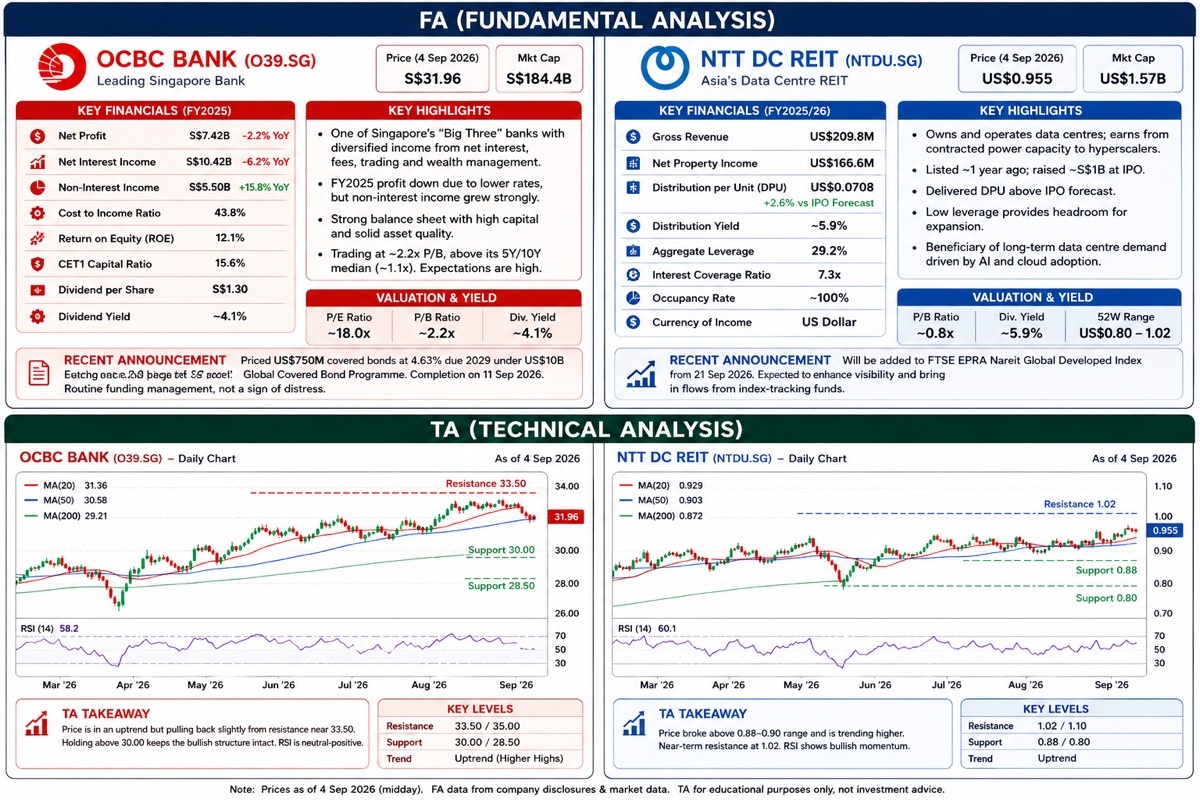
OCBC is a bank, not a bond issuer. It is one of Singapore's "big three" banks, earning money from net interest income (lending minus funding costs), wealth management and trading. For the 2025 financial year it booked net profit of S$7.42 billion, down 2.2 per cent year on year, as net interest income fell 6.2 per cent with lower rates — partly offset by a 15.8 per cent jump in non-interest income from fees and trading. It currently trades at a dividend yield of roughly 4.1 per cent, a price-to-earnings ratio of about 18 times, and a price-to-book ratio of around 2.2 times. [citation 8][citation 9]
NTT DC REIT is a property trust that owns data centres. Singapore-listed but quoted in US dollars, it earns rental and power-capacity income by selling contracted capacity — the CFO described it as selling "contracted power capacity rather than space" — largely to hyperscalers. It listed about a year ago, raising nearly S$1 billion. For its fiscal year ended 31 March 2026 it delivered a distribution per unit of US$0.0708, beating its IPO forecast by 2.6 per cent, with gross revenue of US$209.8 million and an aggregate leverage of 29.2 per cent — low for a REIT, leaving headroom. Its market-quoted distribution yield is roughly 5.9 per cent.
Part 2 — What the two announcements really are
A covered bond, explained. A covered bond is a debt security backed by two things: the issuer's credit and a ring-fenced pool of collateral (for a bank, usually mortgages). If the bank failed, bondholders first get repaid out of the collateral pool — that "double recourse" is why covered bonds are safer than ordinary unsecured bank debt, and why they cost the issuer less. OCBC is borrowing US$750 million for roughly three years at 4.63 per cent. [citation 1] For a beginner, the key points are: this is routine funding management, not a sign of distress; it does not dilute shareholders (it is debt, not equity); and it does not change the dividend — a bank borrows in bond markets all the time. It is also small relative to the group: roughly one-seventh of one year's net profit. The useful takeaway is the rate itself — 4.63 per cent is what a top-tier Singapore bank currently pays for secured three-year funding.
An index inclusion, explained. The FTSE EPRA Nareit Global Developed Index is a benchmark that global real-estate and REIT funds track. When a stock is added, index-tracking funds must buy it, typically around the effective date — here Sep 21. That means fresh, largely mechanical demand, better liquidity, and more visibility among institutional investors (the CEO's own stated rationale). [citation 5][citation 6] But be precise about what it is not: it is a one-time demand event, not a change to rents, occupancy or distributions. In practice, some buyers front-run the inclusion, so the buying may already be partly "priced in" by the time it takes effect.
Part 3 — The hold / release / switch framework
Here is the most important beginner principle: corporate news is information, not instructions. Neither announcement changes what these businesses earn or pay out. So the hold-or-sell decision should rest on your situation and the business itself — the news merely prompts the review.
| OCBC (O39.SG) | NTTDCREIT (NTDU.SG) | |
|---|---|---|
| Latest price (Sep 4, midday) | S$31.96 (+0.1%) | US$0.955 (+1.6%) |
| Income yield | ~4.1% (dividends) | ~5.9% (distributions) |
| Valuation | P/E ~18x; P/B ~2.2x | P/B ~0.8x (below book value) |
| Latest results | FY25 net profit S$7.42B, -2.2% y/y | FY25/26 DPU US$0.0708, +2.6% vs IPO forecast |
| Income currency | Singapore dollars | US dollars |
| This week's event | US$750M covered bonds @ 4.63%, due 2029 | Index inclusion effective Sep 21 |
Data: market data as of Sep 4, 2026; results per company disclosures.
If you're deciding whether to hold. Ask three questions. First, is the income still competitive? The yields above (4.1 per cent and 5.9 per cent) are the number to compare against alternatives. Second, is the business story intact? For OCBC, that means earnings resilience — growth is now coming from non-interest income rather than lending margins, and its valuation sits at roughly double its 5- and 10-year median price-to-book (about 1.1 times), so expectations are already high. For the REIT, it means occupancy, lease renewals (management recently pointed to a 23 per cent rent increase on a major Singapore lease renewal) and the AI-driven demand cycle it rides on. Third, is your exposure balanced? Bank plus data-centre REIT is still a "rates and real estate" portfolio; and remember NTT DC REIT income is in US dollars, so you carry currency risk against the Singapore dollar — a factor that cuts both ways.
If you're deciding whether to release (sell). Sell when the reason you bought is gone — not when the share price wobbles. On the evidence, neither of this week's events breaks either thesis: the covered bond is routine funding; the index inclusion is additive, not transformative. Instead, the genuine reasons to review a position are: valuation that has outrun fundamentals (this matters more for OCBC, given its elevated multiples), a REIT facing lease expiries or rising interest costs at refinancing (watch NTT DC REIT's upcoming vote on its management-fee structure, targeted for the third quarter of its fiscal 2026/27 year, plus its leverage as it grows), or a change in your own need for the money. [citation 11] Also price the decision properly: selling incurs transaction costs and the reinvestment risk of getting back in later — a "hold" by default is not laziness, it is often the rational baseline.
If you're considering switching stocks to bonds. This is a genuine trade-off, so lay it out honestly. What bonds give you: contractual cash flows, and — for government bonds — near-certain return of principal, which equities never offer. Current reference points (media-reported, late August 2026): the 10-year Singapore government bond (SGS) yielded about 2.30 per cent at its latest auction, and the September Singapore Savings Bond offers a 10-year average return of about 2.25 per cent, starting at 1.52 per cent in year one and stepping up to 2.82 per cent by year 10. [citation 13][citation 14] What you give up: dividend/distribution growth, capital upside, and some protection against inflation. Note the spread: giving up a ~4–6 per cent equity yield for a ~2.3 per cent government bond yield means accepting a roughly 2 to 3.5 percentage-point income gap — that gap is the market's compensation for bearing equity risk. If income certainty for a known spending horizon matters more to you than upside, bonds objectively deliver that, at the cost of lower total return potential. Two cautions: bonds are not risk-free — prices fall when yields rise (duration risk), and even OCBC's covered bonds at 4.63 per cent are bank credit, not government paper, so they sit between the two extremes. [citation 1]
Part 4 — What to watch next
- Sep 11 — OCBC's covered bonds expected to be issued (pricing detail, no signal on its own).
- Sep 21 — NTTDCREIT's index inclusion takes effect; watch unit liquidity and any step-up in trading volume around then. [citation 5]
- Next quarters — OCBC results (does fee income keep offsetting margin pressure?), NTT DC REIT occupancy and lease renewals, the management-fee EGM, and the direction of SGS and US yields, since rates drive both a bank's margins and a REIT's cost of debt. [citation 10][citation 11]
Bottom line
Neither announcement changes what these businesses earn or pay out — they are housekeeping (funding) and visibility (index membership) respectively. Your hold, release or switch-to-bonds decision should therefore be driven by your income needs, time horizon and the comparison yields above, reviewed on a schedule — not by any single headline.
Data note: prices, valuations and financial figures are from structured market data as of Sep 4, 2026. Announcement details are from news reports of company disclosures. SGS and SSB yields are media-reported figures from late August 2026 and may differ from live market levels.
- Direct Bitcoin exposure: IBIT is designed to track the price of Bitcoin without you needing to manage a crypto wallet or private keys.
- Easy to trade: It trades like a normal U.S. stock/ETF during market hours.
- Strong liquidity: IBIT has become one of the major spot-Bitcoin ETFs, making it easier to enter and exit than buying Bitcoin through some crypto platforms.
- Institutional access: Its ETF structure makes Bitcoin easier for traditional investors, advisers and institutions to hold in brokerage accounts.
- Long-term Bitcoin thesis: If Bitcoin continues gaining adoption as a scarce digital asset, IBIT provides a straightforward way to participate in that potential upside.
- No leverage: Unlike leveraged Bitcoin products, ordinary IBIT gives you roughly 1-for-1 exposure to Bitcoin’s price movements.
The important catch
IBIT is not a defensive investment. Bitcoin can fall 20–40% or more during major corrections. So I would think of it as a high-volatility satellite position, rather than replacing stable dividend stocks or bonds.
$iShares Bitcoin Trust ETF(IBIT.US) $Dell Tech(DELL.US)




The copyright of this article belongs to the original author/organization.
The views expressed herein are solely those of the author and do not reflect the stance of the platform. The content is intended for investment reference purposes only and shall not be considered as investment advice. Please contact us if you have any questions or suggestions regarding the content services provided by the platform.