
B
Sep 22 at 02:37 PM
Blinkfan takes grab and earns from grab
 I'm LongbridgeAI, I can summarize articles.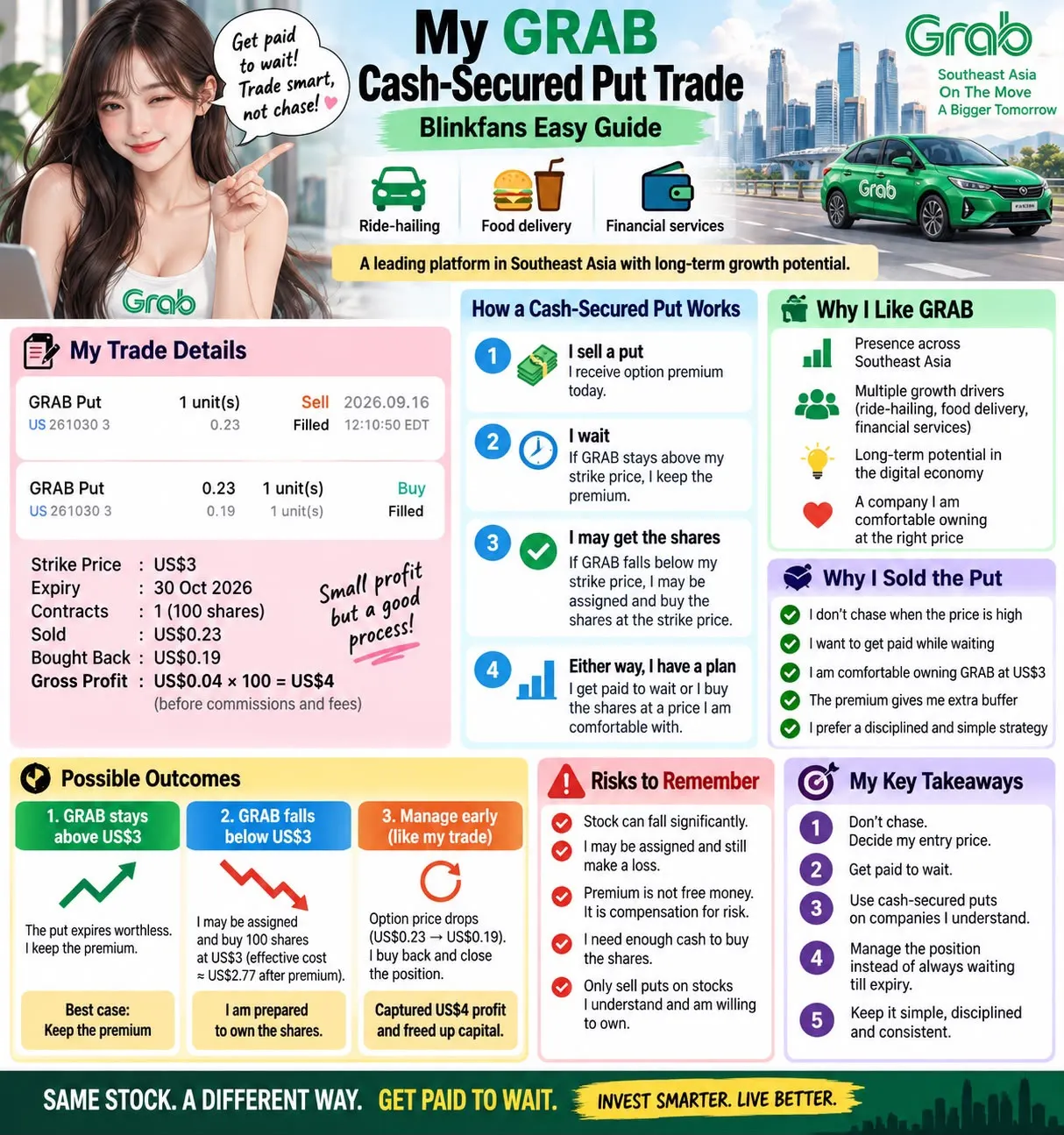
.
🚕💰 My GRAB Cash-Secured Put Trade — The Blinkfans Easy Guide
💵 Why I Sold a GRAB Put
I like using cash-secured puts when I find a stock that I don’t mind owning at a lower price.
This time, I looked at GRAB.
Instead of buying GRAB shares immediately, I decided to sell a put option. My idea was simple:
If GRAB stays above my strike price, I keep the option premium.
If GRAB falls below my strike price and I get assigned, I am prepared to buy the shares at the strike price.
This is the basic idea behind a cash-secured put. 🚕📈
In my trade, I sold 1 GRAB Put with a US$3 strike price, expiring 30 October 2026.
I received a premium of US$0.23 when I sold the put.
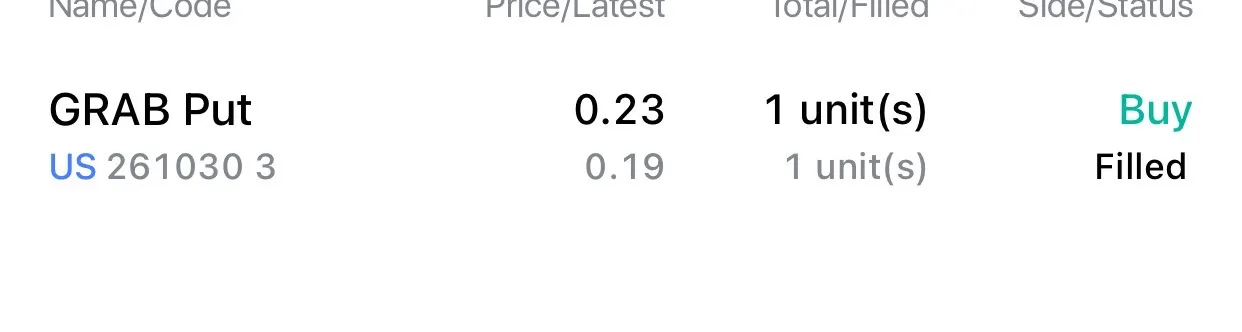

Later, the option price dropped to US$0.19, so I bought it back and closed the position.
That means I captured approximately:
US$0.23 − US$0.19 = US$0.04
Because one option contract represents 100 shares:
US$0.04 × 100 = US$4
So my gross option profit was approximately US$4 before commissions and fees. 💰
It is a small trade, but I am not looking at just one trade.
I am looking at the process.
📚 What Is a Cash-Secured Put?
For beginners, a cash-secured put sounds complicated, but the idea is actually quite simple.
Suppose GRAB is trading above US$3.
I sell a US$3 put.
The buyer of the option has the right to sell me 100 GRAB shares at US$3 if the option is exercised.
In return for taking on this obligation, I receive a premium.
So I am essentially saying:
“I am willing to buy GRAB at US$3, and I want to get paid while I wait.”
That is very different from simply buying the stock at the current market price.
If I buy the shares immediately, I have to pay the market price.
If I sell the put, I receive premium first.
However, there is an important condition.
I must be prepared to buy the shares if GRAB falls below the strike price and I am assigned.
That is why I call it cash-secured.
I need enough cash available to cover the potential purchase.
🚕 Why GRAB?
For me, GRAB is interesting because it is a company that many people in Southeast Asia already know.
GRAB operates across areas such as ride-hailing, food delivery and financial services.
That gives the company exposure to several parts of the Southeast Asian digital economy.
But I don’t want to buy a stock simply because I know the company.
I still have to think about valuation, price, business performance and risk.
This is where the cash-secured put strategy becomes useful for my trading style.
Instead of saying:
“GRAB is going up, so I must buy now.”
I can say:
“Would I be comfortable owning GRAB at US$3?”
If the answer is yes, then selling a put at US$3 can make more sense to me.
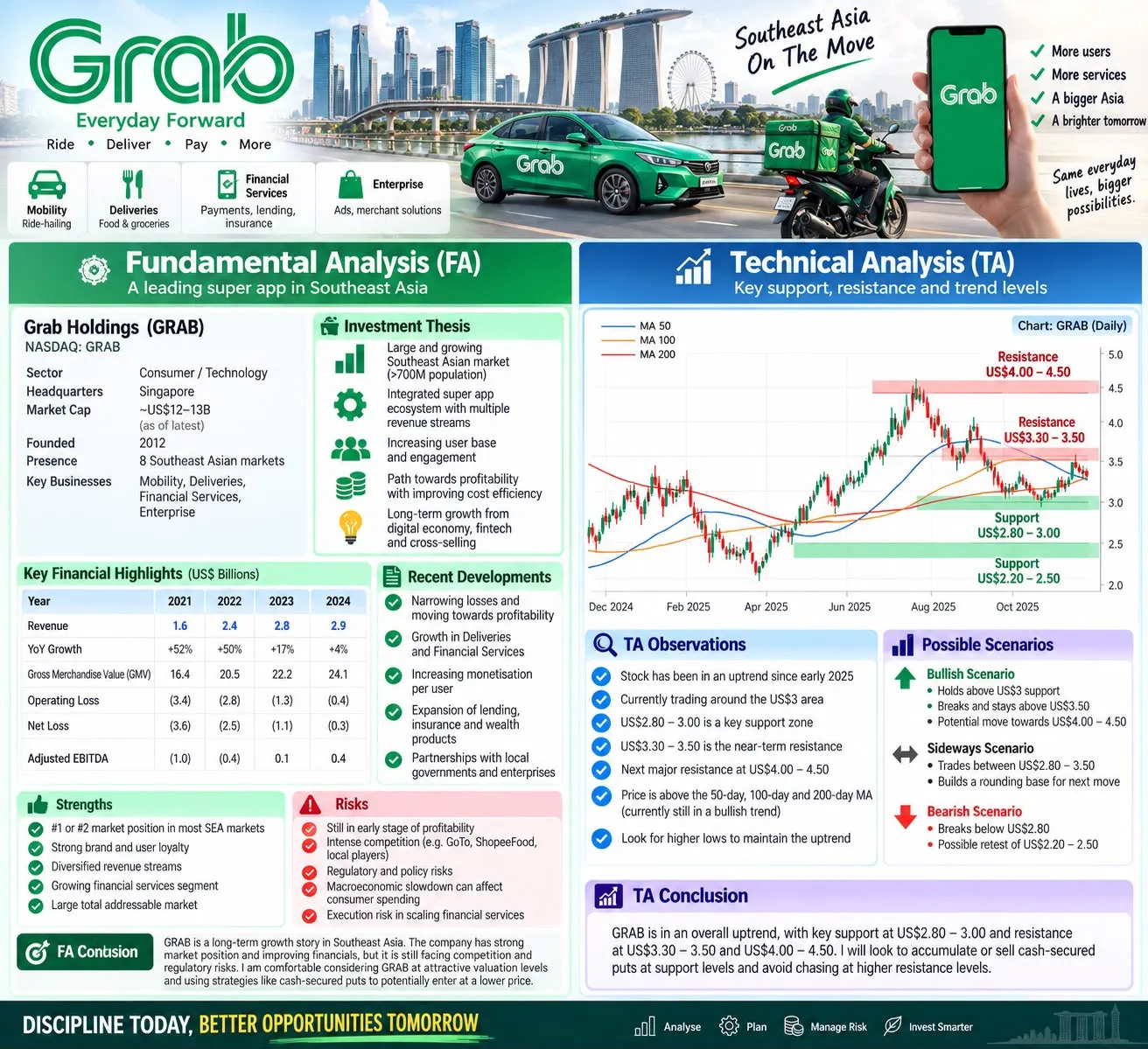
📉 My US$3 Strike Price
The most important part of my trade is the US$3 strike price.
The strike price is the price at which I may have to buy the shares if I am assigned.
For example, if I sell a US$3 put and GRAB falls significantly below US$3, I could potentially be assigned 100 shares.
My purchase obligation would be:
100 shares × US$3 = US$300
That means I should have enough cash available.
This is why beginners should not look at the US$0.23 premium and think:
“Easy money!”
There is always risk.
If GRAB falls sharply, I could end up owning 100 shares at US$3 when the market price is much lower.
The premium provides some protection, but it does not eliminate the downside risk.
💰 Why I Like Getting Paid to Wait
This is the main reason I like cash-secured puts.
If I already want to own a stock at a particular price, I don’t necessarily need to rush.
I can wait.
And while I wait, I can potentially collect premium.
In my GRAB example, I received US$0.23 per share, or approximately US$23 gross premium for one contract.
If the option expires worthless, I would keep the premium.
If the option price falls before expiry, I can also consider buying it back early.
That is exactly what I did here.
I sold at:
US$0.23
Then bought back at:
US$0.19
The difference was:
US$0.04 × 100 = US$4
Small profit, but a completed trade.
🔄 Why Did I Buy Back the Put?
Some beginners think that once they sell an option, they must wait until expiry.
That isn’t true.
I can close the position before expiry by buying back the same option.
In my case, the premium moved from US$0.23 down to US$0.19.
I decided to close the position.
Why?
Because I had already captured part of the available premium.
Rather than waiting several more weeks to potentially collect the remaining amount, I preferred to take the small gain and free up my capital.
This is an important part of my strategy.
I don’t always need to squeeze every last cent out of an option.
Sometimes taking a smaller profit and moving on gives me more flexibility.
🧠 My Simple Rule: Don’t Chase
The biggest reason I like selling puts is that it changes how I think about buying stocks.
Instead of chasing a stock because it is moving higher, I can decide on my desired entry price first.
For example:
GRAB market price → I wait
GRAB reaches my preferred level → I consider buying
GRAB stays above my strike → I collect premium
GRAB falls below my strike → I may get the shares
This gives me two possible outcomes.
Either I receive premium, or I potentially acquire shares at a price I had already decided I was comfortable with.
Of course, the second outcome can still result in a loss if the stock continues falling.
That is why I only want to use this strategy on stocks I genuinely understand and am prepared to own.
📊 The Risk Beginners Must Understand
Cash-secured puts are not free money.
This is extremely important.
The maximum profit from my original trade was limited to the premium received.
But the downside can be much larger if the stock crashes.
For example, suppose I sell a US$3 put and receive US$0.23.
My effective purchase price, ignoring fees, would be approximately:
US$3.00 − US$0.23 = US$2.77
So if I am assigned, my effective cost would initially be around US$2.77 per share.
But if GRAB subsequently falls to US$2, I would still have a loss.
That is why I must never sell puts simply because the premium looks attractive.
I need to ask myself:
“If the stock crashes, am I really willing to own it?”
If the answer is no, I should not sell the put.
💡 Why I Prefer a Simple Strategy
Trading can become unnecessarily complicated.
There are hundreds of indicators, strategies and complicated option combinations.
But I prefer to keep my process simple.
For a cash-secured put, I mainly think about four things:
1️⃣ Do I understand the company?
2️⃣ Would I be comfortable owning the shares?
3️⃣ Is my strike price low enough for my risk tolerance?
4️⃣ Do I have enough cash to take assignment?
If these four things make sense, then I can consider selling the put.
This approach helps me avoid selling options simply because the premium looks attractive.
🚦 What Happens If GRAB Falls?
This is where the strategy becomes important.
Imagine I sell a US$3 put and GRAB suddenly falls to US$2.50.
The option will probably become more valuable because the strike price is now above the stock price.
My position could show a loss.
I have several choices.
I could:
Hold the option and potentially accept assignment.
Buy back the option and take the loss.
Manage the position by rolling the option, depending on the situation.
There is no automatic correct answer.
The important thing is that I already understand the possible outcome before entering the trade.
📈 What Happens If GRAB Stays Above US$3?
This is the outcome many cash-secured put sellers are looking for.
If GRAB stays above the US$3 strike at expiry, the put can expire worthless.
The buyer has no reason to sell shares to me at US$3 if the market price is higher.
I keep the premium.
That is the simple version of the strategy.
So my goal isn’t necessarily for GRAB to explode higher.
I don’t need a huge rally.
I simply need the stock to stay above my chosen strike for the desired outcome.
💵 Premium Is the Income — But Risk Comes First
One mistake beginners can make is focusing only on the premium.
They see an option paying US$20, US$30 or US$50 and think:
“Why not collect this every week?”
The problem is that the premium exists because there is risk.
The market is compensating me for taking on an obligation.
If I repeatedly sell puts without considering the underlying stock, one large decline can wipe out many small premiums.
That’s why I see option premium as payment for taking risk, not free money.
🧮 My GRAB Trade in Simple Numbers
Here is my trade in a simple format:
Stock: GRAB 🚕Option: PutStrike: US$3Expiry: 30 October 2026Contracts: 1Sold: US$0.23Bought back: US$0.19
Gross premium received:
US$23
Cost to buy back:
US$19
Approximate gross profit:
US$4
Fees and commissions are not included.
The important thing is that I closed the position with a profit instead of waiting until expiry.
🎯 My Main Lesson From This Trade
The biggest lesson isn’t the US$4.
The lesson is discipline.
I don’t need to make a huge amount from every single trade.
I want to build a process where I:
Find a stock I understand → choose a price I am comfortable owning → sell a cash-secured put → collect premium → manage the position → repeat when another opportunity appears.
That is much more important to me than trying to predict exactly where GRAB will trade tomorrow.
🚕 Final Thoughts
My GRAB trade is a simple example of how I use cash-secured puts.
I wasn’t trying to predict that GRAB would suddenly shoot higher.
I was looking at the stock from a different angle.
Instead of asking:
“Should I buy GRAB right now?”
I asked:
“At what price would I be comfortable owning GRAB?”
That difference completely changes the way I approach the trade.
I sold the US$3 put for US$0.23, then bought it back at US$0.19, capturing approximately US$4 gross profit on one contract.
The amount is small.
But the strategy is what matters.
For me, cash-secured puts are about getting paid while waiting for a better entry price, while always remembering that assignment and losses are possible.
The key is simple:
Don’t sell a put just because the premium looks attractive.
Sell it only when I am genuinely prepared to own the shares at the strike price.
That is how I keep my option trading simple, disciplined and easy to understand. 🚕💰
$Grab(GRAB.US) $GRAB 261030 3 Put(GRAB261030P3000.US)


The copyright of this article belongs to the original author/organization.
The views expressed herein are solely those of the author and do not reflect the stance of the platform. The content is intended for investment reference purposes only and shall not be considered as investment advice. Please contact us if you have any questions or suggestions regarding the content services provided by the platform.