
B
Sep 23 at 12:16 AM
🚕💰 Grab Fundamental Analysis: How Loans Could Become a Bigger Growth Engine
 I'm LongbridgeAI, I can summarize articles.
🚕💰 Grab Fundamental Analysis: How Loans Could Become a Bigger Growth Engine
🌏 Grab Is Becoming More Than a Ride-Hailing Company

When I first think about Grab, I usually think about rides, food delivery and the green Grab car.
But when I look at Grab from a fundamental analysis (FA) perspective, there is another part of the business that I find increasingly interesting:
Financial Services.
Grab has been expanding beyond mobility and deliveries into payments, digital banking, insurance and lending.
This matters because lending can potentially become a much larger source of revenue as Grab uses the data and customer relationships from its existing ecosystem.
Grab currently operates across more than 900 cities in eight Southeast Asian countries and offers mobility, deliveries and digital financial services. Its financial-services ecosystem includes GXS Bank in Singapore, GXBank in Malaysia and Superbank in Indonesia. (Grab Holdings Investor Relations)
For me, the interesting FA question is therefore not simply:
“How many rides does Grab have?”
It is:
“Can Grab turn its huge ecosystem of users, drivers and merchants into a profitable financial-services business?”
📈 Q2 2026: The Numbers Are Getting Interesting
Grab’s latest reported quarter was Q2 2026, ended June 30.
The numbers showed strong growth across the company.
Revenue reached:
US$997 million
That was up 22% year over year.
On-Demand GMV reached approximately:
US$6.5 billion
up 21% year over year.
Grab also reached approximately:
53.9 million Monthly Transacting Users
up 17% year over year. (Q4 Investor Relations)
But the number that really caught my attention was the loan portfolio.
💰 The Loan Portfolio Jumped 197%
Grab reported a gross loan portfolio of US$2.318 billion in Q2 2026.
A year earlier, it was approximately:
US$781 million
That represents approximately:
197% year-over-year growth.
(
)
That is a very significant change.
And this is where I see the potential financial-services story.
Grab isn’t simply providing a ride or delivering food.
It is increasingly becoming part of the financial lives of its users, drivers and merchants.
The company said total loans disbursed during Q2 reached approximately:
US$1.2 billion
which was up 72% year over year. (Q4 Investor Relations)
This gives me another way to think about Grab.
Grab’s ecosystem → users → transactions → financial data → lending opportunities.
🏦 Why Can Grab Lend Money?
A traditional lender may need to rely heavily on a customer’s financial history when assessing credit.
Grab has a different type of data.
Imagine a driver who uses Grab regularly.
Grab may have information related to:
- driving activity
- earnings
- transaction history
- platform engagement
- repayment behaviour
- business activity
Similarly, a merchant using GrabFood or other Grab services creates transaction data.
This can potentially help Grab assess the financial activity of users and businesses inside its ecosystem.
That doesn’t mean every borrower will be a good credit risk.
Credit losses remain a major risk.
But the ecosystem can potentially give Grab more information for underwriting.
🔄 The Grab Financial Services Flywheel
This is the part I find particularly interesting.
Imagine the ecosystem as a flywheel.
👤 More users
⬇️
🚕 More transactions
⬇️
📊 More data and engagement
⬇️
💳 More financial products
⬇️
💰 More lending opportunities
⬇️
📈 More Financial Services revenue
⬇️
👤 More reasons for users to stay inside the Grab ecosystem
This is why I don’t look at Grab simply as a ride-hailing company.
It is increasingly trying to become a broader digital ecosystem.
📊 Financial Services Revenue Is Growing
Grab’s Financial Services segment generated approximately:
US$134 million revenue in Q2 2026
compared with:
US$84 million in Q2 2025
That’s approximately 59% year-over-year growth. (Q4 Investor Relations)
The company said the increase was primarily driven by increased lending contributions across GrabFin and its digital banks, including the consolidation of Superbank in Indonesia. (Q4 Investor Relations)
However, there is an important detail.
Financial Services Segment Adjusted EBITDA was still:
−US$15 million
in Q2 2026.
That was an improvement from −US$26 million a year earlier. (Q4 Investor Relations)
So the story is not:
“Grab’s lending business is already hugely profitable.”
The more accurate description is:
“The lending business is growing quickly while the segment is moving toward better profitability.”
That distinction is important.
🏦 Superbank Adds Another Layer
Grab also consolidated Superbank into its Financial Services segment in June 2026.
Superbank had more than 6 million customers and reported its first full-year profit for FY2025. Grab said Superbank delivered 72% asset growth and 84% net interest income growth year over year in April 2026. (Grab Holdings Investor Relations)
By the end of Q2 2026, total customer deposits across:
GXS Bank Singapore
GXBank Malaysia
Superbank Indonesia
had reached approximately:
US$2.5 billion.
(
)
This matters because banking creates another part of the financial ecosystem.
Grab isn’t only thinking about lending.
It is building:
Deposits + lending + payments + insurance + investing
into a larger financial-services platform.
🚀 The Atome Financial Deal
Then came another major development.
On 15 September 2026, Grab announced an agreement to acquire a controlling 60% stake in Atome Financial for US$1.49 billion.
This is important because Atome Financial has a significant consumer-lending business across:
🇸🇬 Singapore🇲🇾 Malaysia🇵🇭 Philippines🇮🇩 Indonesia🇹🇭 Thailand
Its businesses include BNPL, consumer cash loans, BNPL cards and digital lending. (Grab Holdings Investor Relations)
Grab said Atome Financial has approximately:
US$1 billion gross loan portfolio
and 25 million cumulative transacted users.
The proposed combination would therefore significantly expand Grab’s exposure to consumer lending. (Grab Holdings Investor Relations)
💰 Grab’s 2028 Loan Ambition
This is perhaps the biggest number I would watch.
Grab says that, including Atome Financial, it expects its Financial Services segment to reach:
More than US$6 billion gross loan portfolio by 2028
and:
US$500 million Financial Services Adjusted EBITDA
by 2028. (Grab Holdings Investor Relations)
Compare that with the current Q2 2026 gross loan portfolio of approximately:
US$2.3 billion
and we can see the scale of the ambition.
However, these are management targets, not guaranteed results.
The Atome transaction is also subject to regulatory approvals and other closing conditions, with completion currently expected by Q3 2027. (Grab Holdings Investor Relations)
🧠 Why Loans Could Be Important to Grab
For me, the fundamental attraction of lending is the possibility of creating a more recurring financial relationship with customers.
A ride is a transaction.
A food delivery is a transaction.
But a loan can create an ongoing financial relationship.
If Grab can successfully lend to drivers, merchants and consumers while maintaining disciplined credit quality, the financial-services business could become a larger contributor to revenue and profitability.
That could potentially make Grab’s business model more diversified.
Instead of relying mainly on:
Mobility + Deliveries
it could increasingly become:
Mobility + Deliveries + Financial Services.
⚠️ But Lending Also Creates Risk
This is where I need to be careful.
A bigger loan portfolio isn’t automatically better.
A loan is an asset only if the borrower repays it.
If borrowers stop paying, Grab can suffer:
Credit losses → provisions → lower profitability.
This is particularly important because Grab’s Q2 results already showed higher net impairment losses on financial assets, mainly driven by Digibank expected credit losses. (Q4 Investor Relations)
So when I analyse Grab’s loan growth, I don’t just look at:
“Loan portfolio +197%!”
I also want to ask:
“How good is the credit quality?”
That is the much more important question.
📉 Growth vs Credit Quality
Imagine two lending companies.
Company A grows its loan portfolio by 100%, but many borrowers stop paying.
Company B grows its loan portfolio by 50%, while maintaining strong repayment performance.
The bigger loan growth number doesn’t automatically mean Company A has the better business.
This is why I would monitor:
1️⃣ Loan growth
How quickly is the loan book expanding?
2️⃣ Delinquencies
Are borrowers falling behind on payments?
3️⃣ Credit losses
How much money is Grab losing from bad loans?
4️⃣ Provisioning
Is Grab setting aside enough money for potential losses?
5️⃣ Financial Services profitability
Is revenue growth eventually translating into positive EBITDA?
These numbers will tell me much more than loan growth alone.
💵 Grab Has a Large Cash Cushion
Another important part of the FA is the balance sheet.
As of 30 June 2026, Grab reported:
Gross cash liquidity: US$7.4 billion
Net cash liquidity: US$5.4 billion
The company defines net cash liquidity as gross cash liquidity less loans and borrowings. (Q4 Investor Relations)
That gives Grab substantial financial resources to invest in its ecosystem.
It also helps explain how Grab can fund strategic transactions.
For example, the proposed Atome Financial acquisition is being funded entirely from existing cash, according to Grab. (Grab Holdings Investor Relations)
📈 Grab Is Also Buying Back Shares
Grab announced in September 2026 that it intends to execute the remaining approximately:
US$900 million
under its approved share repurchase programs over the next 12 months.
If fully executed, cumulative repurchases since the first program in 2024 would reach approximately:
US$1.75 billion.
(
Grab Holdings Investor Relations
)
This is interesting from an FA perspective because management is simultaneously:
investing in growth
and
returning capital to shareholders.
The company said its gross cash liquidity was US$7.4 billion and net cash liquidity US$5.4 billion at June 30, 2026. (Grab Holdings Investor Relations)
📊 My Fundamental Checklist for Grab
When I analyse Grab, I would therefore watch these numbers:
FA Area | What I Watch |
👥 Users | Monthly Transacting Users |
🚕 Mobility | GMV and profitability |
🍔 Deliveries | GMV, revenue and margins |
💳 Lending | Gross loan portfolio |
🏦 Banking | Deposits and net interest income |
⚠️ Credit | Delinquencies and impairment losses |
💰 Profitability | Adjusted EBITDA |
💵 Cash | Gross and net cash liquidity |
🔄 Capital allocation | Share repurchases |
🚀 Expansion | Atome + Superbank + other financial services |
This gives me a much better picture than simply looking at the share price.
🎯 My FA Takeaway
For me, the most interesting part of the Grab story is the transition from a superapp into a broader financial ecosystem.
The latest numbers show:
Revenue: US$997M in Q2 2026Revenue growth: +22% YoYMonthly Transacting Users: 53.9MGross Loan Portfolio: US$2.318BLoan portfolio growth: +197% YoYFinancial Services revenue: US$134MFinancial Services revenue growth: +59% YoYFinancial Services EBITDA: −US$15MGross cash liquidity: US$7.4BNet cash liquidity: US$5.4B (Q4 Investor Relations)
Then we have the proposed Atome Financial acquisition, which could push Grab’s lending business to a targeted US$6B+ gross loan portfolio by 2028. (Grab Holdings Investor Relations)
So my main FA question isn’t simply:
“Will Grab’s stock price go up?”
Instead, I want to watch whether:
Loan growth → revenue growth → better credit quality → Financial Services profitability → stronger overall Grab cash generation.
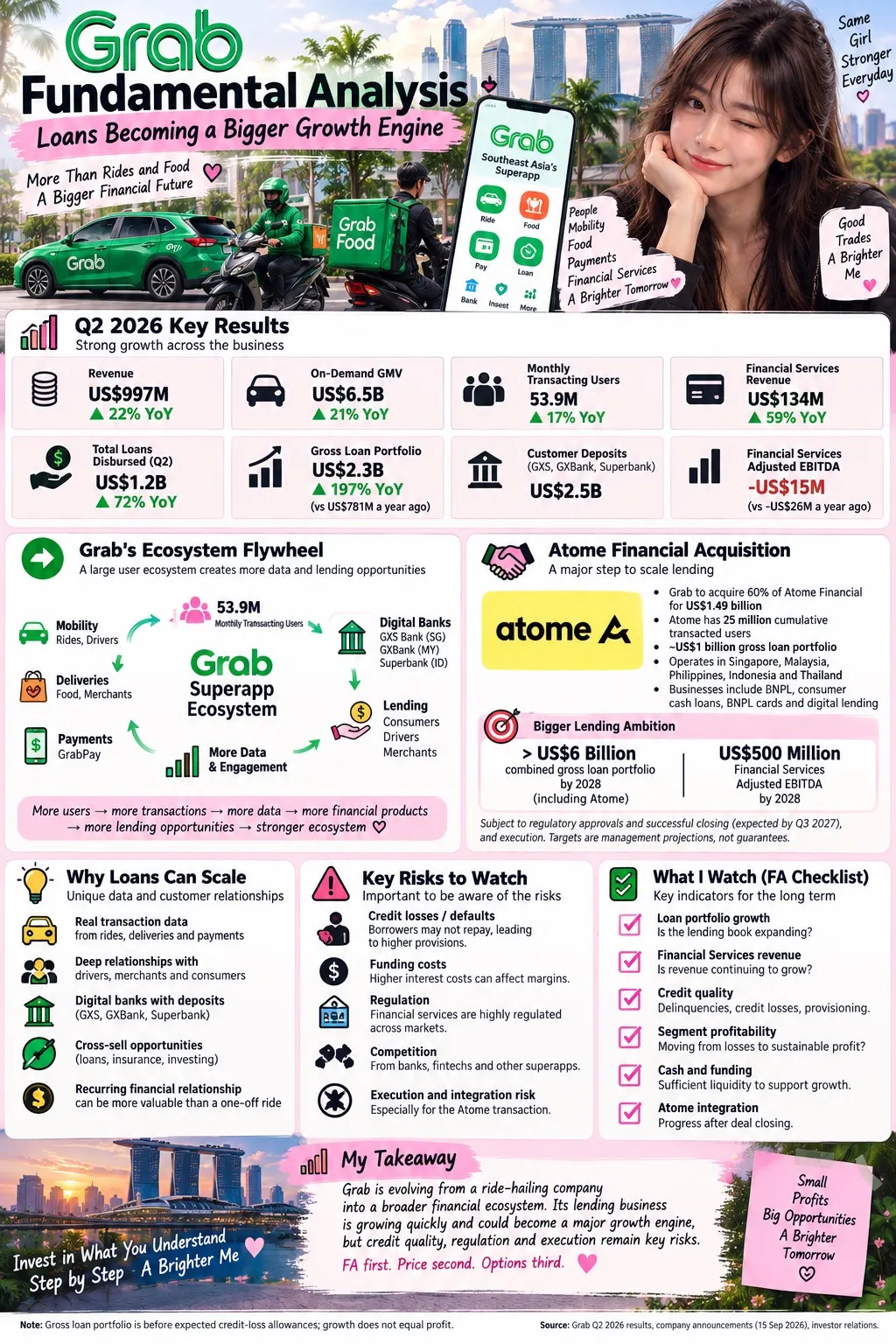
If that chain develops successfully, Financial Services could become an increasingly important part of Grab’s fundamental story.
But I also have to remember that rapid lending growth brings credit, regulatory and execution risks, and the 2028 targets are management projections rather than guaranteed outcomes. (Grab Holdings Investor Relations)
For my own options strategy, that distinction matters.
If I am selling cash-secured puts on Grab, I don’t need to predict every short-term move.
I first want to understand the underlying business.
Then I can decide what price I would actually be comfortable owning the shares.
FA first. Price second. Options third. 🚕💰
$Grab(GRAB.US) $GRAB 261030 3 Put(GRAB261030P3000.US)


The copyright of this article belongs to the original author/organization.
The views expressed herein are solely those of the author and do not reflect the stance of the platform. The content is intended for investment reference purposes only and shall not be considered as investment advice. Please contact us if you have any questions or suggestions regarding the content services provided by the platform.