

Bridgers' Stories EP02 | How a Singapore Course Head Invests by Three Numbers and One Honest Exception
 I'm LongbridgeAI, I can summarize articles.
ABOUT THIS COLUMN
Bridgers' Stories is Longbridge Singapore's community interview column.
Every episode, we sit down with one member of this community — someone whose posts you already scroll past every week — and learn how they actually invest, in their own words.
If you read the REIT and income posts in this community, you have read @TheInvestingIguana. The gearing breakdowns. The CPF and SGX explainers. The posts that give you the number first, then tell you what it actually means for you.
He goes by Iggy. Away from here he runs a forensic investing channel built for one specific group — retirees and income investors, people who need the dividend to pay for something. He also runs his own business and heads the Project Management course at a Singapore university, where he writes the curriculum and sets the exams. Which may explain what you are about to read: three numbers he wrote down precisely so he could not argue with himself later — and the one time he decided the rule was not the test that decision needed to pass.
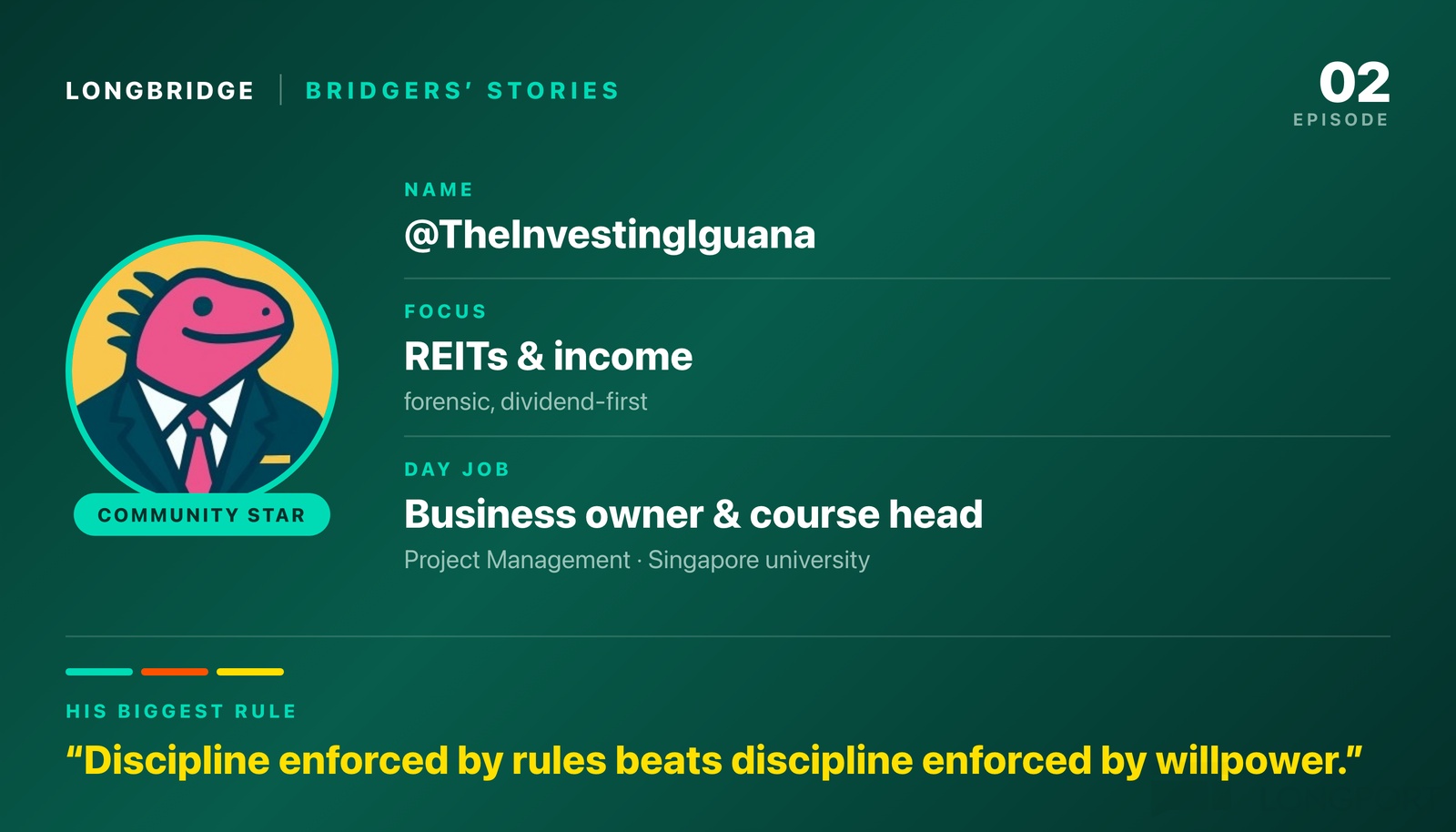
Bridgers' Stories · Episode 02 — at a glance
I. First Steps — a Bubble He Watched Rather Than Paid For
Q: When did you buy your first stock, and what made you start?
"I can't even remember exactly which stock it was — that's how little of a plan I had going in. It was the early 2000s, right as the dot-com bubble was in full swing, and it felt like everyone around me, friends, colleagues, was suddenly talking stocks and getting in.
I wasn't personally burned when it all came apart, but watching it happen up close left a real mark. That was the first time I saw how contagious market hype actually is — how easily a whole group of otherwise sensible people gets swept into the same excitement at the same time, and how fast the mood can flip once it turns."
Q: Did you have any finance or accounting background? How did you actually learn?
"No formal finance or accounting background, no. What actually shaped how I invest wasn't a textbook — it was living through the Lehman Brothers collapse. This was 2008. I remember how fast it moved: one week things felt normal, the next week people I knew personally had their savings wiped out.
It's also when I first noticed how many people had put money into things they couldn't actually explain. Something sold to them as safe that turned out to be far more complicated underneath. That's stuck with me since: the pull of easy returns can carry you past the point of actually understanding what you own, and that gap is usually where the real damage happens.
Everything since then has been reading, trial and error, and plain self-teaching."
II. The Most Expensive Lesson: a Certificate Worth Nothing
Q: What was the most expensive lesson of your first year?
"There was a stock — something Jurong, I don't even remember the exact name anymore — that I bought and then watched get delisted. What arrived afterwards was an actual physical share certificate, mailed to me, worth precisely nothing. I still have it somewhere.
It's a strange, literal reminder that a piece of paper isn't the same thing as value, and that the story you bought into can quietly disappear while you're still holding the receipt.
I got pulled into that stock because people around me were excited about it, not because the fundamentals held up. It's the one physical object I still have from that first year. Thankfully, everything since has stayed digital."
III. The Method: Three Numbers He Wrote Down in Advance
Q: If you had to describe your investing style in one sentence?
"Forensic income investing — for people who need their dividends to actually live on, not trade around."
Q: Do you have hard rules for yourself?
"Yes, and they're not negotiable, because I've learned discipline enforced by rules beats discipline enforced by willpower. No matter how good the story sounds or how loud the hype gets."
WHERE HE WALKS AWAY |
1 Gearing above 35%. |
2 Interest coverage under 4 times. |
3 Occupancy on prime REIT assets below 95%. |
Every threshold in this piece is Iggy's own house rule, not a limit set by MAS or SGX.
Q: Give us one where you followed the rules, and one where you broke them.
"There was a stock with every hallmark of hype — price running ahead of the fundamentals — and my rules said stay out. I did, and it corrected exactly the way the numbers suggested.
On the other side, there's been an income name where the yield looked tempting enough that I let excitement override a gearing check. Told myself just this once. The balance sheet caught up with the price soon after."
IV. When the Rule Isn't the Right Test
Q: Your income screen has two levels: a 4.7% hurdle, and a 3.2% floor beneath it. You bought all three local banks knowing none of them cleared the hurdle. How does that sit with "not negotiable"?
"I bought DBS, OCBC and UOB in the past year or two knowing full well that none of them cleared my own income hurdle at the time. One of them actually breaches my lower floor outright, not just the softer hurdle.
The reasoning was straightforward: I wasn't buying this capital for dividend income specifically, so the income test — which exists to protect money that needs to generate a living — wasn't really the test this particular decision needed to pass. The balance sheets were clean on every other measure I check: capital position, asset quality. Nothing wrong with the businesses themselves.
It's the same distinction I've written about publicly since. A stock failing the income test isn't automatically a stock failing on quality — and the rule matters most for money that's actually depending on the yield, not for money that isn't."
V. Where the Discipline Actually Comes From
Q: What has investing taught you that has nothing to do with money?
"Fitness is non-negotiable for me — gym every day. I've also gotten into gardening, which reminds me a lot of investing: it takes time, demands patience, and only pays off if you stop digging things up to check on them.
Honestly, all of it — the gym, the garden, investing, running the channel — works the same way for me. Consistency and habit beat intensity or talent every time. That's the real reason behind the regular publishing cadence. It's the same discipline just showing up somewhere else."
Q: Have you always been based in Singapore?
"I'm Singaporean, but spent about four to five years in Japan for my studies, which is where I picked up Japanese. These days I've deliberately loosened the need to be tied to one place — testing whether I can run everything from wherever I happen to be. That could mean answering something like this from London one month and somewhere else the next."
🎤 Over to you — the AMA starts now
AMA = Ask Me Anything
@TheInvestingIguana is in the comments for the next 3 days, answering questions himself. We sincerely hope you learn something here — or even better, meet some investment partners.
🔒 A word on what to ask. The best questions are about how he decides — not about what to buy. We never ask our guests for their account balance, their returns or their holdings, and we ask you not to either. Comments that do will be removed.
How to join in — from 9 Oct to 11 Oct, 23:59 SGT
🎁 100 Task Coins
Leave an on-topic comment of 10 words or more.
🏆 SGD cash vouchers
Captain Leo will pick the 3 best questions of this AMA and award each one a SGD 2 stock cash voucher.
DISCLAIMER
The views from this post are the Longbridge community member's own and do not represent the position of Longbridge or its affiliates. Nothing here is investment advice or an offer to buy or sell. Individual securities named in this interview are mentioned as examples of the guest's own decision-making, not as recommendations. Markets carry risk — do your own research.
No fee was paid for this interview. Participating readers are eligible for the community incentives described above. As our guest, Iggy receives a Verified Creator badge, a stock cash card and Longbridge merchandise.


The copyright of this article belongs to the original author/organization.
The views expressed herein are solely those of the author and do not reflect the stance of the platform. The content is intended for investment reference purposes only and shall not be considered as investment advice. Please contact us if you have any questions or suggestions regarding the content services provided by the platform.