

🐶📉 Options Puppy Trading Journal: Why I Sold a KWEB $22 Cash-Secured Put Near Support
 I'm LongbridgeAI, I can summarize articles.
🐶📉 Options Puppy Trading Journal: Why I Sold a KWEB $22 Cash-Secured Put Near Support
🐾 1️⃣ Why am I making this trade now?
📉 I believe KWEB is approaching a potential support zone
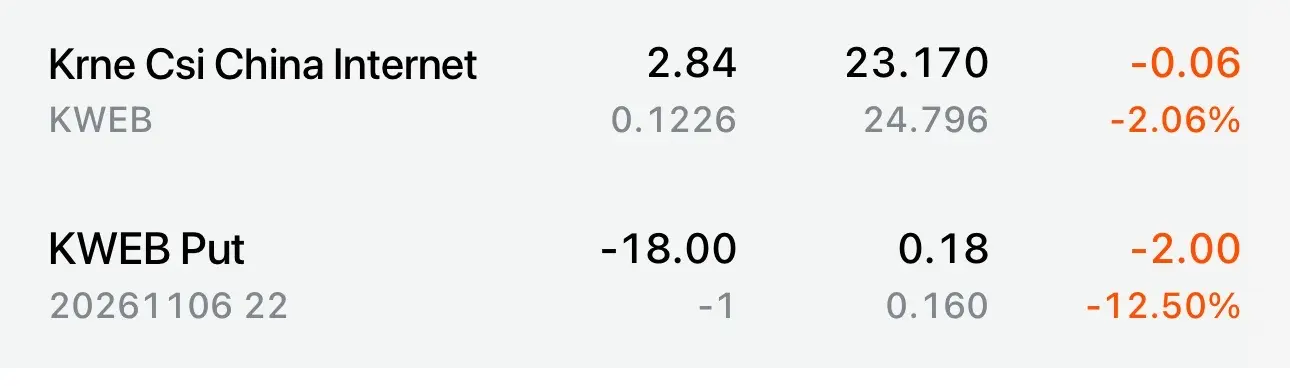
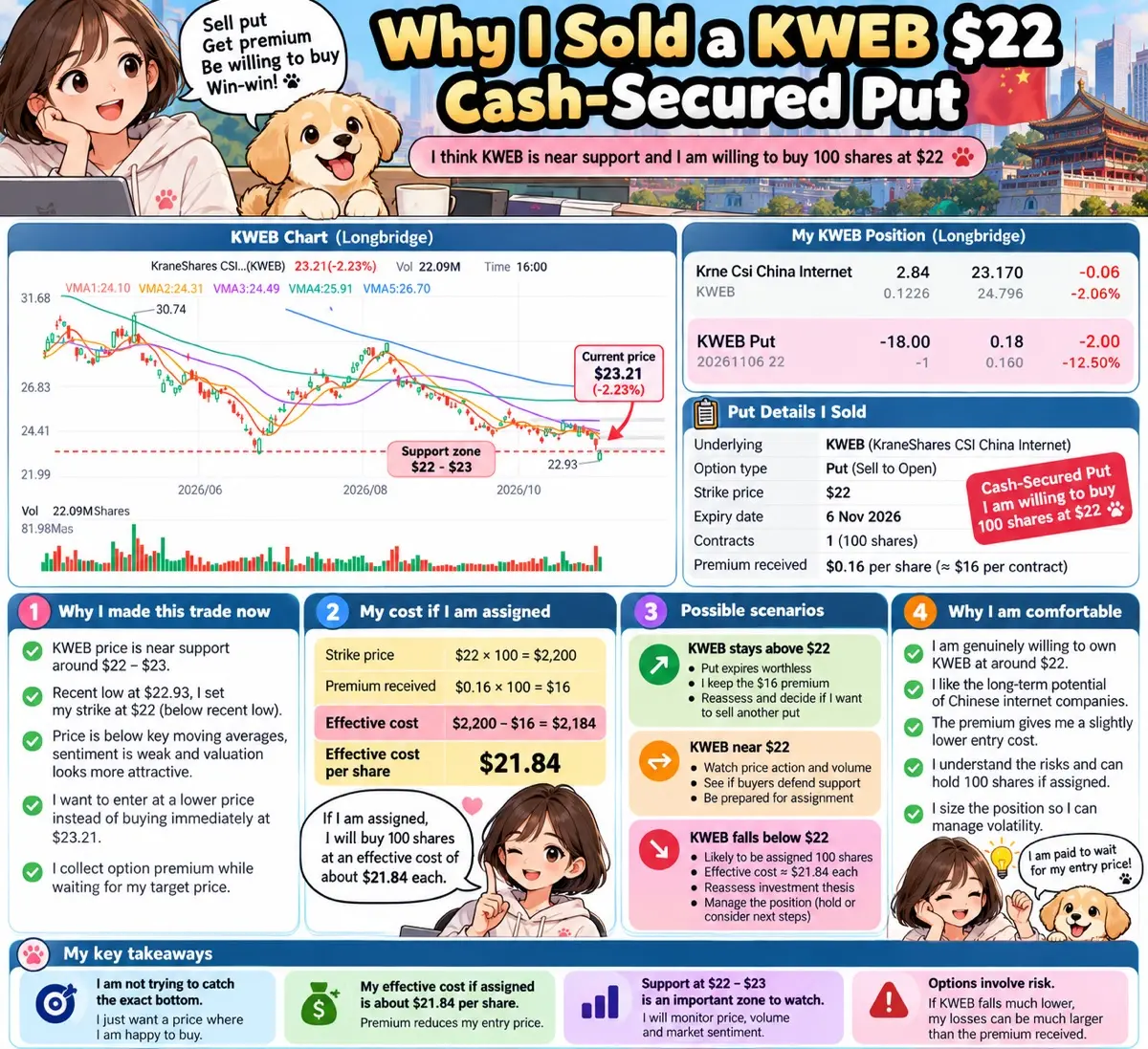
I sold one cash-secured put on the KraneShares CSI China Internet ETF (KWEB), with a US$22 strike price and an expiry date of 6 November 2026. I received a premium of approximately US$0.16 per share, or US$16 for the contract covering 100 shares, before transaction fees.
My decision is based on a simple idea: I believe KWEB is approaching a potentially interesting price level where I would be comfortable buying the ETF for the longer term. Instead of buying 100 shares immediately at the market price, I prefer to let the market come to my desired entry price while collecting option premium in the meantime.
Of course, support levels are never guaranteed to hold. I am not claiming that KWEB has definitely reached its bottom. I am simply identifying a price zone where the potential risk and reward look reasonable enough for me to consider taking a position.
📊 What does my KWEB chart tell me?
Looking at my daily chart on Longbridge, KWEB is trading around US$23.21, down approximately 2.23% in the displayed session. The chart shows a broader downward trend over the preceding months, with the ETF falling from its earlier highs above US$30.
The price has also declined below several moving averages. My displayed volume moving averages are approximately US$24.10, US$24.31, US$24.49, US$25.91 and US$26.70. These levels suggest that KWEB is trading below its recent average price levels, indicating that the broader technical picture remains weak.
This is important because I do not want to confuse a low price with a confirmed reversal. When an ETF trades below its moving averages, it can continue falling even after appearing cheap.
However, I am interested in the recent low around US$22.93 shown on my chart. That level gives me a nearby reference point for monitoring whether buyers begin defending the price or whether selling pressure continues.
I see the US$22–US$23 region as an area worth watching. My US$22 put strike is below the recent US$22.93 low, providing some distance between the recent low and my intended entry price. That does not eliminate downside risk, but it gives my trade a clear level to work around.
🧱 Why am I interested in buying near US$22?
My intention is not to catch the exact bottom. Nobody knows exactly where the bottom will be until the market has moved past it.
Instead, I want to establish a price at which I am prepared to own KWEB. The US$22 strike is attractive to me because it is below the ETF’s current market price and below the recent low marked on my chart.
If KWEB stabilises and rebounds, my put could expire worthless, allowing me to keep the premium. If KWEB continues falling and I am assigned, I will acquire 100 shares at US$22 per share and can manage the position as an ETF investment rather than treating the assignment as a failed trade.
The key condition is that I must genuinely be comfortable owning the ETF at that price. Selling a put just because the premium looks attractive is not enough. I need to be willing to hold the underlying asset if the market moves against me.
🇨🇳 Why am I still interested in China’s internet sector?
KWEB provides exposure to Chinese internet-related businesses. This sector can offer opportunities when investor sentiment toward Chinese equities becomes excessively pessimistic, but it can also experience substantial volatility.
Chinese internet companies are influenced by several factors, including domestic economic growth, consumer spending, regulatory developments, competition, corporate earnings and investor confidence. Broader US-China relations and changes in global risk appetite can also affect valuations.
When sentiment deteriorates, investors may sell the entire sector rather than carefully distinguish between individual companies. This can create opportunities for investors who have a longer investment horizon and are prepared to tolerate volatility.
However, I must also recognise that low valuations alone do not guarantee recovery. Economic growth may disappoint, regulation may change, and market sentiment may remain weak for longer than expected.
My decision to sell the put is therefore not a prediction that Chinese internet stocks must rebound immediately. It is a way to establish a potential entry price while being paid to wait.
💵 Why sell a put instead of buying 100 shares immediately?
If KWEB is trading around US$23.21, buying 100 shares immediately would require approximately US$2,321 before transaction costs.
By selling the US$22 put, I am committing to a potential purchase at a lower strike price. The contract represents an obligation to buy 100 shares at US$22 each if assigned.
That means I am targeting US$2,200 of gross purchase value rather than buying at the current market price. In exchange for accepting that obligation, I receive the option premium.
This approach suits my trading style because I prefer to identify a price where I am willing to own a stock or ETF, then use options to potentially improve my entry cost.
I must remember, however, that the market can rebound without me. If KWEB rises above US$22 and the put expires worthless, I will not acquire the shares. I will simply keep the premium.
That is an acceptable outcome for this particular strategy because I am not trying to predict every market movement. I am trying to follow a repeatable process with a defined entry price.
💰 2️⃣ What is my actual cost if I am assigned?
🧮 My KWEB put calculation
Here is the basic calculation for my trade, assuming I received US$0.16 per share in net premium.
- Underlying ETF: KWEB
- Put strike price: US$22
- Expiry date: 6 November 2026
- Contracts sold: 1
- Shares per contract: 100
- Premium received: US$0.16 × 100 = US$16
- Gross purchase obligation: US$22 × 100 = US$2,200
- Effective cost if assigned: US$2,200 − US$16 = US$2,184
- Effective cost per share: US$2,184 ÷ 100 = US$21.84
My effective entry cost would therefore be approximately US$21.84 per share, before fees and any other applicable costs.
This is the number I want to focus on. Although the contractual strike price is US$22, the premium reduces my effective cost basis to US$21.84 if I am assigned and can retain the premium.
The US$16 premium is my maximum profit on the short put if the option expires worthless, assuming I can retain the entire premium and excluding fees. If KWEB falls sharply, my losses can be much larger than the premium received.
For example, if KWEB falls to US$20 at expiry and I am assigned, my shares would have an effective cost of US$21.84. Their market value would be US$2,000, compared with my effective cost of US$2,184. That represents an unrealised loss of US$184 before fees.
This is why I must size my trades carefully and avoid selling puts on assets that I would not want to own.
🐶 3️⃣ Why I am comfortable with the risk
My confidence comes from having a clear entry price, not from believing that the trade cannot lose money.
I am prepared to accept that KWEB may fall below US$22. If that happens, I may become the owner of 100 shares while the market price is lower than my effective cost basis.
I must then decide whether the original investment thesis remains valid. If the decline is caused by temporary market weakness and the underlying businesses remain attractive to me, I may choose to hold the ETF. If new information materially weakens the investment case, I should reassess rather than automatically averaging down.
I also need to consider opportunity cost. The US$2,200 collateral committed to this trade cannot be freely used for another opportunity while it is reserved for the put. Although I may earn interest on eligible idle cash depending on my broker’s arrangements, I should not assume that such interest is guaranteed.
The premium is compensation for accepting downside exposure and the possibility of buying the ETF at an inconvenient time. It is not free money.
📈 4️⃣ What is my plan from here?
🟢 Scenario A: KWEB stays above US$22
If KWEB remains above the strike price until expiry, the put may expire worthless. I would retain the US$16 premium before fees, and I would not need to purchase the 100 shares.
I could then reassess the chart and decide whether to sell another put at a suitable strike price. I would not automatically open another position just to generate daily income. I want the next trade to make sense based on the price, volatility and market conditions at that time.
🟡 Scenario B: KWEB approaches US$22
If KWEB approaches the strike price, I will pay attention to price action, trading volume and whether the ETF can stabilise around the recent low.
A bounce accompanied by stronger buying volume could indicate that buyers are becoming more active, although it would not confirm a durable reversal.
If the ETF falls through support with heavy selling volume, I will be more cautious. A support break can lead to further downside, and I must be prepared for assignment rather than assume the price will recover immediately.
I will also monitor the put’s market value. A short option can become more expensive to buy back even before the underlying reaches the strike price, particularly if volatility rises or the ETF declines rapidly.
🔴 Scenario C: KWEB falls well below US$22
If KWEB drops sharply, I will reassess the reasons behind the decline. I will distinguish between a broad market sell-off, a deterioration in the sector’s outlook and company-specific or regulatory developments affecting the ETF’s holdings.
If assigned, my effective purchase cost is approximately US$21.84 per share, assuming the original US$0.16 premium is retained. I will then manage the 100-share position according to the investment outlook and my risk tolerance.
I will not sell additional puts automatically just because the ETF becomes cheaper. Before adding to the position, I will consider my total exposure to Chinese equities, the amount of available cash and whether the original reasons for buying remain valid.
🧠 5️⃣ My final thoughts: I am paid to wait for my entry price
The purpose of this trade is straightforward. I believe KWEB is approaching a potentially interesting support region, and I am willing to buy 100 shares at a US$22 strike price.
By selling the put, I collect approximately US$16 in premium and potentially reduce my effective entry cost to US$21.84 per share.
I am not claiming that KWEB has bottomed. My chart still shows a weak broader trend, and the ETF could fall below the recent US$22.93 low. The premium provides only a small cushion against that risk.
What matters most is that I have selected a price where I am prepared to own the ETF, calculated the capital required and considered what I will do if the market moves against me.
For me, options trading is about discipline rather than predicting every market move. I do not need every put to expire worthless, and I do not need every trade to make money. I need to understand the risk before entering and have a plan for different outcomes.
🐶 Options Puppy lesson: I sell a cash-secured put because I am willing to buy the underlying at my chosen price. The premium is a bonus for accepting the obligation, not a guarantee of profit.
This is my personal trading journal and reflects my own market view, not financial advice. Options involve risk, and the maximum loss on a short put can be substantial. Please verify the contract details, premium received, fees and available collateral before placing a trade.
https://youtube.com/@optionspuppyfinance?si=igUOUyWboU8eMJjF
$KWEB 261106 22 Put(KWEB261106P22000.US)

The copyright of this article belongs to the original author/organization.
The views expressed herein are solely those of the author and do not reflect the stance of the platform. The content is intended for investment reference purposes only and shall not be considered as investment advice. Please contact us if you have any questions or suggestions regarding the content services provided by the platform.