

🏦 DBS Bank Beginner Guide — Part 4 optionspuppy
 I'm LongbridgeAI, I can summarize articles.
💰 How Many DBS Shares Do I Need to Earn S$100, S$500, S$1,000 or S$2,000 in Dividends Every Quarter?
Options Puppy investing series · Beginner-friendly guide · Singapore market
In Part 3, I explored how the new SGX board-lot rules make it easier for eligible investors to start buying DBS shares in smaller quantities. Now, in Part 4, I want to answer a question many dividend investors ask:
How many DBS shares do I need to own before the dividends become meaningful?
For me, dividend investing is not just about buying a famous bank and waiting for money to arrive. I want to understand how much capital I need, what dividend income I might receive, what could go wrong, and whether the shares are worth buying at the price I pay.
The most important lesson is this: I should calculate my potential dividend income before I buy, rather than buy first and hope the dividends will be enough.
1️⃣ 💵 First, understand how DBS dividends work
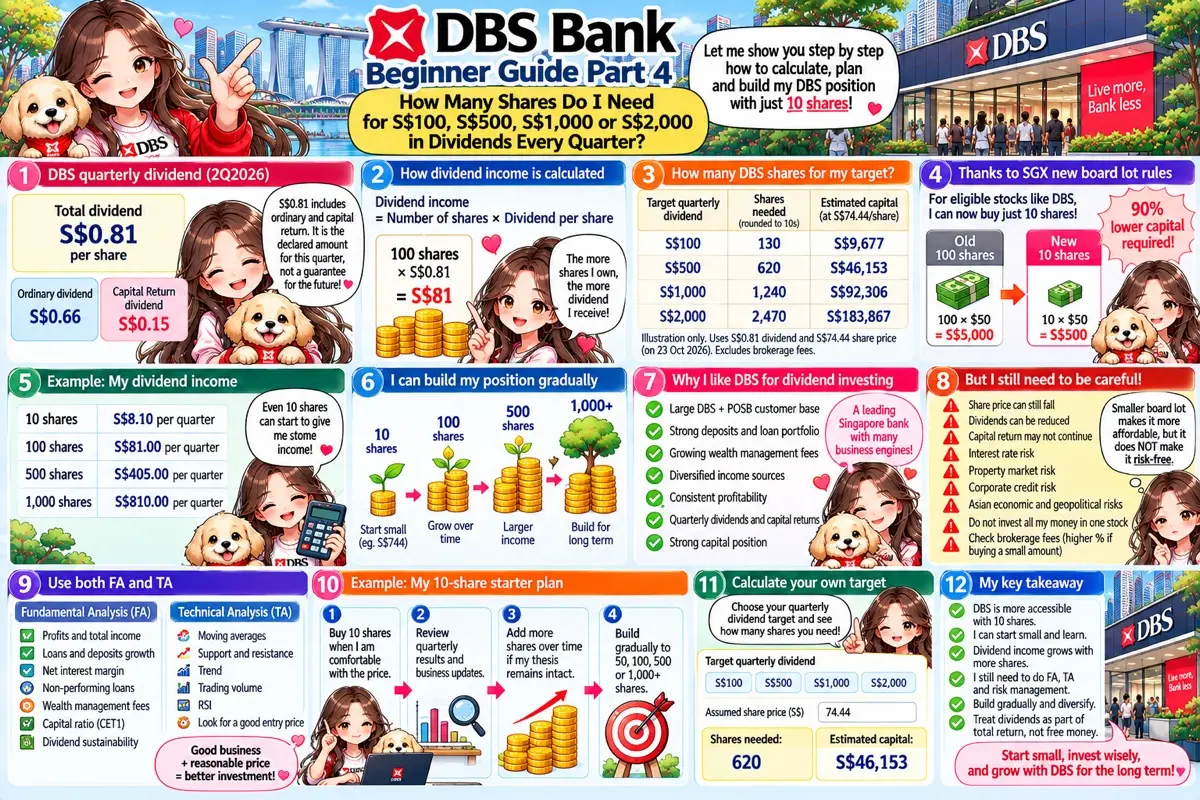
DBS declared a dividend distribution of S$0.81 per share for 2Q2026, made up of an ordinary dividend of S$0.66 and a capital-return dividend of S$0.15. This is an actual declared distribution for that quarter, not a promise that every future quarter will pay the same amount.
Here is the simple formula I use:
\text{Dividend income}=\text{Shares owned}\times\text{Dividend per share}
For example, if I own 100 DBS shares and the dividend is S$0.81 per share:
100\times \$0.81=\$81
I would receive S$81 for that particular distribution, assuming I qualify for it.
But I must remember one important detail: ordinary dividends and capital-return dividends are not the same thing. Capital returns may be temporary or change over time. I should not build my retirement budget around the assumption that the full S$0.81 will repeat every quarter.
2️⃣ 🎯 My dividend income targets
Let’s calculate how many shares I would need to target different quarterly dividend amounts, using S$0.81 per share as an example.
Target per quarter | Calculated shares needed | Shares rounded to 10s | Example capital at S$74.44/share |
S$100 | 124 | 130 | S$9,677 |
S$500 | 618 | 620 | S$46,153 |
S$1,000 | 1,235 | 1,240 | S$92,306 |
S$2,000 | 2,470 | 2,470 | S$183,867 |
Illustration only. The share price of S$74.44 was the DBS price displayed on 23 October 2026. Capital estimates exclude brokerage fees and other transaction costs. Dividend amounts use the declared S$0.81 distribution as a scenario, not a forecast.
The figures may surprise some beginners. Earning S$100 from one quarterly distribution sounds achievable, but it can still require nearly S$10,000 of capital under these assumptions.
To target S$1,000 per quarter, I would need roughly S$92,000 of DBS shares at the illustrative price. That is a significant amount of money to place in just one company.
This is why I would never look at dividend income alone. I must also consider diversification, valuation and the possibility that the share price could fall.
3️⃣ 🐶 My Options Puppy approach: build slowly
I do not need to start with hundreds or thousands of shares on day one. With the smaller board lots introduced for eligible securities, I can think about building my position in stages.
Stage 1 — Start with 10 shares
At S$74.44 per share, the illustrative purchase cost is S$744.40 before fees. At S$0.81 per share, one comparable distribution would be S$8.10.
Stage 2 — Grow to 100 shares
Illustrative cost: S$7,444. One comparable distribution: S$81.
Stage 3 — Work towards 500 shares
Illustrative cost: S$37,220. One comparable distribution: S$405.
These stages are examples, not instructions to keep buying regardless of price. I would add shares only when the valuation, business outlook and my available capital make sense.
If DBS becomes expensive relative to its earnings and dividend prospects, I can wait. If I already have substantial exposure to Singapore banks, I might direct new money elsewhere.
4️⃣ 🏦 Why I would consider DBS for dividend investing
DBS is more than a company that pays dividends. It operates a major banking franchise with retail banking, corporate lending, wealth management and transaction services.
In its second-quarter 2026 results, DBS reported net profit of S$3.08 billion, up 9% year on year, and total income of S$6.09 billion, up 6%. Net fee income rose 25% to S$1.46 billion, supported by strong wealth-management activity.
These numbers matter because a sustainable dividend generally needs a business that can generate profits and maintain adequate capital.
When I review DBS, I would watch:
- Net interest margin: How profitably the bank earns interest from its lending and deposit activities.
- Loan quality: Whether borrowers are repaying loans or defaults are increasing.
- Fee income: Whether wealth management and other services are helping diversify earnings.
- Capital strength: Whether the bank has sufficient capital to absorb losses and support its business.
- Dividend policy: Whether the ordinary dividend is supported by sustainable earnings and cash generation.
DBS reported a non-performing loan ratio of 1.0% for 2Q2026, while its reported Common Equity Tier 1 capital ratio was 16.6% under transitional arrangements. These are useful indicators to follow, but they do not eliminate future risk.
5️⃣ 📊 Why I still need FA and TA
Fundamental analysis (FA) helps me decide whether DBS is a business I want to own. I review earnings, dividends, loan quality, capital strength and valuation.
Technical analysis (TA) helps me plan my entry. I may look at support and resistance, moving averages, RSI and trading volume to understand the share-price trend.
Neither method can predict the future with certainty. A technically attractive entry can still decline after unexpected news, while a strong bank can be a disappointing investment if I overpay.
My preferred approach is to combine both: understand the business first, then consider whether the price offers a reasonable opportunity.
6️⃣ ⚠️ The biggest dividend-investing mistake
The mistake is assuming that a high dividend automatically means a good investment.
Imagine I buy DBS shares mainly because I expect a large quarterly payout. If the share price then falls 15%, the paper loss could exceed several quarterly dividend payments.
For example, a S$10,000 position falling 15% would decline in market value by S$1,500. Receiving S$100 in dividends for a quarter would not offset that decline.
Dividends can also be reduced, and capital-return distributions may not continue indefinitely. I should assess total return, which includes both dividends received and changes in share price.
I also need to check brokerage commissions, minimum fees and other trading costs. For small purchases, costs can take up a meaningful percentage of the investment.
7️⃣ 🧮 Calculate your own dividend target
Use this simple calculator to explore a quarterly target. It uses the illustrative S$0.81-per-share distribution and rounds the required shares up to the next 10.
My target quarterly dividend
S$100 per quarter
S$500 per quarter
S$1,000 per quarter
S$2,000 per quarter
Assumed DBS share price (S$)
Shares required
620
Estimated capital
S$46,152.80
This is a mathematical scenario, not a dividend forecast or buy recommendation. It excludes transaction costs and assumes the selected share price stays unchanged.
8️⃣ 🐾 What is my plan from here?
My plan is to treat DBS as one potential part of a diversified portfolio, rather than assume it must be my only dividend stock.
I would review the latest quarterly results, compare the current valuation with its earnings and dividend prospects, and consider how much exposure I already have to Singapore banks. I would also keep enough cash for emergencies rather than investing money I may need soon.
If the business remains healthy and the price is reasonable, I can consider adding gradually. If the valuation becomes stretched, the outlook deteriorates or my portfolio becomes too concentrated, I can pause and reassess.
The goal is not to collect the highest possible number of shares. It is to build a portfolio that suits my financial needs and risk tolerance.
🐶 Options Puppy’s final takeaway
I do not need to own 1,000 DBS shares before I can begin learning about dividend investing. I can start small, study the company and build my knowledge alongside my portfolio.
But I must separate a declared dividend from a guaranteed future income stream. DBS has a substantial banking franchise, but its share price, earnings and future distributions can all change.
My rule is simple: I buy for the business, pay attention to the price, and treat dividends as part of my total return—not free money.
Disclaimer: This article is for general educational purposes only and is not financial advice or a recommendation to buy or sell DBS shares. Dividend amounts, share prices and capital requirements can change. Past performance and declared distributions do not guarantee future returns. Please conduct your own research and consider your financial circumstances and risk tolerance before investing.
$Amova Singapore STI ETF(G3B.SG)
The copyright of this article belongs to the original author/organization.
The views expressed herein are solely those of the author and do not reflect the stance of the platform. The content is intended for investment reference purposes only and shall not be considered as investment advice. Please contact us if you have any questions or suggestions regarding the content services provided by the platform.