

隨着 PJM “自帶電源” 時代到來,谷歌接入 Constellation 的核反應堆
 我是 LongbridgeAI,我可以總結文章信息。
谷歌已與 Constellation Energy 簽署一項大規模電力協議,將在 PJM 電網內獲得 3,590 兆瓦的電力供應。該協議包括一份由 43 億美元投資支持的 890 兆瓦核電容量購電協議(PPA),以及一份單獨的 2,700 兆瓦長期供電合同。此舉旨在回應 PJM 提出的 “自帶電源” 方案,該方案要求大型數據中心必須自行確保能源供應,否則將面臨限電風險。此消息公佈後,Constellation 股價大幅上漲
For most of 2026, the bear case on the US power producers could be summed up in one sentence: nobody is signing data center PPAs in PJM. Last week Amazon did. This morning Google did, too, and this one is five times bigger.
Google parent Alphabet has contracted for 3,590 megawatts of power from Constellation Energy (CEG) inside PJM, the largest US grid, the companies said on Tuesday, according to Reuters, confirming an overnight leak. Roughly a quarter of it, 890 MW, is new nuclear capacity squeezed out of 11 existing reactors under a 20-year PPA, backed by more than $4.3 billion of Constellation investment. The rest is a long-term supply agreement for another 2,700 MW. And in case anyone missed why this is happening now, the companies said it outright: the deal is a response to PJM's "bring your own power" proposal.
Constellation shares jumped as much as 10% premarket (they were up 6.3% when Bloomberg first broke the story last night).
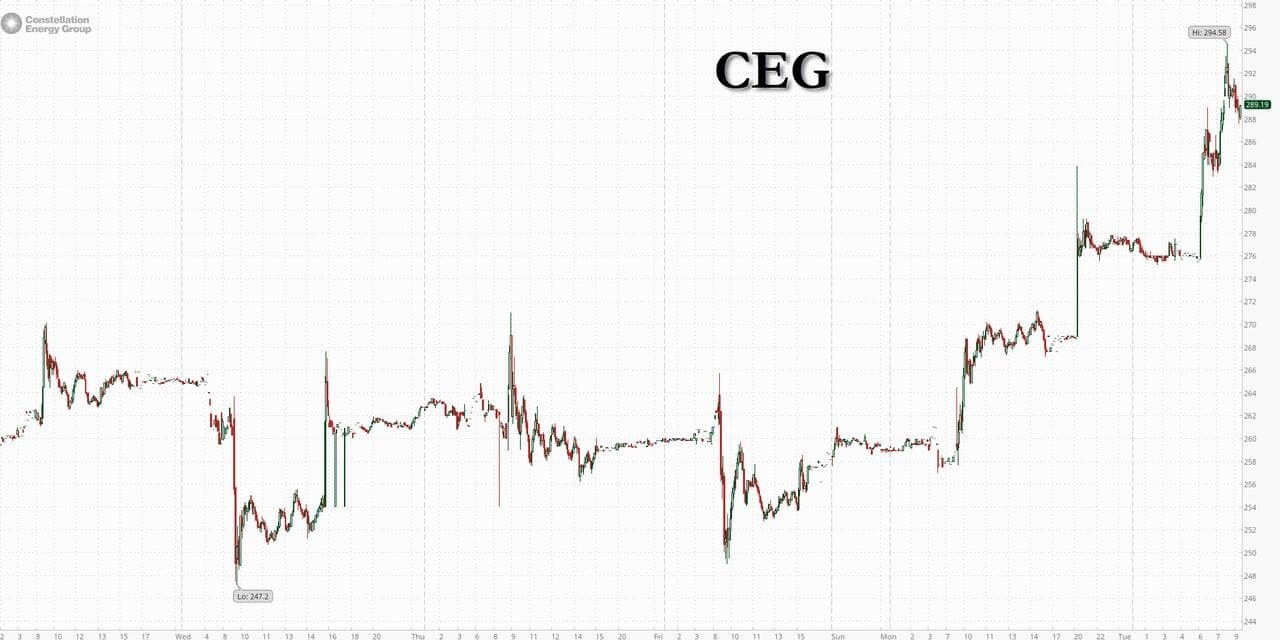
Zerohedge readers know this story didn't start this morning. We have been tracking the AI-nuclear trade since Microsoft agreed to restart Three Mile Island in September 2024, when nuclear names surged across the board on what was then a shocking headline. (Five years earlier, we were writing about "America's Chernobyl" finally closing its doors. Funny how the AI capex cycle changes things.) Two years later, Constellation has become Big Tech's nuclear landlord.
Below we break down the deal, why PJM forced Google's hand, what Goldman's power desk and utilities team are saying, and why the cheapest nuclear megawatt is the one already built.
The Deal: 890 Nuclear Megawatts... Plus 2,700 More
The terms, per the companies' statement and the Reuters and Bloomberg reports:
- 890 MW of new nuclear capacity under a 20-year PPA, coming from upgrades at 11 Constellation units in Illinois, Pennsylvania and New Jersey. The first upgraded plant is expected to start delivering in 2028.
- $4.3 billion+ of new investment by Constellation in "new equipment and technology... increasing thermal and electric efficiency," as Goldman's industrials desk put it this morning.
- A separate long-term supply agreement for 2,700 MW in PJM that is "not tied to a specific generation source and serves as long-term revenue certainty for Constellation's operating plants," per Google.
Translation: the 890 MW is the headline-friendly "new clean firm power" part. The 2,700 MW is essentially Google locking in a long-dated price for a big chunk of Constellation's existing output. Who needs a hedging desk when you have a hyperscaler?
Stack it next to Constellation's other hyperscaler deals and Google's is bigger than Microsoft, Meta and Amazon put together (2,646 MW combined), at least once the non-unit-specific supply is counted:
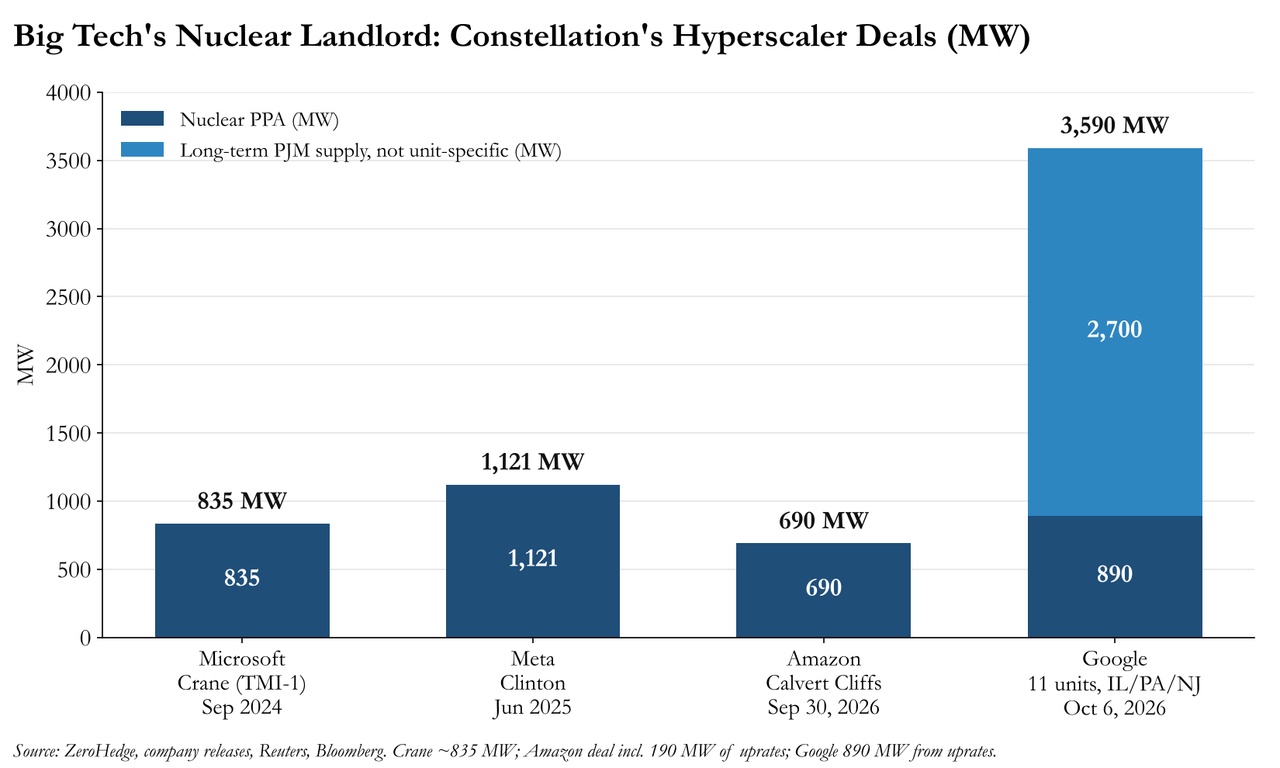
It also comes less than a week after Amazon's 690 MW, 20-year PPA at Calvert Cliffs, which we covered on Thursday in "Amazon Secures 20 Years Of Nuclear Power From Constellation As Goldman Sees Industry-Wide Win". And Google is hardly new to the game: it is already funding the restart of NextEra's Duane Arnold reactor in Iowa (which just landed a $1.9BN DOE loan), and last month lined up new capacity from Southern Co. by paying for upgrades at two of its nuclear plants.
Why Now? "Bring Your Own Power" Is Coming To PJM
The key line in the Reuters story is the last one. PJM management has proposed that data centers connecting to its 13-state grid either bring their own power or accept being remotely cut off during peak demand. Goldman's Nelson Armbrust laid out the mechanics in his What Matters Today note this morning (available to pro subs):
"Today, when you build a data center, you need a permit but you don't need to secure energy – this is what will be ruled (hopefully) on October 12th. PJM's proposed Interim Resource Adequacy Service (IRAS) targets new large loads (≥ 50 MW) entering service after June 1, 2027. To avoid priority grid curtailment during emergencies, data centers must secure their own power under the "Bring Your Own New Capacity" (BYONC) framework."
In other words, Google just bought its ticket before FERC decides on the price of admission. Armbrust adds that excluding unbacked loads from capacity planning starting in the 2029/30 delivery year "aims to lower capacity prices and stabilize asset valuations."
Lower capacity prices would certainly be a change of pace. As we tweeted the night of July's auction, PJM is already out of power:
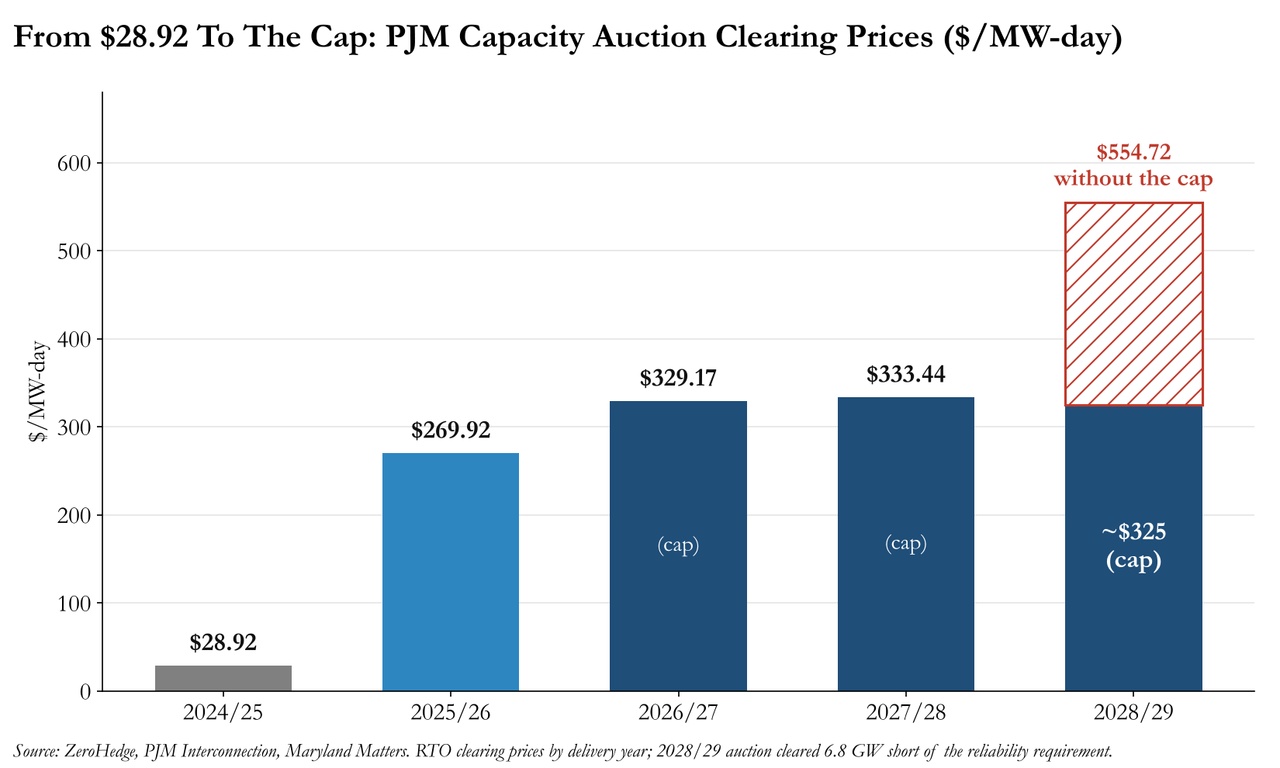
Today PJM failed to secure 7GW in energy to ensure system stability into 2028 (due to price caps, without which electricity prices would be 70% higher). PJM is already below the critical reliability threshold, and in 2027 is facing a catastrophic shortage of power and brownouts
— zerohedge (@zerohedge) July 15, 2026
Capacity prices have gone from $28.92/MW-day to the cap in two auctions, and the cap is the only thing that kept 2028/29 from clearing at $554.72:
PJM's emergency fix, a one-time "backstop" auction for new capacity, didn't go much better. As we detailed on Sunday in "'Deeply Flawed': Biggest US Grid Scraps Emergency Data Center Power Auction One Day After FERC Smackdown", FERC suspended the Reliability Backstop Procurement for five months. That's a power auction for data centers... delayed. Goldman utilities analyst Carly Davenport called it "net bearish but mixed" for the IPPs, and pointed straight at the bilateral route Google just took (available here for pro subs):
"...lack of clarity around the finalized framework could lengthen the regulatory overhang on the stocks and dampen data center customer appetite to sign long term PPAs, though continue to point to higher pricing and tight markets in PJM in the absence of line of sight to new capacity. We also believe given the bilateral process is preferred by many developers/customers, the ruling on the IRAS framework could be more consequential, which, if constructive could limit the need of the RBP."
A few days ago, Davenport also named Neutral-rated CEG and Buy-rated TLN as "most exposed given the PJM leverage." This morning that exposure worked in Constellation's favor.
As for who has been paying for PJM's shortfall so far: the ratepayers. Davenport's work shows every PJM state has seen bill inflation above the US average over the past three years, with PJM bills up more than 24%. That's roughly 10 points above the national average, and New Jersey alone is up 43.4% (chart source GS Power Up America webinar):
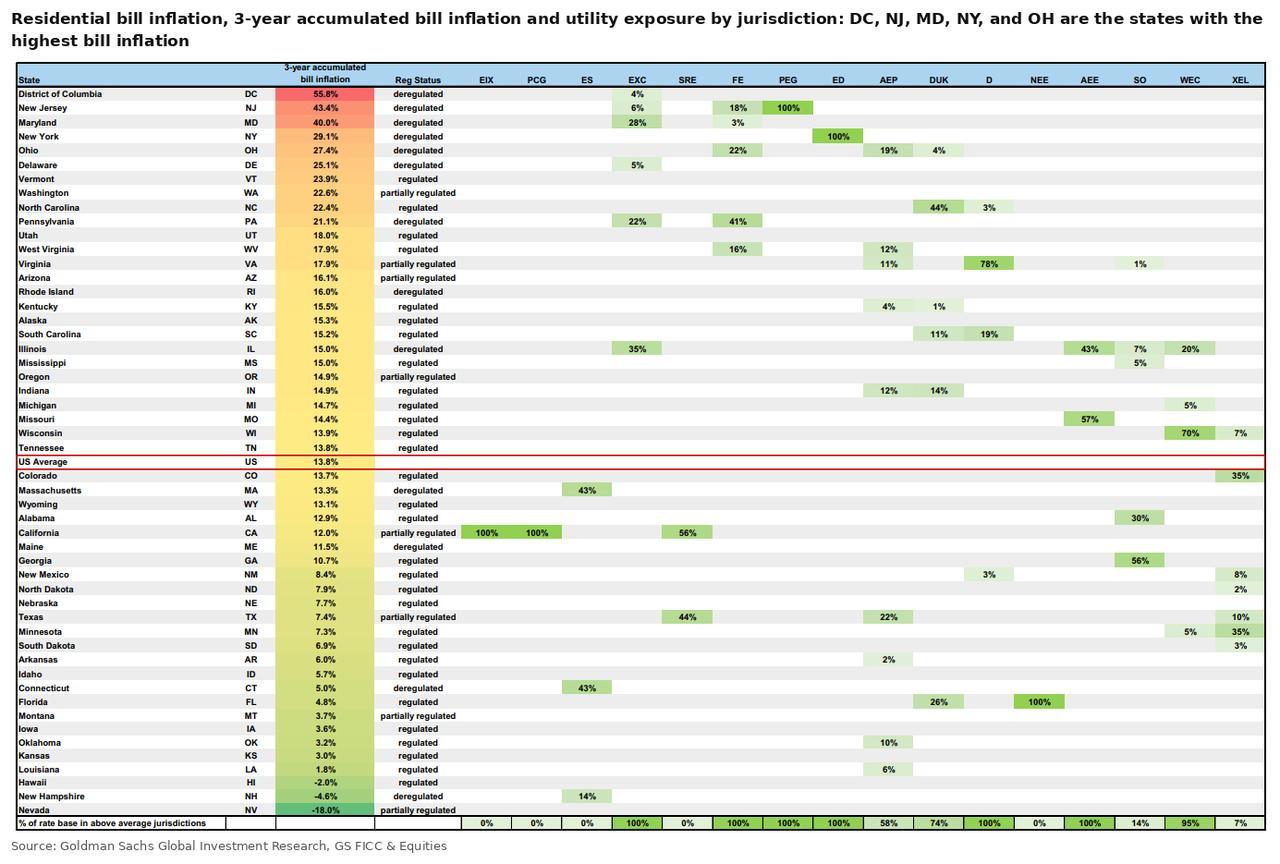
With the midterms four weeks away, nobody in Trenton, Annapolis or Harrisburg wants to explain the next leg higher. Hence "bring your own power."
Goldman: From A "Heartbeat" To A Pulse
For context on why the IPPs have been such a slog, here is Goldman's GSX desk summarizing last week's Power Up America webinar with Davenport, Joe Ritchie, Adam Bubes and Olivia Foster (available to pro subs):
"No large-scale data center PPA between a developer and an IPP has been announced since January. FERC is expected to rule on the PJM large-load framework on October 12... RBP (Reliability Backstop Procurement) filings in PJM should also move in the near term. Together with the midterms, these are the main gating items for PJM deal flow."
That "since January" drought ended twice in seven days. The webinar also noted that the group is down ~30% over the last 12 months, with CEG, NRG, TLN and VST trading on average at just over 7x EBITDA and a 12% free cash flow yield on 2027 estimates, "both at the discounted end of historical ranges," while the IPP basket trades near its Liberation Day lows:
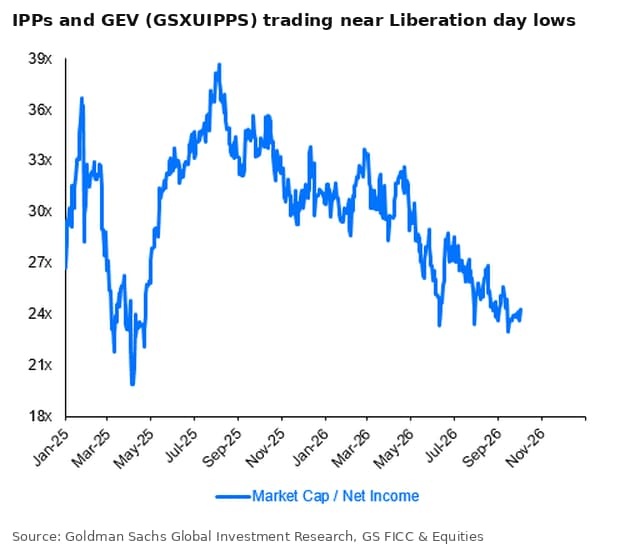
After the Amazon deal, Goldman's power specialist Adam Wijaya said one investor question "stuck out": can this get the group working again? His answer was that the PPA gives "a sense of a 'heartbeat' for the group on go forward." A second, bigger deal a week later starts to look like a pulse.
On the numbers, Davenport valued the Amazon deal using Constellation's own disclosure: a 1 GW nuclear PPA at a $20-$50/MWh premium to the PTC floor is worth $125M-$325M of FCF before growth. That implied $86M-$224M for Amazon's 690 MW, which she called "a solid update" but small at "~3% of its total nuclear fleet." Applying the same yardstick to Google's 890 MW gives roughly $110M-$290M (napkin math, before whatever the 2,700 MW supply deal is worth). Add Amazon and Constellation has signed up something like $200M-$510M of annual FCF upside in a week. Davenport is still Neutral with a $305 price target, which is suddenly just ~5% above where the stock traded premarket. We expect the next target revision to point (much) higher.
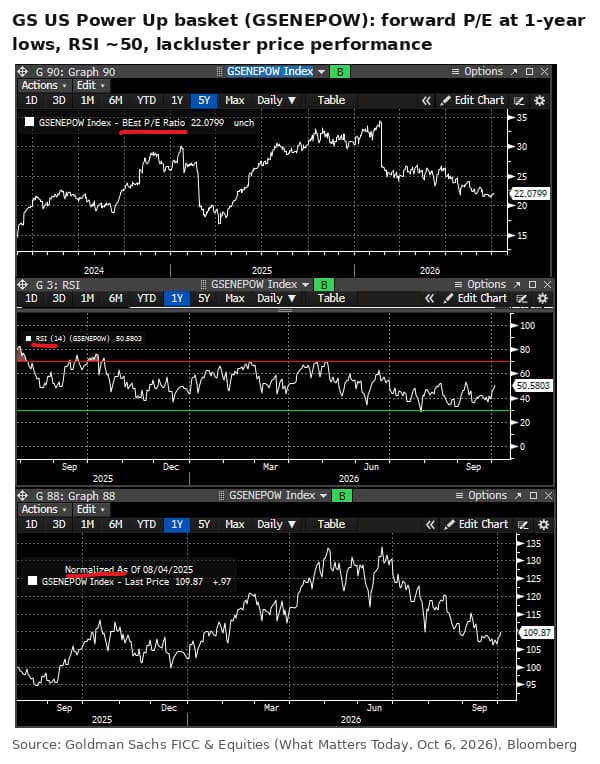
Goldman's desk was already leaning in before this morning's print. Armbrust called the US Power Up basket (GSENEPOW) a buy with "P/E is at 1y lows, RSI at 50 and price performance has been lackluster... I think its a buy."
The Cheapest Nuclear Megawatt Is The One You Already Own
The underappreciated part of the deal is how Google gets its new 890 MW: uprates, meaning squeezing more output from reactors that are already licensed, built and on the grid. No new site, no decade-long permitting, no first-of-a-kind cost overruns.
Some napkin math: $4.3 billion for 890 MW works out to roughly $4,800 per kW. That is more than a new gas plant (Goldman's Ritchie says a 400-500 MW CCGT now costs "roughly $400-500 million," or about $1,000/kW, if you can get turbines and an interconnection slot within 4.5 years). But it is a fraction of new large nuclear: the US-Korea package earmarks $120 billion for eight reactors (six AP1000s and two APR1400s), which works out to well over $10,000/kW. And unlike the gas plant, the uprate comes with 20 years of carbon-free, around-the-clock output and no fuel-price risk.
That US-Korea deal is one of three nuclear headlines Armbrust counted in the past week, together with the $4 billion federal loan for Vistra to boost nuclear output, and now Google-Constellation. And yet positioning is going the other way:
"Positioning in in our Uranium basket (GSXURANI) is at the lows… time to reengage?"
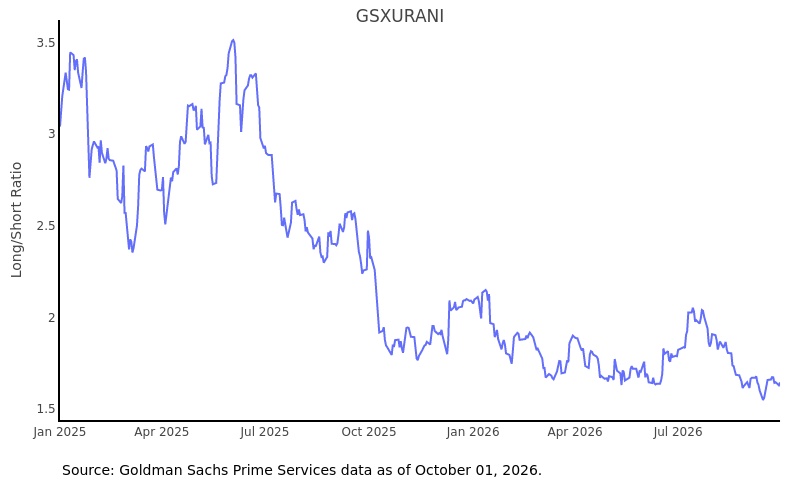
Goldman's Brian Lee added that the Korea program "further tighten[s] the expected uranium supply balance in the 2030s." Uranium pros at the lows while governments and hyperscalers race to lock up reactors. That is one hell of a setup.
The demand side isn't easing either. GIR sees 108 GW of US data center power demand by 2030, up from 39 GW in 2025...
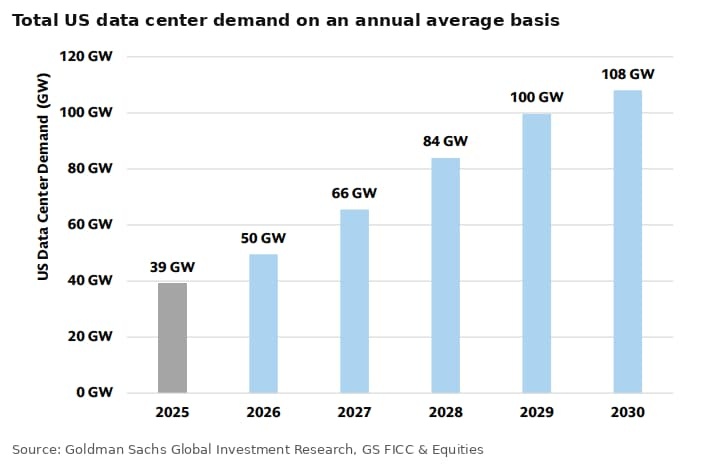
...which lifts total US power demand growth to a 3.5% CAGR, a number that would have been laughed out of any utility investor day five years ago:
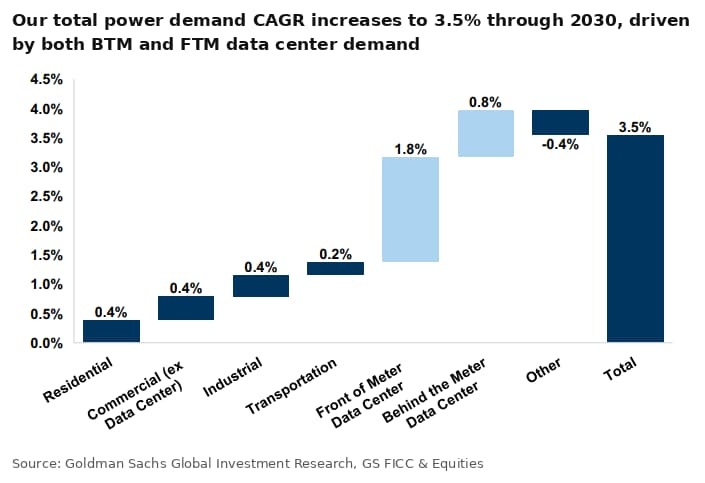
Or, as Ritchie put it: "the demand environment right now honestly just couldn't be better."
Who Pays? (Hint: Not Just Google)
Google can afford it. Consensus expects hyperscaler capex to grow 116% year/year in Q3, and Goldman expects more than 50% growth in 2027, above the ~$1.1 trillion consensus. That's something we discussed earlier in "'The S&P 2': Micron And Nvidia Alone Will Deliver A Third Of Q3 Earnings Growth":
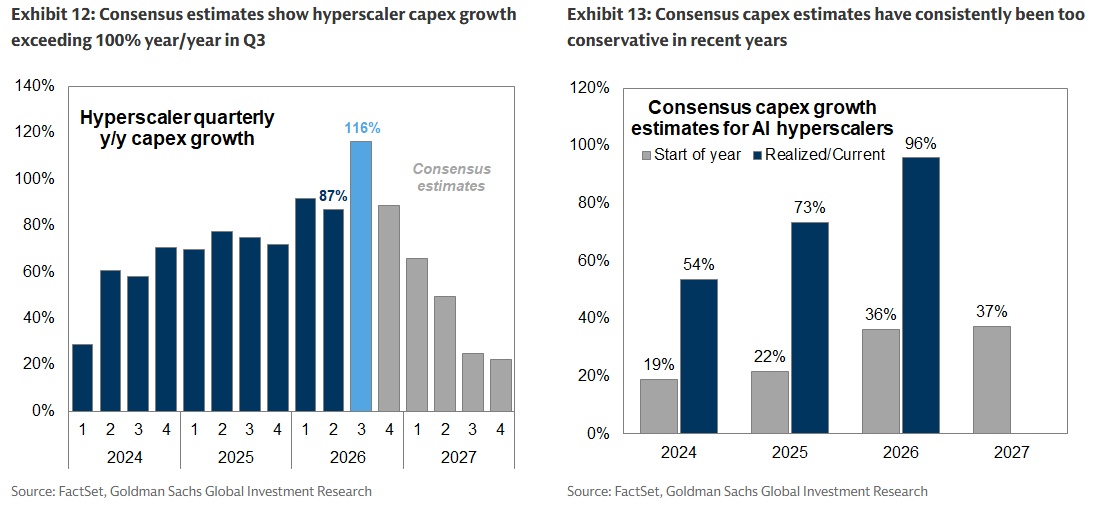
How that capex gets financed is a separate question, and increasingly a debt-funded one. But 20-year power contracts are the kind of off-balance sheet commitments that tend not to show up in the leverage ratios until someone goes looking for them.
Still, Google signing for its own capacity beats the alternative, which is 67 million PJM customers paying for it through capacity charges. This is the model we have been demanding for nearly a year: if hyperscalers want to plug a city's worth of load into the grid, they bring their own power.
Make "behind the meter" mandatory https://t.co/bCBnwx2E5g
— zerohedge (@zerohedge) December 24, 2025
Goldman has since come around, raising its behind-the-meter forecast to 67GW by 2030. Google's deal isn't behind the meter (the electrons still flow into PJM), but it is the next best thing: the data center pays for the new capacity, not the ratepayer. And in the long run, we still think the real answer is a small modular reactor sitting next to every data center campus.
Bottom Line
Wijaya put it best after the Amazon deal: "we know how quickly the tide can turn on power." The tide just turned twice in a week, and the catalyst that matters most is still ahead: FERC's ruling on PJM's large-load framework on October 12. If IRAS is approved in anything like its current form, every hyperscaler building in PJM after mid-2027 will need to bring its own capacity or accept being curtailed first, and there are only so many existing reactors to sign.
Which is why we think the 3,590 MW is the floor, not the ceiling. Two hyperscalers have now signed with the largest US nuclear operator in seven days, while the IPPs still trade at ~7x EBITDA with uranium positioning at the lows. Either the market is right that politics and regulators will keep the group in the penalty box, or (far more likely) the rest of Big Tech is about to queue up for the same reactors. Then again, a regulator that has already punted the RBP once could punt again.
We'll check back after FERC rules next Monday.
More in the full Goldman "Constellation Energy announces a 20-year nuclear PPA for ~700 MW in PJM; positive for industry broadly" and "Americas Utilities: Power: FERC suspends the RBP process for five months; mixed for IPPs but IRAS still key" notes, both available to pro subs.