D
 +8
+8
MNST: Valuation in Overdrive — How Long Can the Honeymoon Last?
A standout set of results, powered by a banner year for product innovation
+8
MonsterFinancial Analysis

A standout set of results, powered by a banner year for product innovation
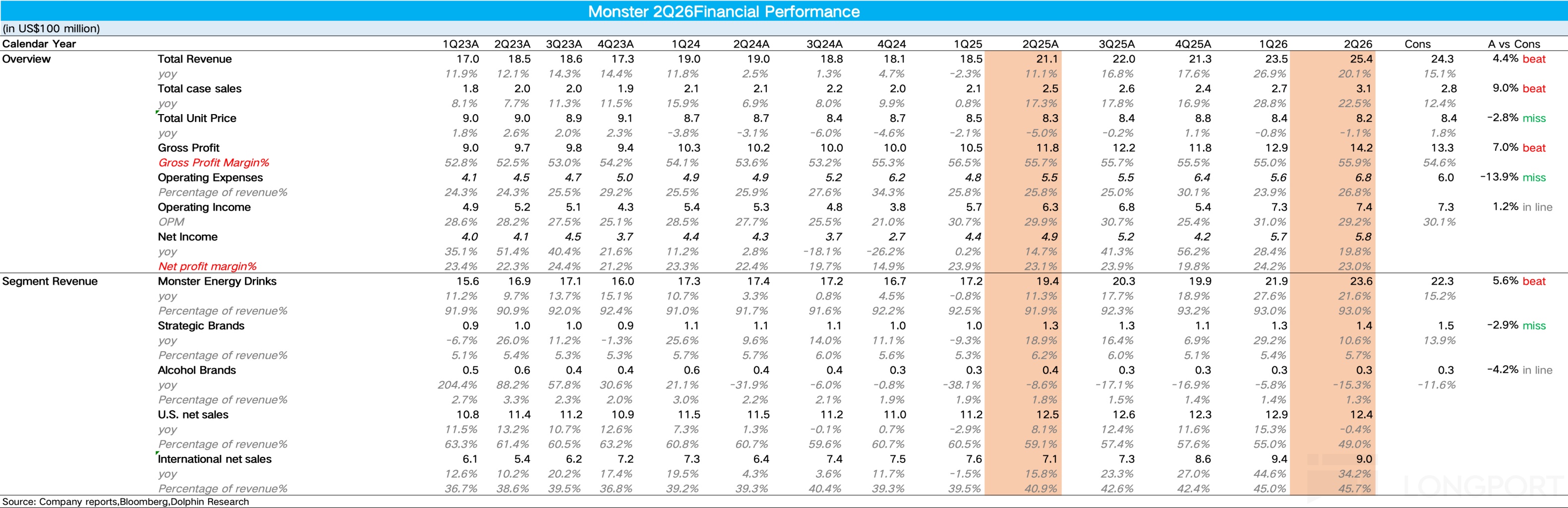
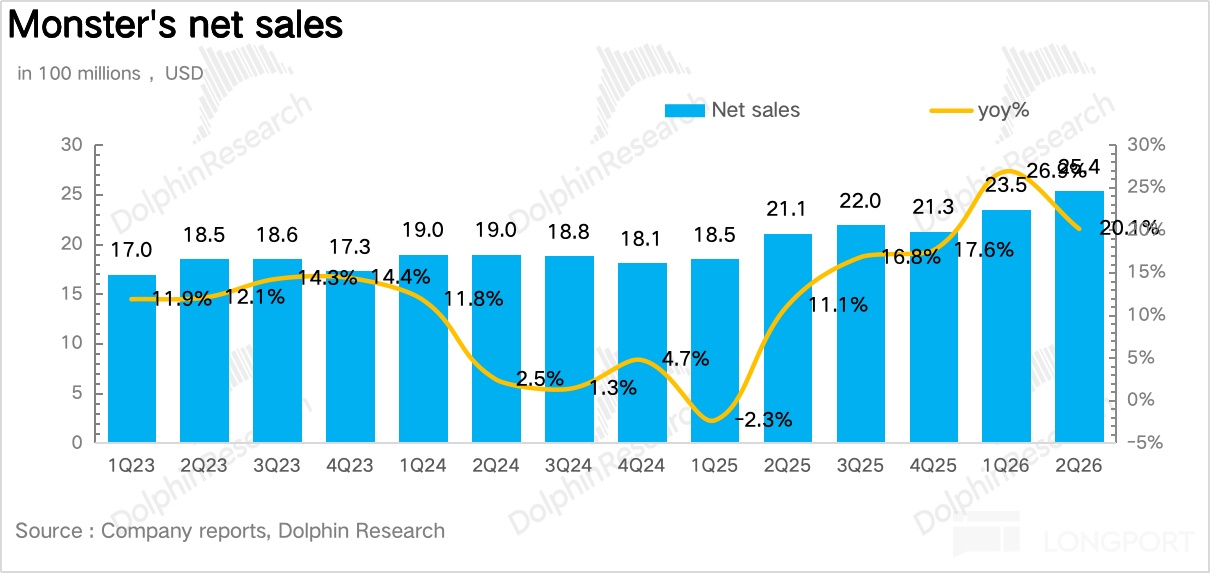
+8Q2 net sales topped $2.5bn, reaching $2.54bn (+20.2% YoY) with double-digit growth across all regions. However, higher freight and stepped-up marketing lifted the selling expense ratio to 10.6%, and Adj. OP rose only 13.3%, lagging revenue. The company plans selective price increases in the U.S. in Q4 2026.

Below is Dolphin Research's Trans of MNST's FY26 Q1 earnings call.
For the earnings analysis, cf. 'Monster: product cycle tailwinds, Intl markets ignite — a 'sweet' pivot?'Revenue growth hit its highest quarterly pace in nearly four years
Monster Beverage will kick off a new product cycle in 2026.
A fresh lineup will begin rolling out that year.Ultra (Zero Sugar) series performs outstandingly
$Monster Beverage(MNST.US) Monster Beverage (MNST), the leading energy drink company, released its Q3 2025 financial results (ending September 2025) after US market hours on 7 November 2025 Beijing time. 1. Revenue growth reached its highest quarterly level in three years. Monster achieved revenue of $2.2 billion in 3Q25, representing a 16.8% year-on-year increase that exceeded market expectations. Analysing volume and price dynamics, Monster's unit case sales grew by 17.8% year-on-year, maintaining the robust growth momentum observed in the second quarter...
In the cross-market comparison of beverages between China and the United States, Dolphin Research recently selected Monster Beverage ("Monster") as a comparison to introduce the upcoming peer research on Dongpeng Beverage. In the previous study, we focused on how Monster, as a follower, achieved surpassing its predecessors through differentiated positioning, community marketing, and leveraging giant channels. However, past success does not guarantee a smooth future, as demonstrated by Lululemon, a typical counterexample previously covered by Dolphin Research. As the earnings season concludes, Dolphin Research is swiftly moving to study the next truly critical core proposition, looking at the present: 1. What will drive Monster's future growth? Are its wings stable? 2. Will it be a good investment target? How is its current cost-effectiveness?
In the analysis of Monster, we explore the following three questions:
1. What is Monster's business model?2. In the years when Red Bull dominated the U.S. energy drink market, how did Monster manage to "tear apart" the Red Bull empire?3. From the current standpoint, how should we assess Monster's investment value?