Dolphin Research

Dolphin Research

Thinking with soul, research with attitude

0Following5,281Followers2,700Likes & Bookmarks
D
Dolphin Research

Where will AI money actually come from? That is the core question now.The playbook of subsidize first, build habits, then harvest no longer works—at least for now—given compute costs. Consumer chatbots have low pay rates and short daily usage, making C-side monetization unusually hard.

So where is the real willingness to pay? The answer points to task-oriented Agents, which, once introduced, have unlocked enterprise demand.

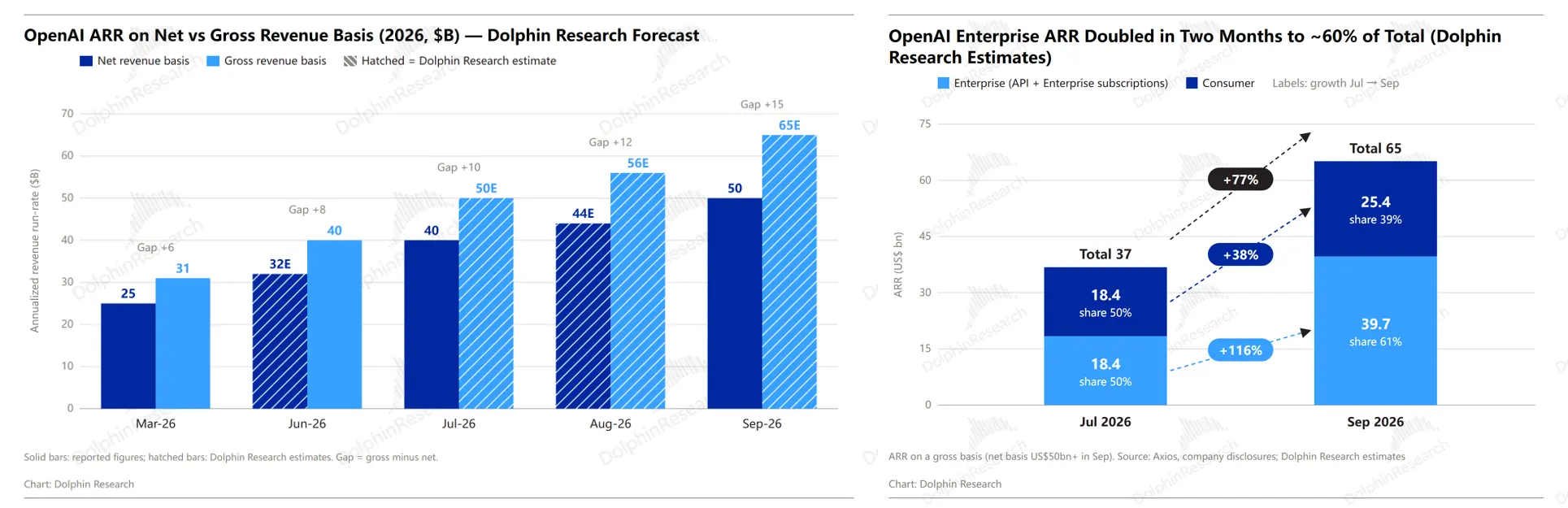
A Stack Overflow sample survey shows 59% developer Agent usage, with 37% using them daily. Among developers using AI tools, 66% use coding agents and 73% of them use them daily.OpenAI’s revenue mix also tilts to enterprise: by Jul, B2B (API, enterprise subscriptions) had surpassed consumer (which was 40% in Apr), with ARR at $20bn+. It doubled by end-Sep.On a $65bn gross ARR basis (net $50bn+), B2B accounts for 60%+. Back-solving implies the consumer side at ~$25bn, up less than 40% vs. Jul.

Advertising isn’t smooth either: CPM fell from ~$60 in early gray tests to $15–25, and the self-serve minimum dropped from $50k to zero. By end-Aug, ad ARR reached $1bn.It spans tens of thousands of advertisers across 40+ countries and regions.
图片 1,共 1 张
D
Dolphin Research

Dolphin Daily | From Circuit Break to Rebound Overnight: Money Dumps AI hardware for Value — Dip Buy or Rotation?

Good morning! It is Oct 16, 2026 (Beijing). Dolphin Research brings you a quick take on global markets.

Moves: Thu, 10/15 close vs. prior session. Trading focus: Anthropic's quarterly rev growth slowed, and memory supply concerns resurfaced.

Asian chip stocks tumbled; KOSPI -7.6% with an intraday circuit breaker halt, SK Hynix -11%...

amazon Microsoft ORACLE Alphabet CW CoreWeave AI ANTHROPIC OpenAI NVIDIA AMD 00M
海豚研究 DolphinResearch 核心总结 KEY TAKEAWAYS
海豚研究 DolphinResearch 相关标的 RELATEDTICKERS
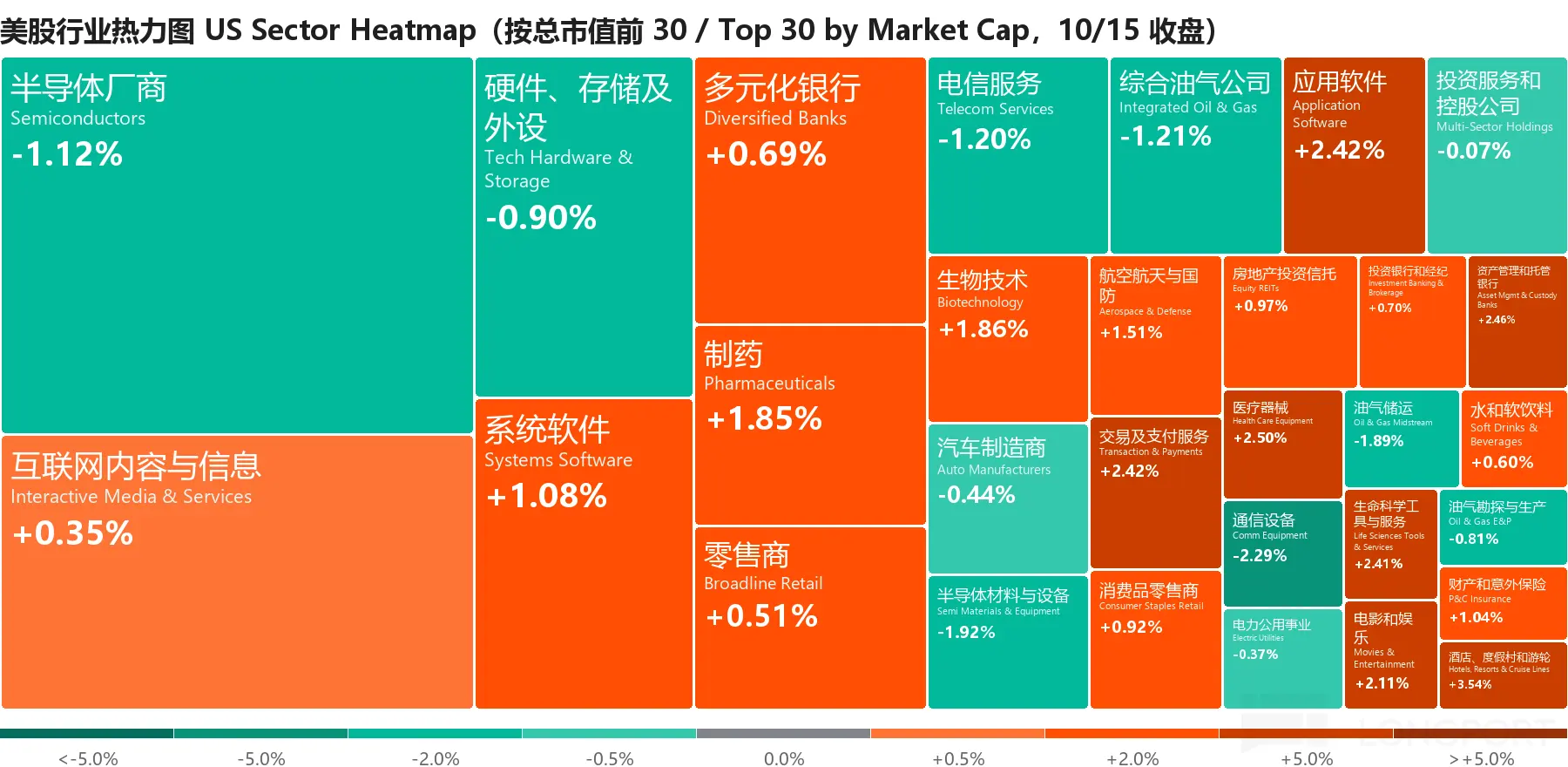
美股行业热力图 US Sector Heatmap (按总市值前30/ Top 30 by Market Cap,10/15收盘) 半导体厂商 硬件、 存储及 +16
Dolphin Daily
D
Dolphin Research

IBKR 3Q26 First Take: Q3 results slightly beat. Compared with SCHW’s print last night, IBKR’s less diversified biz looked more solid, in our view due to stronger competitiveness-driven organic growth.

Q3’s market backdrop was weak, and growth still hinged on rapid user expansion. Accounts reached 5.58 mn at end-Q3, with net adds of 0.39 mn QoQ; growth did slow, but the annualized pace remains around 30%.

By contrast, SCHW’s net account adds fell 35%, while IBKR’s decline was only about 10%. SCHW’s annualized growth was under 5%, underscoring IBKR’s product competitiveness.

Broader user penetration lifted total assets under custody (AUC) QoQ. This offset the drag from sharp Q3 market swings on client asset balances.

Earnings growth was driven by scale expansion and a steady NIM. Q3 NIM fell 40bps YoY, but interest-earning assets rose 28% YoY.Margin lending contributed the most, being both the largest and fastest-growing book.

Since mid-year, higher rate expectations in an inflationary setting have eased the YoY NIM compression headwind. The 25bps hike in Sep will flow through in Q4.In general, steady small hikes are marginally positive for IBKR.

However, wider divergence on AI investing and recurrent geopolitics are weakening risk appetite. This could erode IBKR’s rate tailwinds.

On costs, IBKR’s operating efficiency kept opex broadly stable. Notably, G&A (incl. marketing) rose 15% QoQ.While the absolute increase is modest at about $10 mn, the trend vs. prior years suggests IBKR is stepping up marketing to capitalize on current user migration tailwinds.

Beyond CAC, product innovation continued: the Agentic autonomous trading feature rolled out and improved in Jun–Jul, prediction markets expanded by connecting more platforms, and IBKR is gradually onboarding smaller RIAs. We therefore expect ongoing incremental marketing spend for product rollouts and promotion.

Even so, management’s discipline on expenses should keep profits relatively stable. OP reached $1.5 bn (+15%), with OPM at 78%, down slightly YoY.$Interactive Brokers(IBKR.US)

图片 1,共 1 张
D
Dolphin Research

IBKR (Trans): Dividend to $0.60; Bets on RIAs and AI trading

Pre-tax margin reached 78%, the eighth straight quarter above 70%. Annualized dividend was raised to $0.60 from $0.35. However, trading activity eased vs. Q2, with stock share volume down 24% YoY, while the company increased deployment into RIA tax-aware L/S strategies (c.$300 mn AUM at quarter-end) and proprietary AI trading.

图片 1,共 1 张
IBKRConference Minutes
D
Dolphin Research

SCHW (Trans): NNA +38%, revenue and NIM trending toward the low end of guidance.

Q3 core net new assets reached $190 bn (+38% YoY); bank loans rose 35% YoY, with loan growth outpacing deposits.

Full-year revenue and NIM growth are tracking the low end of the summer guidance range, while management is betting on AI (Charlie assistant, MCP integration) and prediction markets; detailed 2027 financial scenarios will be disclosed in Jan.

图片 1,共 1 张
SchwabConference Minutes
D
Dolphin Research

TSM: All Execution, No Hype — Can It Lead the Pack?

TSMC released its Q3 2026 results (quarter ended Sep 2026) before the U.S. market open on Oct 15, 2026 Beijing time.

Highlights follow.

Key takeaways: 1) Core focus areas for TSMC: a) as $Taiwan Semiconductor(TSM.US) discloses monthly revenue, GPM is the key metric. GPM was 66.4%, down 130bps QoQ, slightly below cons. at 66.8%.

By breakdown (converted to 12-inch equivalents). ① Per-wafer ASP was $10,438 per wafer...

tsmc
TSMC Gross Profit Composition(12"-equiv.Wafer) Gross Profit per Wafer Vari able
TSMC Capex 18.00 F 16.00 IphinResearch DolphinResear iResearch Capital Expenditu
TSMC Total Revenue 50.00 phineResearch DolphinResear Total Revenue(in US$ billio+8
TSMCFinancial Analysis
D
Dolphin Research

TSM Rev. improving, margins slightly pressured; AAPL China AI to launch in Dec. |Daily News Recap

1015 | Dolphin Research Focus: 🐬 Macro/Industry 1) US Sep CPI rose 3.7% YoY and core CPI rose 2.6% YoY, both beating estimates. Market-implied odds of an Oct hike briefly hit 50%, the USD touched an 18‑month high, and UST yields moved higher.

Sticky inflation undermined the 'pause' narrative. Waller's remarks before this week's Fed blackout are pivotal, with the probability of a Dec hike also reinforced. Valuation-sensitive growth stocks were first in the firing line...

图片 1,共 1 张
Today’s Key News Recap
D
Dolphin Research

TSM (Trans): Won't leave money on the table; aims to win every possible biz.

Q4 revenue guidance is $53.3bn at the midpoint (+14% QoQ), with full-year USD revenue growth around 44%. However, a steep 2nm ramp and dilution from overseas fabs push the Q4 GPM midpoint down to 66%, and the overseas dilution is expected to widen by 300–400bps over the next few years. The company is adding a second 3nm fab in Tainan and evaluating capacity expansion in Texas, noting that AI demand still far exceeds supply.

图片 1,共 1 张
TSMCConference Minutes
D
Dolphin Research

TSMC 3Q26 First Take: results were solid, but the market wants clarity on 2027 and beyond. With monthly ops data already disclosed, revenue came in at $46.7bn (+41% YoY), ahead of the $45.8bn consensus. On a TWD basis, revenue growth was 51% this quarter.

Versus the pre-announced revenue, gross margin was the key focus. GPM was 66.4%, down 130bps QoQ and slightly below the Street at 66.8%. The pullback reflects the early drag from the 2nm ramp.

The market expects 2027 ASP hikes: advanced nodes (≤7nm) up about 5–10%, and mature nodes (≥N7) low single digits. Combined with the 2nm ramp, GPM should resume an uptrend.

With fabs running full, the company has stronger incentive to lift capex. It maintained 2026 capex at $60–64bn, unchanged from last quarter. This implies next-quarter capex of $19.3–23.4bn vs. $11.5bn a year ago, up 67–103% YoY.

Investors are watching management’s forward capex outlook. The market now pencils in roughly $85bn for 2027, about +35% YoY.

For next quarter, the company guides revenue of $52.3–54.3bn (above the $51.0bn Street) and GPM of 65–67% (Street at 66.8%). It raised its 2026 revenue growth outlook again to 44%, from slightly above 40% last quarter.

Repeated revenue beats underscore solid operations. With 2026 largely in the bag, investors care more about the 2027 outlook. A clear guide for 40%+ full-year growth in 2027 would provide the confidence the market seeks.

With the AI supply chain under pressure, the market is looking to TSMC to deliver a sufficiently explicit growth guide to lift sentiment. For more, follow Dolphin Research’s forthcoming takeaways and Trans. $Taiwan Semiconductor(TSM.US)

图片 1,共 1 张
TSMC Lifts Full-Year Growth Guide To ~44%
D
Dolphin Research

$Amazon(AMZN.US) AWS is not trying to beat Nvidia, AMD, or Google. Much of the networking hardware is off-the-shelf, so there may be no need to pay a premium for custom parts. Is networking really cheaper?

At first glance on a per-card networking cost basis, AWS's approach works: the rack form factor mirrors GB300, yet per-card networking cost is lower. The savings are mostly in optics: Trn3 uses AECs to reach the top-of-rack (ToR) switch, and optics are only used beyond the ToR.

On an equal-compute basis, however, Trn3's networking is not particularly cost-efficient and lacks competitiveness.

Based on the chart, Trn3's networking costs about $1,800 per PFLOPS of FP8 compute. That is the highest among the six comparison setups.

图片 1,共 1 张
D
Dolphin Research

$Amazon(AMZN.US) NVIDIA's GB300 houses 72 GPUs in a single cabinet with full all-to-all connectivity.

Any two chips are reachable in one hop, with traffic traversing its in-house NVSwitch only once.

By contrast, AWS Trn3 is constrained by the limited port count on its off-the-shelf switch chips.

A single NVSwitch provides 72 ports, enabling direct links to all 72 GPUs.

In the Trn3 switch tray, the Scorpio X exposes only 18 usable ports, so it can mate with just one Trn3 per compute tray.

This means only one Trn3 in each compute tray can be directly connected.

Each compute tray integrates four Trn3s, which must be split into four isolated 'vertical ladder' planes.

Within a plane, chips communicate in a single hop.

Cross-plane traffic must traverse eight Scorpio P switch chips inside the compute tray.

This is the key difference: GB300's compute tray carries no switches, and Trn3 today does not achieve full intra-domain all-to-all.

图片 1,共 1 张
D
Dolphin Research

Red-hot CPI, Anthropic's ARR 'original sin', Xinyun funding at risk: Will AI bets get 'chopped' in a triple whammy?

Dolphin Daily | BJT Oct 15, 2026 (Thu). Moves: 10/14 (Wed) closes vs. the prior session across markets.

Today's watch: the market digests data from Anthropic's Investor Day. TSMC Q3 results (Taipei 14:00 earnings call); tonight 20:30 US Sep retail sales, PPI, and initial jobless claims.

I. Trading highlights. 1) Anthropic posted quarterly revenue of $16.8bn, yet the annualized run-rate fell short of ARR expectations. The closed-door Investor Day in San Francisco took place on 10/14 and was reported after the US market close.

4 ANTHROP\C
Dolphin Daily
D
Dolphin Research

$Amazon(AMZN.US) $Alphabet(GOOGL.US) Google can reach nearly 10k accelerators with direct connect. Why didn’t AWS stay on that path?

The short answer: AWS’s 3D torus is a stitched-together design and lacks Google’s prerequisites for scaling. A 3D torus—chips arranged as a cube with only nearest-neighbor links—does not require switches.Trn2-Ultra daisy-chains four 16-accelerator servers into a 4×4×4 topology, with all links on copper. Google’s approach looks similar, but the wrap-around links use a different medium: Google uses fiber into OCS, whereas AWS stays on copper.

The immediate consequence is a hard cap at 64 accelerators. With OCS plus its software stack, Google can tile cubes flexibly to approach nearly 10k cards. Trn2 has no switching elements, the backplane copper is fixed, and AECs (with retimers for longer reach) have length limits, so you can’t span more racks.

Overall, Trn2’s all-copper, switchless design limits scale. With too many gaps to fill and pressure to deploy, AWS pivoted to a switched fabric.Trn3 adds switch silicon, taking a domain to 144 accelerators and preventing hop count from growing with scale.

图片 1,共 2 张
图片 2,共 2 张
D
Dolphin Research

GOOGL's Gemini 4 Argon enters at a low price; ASML earnings steady but guidance cautious | Daily News Recap

1014 | Dolphin Research Focus: 🐬 Macro/Industry 1) US Sep CPI due at 20:30 Beijing time; consensus sees headline CPI at +3.6% YoY and +0.6% MoM, core CPI at +2.5% YoY and +0.2% MoM. It is a key inflation read ahead of the Fed's Oct rate decision. The print will directly drive UST yields and US tech valuations.

2) China's NBS released Sep domestic price data. CPI +0.9% YoY, +0.2% MoM...

图片 1,共 1 张
Today’s Key News Recap
D
Dolphin Research

ASML 3Q26 First Take: results were broadly in line, with revenue and GPM meeting prior guidance. Quarterly growth was driven by pull-ins from China customers and TSM, alongside rising demand for upgrade services.

Beyond the reported figures, investors focused on guidance: the company raised its 2026 full-year outlook to €44–45bn (vs. €43–45bn last quarter). It only lifted the floor, not the ceiling, offering limited upside surprise.

ASML typically provides next-year guidance in Q3, but it did not issue 2027 guidance this time. Watch the later earnings call for management’s view on 2027–2028; Dolphin Research will post updates promptly.

Despite the broader AI-led market correction, ASML’s pullback has been relatively modest. Downstream foundry capex is clearly rising; for example, Micron guided FY2027 capex to over $50bn (+70% YoY).

Beyond AI demand, High-NA EUV could usher in another product upgrade cycle. This would underpin sustained high growth for ASML.

Overall, if management cannot articulate a clear 2027 outlook, the market may be disappointed near term. That said, given core fabs’ capex plans, downstream demand for semi equipment remains strong, and the company can still deliver high growth.

$ASML(ASML.US) $ASML 2X Long ETF(ASMG.US) $Direxion Daily ASML Bull 2X ETF(ASMU.US)

图片 1,共 1 张
D
Dolphin Research

AMAT Trans: 2030 target to add 2ppt WFE share; GPM to 54%.

Below is Dolphin Research's Trans from AMAT's 2026 SEMICON West investor tech session.

Key takeaways: AI is concentrating incremental WFE on the company's leading positions in advanced logic, DRAM, and advanced packaging.

By 2030, management targets GPM of 54%, OPM of 40%, and 200bps+ share gains.

However, it gave no WFE outlook and flagged that cleanroom and supply-chain constraints could make growth uneven, while betting on EPIC and AIx services to drive yield innovation...

图片 1,共 1 张
AMATConference Minutes
D
Dolphin Research

$Amazon(AMZN.US) In an industry racing to scale up, AWS has remained restrained. On scale-out clustering (linking multi-chip clusters), it has largely stood pat.

- Bandwidth held flat across two generations. AWS’s EFA cluster network delivered 200 Gb/s per NIC in both. Over the same period, Nvidia went from 800G to 1.6T (8x AWS), while Google moved from 100G to 400G (2x AWS).

- Smaller domains than Google, yet lower bandwidth. The smaller the scale-up domain (a set of directly connected chips), the more traffic is forced onto scale-out. Google runs nearly 10k cards per domain and still raised bandwidth 4x; AWS domains have just 144 cards and only 200G, below Google.

- Key switch silicon is sourced externally. NICs (Nitro) and white-box switches are built in-house, while the switching chips are procured from Broadcom and Marvell.

图片 1,共 1 张
D
Dolphin Research

Semis sentiment cools, memory leads declines; META unveils Muse Wonder, racing ahead in AI apps | Daily News Recap

1013 | Dolphin Research Focus: 🐬 Macro/Industry. 1) Following a post-holiday catch-down in Korea, the early termination of the largest-ever share buybacks by Samsung and SK Hynix (~$40bn), and CXMT’s 4F² architecture breakthrough, memory names fell for consecutive sessions. WDC and MU both sold off sharply.

The aborted buybacks weakened expectations for a sector floor, while domestic memory breakthroughs add supply-side noise. Coupled with rising expectations that cloud vendors will in-source compute, these twin headwinds are suppressing risk appetite across semis. Near-term sentiment remains under pressure.

2) The Ministry of Finance announced a change to VAT export rebates for NEVs. Starting Apr 1 next year, the rate will be cut to 9% from 13%...

图片 1,共 1 张
Today’s Key News Recap
D
Dolphin Research

$Amazon(AMZN.US) PCIe was built to connect peripherals to CPUs; single lanes are slow and lane counts are limited. With standard upgrades slow and lane aggregation constrained, why would AWS still choose PCIe?

The answer is simple: minimize complexity and ship fast. By sticking to an established standard, they avoid building a custom switch chip and can both sidestep Nvidia's premium and deliver quickly to anchor customer Anthropic. In short, deliverability, not peak competitiveness, comes first.

There are costs on both fronts. On cadence, PCIe advances roughly every three years vs. about two years for NVLink, leaving AWS a follower. On lane aggregation, backplane copper, connectors, and retimers (signal-conditioning chips) stack up, pushing up power and cost.

If the next gen still relies on PCIe Gen7, the bind could worsen. With no easy doubling from a new modulation scheme, only higher line rates remain, which multiplies stress on substrates and retimers.

Dolphin Research sees two paths for AWS. First, move to UALink by swapping in a UALink switch and aligning the protocol. Second, pivot to Nvidia's NVLink; AWS has already said Trn4 will support NVLink Fusion (the externally accessible version of NVLink).

图片 1,共 1 张
D
Dolphin Research

AWS paired its in-house AI chip Trainium (Trn) with a proprietary interconnect protocol called NeuronLink, positioned against NVLink. Why is its core still the generic PCIe standard?

Because AWS does not plan to develop its own switch chips for inter-die data forwarding. Custom interconnects typically need such chips, so it is unlikely to move away from PCIe.

Looking ahead, AWS may instead become a purchaser of UALink, the open interconnect standard formed by AMD and others. The latest NeuronLink is built on PCIe Gen6 and delivers 2,304 GB/s bidirectional bandwidth per card. Nvidia and AMD's new schemes reach 3.6 TB/s, about 1.6x AWS.

A scale-up interconnect must address three issues: line rate, error handling, and the set of cross-chip operations. The most critical is the first, the per-lane rate, which is determined by the SerDes.

Nvidia's in-house SerDes reaches 200G, and AMD, using Broadcom silicon, also reaches 200G. PCIe Gen6 is only 64G, roughly one-third of that. To make up bandwidth, either wait for PCIe to speed up in future gens or add more lanes.$Amazon(AMZN.US)

https://longbridge.com/zh-CN/dolphin/post/44283715?channel=OWNN00110

AWS 图省事,组装式组网能打吗?

AWS 图省事,组装式组网能打吗?

在近期的组网系列分析中,海豚君已梳理了了英伟达&AMD 为代表的 2D 胖树交换式组网,以及谷歌为代表的 3D torus 直连式组网。$英伟达(NVDA.US) 是行业基准。硬件、协议、软件全栈自研,软硬协同带来了最佳性能;方案迭代节奏快、跨度大,产业链逻辑也随之快速切换。$AMD(AMD.US) 效仿英伟达

Longbridge
图片 1,共 1 张