

TSM: All Execution, No Hype — Can It Lead the Pack?
 I'm LongbridgeAI, I can summarize articles.
TSM released Q3 2026 results (to Sep 2026) pre-market on Oct 15 (Beijing time). Key takeaways are below.
1) Core focus areas
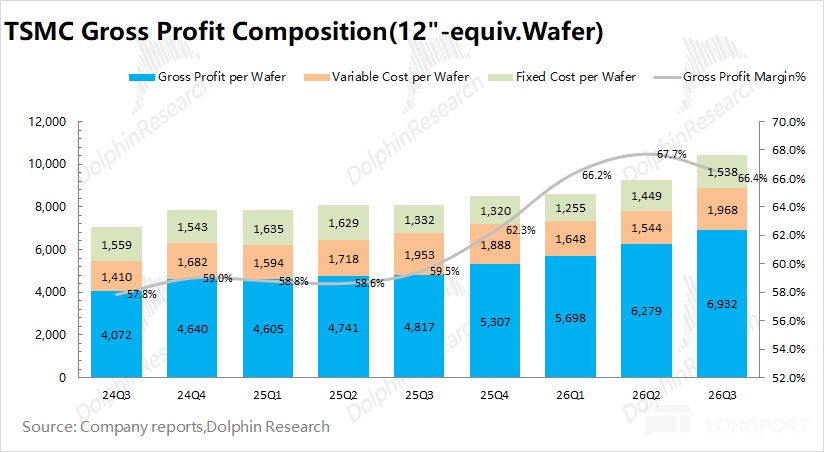
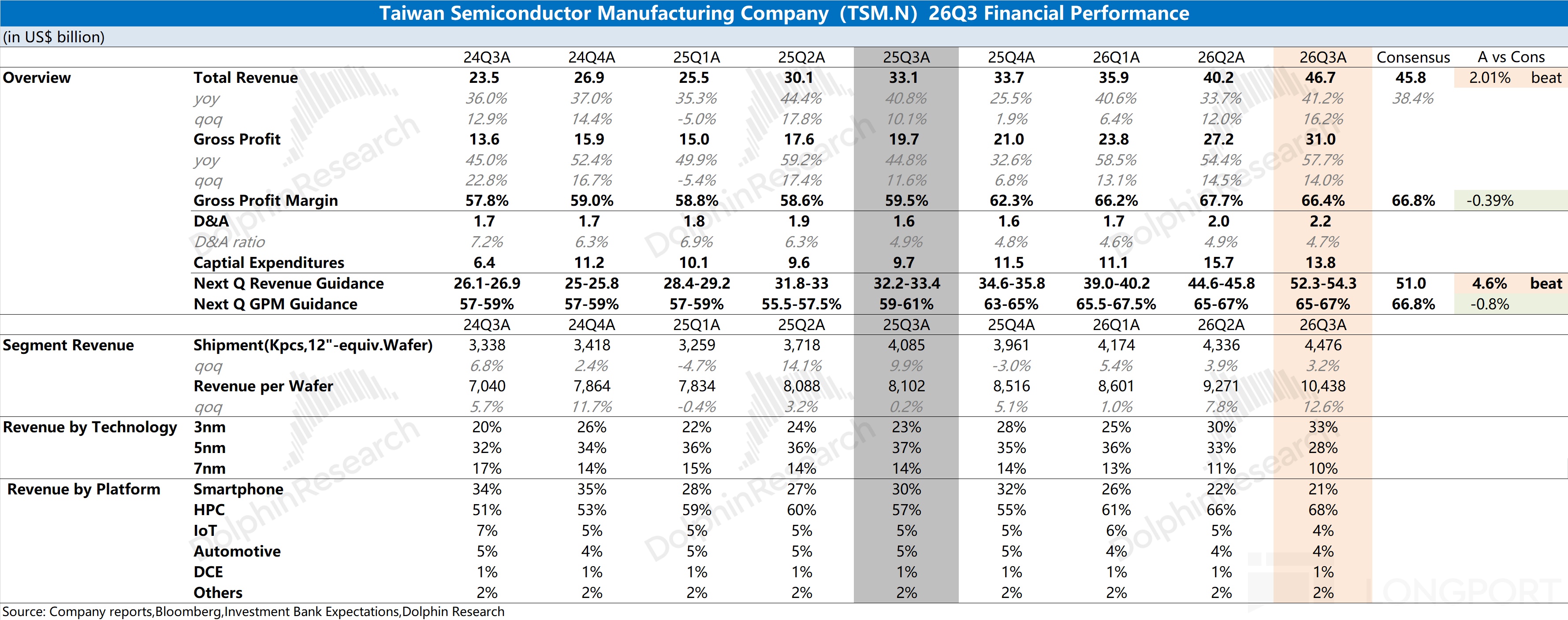
a) Because$Taiwan Semiconductor(TSM.US) reports monthly revenue, GPM is the key metric. GPM came in at 66.4%, down 130bps QoQ and a touch below the Street at 66.8%.
On a 12-inch equivalent basis: (1) wafer ASP was $10,438 per wafer, up $1,167 QoQ; (2) avg. fixed cost (D&A) was $1,538 per wafer, up $89 QoQ; (3) avg. variable cost (other mfg. opex) was $1,968 per wafer, up $424 QoQ.
Overall, both ASP and unit cost rose meaningfully, mainly as 2nm mix increased. Early-stage 2nm ramp is dilutive to consolidated GPM (mgmt. estimates a 2-3ppt impact). As 2nm yields ramp and advanced nodes take a larger mix, GPM should resume an upward trend.
b) Guidance: next-quarter revenue of $52.3-54.3bn (above the Street at $51.0bn) and GPM of 65-67% (Street at 66.8%).
TSM raised its 2026 revenue growth outlook to 44% (vs. slightly above 40% last quarter), implying next-quarter revenue of roughly $53.0-53.5bn with YoY growth above 55%. GPM guidance is conservative, as early 2nm ramp remains a drag.
With 2026 largely de-risked, similar to ASML yesterday, the market is more focused on 2027 guidance. Confidence would be strongest if mgmt. could explicitly guide 2027 growth to '40%+' or better.
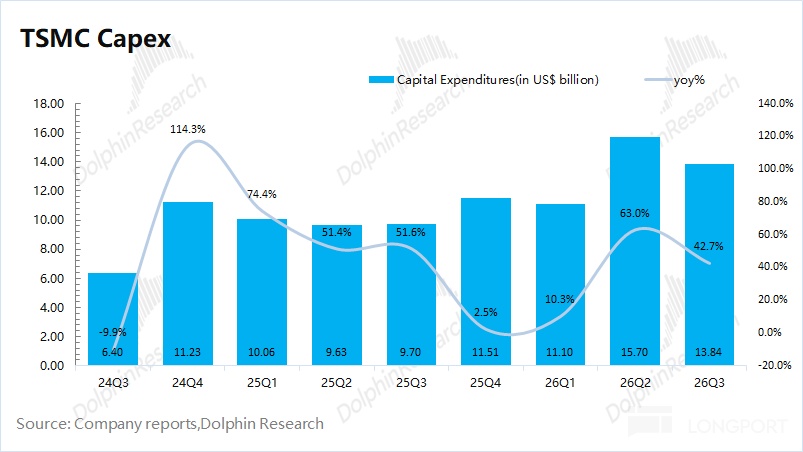
c) Capex: Q3 capex was $13.8bn; mgmt. maintained 2026 capex of $60-64bn, implying Q4 capex of $19.3-23.4bn (vs. $11.5bn a year ago), up 67-103% YoY.
Consensus now expects 2027 capex at around $85bn. Watch for 2027 capex outlook, which signals mgmt. confidence in demand and expansion.
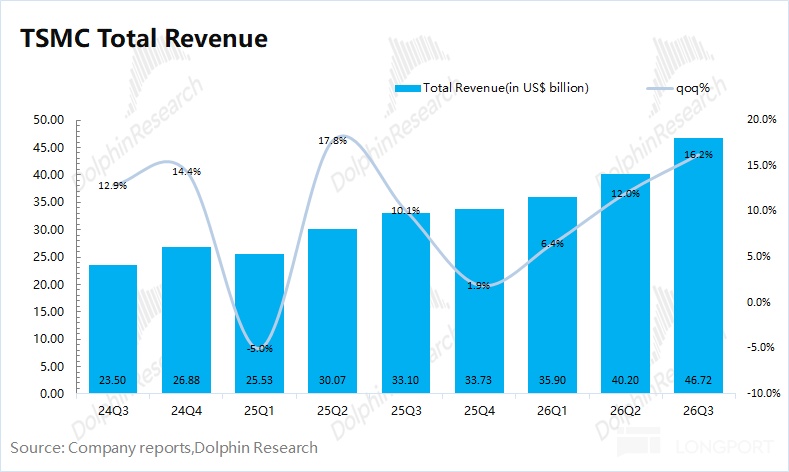
2) Revenue: Q3 revenue was $46.7bn, up 16% QoQ and ahead of the Street ($45.8bn). Growth was driven by 2nm ramp for new Apple devices and stronger AI chip demand, as key customers have migrated AI chips to 3nm/2nm.
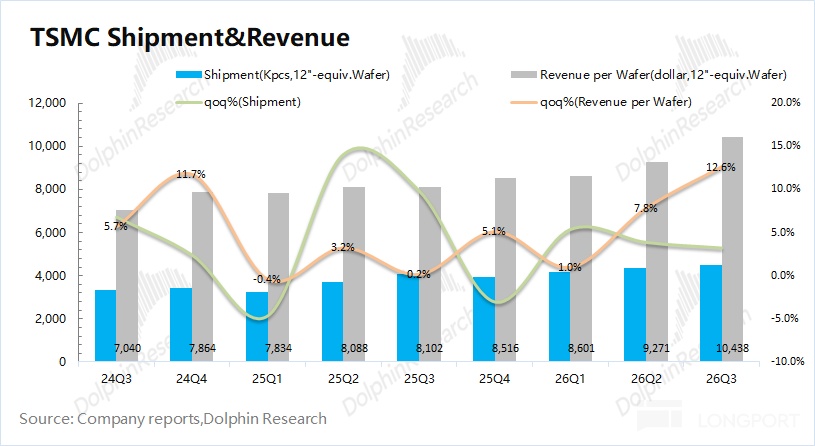
On volume/price (12-inch eq.): (1) wafer shipments were 4,476k wafers, up 3% QoQ; (2) wafer ASP was $10,438, up 12.6% QoQ, reflecting 2nm ramp and a richer advanced-node mix.
3) Business progress: nodes, end-markets, regions
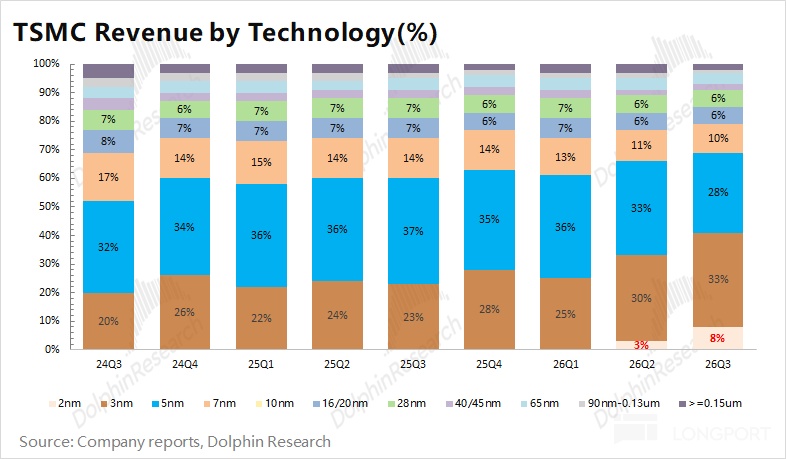
a) By node: advanced nodes at 7nm and below rose to 79% of revenue this quarter. 2nm delivered 'material' revenue starting last quarter, and rose to 8% this quarter; Apple and AMD MI450 are on this node.
With 2nm ramping, mainstream AI customers have largely moved to 3nm/2nm. The revenue mix continues to tilt toward advanced nodes.
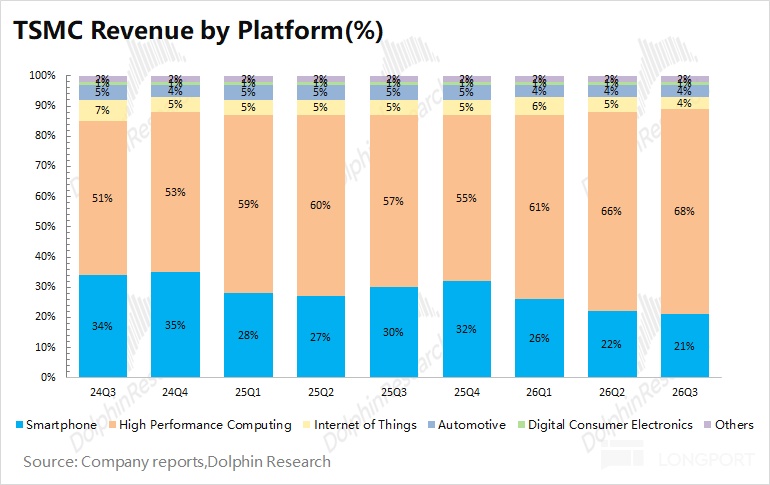
b) End-market: QoQ growth was mainly driven by AI chips, while smartphones saw seasonal uplift on Apple's 2nm devices. HPC remained the largest segment at $31.8bn, up $5.3bn QoQ, accounting for 68% of revenue, led by higher shipments of NVIDIA Rubin, Broadcom TPUs and other AI parts.
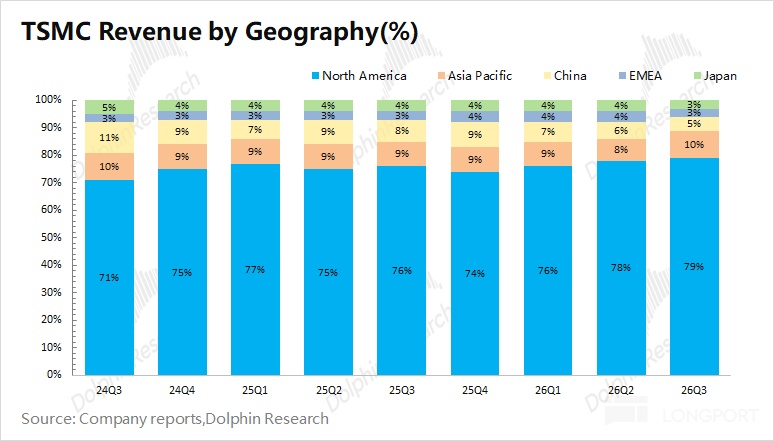
c) By region: North America remained the largest region, spanning NVIDIA, Apple, AMD and other key accounts, at 79% of revenue. China revenue was about $2.3bn, stable, with share compressed to around 5%.
TranscriptClick
Dolphin Research view: 2026 is largely set, but 2027 guidance is missing
As the anchor of the semiconductor cycle, TSM delivered another steady print. GPM dipped modestly due to the 2nm ramp, which is not ideal, but not structurally negative either.
More importantly, unlike memory where scarcity drives sharp price hikes, TSM as a high-moat scarce asset raises prices in a more predictable and stable way—modest list price moves, with structural uplift coming from technology upgrades; CoWoS is allocated, not auctioned.
This approach avoids a shock to the supply chain. It also shows leadership as the AI chain leader in US equities.
With core AI investing pillars wobbling—Anthropic ARR occasionally disappointing and AI financing costs rising—the market hoped TSM would offer a confidence boost as 2026 ends.
A. A 2027 outlook well above the Street, ideally 40%+, and better yet 50%+;
The Street expects advanced nodes (7nm and below) to see 5-10% price increases in 2027, with low-single-digit increases for mature nodes, plus 2nm mix tailwinds. Revenue and GPM guidance should thus convey confidence.
B. 2027 capex above the ~$85bn Street (vs. 2026 guide of no more than $64bn).
These were not included in the initial materials, which may disappoint. TSM leads the real economy, not capital markets narrative, so some disappointment is understandable.
Beyond results, the market is tracking the following:
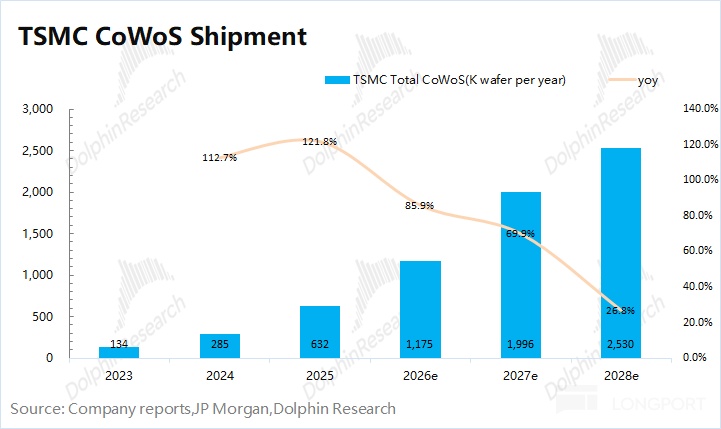
a) CoWoS capacity: mainstream AI chips (NVIDIA, AMD, TPU) all use CoWoS, and TSM supplies over 90% of the global capacity.
Even if chip designers want to ramp, CoWoS allocation directly caps AI chip shipments, making TSM the choke point in the AI chain. Based on industry data and expectations, monthly CoWoS capacity is around 100k wafers now, rising toward 200k by end-2027.
Dolphin Research estimates 2027 CoWoS shipments could reach ~2.0mn wafers, up ~70% YoY, with NVIDIA, Broadcom and AMD as the largest customers.
b) 2nm progress and node migration: 2nm began a volume ramp in H2 2026 and contributed 8% of revenue this quarter, with Apple and Qualcomm smartphone demand migrating to 2nm. AI chips have fully moved into the 3nm/2nm era, with Rubin and Google TPU v720 fully on 3nm.
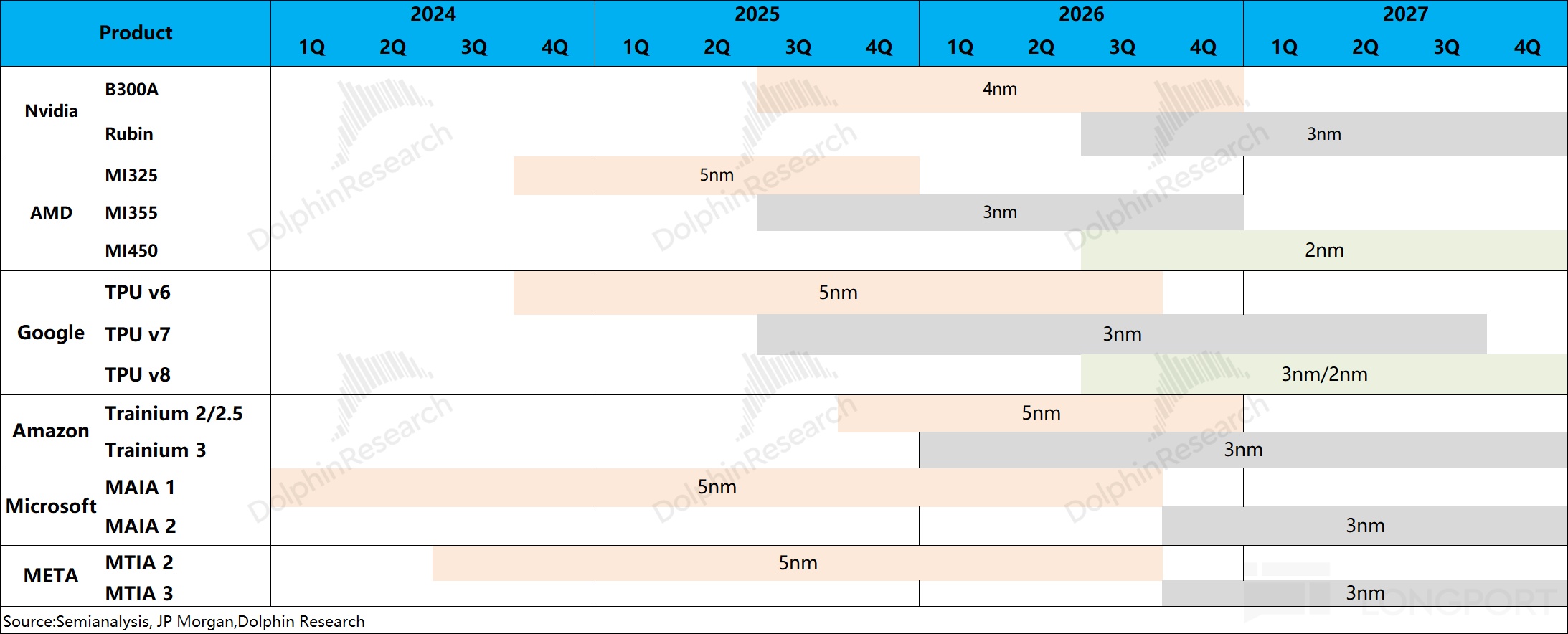
3nm lines remain very tight, running above 100% utilization. With good 2nm yields, TSM is accelerating the 2nm ramp, which in turn drives higher capex (full-year capex guide $60-64bn, up ~50% YoY).
c) Foundry competition: after TSM entered 2nm volume, Samsung and Intel moved into SF2 (2nm) and 18A (1.8nm) nodes, respectively.
Intel and Samsung still trail TSM: (1) their latest-node transistor densities are below 250 MTr/mm², well under TSM at 313 MTr/mm²; (2) yields are lower, so volume mainly serves in-house chips, while TSM serves a broad base of core external customers.
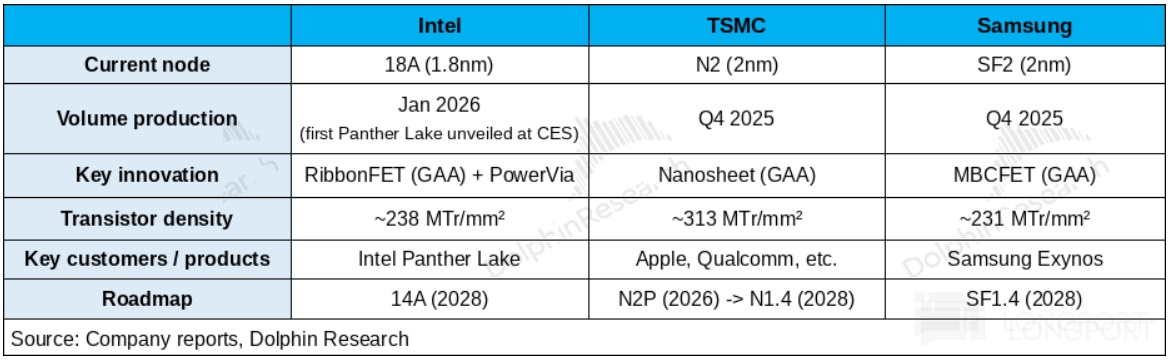
Given persistent AI chip tightness, if Intel and Samsung break through in advanced packaging and improve yields, they could win overflow orders.
Intel also has a strong 'Made in USA' profile, and US stakeholders are willing to give it room to experiment. Google TPU v9 and AMD are testing back-end packaging collaborations with Intel.
Previously, the Intel-Tesla 'TeraFab' plan was seen as a threat to TSM. Recent reports that Tesla is discussing US capacity with TSM suggest the 'Intel-Tesla TeraFab' narrative is fading, underscoring TSM's competitiveness.
In a hot cycle, TSM's key decision is not demand, but how far to expand: under-expand and risk share loss via order overflow; over-expand and bear downcycle risk.
This time mgmt. signaled: 'what's on the table is ours.' That stance invites the question—will 2027 expansion be more aggressive than the Street expects? We will watch closely.
From a valuation lens, with a current mkt cap of ~$2.23tn, TSM trades at about 17x 2027 EPS (assuming +44% revenue CAGR, 68% GPM, 17% tax). Versus its historical 20-30x PE range, the stock sits at the low end. With 40%+ growth and sub-20x PE, the pullback leaves TSM attractive.
The recent pullback is largely sector beta from AI, though TSM fell less (~10% over two weeks), supported by its advanced-node dominance and earnings visibility.
TSM still supplies over 90% of core AI chip capacity. Until Intel/Samsung crack both technology and yields, TSM's CoWoS remains the best option.
On the print itself, revenue and next-quarter guidance were solid, and GPM pressure from 2nm ramp is understandable. But with 2026 largely locked, the market cares more about 2027 and beyond.
While mgmt. declared it aims to 'leave nothing on the table' and pursue every piece of business, it did not provide explicit 2027 guidance on the call. The message was largely 'no updates', 'cannot assess', or 'no comment', with only that '2027 revenue growth will outpace capex growth'.
With recent weak Anthropic data and US 10Y yields near 5%, the AI complex is under pressure. The market hoped for a clear growth guide from TSM to lift confidence. Instead, mgmt.'s equivocal tone on 2027+ may disappoint in the near term.
Overall, TSM and ASML remain structurally strong with high growth, which also limited their drawdowns in the AI pullback.
After the correction, TSM remains the scarcest, most monopolistic on capacity, and the highest-visibility asset in the chain. As sector beta stabilizes, valuation could re-rate above 20x PE, with potential to challenge $500.
<End>
Related Dolphin Research on TSM
Jul 16, 2026 Trans 'TSM (Trans): Full-year growth above 40%, capex lift remains prudent'
Jul 16, 2026 Earnings take 'No 'blowout'! 'Decent' TSM can't carry the grand AI narrative?'
Apr 16, 2026 Trans 'TSM (Trans): Consistently 'prudent', small full-year guide raise'
Apr 16, 2026 Earnings take 'TSM: The true AI overlord, who can shake it?'
Jan 15, 2026 Trans 'TSM (Trans): $10bn capex lift, aligned with downstream'
Jan 15, 2026 Earnings take 'TSM: The true AI boss, who would say no?'
Oct 16, 2025 Trans 'TSM (Trans): 2nm mass production by year-end, bigger investment next year'
Oct 16, 2025 Earnings take ''Dominant' TSM, the strongest in the AI era?'
Jul 17, 2025 Trans 'TSM (Trans): Full-year revenue growth raised to 30%'
Jul 17, 2025 Earnings take 'TSM's backbone strength in semis!'
Risk disclosure and disclaimer: Dolphin Research disclaimer and general disclosure


The copyright of this article belongs to the original author/organization.
The views expressed herein are solely those of the author and do not reflect the stance of the platform. The content is intended for investment reference purposes only and shall not be considered as investment advice. Please contact us if you have any questions or suggestions regarding the content services provided by the platform.