

AI Portal War 2.0: Tencent, BABA or ByteDance — who is the hidden champion in AI productivity?
 I'm LongbridgeAI, I can summarize articles.
Over the past year, the most bankable AI use case has been coding, with developers becoming the first white-collar cohort willingly paying for AI tools. That said, core coding scenarios already show roughly 70% penetration, and the market is now looking for the next growth arena. Beyond developers, there are about 1 billion knowledge workers globally.
Can AI for office work — also called Co-work or work Agents — pick up where Coding left off, becoming the next scenario with a sharp penetration ramp and a proven biz. model? That is the central question investors are asking.
This piece by Dolphin Research focuses on AI for office workflows and analyzes four issues: 1) Why is the entry point shifting from a chatbox to an Agent? 2) What enables Agents to work, and can tech become a moat?
3) Which lands first, personal Agents or work Agents? 4) Using China as a case study, how do we assess each core player’s odds?
Details follow:
I. The AI entry-point shift: from 'chatting with you' to 'doing your work' The fight for AI entry points has tracked core model advances, but unlike the old internet era where marginal user costs were near zero, today’s compute costs break the classic 'subsidize, train user habits, then monetize' pure traffic playbook. Under cost pressure, platforms with tech, ecosystem, and traffic advantages are now focused on unit economics.
On the consumer side, low pay rates reminiscent of 'knowledge paywalls' and short daily usage — too brief to support ample ad inventory — make monetizing early AI chatbots unusually hard. This has constrained scale-up despite rapid initial diffusion.
By contrast, task-completion Agents unlocked enterprise willingness to pay, especially among tech firms and IT pros. Stack Overflow surveys in Apr and Oct 2026 show 59% Agent usage, with 37% using daily. Among developers using AI tools, 66% use Coding Agents and 73% of them use them daily.
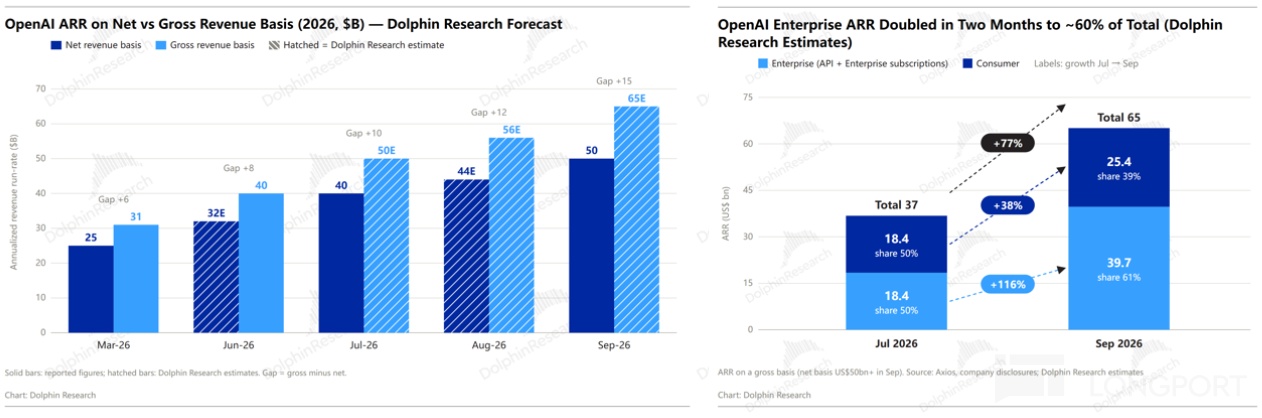
In Jul this year, OpenAI’s B-side revenue (API, Enterprise subs.) surpassed C-side (still 40% in Apr), hitting a $20+ bn annualized run-rate. By end-Sep it doubled, and on a total ARR of $65 bn gross ($50+ bn net), the B-side accounted for over 60%.
On the C-side, back-solving suggests ARR was about $25 bn by end-Sep, up less than 40% vs. Jul. Growth is clearly skewing toward enterprise.
On ads, OpenAI entered the market early this year with strong conviction, staffing up while partnering across third-party ecosystems. But with weak conversion, CPMs were repeatedly cut — from $60 per thousand impressions in gray tests to $15–25, aligning with mature digital ad platforms. Meanwhile, the self-serve minimum buy fell from $50,000 to zero.
Latest update: ARR reached $1 bn by end-Aug, but that already covered tens of thousands of advertisers across 40+ countries. Scale did not translate into pricing power.
Why is chatbot monetization so difficult? It is not that AI is useless; rather, the chatbot interaction format makes value hard for users to quantify and verify. AI’s value has two sides: verifiable efficacy and measurable revenue lift or cost savings.
Chatbots deliver 'advice', not 'results'. In most cases users cannot quantify time saved or money saved, and outcome quality is 'felt' rather than verified. Users often must rerun the process to confirm results, which raises acceptance costs and erodes trust.
As acceptance costs rise, trust becomes unstable, confining usage to shallow Q&A. The user data generated here lacks feedback richness and contributes little to post-training, forcing platforms to procure or label high-quality data and build validation environments. To lift models, they must then spend even more to extract high-grade content from everyday Q&A logs.
Low trust and simple tasks also mean no meaningful data assets accrue. Switching costs stay low, and users can glide to any cheaper chatbot. As a result, chatbots can maximize 'user counts' but struggle to raise 'pay rates' that reflect stickiness and loyalty.
Why did Coding break out first? Unlike chatty outputs, Agents aim to complete tasks, aligning with enterprise needs. They also hit both sides of the AI value equation: verifiability and measurability.
Coding lives within bounded knowledge with clear right/wrong and can be auto-verified end-to-end. The incremental value is also measurable, mapping directly to high IT wages.
Other high-value, quickly accepted scenarios include financial reconciliation, legal compliance review, data analysis, investment workflows, and sales strategy. These share verifiability and high per-task economic value.
The larger opportunity is to merge and extend these scenarios into a unified enterprise productivity platform. By embedding in enterprise workflows, providing traditional office capabilities, and using AI to drive growth, vendors can move beyond mere 'employee cost cuts'. This is a structurally bigger play.
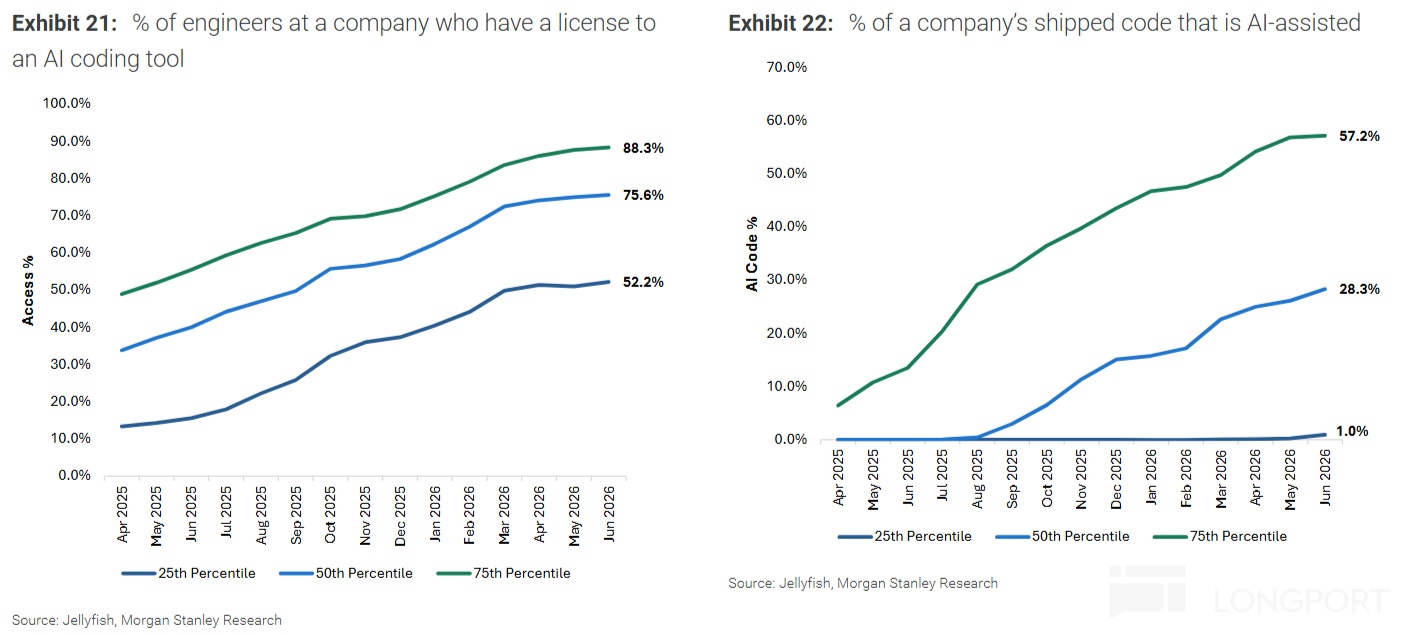
However, a unified office platform is not a simple copy of Coding. Its path will be less linear than Coding, which drove AI Coding adoption above 70% among IT staff in a year, with AI-assisted code nearing 30% of total output.
Three factors are decisive: (1) Acceptance standards are fuzzier and more complex, with many outcomes requiring human judgment rather than auto-validation. (2) Task chains are longer, and any small failure can stall the pipeline, e.g., month-end reconciliation touches online banking, tax systems, and ERP, leaving less tolerance for error at each step.
(3) For cybersecurity reasons, enterprises prefer on-prem or private deployment, requiring the AI office vendor’s FDE team to embed on-site. Procurement cycles are therefore longer than for AI Coding, slowing rollout.
II. In the Agent race, is tech the core moat? 1) Agent = LLM + Harness To judge sustained moats, start with how Agents work.
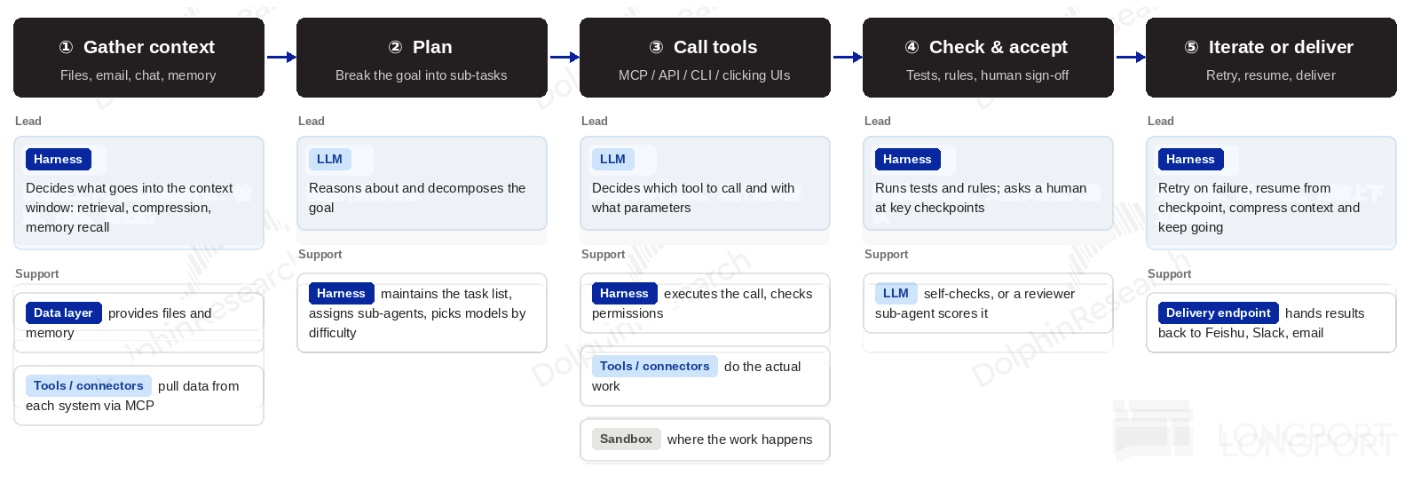
An Agent completes a job through five key steps, each with distinct software tools. Two core layers are the LLM and the Harness: the model reasons and decides or requests actions, while the Harness executes and validates safely and reliably.
2) The real moat is 'data' Stable delivery requires accurate model judgments and a dependable Harness for execution. So do leading Agents gain moats from the model or from the Harness?
(1) The Harness is essentially a technical shell. Its design patterns and engineering primitives — logs, permissions, sandboxing, archiving, UI — are mature and generic infrastructure. Integration protocols like MCP and Skills have become open standards.
OpenAI open-sourced Codex Harness, with Dots running on it. Open-source OpenClaw inspired Microsoft Autopilot and Meta Muse, underscoring how shareable Harness ideas are.
Thus the Harness itself is not a moat, and models are absorbing parts of its function. Capabilities once patched by the Harness are being trained into models over time.
a. Scheduling and execution folded into the model (for parallel tasks) Kimi exemplifies this: starting with K2.5’s Agent Swarm, the model splits tasks and dispatches sub-Agents itself. K2.6 and K3 continue this path, training more Agent collaboration into the model to reduce reliance on serial Harness orchestration.
That said, top labs still commonly delegate orchestration to the Harness. Models are trained to use 'task decomposition' as a tool, and when needed, the Harness launches multiple sub-Agents for parallel execution.
b. Context and self-correction folded into the model Context windows are converging toward 1M tokens, and planning plus self-correction is increasingly native to models. This reduces the relative importance of the Harness functions for context management, compression, and error checking.
(2) Models are converging, and you don’t need the frontier model perpetually. Differences in base models do affect UX, but frontier leads tend to last only 3–6 months. Open-source models caught up materially mid-year, and over the past two months, leading closed models in North America have also kept pace with rapid updates.

Closed models have locked down chain-of-thought to prevent distillation, yet challengers still iterate via better post-training — i.e., richer feedback-validated data loops. Meanwhile, on the 'can do the job' baseline, performance gaps are narrowing.
Even as closed models cut prices — sometimes fielding cheaper small models to slug it out with China’s open models — their former marquee clients are turning into competitors. These cases show 'pure model-layer' lock-in is weak.
a) Meta first used Claude Code to develop Muse, then replaced it with in-house Muse Code. b) Microsoft routed Copilot by default to cheaper OpenAI models. c) In Jul, Alibaba dropped Claude Code in favor of its own Qoder.
(3) What’s truly hard to copy is retained 'user usage data' If neither models nor Harnesses are moats on their own, why do users find Codex and Claude Code consistently 'smarter'? That 'smarts' is largely the ability to infer intent quickly and internalize past experience for future tasks — in short, superior context.
An Agent with deep context can store user data and retrieve it for future tasks. This includes chats, files, emails, permissions, industry know-how, internal policies, org charts, and process logs. Crucially, user trajectories — corrections, approvals, rejections — feed back into post-training via RL.
This is why the Harness as the entry point — even when using a third-party model — can collect usage trajectories to train its own models. As shown below, along the Agent workflow, the Harness sees far richer user data than the base model.
In particular, the 'human confirmation and delivery' stage is nearly invisible to the model. It loses the best post-training fuel, while the Harness captures it.
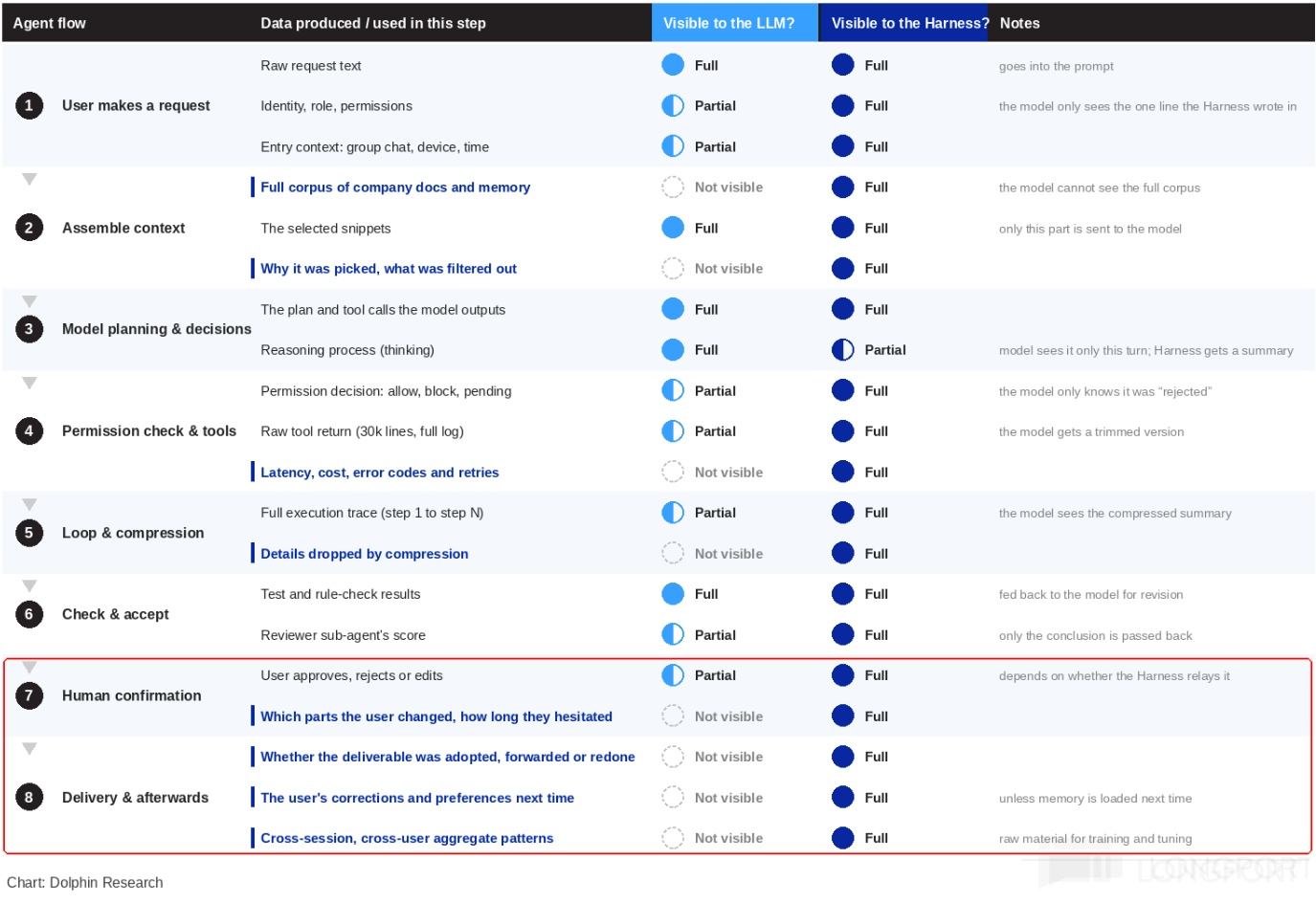
If the model vendor and the Harness platform are different companies, data feedback to the original model is diluted. Conversely, the Harness platform can use usage trajectories to rapidly improve its own lagging model.
The best setup is one company owning both the model and the Harness, ensuring full access to usage data. Continuous post-training then drives a perception of 'getting smarter the more you use it'.
3) Own-ecosystem advantages are another head start Data feedback scales with user volume. Users may come for product utility (model performance, skill ecosystem breadth), or from high-frequency entry points — i.e., tool integrations (MCP/API or Computer Use) and distribution channels (IM, OS, browsers).
Either way, you must interface with traditional internet platforms. In walled gardens, whoever owns more native ecosystem and a high-traffic IM entry starts ahead. Distribution often beats pure tech advantages at the gate.
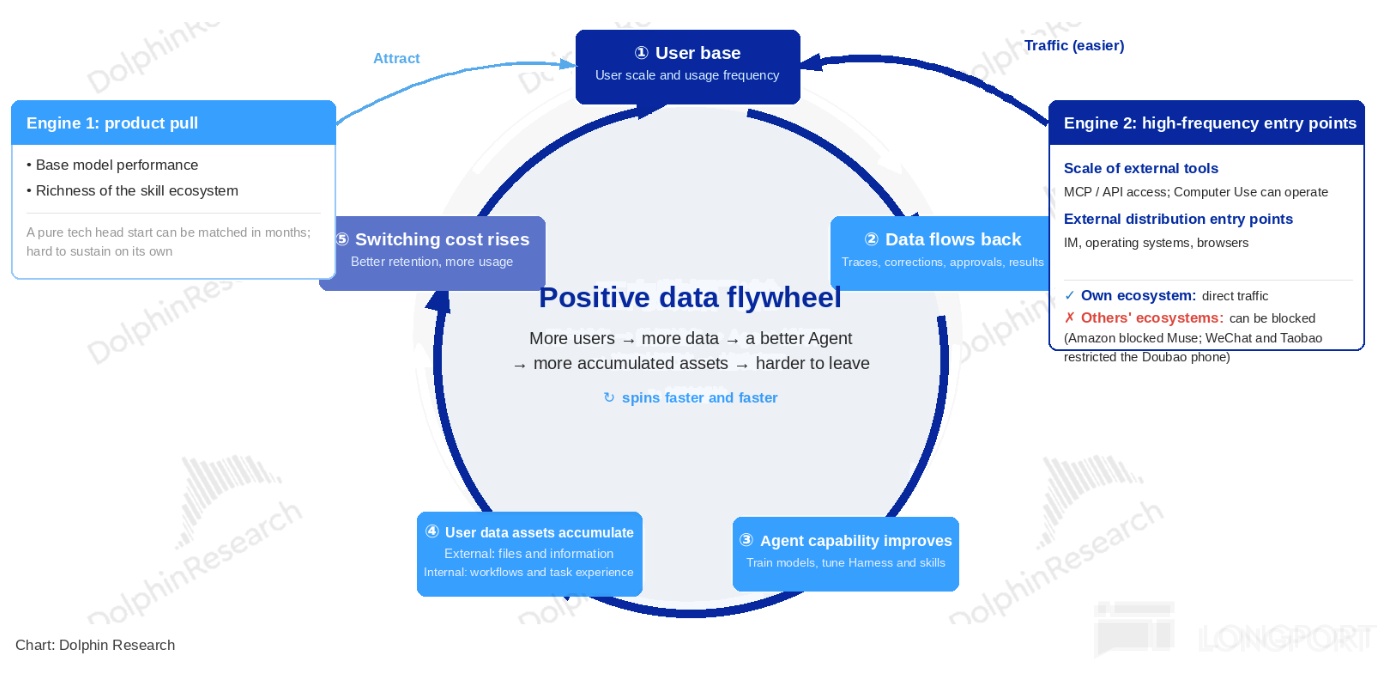
To wrap up Part 1: the AI entry point is shifting from the chat box to the agent, because chatbots deliver advice rather than outcomes. Users cannot measure the value or verify the result, so they stay in shallow Q&A, leave little useful data behind, and churn easily. Agents changed that in coding, where results verify themselves and the savings are easy to price.
The moat, though, sits in neither the model nor the harness. Both are converging. What is hard to copy is the trail of user data an entry point accumulates, plus the ecosystem that feeds it traffic.
So how big is this market, and which of China's giants is best placed to own it? That is what Part 2 is about: link.
<End>
Risk disclosure and disclaimer: Dolphin Research Disclaimer & General Disclosure


The copyright of this article belongs to the original author/organization.
The views expressed herein are solely those of the author and do not reflect the stance of the platform. The content is intended for investment reference purposes only and shall not be considered as investment advice. Please contact us if you have any questions or suggestions regarding the content services provided by the platform.