

KO: Post-World Cup, can the 'happy sugary soda' keep coasting?
 I'm LongbridgeAI, I can summarize articles.
Coca-Cola: World Cup fades, volumes don’t
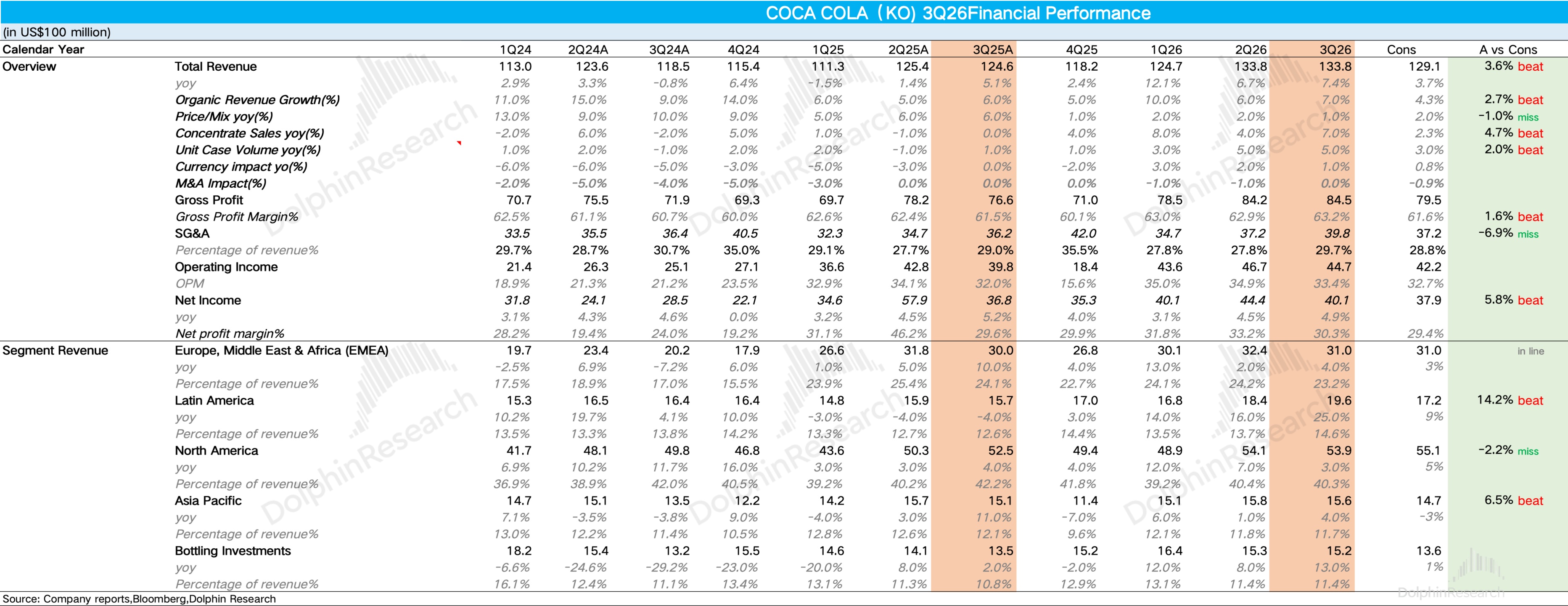
'The No.1 consumer stock in the universe' Coca-Cola (KO) released its Q3 2026 results (to Oct 2, 2026) pre-market on Oct 27 Beijing time. In a quarter lapping the World Cup tailwind, the company beat expectations again and raised FY guidance for the third time this year. $Coca Cola(KO.US)
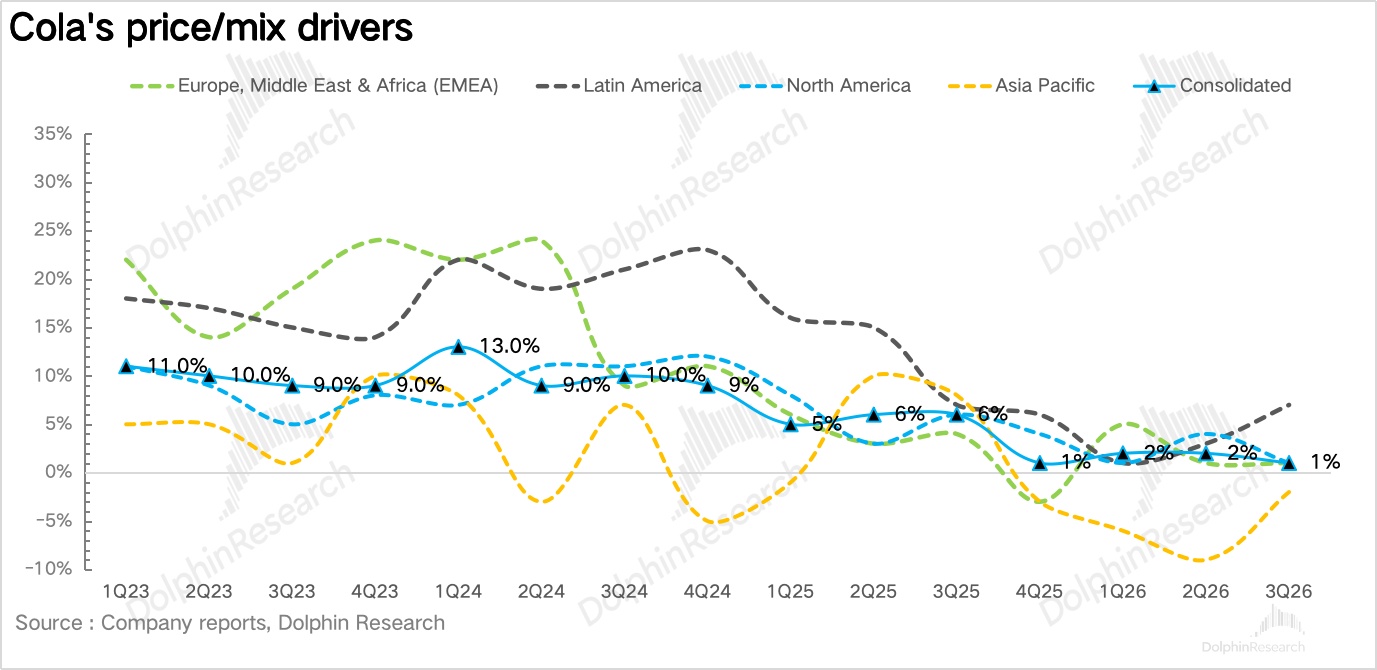
1) Volume beat, pricing lagged. Q3 revenue was $13.4bn (+7% YoY), with organic revenue +7%, ahead of market expectations (~+4%). On mix, concentrate sales rose 7% and unit cases increased 5%, marking a second straight quarter at +5%, easing concerns about a post-World Cup volume cliff. Price/mix was up just 1%, the lowest YTD, mainly dragged by geographic mix as emerging, lower-ticket markets gained share.
2) EMs took the baton; N. America was flat on volume. The growth engine shifted from North America in Q2 to EMs this quarter. LatAm organic rose 16% (unit cases +6%, price/mix +7%), a sharp acceleration, driven by Mexico’s centennial marketing and share gains in Brazil. North America unit cases were flat and price/mix rose 1%, taking organic growth down to 3% vs. 7% in Q2.
3) Zero-sugar stayed strong; CSDs accelerated. By category, CSDs grew 5% vs. 4% in Q2, with Trademark Coca-Cola +5% and Coke Zero Sugar +16%. Both grew across all regions, and Zero Sugar growth matched Q2 at near multi-year highs. Non-CSD performance was mixed: water +8%, sports drinks −3% (APAC drag), and coffee/tea flat.
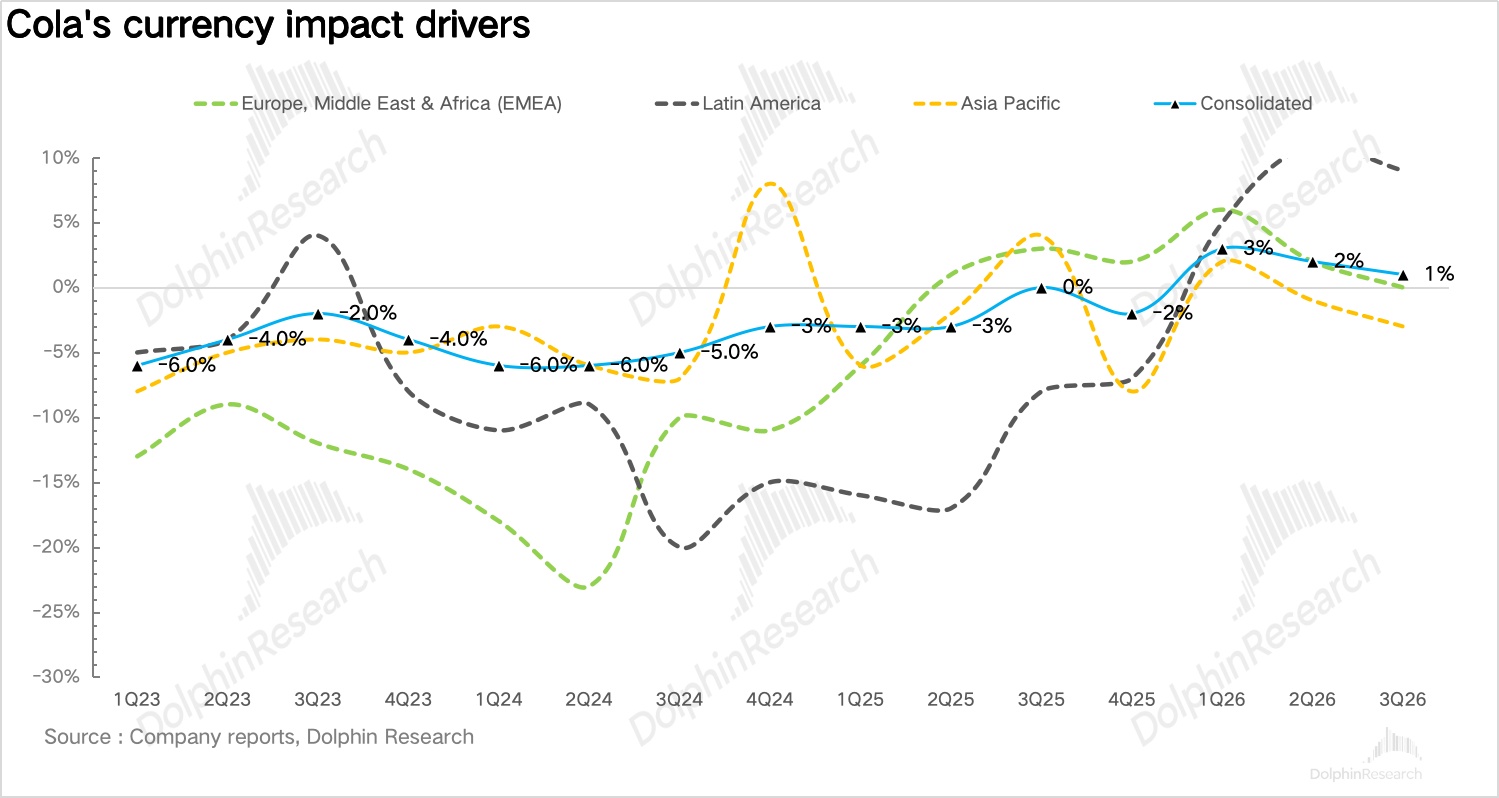
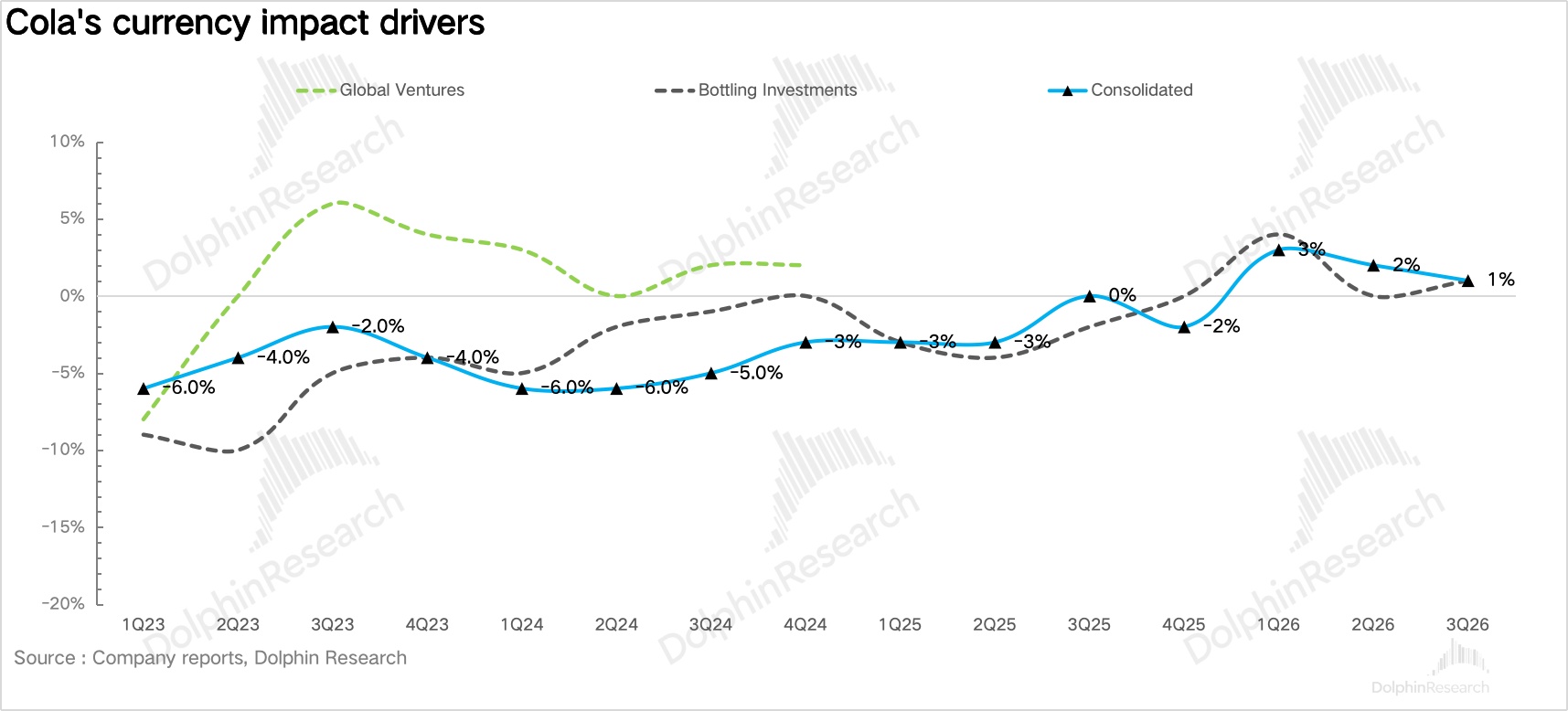
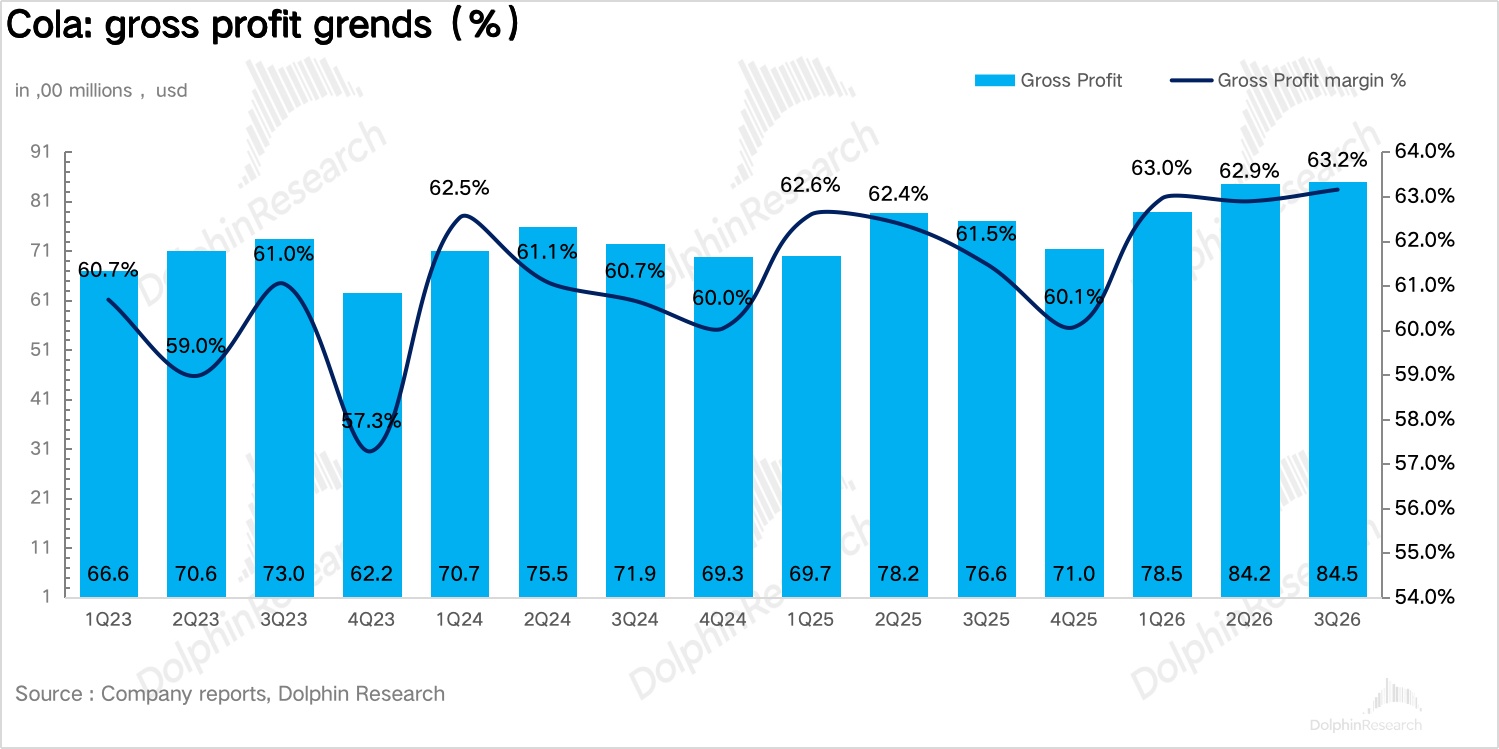
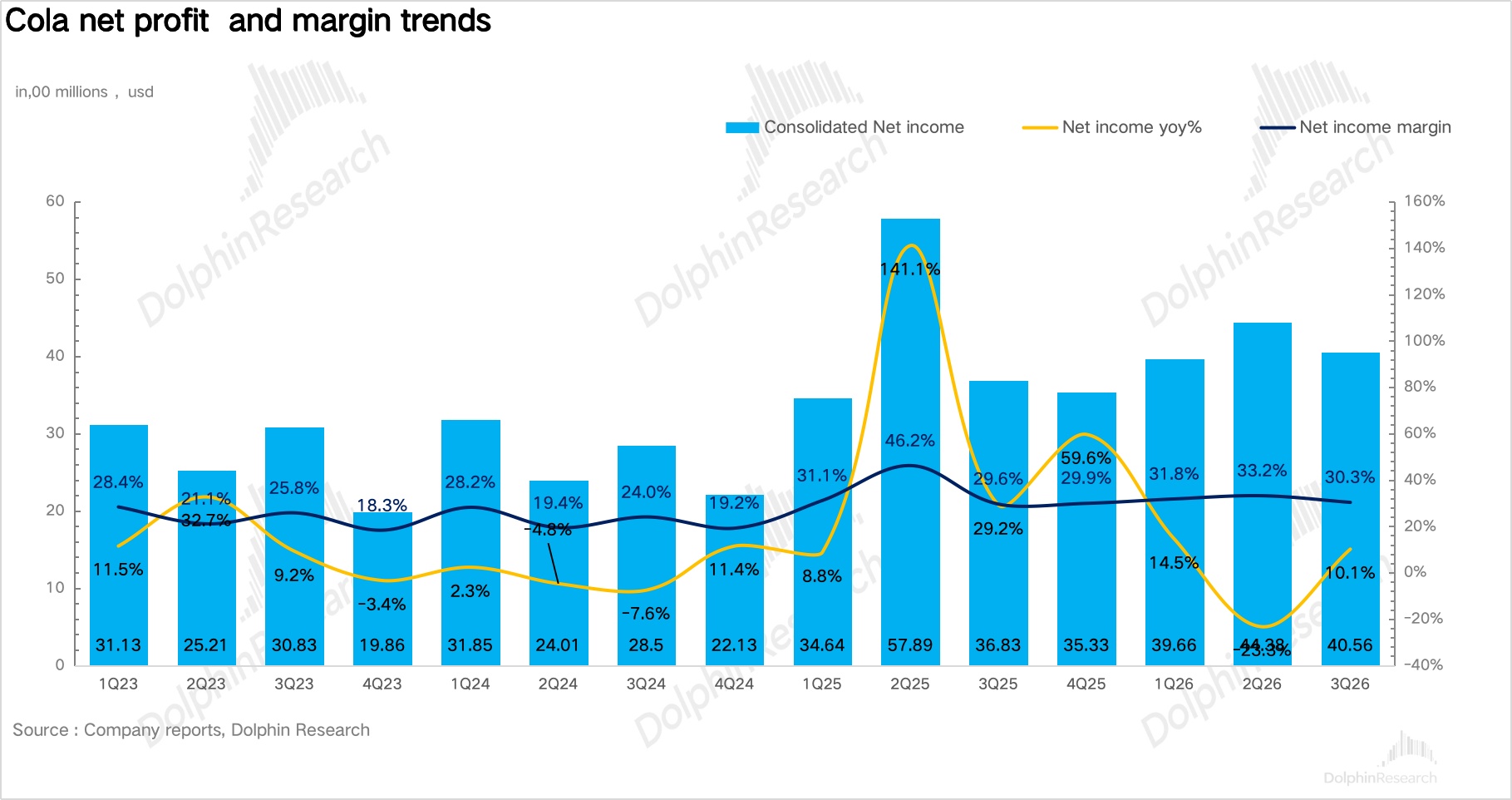
4) GPM expanded sharply; profitability improved. With lower-margin non-CSDs down in mix, Q3 GPM expanded 170bps YoY to 63.2%. On opex, marketing stepped up for European music festivals and LatAm centennial events, lifting the opex ratio by 60bps to 29.8%, while comparable OPM rose 100bps to 32.9%. Comparable EPS was $0.91 (+11% YoY), with FX contributing ~200bps.
5) Third FY guidance raise this year. The company lifted organic revenue growth from ~5% to at least 5%. Comparable EPS growth was raised from 9%–10% to at least 11%.
6) Key financials at a glance
Dolphin Research view:
On the numbers alone, +7% organic growth and +11% EPS growth, alongside a third guidance raise YTD, is an excellent print for a mature staples leader. Below we unpack several details from the release to discuss what mattered. First, units: unit cases rose 5% for a second straight quarter, a rarity over the past 4–5 years. Unlike Q2’s twin engines in North America and LatAm, growth this quarter came almost entirely from EMs, led by India, China, Mexico, and Brazil.
Breaking it down, U.S. high-frequency scanner data we tracked had already signaled accelerating CSD volumes and share gains, which the company confirmed via growth and value share gains for Trademark Coca-Cola in North America. The issue was in non-CSDs: water, sports drinks, coffee, and tea declined in North America, fully offsetting CSD gains. This implies North America is increasingly reliant on the Trademark Coca-Cola franchise, while second-curve brands like BODYARMOR and Smartwater have not yet picked up enough momentum in the region.
Price/mix was just +1% this quarter. By region, pricing was not weak: LatAm price/mix rose 7% vs. 3% in Q2, indicating recovery in post-tax pass-through in Mexico; North America and EMEA were both +1%, while APAC was −2% (vs. −9% in Q2, a major improvement). The drag at the consolidated level came from mix: fast-growing markets like India, China, and SE Asia have much lower revenue per case than North America and Europe, so their rising volume share diluted overall price/mix.
Lastly, management expects the sale of the Africa bottler CCBA to close in Q4, creating an ~8% revenue headwind in 2027. On the company’s long-term organic growth algorithm of 4%–6%, we estimate reported revenue is likely to decline in 2027, with comparable EPS growth potentially around 5%, a visible step-down from at least 11% this year. Historically, such divestitures mainly impact reported 'revenue scale' rather than profitability. From 2015–2018, re-franchising the North America bottling network took revenue from $40bn+ to just over $30bn, but OPM rose from low-20s to near 30%.
The Africa bottler being sold is also a low-margin, asset-heavy finished-goods business. Post deconsolidation, revenue growth will be mechanically lower in the near term, but the profitability midpoint should move materially higher. On valuation, guided EPS growth of at least 11% implies EPS of $3.33. At the pre-print price of ~$93, that is ~28x, above the 10-year midpoint of ~25x, driven by a flight to defensives amid AI-volatility and Coca-Cola’s standout execution within staples.
Dolphin Research view unchanged: For existing holders, KO remains a core defensive position and the most stable slot in a portfolio, with no need to exit due to the 2027 structural headwind. For new positions, a better entry may be around 25x, or roughly $83.
I. Investment framework
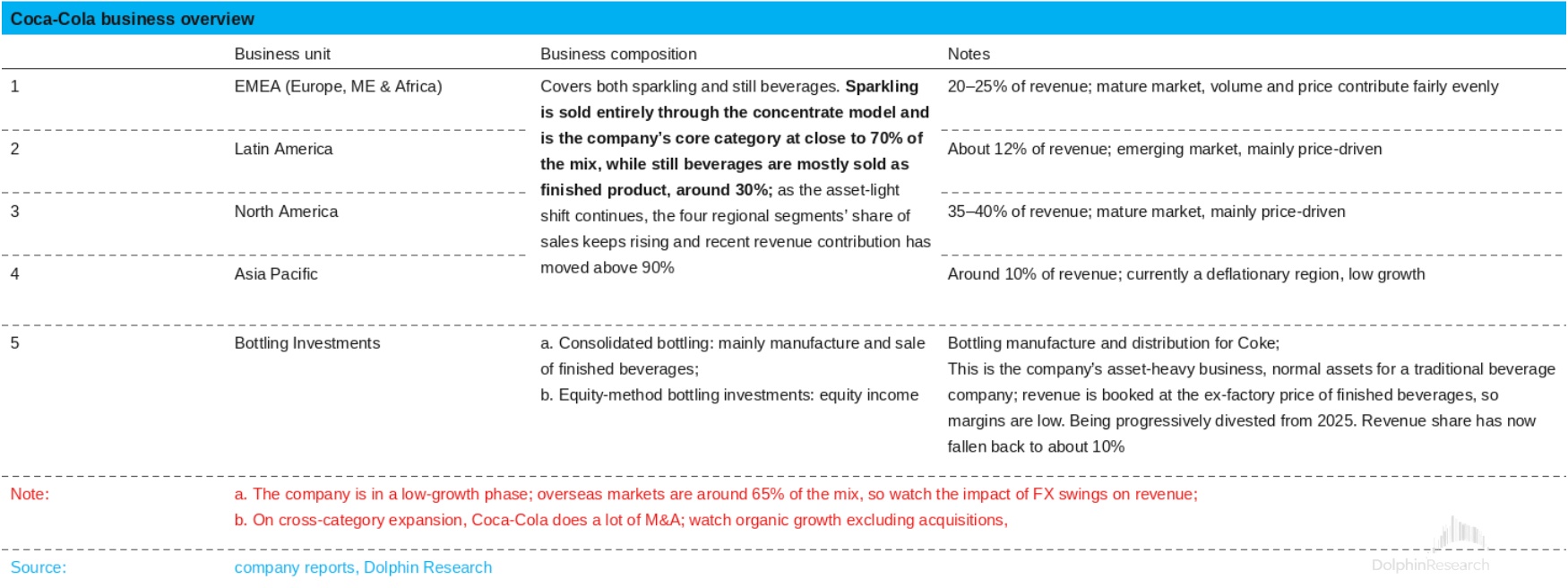
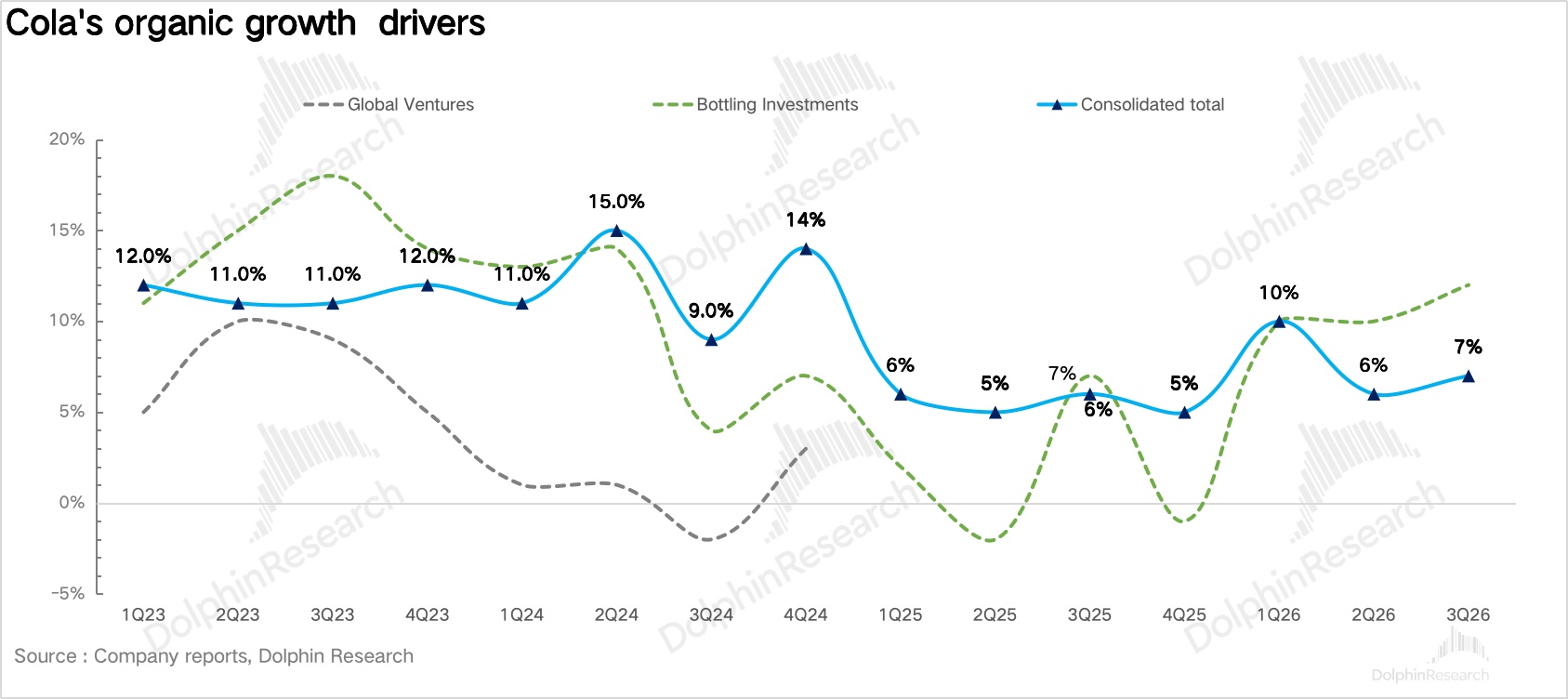
Per company disclosure, reported revenue growth is broken down by EMEA, LatAm, North America, APAC, and Bottling Investments. Each segment’s revenue growth further splits into organic growth, structural impacts (M&A), and FX effects.
(1) EMEA, LatAm, North America, and APAC are regional groups. They include both CSDs and non-CSDs, with CSDs sold via concentrates and representing nearly 70% of the business, while most non-CSDs are finished-goods sales at ~30% share.
(2) The Global Ventures Dept. was established in 2019 to acquire promising brands worldwide. Since 2015 it no longer discloses separately; acquired brands like Costa (coffee), Innocent (juice), and Dogadan (tea) are reported within their regional segments.
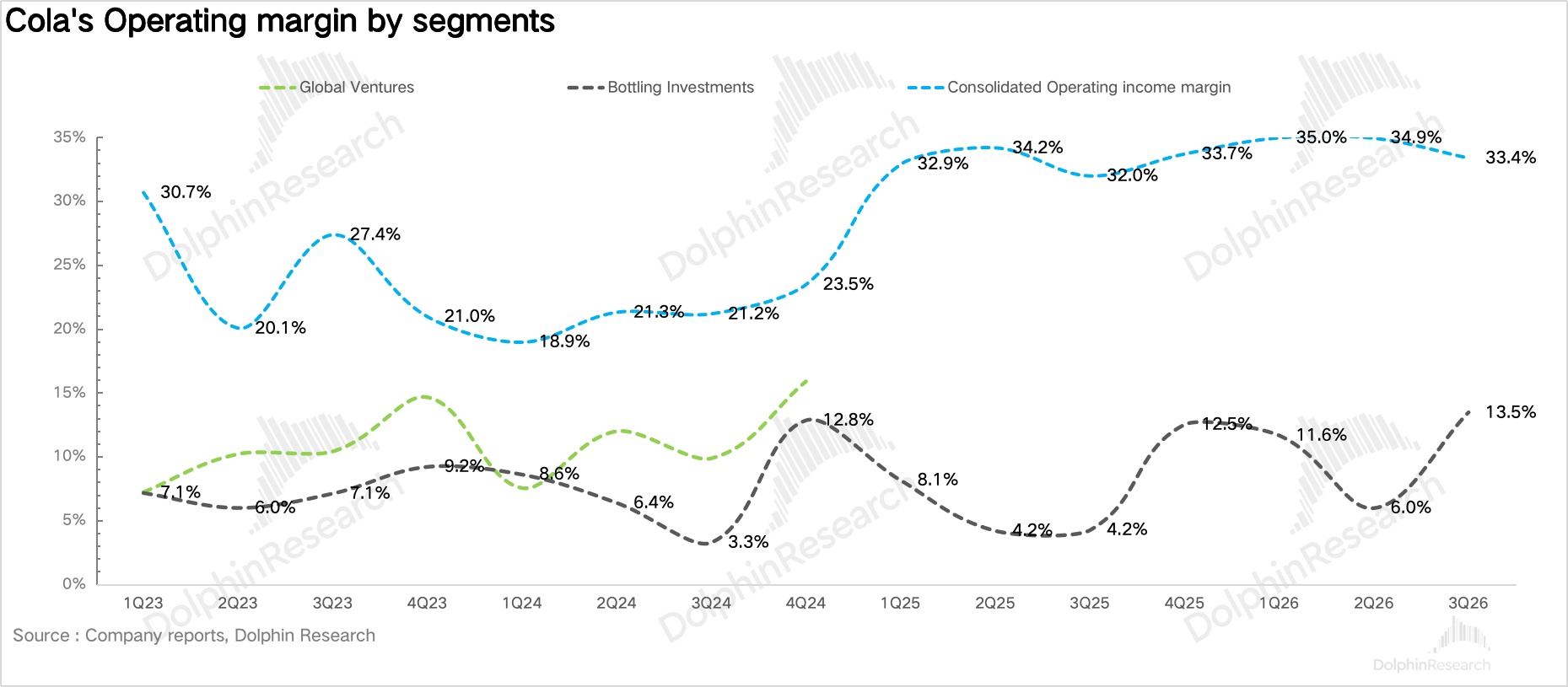
(3) Bottling Investments comprises company-controlled bottlers globally, with most revenue from finished-goods manufacturing and sales. As this is asset-heavy with lower profitability, Coca-Cola has been divesting globally since 2015. We focus below on organic revenue growth, decomposed into concentrate volumes and price/mix drivers:
II. Broad-based beat vs. expectations
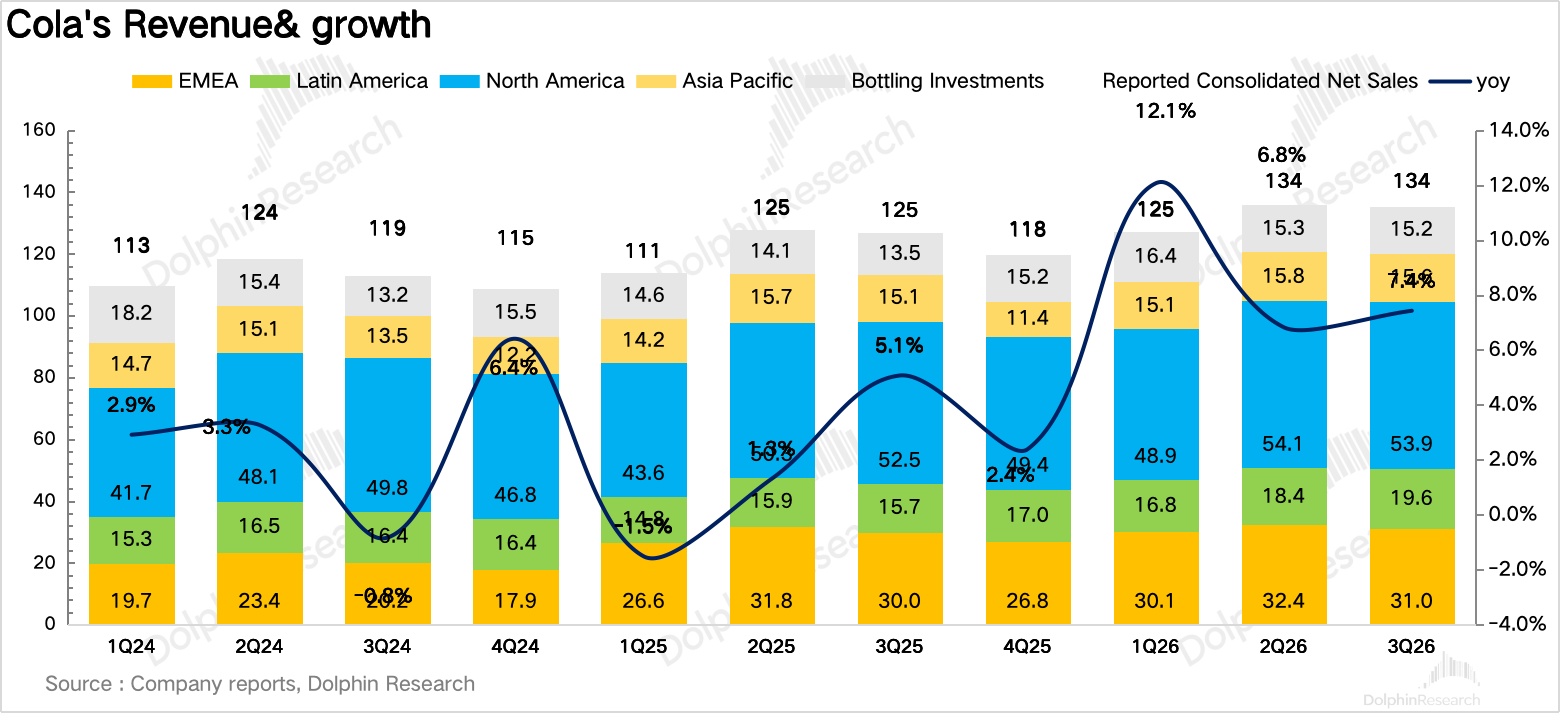
Q3 2026 reported revenue was $13.38bn (+7% YoY). Comparable revenue was $13.35bn (+8% YoY), with organic revenue +7%, well above the ~+4% consensus. This quarter was even more volume-led than Q2: concentrates contributed 7pp while price/mix contributed 1pp, the reverse of last year’s structure when price added 6pp and volume was flat. Versus management’s long-term algorithm of roughly half volume, half price, the mix has swung from the past two years of 'more price, less volume' to 'more volume, less price'.
By region:
North America: Revenue was $5.4bn (+3% YoY), organic +3%, down from +7% in Q2. Unit cases were flat and price/mix rose 1% (vs. 4% in Q2). Structurally, Trademark Coca-Cola continued to grow with value share gains, but declines in water, sports drinks, coffee, and tea fully offset CSD growth. Value share gains were led by juice, value-added dairy and plant-based, and the Trademark Coca-Cola franchise, suggesting the mid-Jul fairlife outage did not impair shelf momentum as fairlife still grew.
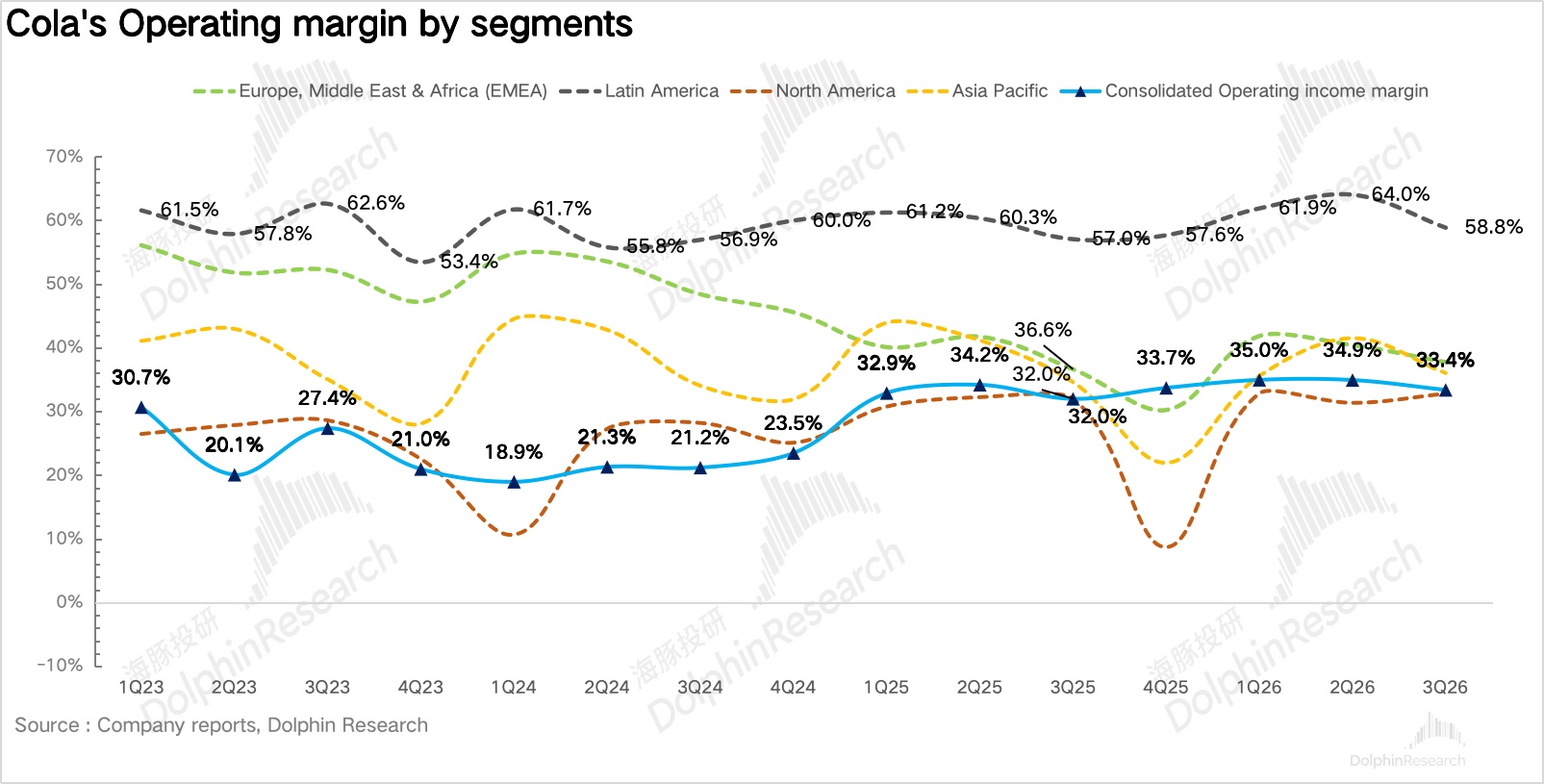
Price/mix deceleration reflected a high base from fairlife and Topo Chico last year and fewer higher-ticket non-CSD finished-goods shipments. Profitability improved with North America OP up 5%, and segment OPM up 80bps to 32.1%.
EMEA: Revenue was $3.1bn (+4% YoY). Organic rose 7%, with unit cases +5%, concentrates +6%, and price/mix +1%. Volume growth benefited from European summer music-festival marketing. On profits, lower input costs drove OP +7% and segment OPM +120bps to 37.4%, a clear recovery from Q2’s decline.
LatAm: Revenue was $1.94bn (+24% YoY). Organic rose 16% (FX +9pp), with unit cases +6% and growth across all categories. Mexico was the standout: its centennial marketing with limited editions and local IPs lifted volumes sharply, and both Brazil and Mexico gained value share. Pricing recovery suggests post-IEPS tax pass-through is normalizing, alleviating prior concerns about 'price-for-volume' in LatAm. Profitability was strong with comparable OP +28% (+14% ex-FX), and segment OPM at 58.4% (+170bps), the highest across regions.
APAC: Revenue was $1.57bn (+5% YoY). Organic rose 6%, with unit cases +6% and broad category growth. Price/mix fell 2%, a major improvement vs. −9% in Q2, indicating phase-in investments for 'price-for-volume' are working. On profits, OP rose 14% ex-FX and one-offs, with segment OPM up 240bps to 36.2%.
II. CSDs accelerated; non-CSDs diverged
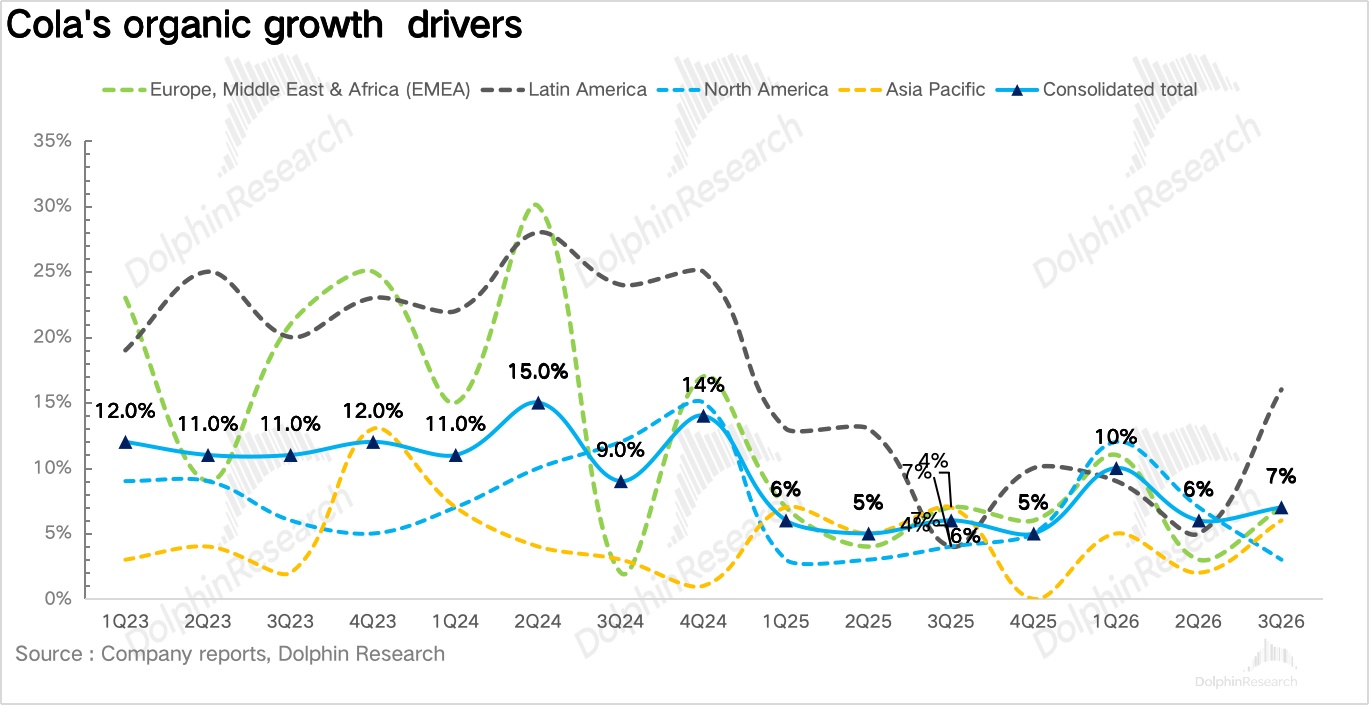
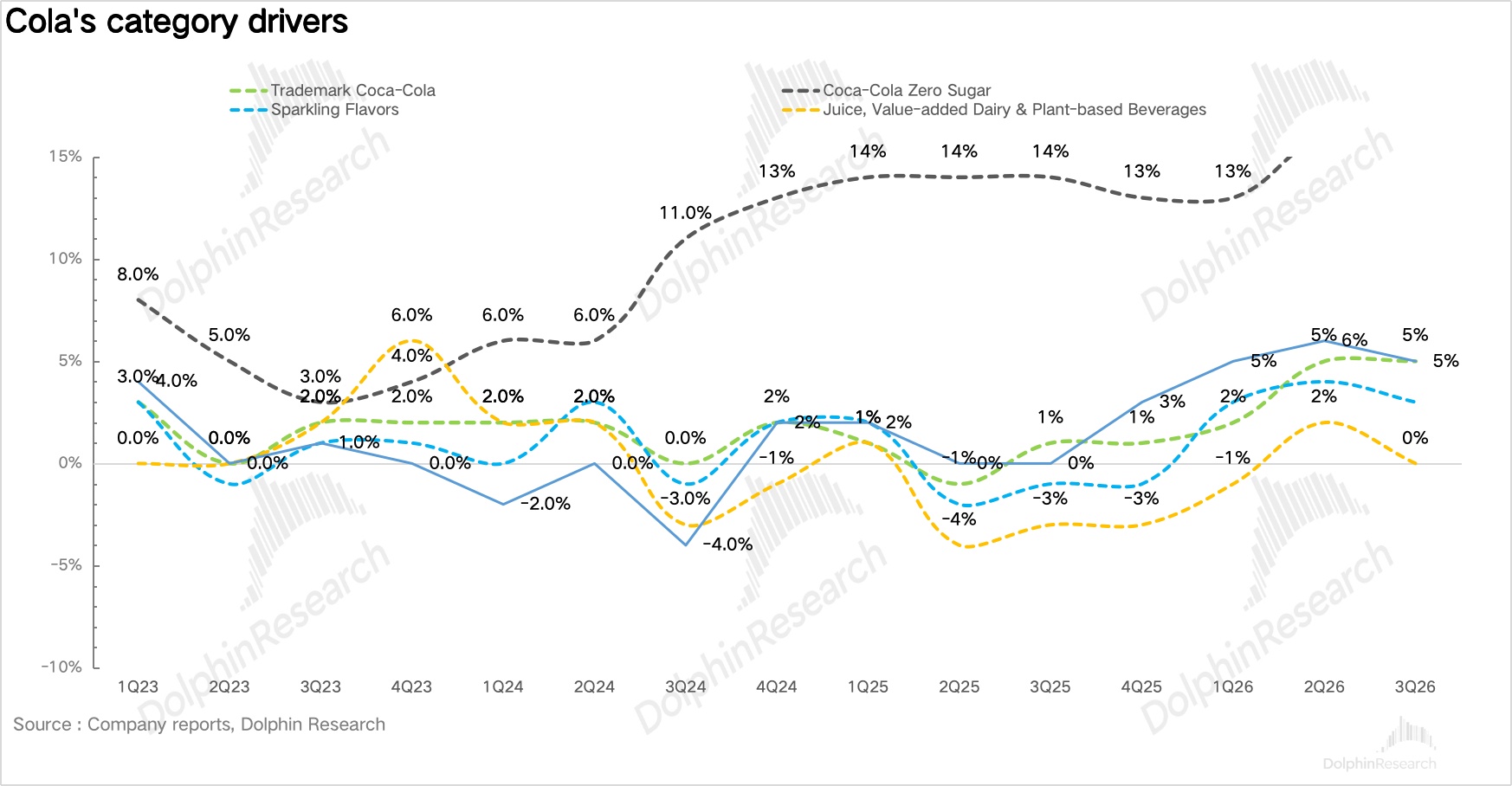
Volume: Concentrate shipments rose 7% YoY and global unit cases increased 5%, with a 2pp gap due to concentrate shipment timing. The gap widened from 1pp in Q2. CSDs grew 5% vs. 4% in Q2, with Trademark Coca-Cola +5% and Coke Zero Sugar +16%, both growing across all regions. Zero Sugar growth matched Q2 at a near multi-year high, and did not roll over after the World Cup limited editions faded, suggesting structural rather than promo-driven strength.
Zero Sugar, Zero Caffeine Coke is rolling out to Brazil, Mexico, and Chile after Europe, likely becoming the next growth vector for CSDs. Juice, value-added dairy, and plant-based were flat YoY (vs. +2% in Q2), with APAC, LatAm, and North America up but offset by declines in EMEA. By brand, fairlife, Maaza (mango juice, India), and Minute Maid all grew.
Water, sports, coffee, and tea rose 5% in aggregate, but with sharp divergence: water +8%, sports −3%, and coffee/tea flat. Notably, these non-CSD categories declined in North America, which directly capped unit case growth there. We believe second-curve brands like BODYARMOR and Smartwater face intense competition from Gatorade and Celsius in North America.
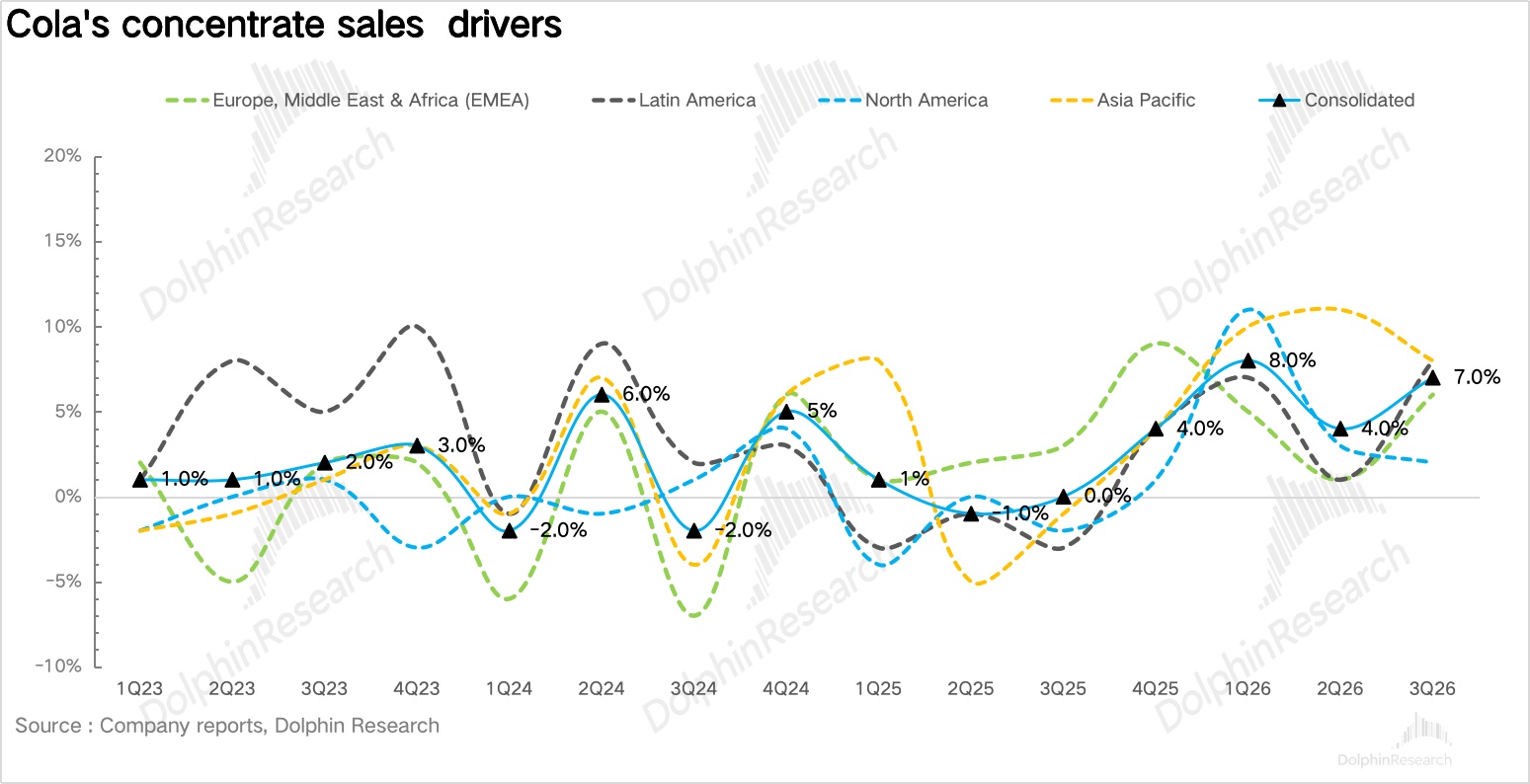
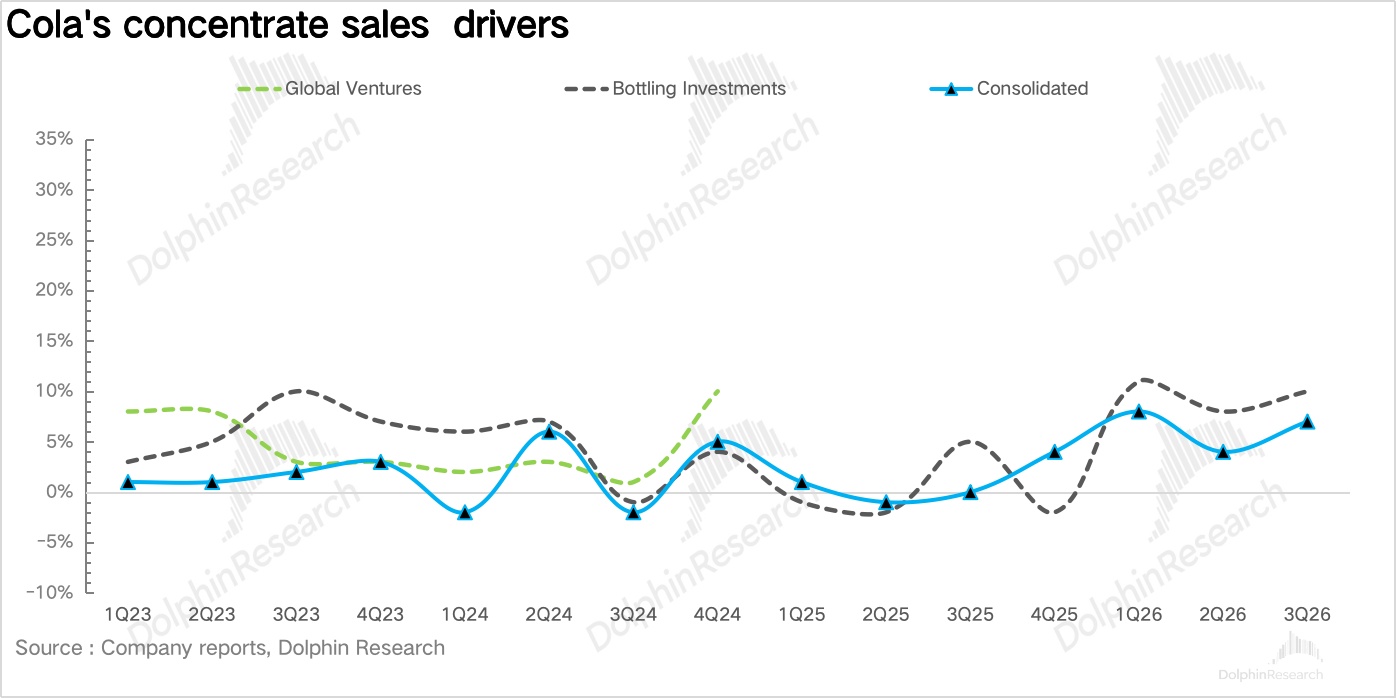
Price: Overall price/mix rose 1%, down from 2% in Q2. By region, LatAm +7%, North America +1%, EMEA +1%, and APAC −2%, with LatAm and APAC both improving vs. Q2. The consolidated drag was mix: faster growth in lower revenue-per-case markets (e.g., India and China) diluted overall price/mix. The real test of pricing power will be the early-2027 round of price negotiations.
III. GPM expanded sharply; marketing stepped up; margins up again
Comparable GPM rose 170bps YoY to 63.2%, the biggest expansion in recent quarters. The core driver was mix shift toward higher-margin categories: growth was driven almost entirely by concentrates (concentrates +7%, with shipment timing 2pp ahead of unit cases), while lower-margin finished non-CSDs like water, sports, and tea declined in North America.
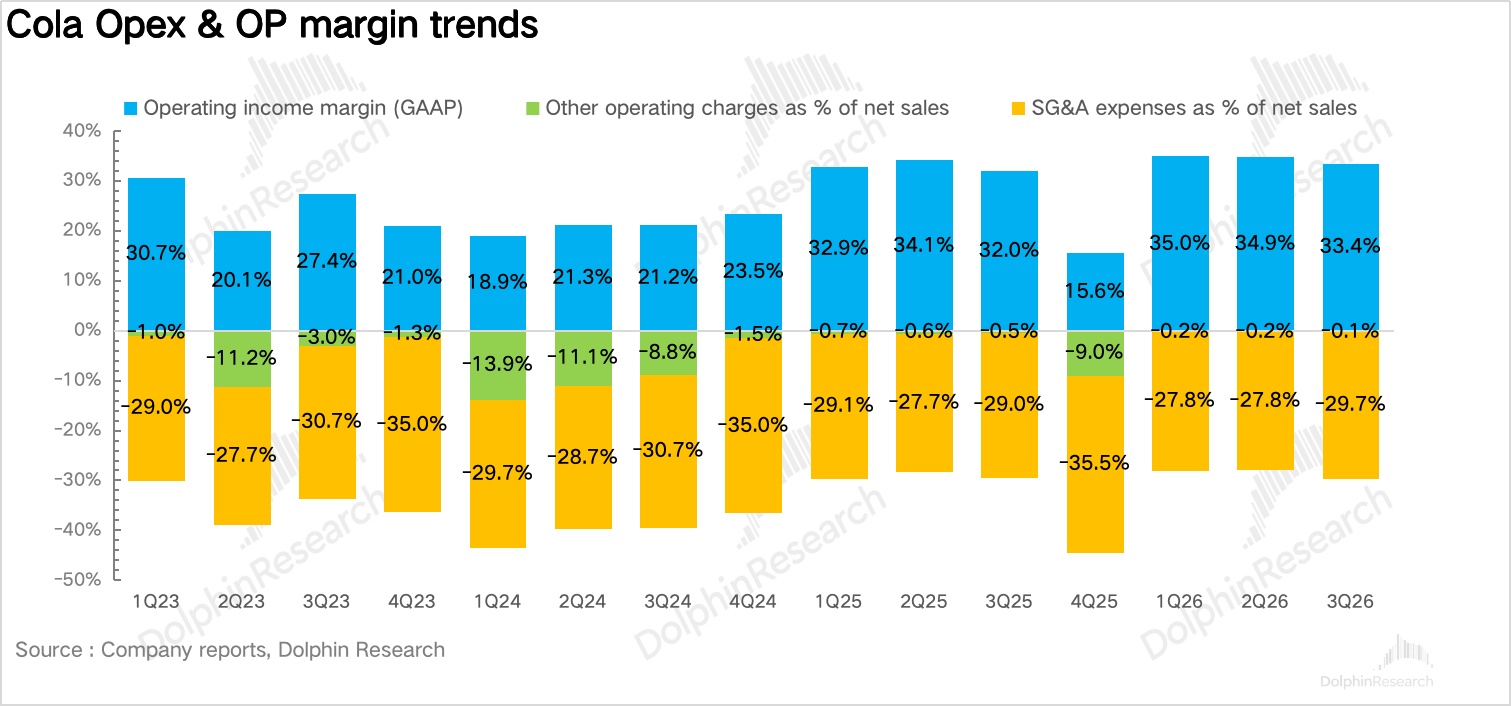
Opex rose, with SG&A at $3.98bn (+10% YoY) and the opex ratio up 60bps to 29.8%, driven by heavier marketing (European festivals, Mexico centennial, Nigeria 75th anniversary, and other local campaigns) and operating costs. North America marketing was lower due to timing. Comparable OP reached $4.4bn (+11% YoY; +8% ex-FX).
<End of text>
Dolphin Research coverage on [Coca-Cola]:
Earnings season
Feb 12, 2025: Coca-Cola: Buffett’s pick still wins big
Apr 29, 2025: Qtr. review 'Tariffs up, Coke more precious?'
Jul 22, 2025: Qtr. review 'Still the safest harbor?'
Feb 10, 2026: Coca-Cola: Betting on AI
Jul 28, 2026: AI wobble, Coke old guard back in charge?
Deep dives
Coca-Cola: Why the Oracle’s favorite?
Coca-Cola: Long past its peak? Still steady returns
Risk disclosure and statement: Dolphin Research Disclaimer and General Disclosure
The copyright of this article belongs to the original author/organization.
The views expressed herein are solely those of the author and do not reflect the stance of the platform. The content is intended for investment reference purposes only and shall not be considered as investment advice. Please contact us if you have any questions or suggestions regarding the content services provided by the platform.