D
 +14
IREN: Power but no orders, land but no cash — why is the miner-to-cloud shift so hard?
Owned power and buildings have not turned into profit; contract wins, GPU access and financing all lag.
+14
Owned power and buildings have not turned into profit; contract wins, GPU access and financing all lag.
+14HBM prices have surged, and SK hynix shares have jumped as much as 10x over the past six months, but Samsung Electronics and Micron Technology are rapidly grabbing supply-chain share.
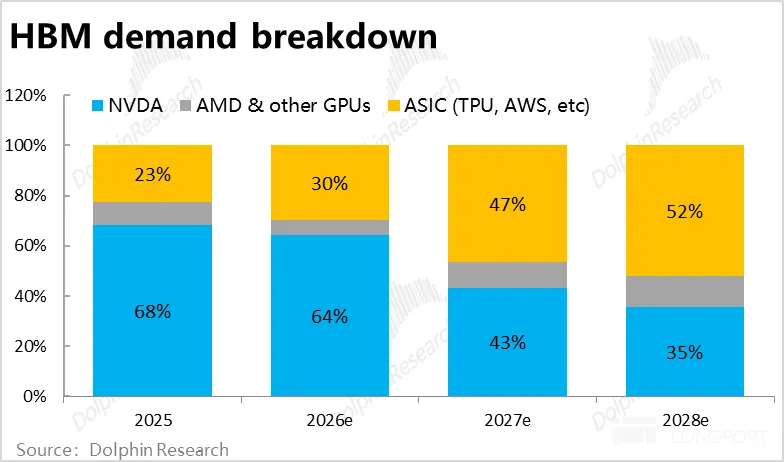
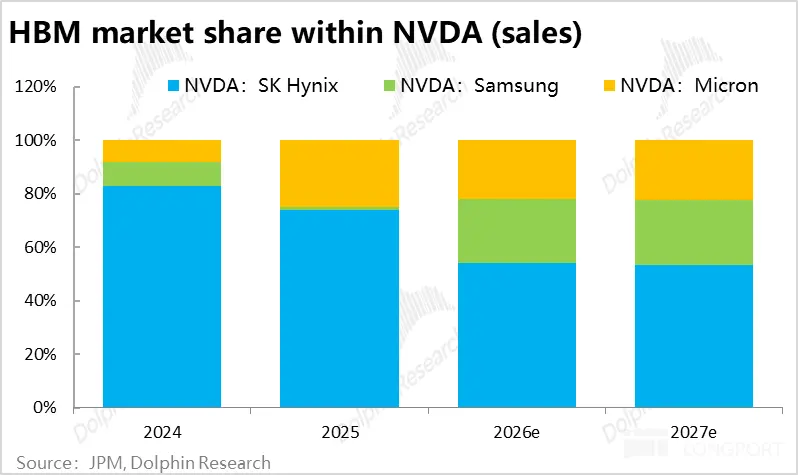
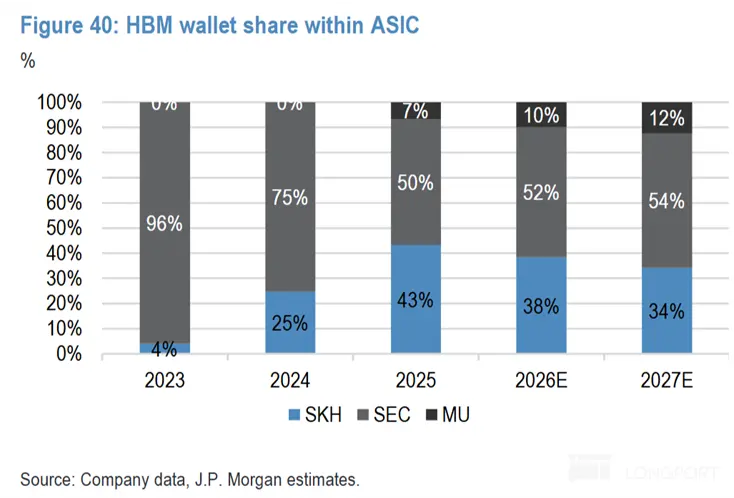
In Part 1, we mapped the DRAM/HBM supply-demand gaps and identified the cycle inflection; please refer to that piece. However, an industry upcycle does not guarantee steady profits at the company level.Here we stay focused on SK hynix, analyzing its partnerships with NVIDIA and major ASIC customers. We also compare long-term agreement strategies across the Big Three. We then model forward earnings and assess the current valuation, as incremental memory demand in the AI era is concentrating with a handful of XPU vendors and cloud players...
 +12
The last two pieces from Dolphin Research outlined the underlying logic and trajectory of the 'memory' rally from a tech lens, while this one shifts back to the company level. It zeroes in on the most representative HBM leader of this cycle — $SK Hynix(SKHY.US).
SK hynix’s current position is delicate. Memory prices have surged and HBM remains tight, driving a step-change in earnings.
The stock at one point rallied ~10x within six months.On the other hand, Samsung and Micron are rapidly plugging into the supply chain of core customers such as Nvidia, shifting Hynix’s edge from exclusive to merely leading.
As a manufacturing company...In this cyclical, market‑driven brokerage industry, Interactive Brokers ($Interactive Brokers(IBKR.US)) is an outlier: it barely advertises, and its terminal interface long deterred retail novices. Brand awareness was so limited that it once failed to crack the top 10 in investment app download rankings.
Compared with the meteoric rise of HOOD over the past five years and the deep brand equity of SCHW, IBKR appears understated. Yet it has consistently delivered 70%+ OPM and approx. $2 mn revenue per employee per year. Dolphin Research believes the edge lies in 'licenses and technology'...
In Part I, we unpacked SoFi's business framework and identified its growth engines: expansion of the Loan Platform Biz. (LPB) and the revival of student lending.
In Part II, guided by Muddy Waters' short case, we surfaced several 'hidden wounds' — shifting credit losses on/off balance sheet to manage the NPL ratio, profit inflation from fair value accounting, and equity dilution.Put together, a somewhat contradictory picture emerges: despite inherent flaws under constant market scrutiny, SoFi still spiked to a $42bn market cap in H2 2025...Per Dolphin Research's prior note on Oracle, our core takeaway is that Oracle is essentially a scaled-up CoreWeave. The bull case hinges on explosive AI compute demand that could lift its compute-rental revenue by 10x or more.
The key risk is the mismatch between uncertain AI demand and fixed upfront capex and leverage, which could lead to sizable credit losses if the AI cycle unwinds. Overall, visibility is limited...Long-rumored Kunlun Chip spin-off is now official as $Baidu(BIDU.US) announced it.
On Jan 2, BIDU proposed to spin off Kunlun Chip Technology for an independent listing on the HKEX Main Board, while retaining control (59.45%).
BIDU has filed confidentially, and the detailed prospectus is not yet public.
Based on available information, Dolphin Research will first outline a few key questions.
1. Kunlun Chip's origins and evolution? It traces back to BIDU's FPGA accelerator project launched in 2011...
In the prior piece, Dolphin Research reviewed Meitu's history, product suite, and competitive landscape in depth. This follow-up focuses on Meitu's growth potential.
1) Will large models eat Meitu's lunch? To evaluate its growth, we must ask how vertical platforms defend against general-purpose platforms.
As seen across internet cycles, a few lucky players evolved into 'small but mighty' vertical champions. Tencent Music, Kanzhun, and even Bilibili endure thanks to distinctive attributes. Most others faded into the background, becoming stepping stones as tech giants broadened their ecosystems...
Google’s full-stack AI strategy has been unfolding for over a month, and cracks in OpenAI’s circular financing narrative have prompted a seemingly sudden shift in the AI storyline.
For Google, this is a build-and-breakthrough arc: incremental upgrades compounded into a step-change, and more importantly, its business positioning has fundamentally shifted. As Anthropic places another 11bn TPU order and Meta advances a collaboration with Google on foundational language models...These days, it's rare to see trillion-dollar giants fluctuating by 10% or 20% in a single day, but Meta is an exception. It took Meta just one quarter to fall from grace. After the Q3 earnings report, investors' panic seemed to have just been digested. Recently, with the expectation of interest rate cuts rising, $Meta Platforms(META.US) has rebounded 10% from the bottom. In terms of narrative, first, Meta has the most extensive application scenarios, and the AI investment process will be accompanied by accelerated revenue, the "AI darling" narrative; then came the Q3 combination of increased investment and slowed revenue growth guidance...