
 I'm LongbridgeAI, I can summarize articles.
Author: Xiaobing, Deep Tide TechFlow
2In 2014, Microsoft spent $7.2 billion to buy Nokia's mobile phone business.
That year, everyone thought the story of this Finnish company, which had been around since 1865, was over.
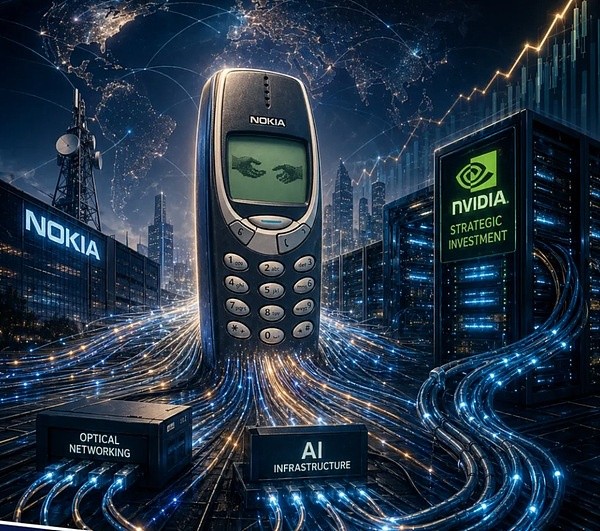
The Nokia 3310, a phone that could crack walnuts, withstand being thrown against a wall without breaking, and even run Snake in the memories of a generation, along with the entire company behind it, has been relegated to the album of "tears of the times." Eleven years later, Jensen Huang called, offering them $1 billion. Nokia's stock has risen approximately 73% since the beginning of January this year, and 130% compared to the same period last year. This isn't a "dead cat bounce" in the stock market; it's an underestimated undercurrent in the entire AI narrative from 2025 to 2026. Moreover, almost no Chinese investors are seriously discussing it. Who is Justin Hotard? The story begins with a name. In February 2025, Nokia's board of directors announced that current CEO Pekka Lundmark would step down, and on April 1st, an American named Justin Hotard would take over. This is Nokia's first American-born CEO since its founding in 1865. Hotard is a typical example in the tech world of someone who is "not very famous but always riding the wave of success." He holds a bachelor's degree in Electrical Engineering from the University of Illinois and an MBA from MIT Sloan. He worked at Hewlett-Packard (HPE) for eight and a half years, eventually becoming the head of the High Performance Computing and AI Labs, where he personally delivered the world's first exascale supercomputer to the U.S. Department of Energy. Then, in early 2024, he was poached by Intel to head the Data Center and AI business unit, reporting directly to Pat Gelsinger. Note his resume. HPC, data centers, and AI—these three keywords have absolutely nothing to do with Nokia's image over the past decade. What did Nokia do? It made base stations, telecommunications equipment, fiber optic cables, and sold them to operators. A typical, slow-moving, and forgotten "old European" hardware company. But in early 2025, Nokia's board of directors made a seemingly illogical decision: they didn't want someone knowledgeable in telecommunications; they wanted someone knowledgeable in AI. In the appointment announcement, Chairman Sari Baldauf stated: "AI and the data center market are key areas for Nokia's future growth." At that moment, almost no one took it seriously. The market reaction was muted, and the stock price rose slightly. All analysts were writing predictable analyses like, "The Finnish powerhouse changes leadership; can the newcomer turn the tide?" No one realized that the company was quietly changing its engine.
An Undervalued Acquisition
If you only look at Hotard's appointment, it's just a routine executive rotation. But if you compare it with another event from six months ago, the script changes completely.
In June 2024, Nokia announced a $2.3 billion acquisition of an American company—Infinera.
What kind of company is Infinera? It does optical networking, which, simply put, is the "fiber optic communication equipment" between data centers and between racks.
If you've ever talked to someone working on AI infrastructure, you'll know this fact: The biggest bottleneck in AI data centers isn't GPUs, it's optical communication. Nvidia can cram 72 GPUs into a single rack, and these GPUs need to exchange data frantically. A data center might have tens of thousands of GPUs, and they also need to exchange data. Two data centers also need to synchronize training data. With each additional cluster, the demand for optical modules grows exponentially. This is why, in the past two years, the stock prices of optical module companies like Coherent in the US, and InnoLight and Eoptolink in China, have skyrocketed. Infinera is one of the few companies that simultaneously possesses two core technologies: photonic integrated circuits (PIC) and data center interconnects. It already has established customer relationships with North American hyperscale cloud providers (Microsoft, Amazon, Google). When Nokia signed this deal in June 2024, the market interpreted it as: "A traditional telecommunications company acquired a traditional fiber optic company—a 'typical' story of two elephants huddling together for warmth." However, after the transaction was completed in February 2025 and Infinera was consolidated into Nokia's financial statements, the financial figures of this long-established Finnish company began to change: In 2025, revenue from optical networking services increased by 17% year-on-year. In the first quarter of 2026, optical networking sales reached €821 million, a year-on-year increase of 20%, surpassing IP and core software to become Nokia's second-largest business. Sales contributed by AI and cloud customers surged by 49% year-on-year in a single quarter. The most crucial figure is this: In the first quarter of 2026, AI and cloud customers placed orders with Nokia totaling €1 billion. What does this figure mean? It's equivalent to a quarter's worth of orders, exceeding Infinera's entire sales revenue for the year before its acquisition. And all of this went almost unnoticed outside of Western tech media. What truly sent shockwaves through the market was October 28, 2025. On that day, at the GTC conference in Washington, Nvidia announced: Nvidia would invest $1 billion in Nokia at a price of $6.01 per share. Note this detail: "$6.01 per share" is a subscription price, not a market price. Nvidia didn't buy shares on the secondary market; Nokia specifically issued a batch of new shares to Nvidia. Nvidia's investment was strategic, not just financial. Why did Jensen Huang invest $1 billion in Nokia? Nvidia's official statement is that the two companies will jointly develop AI-RAN (AI Radio Access Network). Nokia's 5G and 6G software will be ported to Nvidia's CUDA platform; Nvidia's Arc-Pro accelerator, specifically developed for the telecom industry, will be embedded in Nokia's base stations. T-Mobile US became the first pilot operator. Dell provided the servers. This sounds like another common "AI empowering XX industry" story. But the real surprise lies in a technical detail that 99% of people won't notice. First, you need to know some background: Nokia is not the only player in the AI-RAN race. Its biggest competitor is Ericsson, also from Northern Europe. Ericsson and Nokia seem to do exactly the same thing: providing 5G/6G base station equipment to operators. But in the matter of "how to fit a GPU into a base station," they've taken two completely opposite paths. Engineers jokingly call these two paths a "religious war." The first path is called "Lookaside" (bypass acceleration). This is the path Ericsson and Intel are taking. Simply put: the CPU in the base station is still the main controller, while the GPU is just a "helper." When an acceleration task needs to be performed, the CPU "passes" the task to the GPU, which then "returns" it after processing. Data jumps back and forth between the CPU and GPU repeatedly. The second approach is called Inline (online acceleration). This is the path Nokia and Nvidia are taking. Simply put: network data received by the base station first enters the GPU, which processes it before handing it over to the CPU. The GPU becomes the main player, and the CPU becomes a supporting role. Sounds like just a matter of engineering sequence? No, this is a fundamental disagreement about "who will be the computing center in the future." The very existence of Nvidia is to prove that GPUs should be the center of data processing, and CPUs should give way. The entire CUDA ecosystem is designed with a "GPU-centric" philosophy. The Lookaside approach, from its architecture, presupposes that "CPUs will still be number one," which is fundamentally incompatible with Nvidia's worldview. Therefore, when Nvidia needs a telecom partner, it cannot choose Ericsson. It must choose a partner willing to place GPUs at the center. Nokia is that partner. This is why this $1 billion isn't just a simple "strategic investment." Jensen Huang has personally stamped his mark on a new chapter in the AI narrative; he's buying an entry point that will allow Nvidia's GPUs to reach 5 million base stations worldwide. According to Omdia's forecast, the cumulative market size of AI-RAN will exceed $200 billion by 2030. If this story is told correctly, this $1 billion investment by Jensen Huang could be one of the most profitable investments of his lifetime. Geopolitics played a role. Nokia's comeback also had a sensitive undercurrent. On April 13, 2026, Bank of America analyst Oliver Wong upgraded Nokia from "neutral" to "buy," significantly raising his target price from €6.87 to €10.70. Nokia's stock price surged 9.67% that day, with trading volume increasing by 178% compared to the 3-month average. In that report, Oliver Wong listed four reasons why Nokia was undervalued. The third reason, though worded subtly, is very clear: "After European countries gradually restricted Huawei and ZTE, Nokia has effectively become 'the last Western sovereign supplier to choose from.'" In plain terms: Europe wants to build sovereign data centers and sovereign 5G/6G networks. Chinese equipment is unusable, and there are no such companies in the US. The only remaining Western suppliers are Nokia and Ericsson. Ericsson lacks full-stack capabilities in optical networks, Infinera was acquired by Nokia, and Cisco is an American company. Therefore, the money for European sovereign cloud projects almost exclusively flows to Nokia. This is a classic example of a "geopolitical arbitrage" opportunity. The changing international order presented Nokia with a significant gift; as long as Nokia remained in the game, it could reap the benefits. Add to this the demand for optical networks from US hyperscale cloud providers and T-Mobile's bet on AI-RAN, and three streams of capital simultaneously poured into Nokia from three directions. It took the market 18 months to react. Piecing together all the clues, you'll find a very dramatic timeline: June 2024: Nokia announced the acquisition of Infinera. February 2025: Hotard was appointed as the new CEO. October 2025: Nvidia invested $1 billion. 2026... On April 13, 2026, Bank of America upgraded its rating, and the stock price rose by 9.67% in a single day. On April 22, 2026, the Q1 financial report disclosed €1 billion in AI/cloud orders, and optical network business increased by 20%. On April 27, 2026, CFRA doubled its target price from $8 to $16, and Nokia's stock price hit a new high since 2015. Did you notice? The fundamentals began to change as early as 18 months ago. But it took the market 18 months to connect these clues. This is the classic process of "value discovery." When a story hasn't been fully explained, everyone treats it as "old wine in an old bottle"; by the time the story is clear, the valuation has already recovered significantly. Nokia's current P/E ratio is 26 times forward PE, which isn't expensive for a 17% growing optical networking business. But compared to its lows at the beginning of the year, it's no longer the "forgotten stock" lying on the ground. Over the past two years, Chinese investors have been focused on Nvidia, TSMC, Broadcom, and AMD—the engines of this AI wave. But beyond the engine, there are also gearboxes, drive shafts, tires, and highways. The AI narrative is spreading from "chips" to "pipes." The story of optical module manufacturers has been told for over a year; the next thing to be repriced by the market may be base stations, fiber optic cables, data center power, and cooling systems. The story won't repeat itself, but it will rhyme. When a new technological paradigm truly arrives, the biggest alpha may not be in the obvious places. It's in those corners you thought were "forgotten."