

Meituan: Delivery Rebounds, In-Store Under Pressure, Can a Defiant Meituan Still Find a Way Forward?
 I'm LongbridgeAI, I can summarize articles.
After the Nov 27 close, Meituan reported Q3 results. Headline numbers looked solid, with profit seemingly very strong at first glance. Management had warned last quarter that food delivery UE (unit economics) would worsen QoQ on heavier summer subsidies and that in-store margins would come under more pressure from competition.
As a result, the market had set the profit bar very low and expected a notable QoQ deterioration. In reality, both group profit and core local commerce profit were roughly flat vs. last quarter, effectively a beat against muted expectations. $MEITUAN(03690.HK)
In detail:
1) Profit looked like a big beat at first glance — but was it propped up by investment gains?
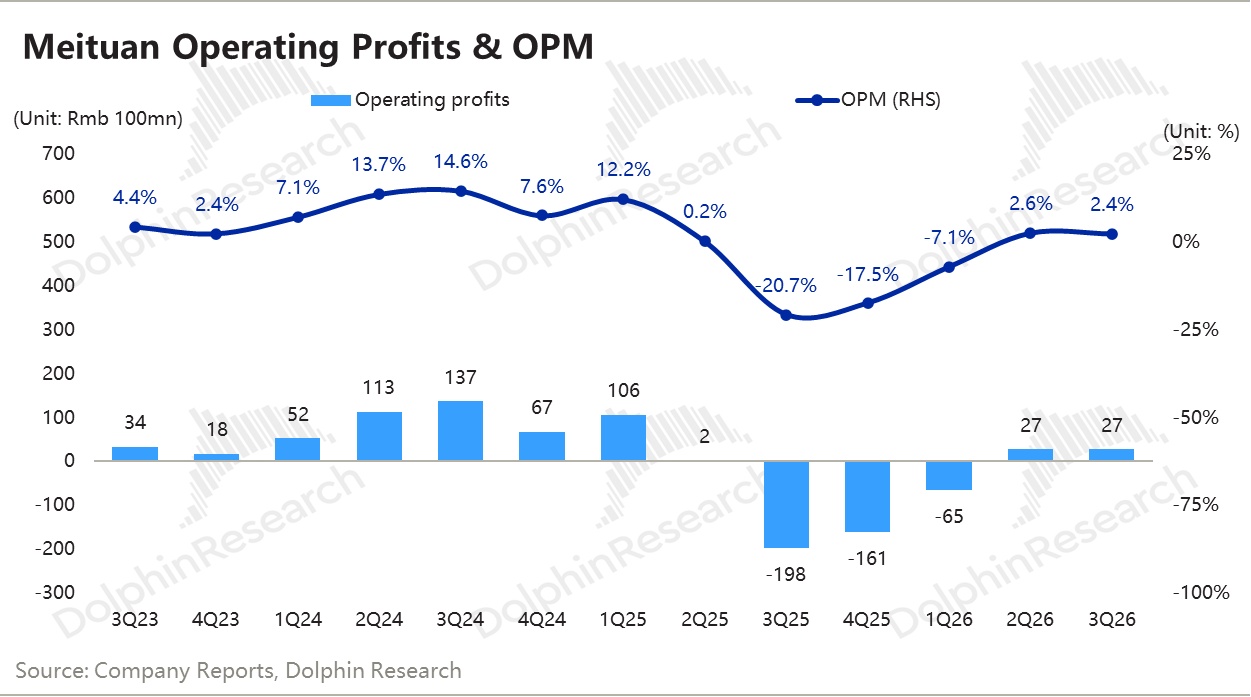
Group OP was RMB 2.74bn, essentially flat QoQ and well above the RMB 0.59bn consensus. However, this included RMB 2.35bn of FV gains on investments and RMB 1.02bn of other income.
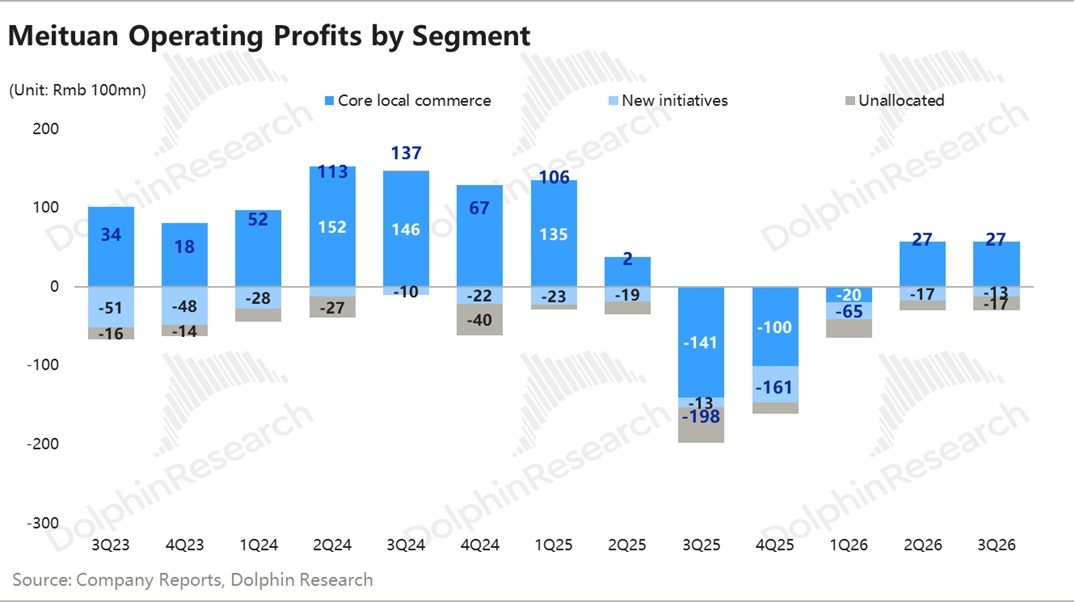
Ex these items, core operating profit showed a loss of RMB 0.37bn vs. a RMB 0.54bn loss last quarter. The business is still loss-making on a core basis, but the improving trend remains intact.
By segment, core local commerce profit was flat QoQ and new biz losses narrowed QoQ, both better than feared. Only the unallocated line saw deeper losses on AI spending.
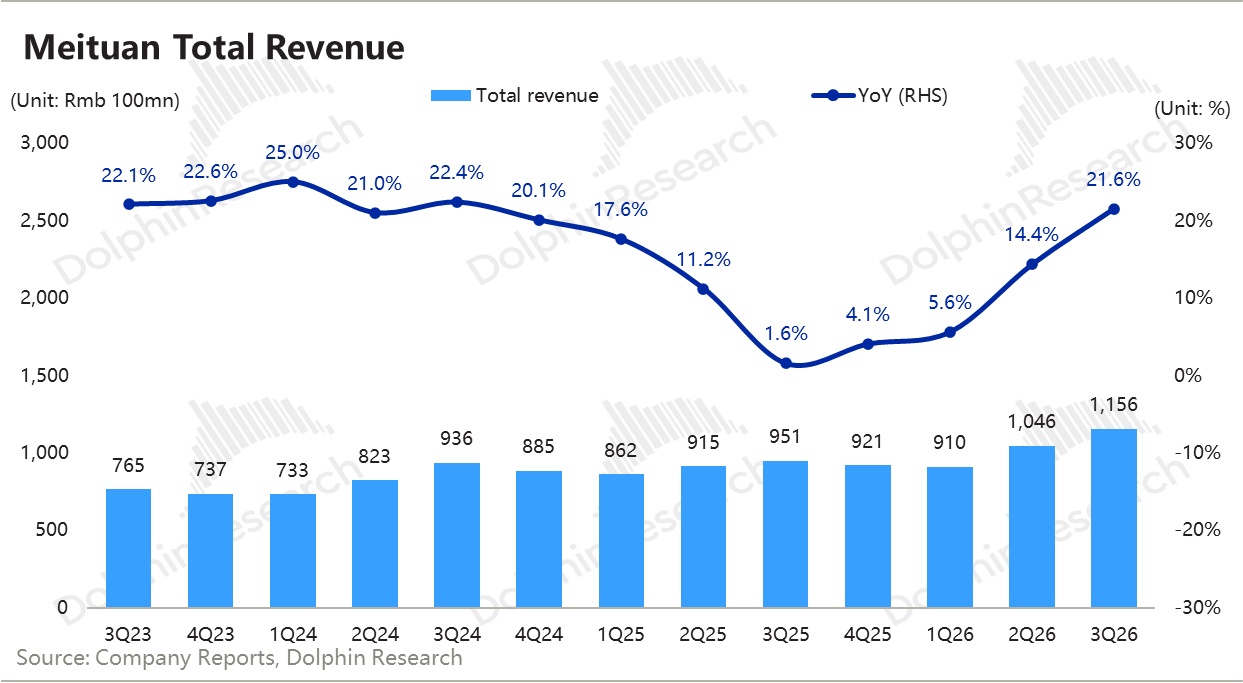
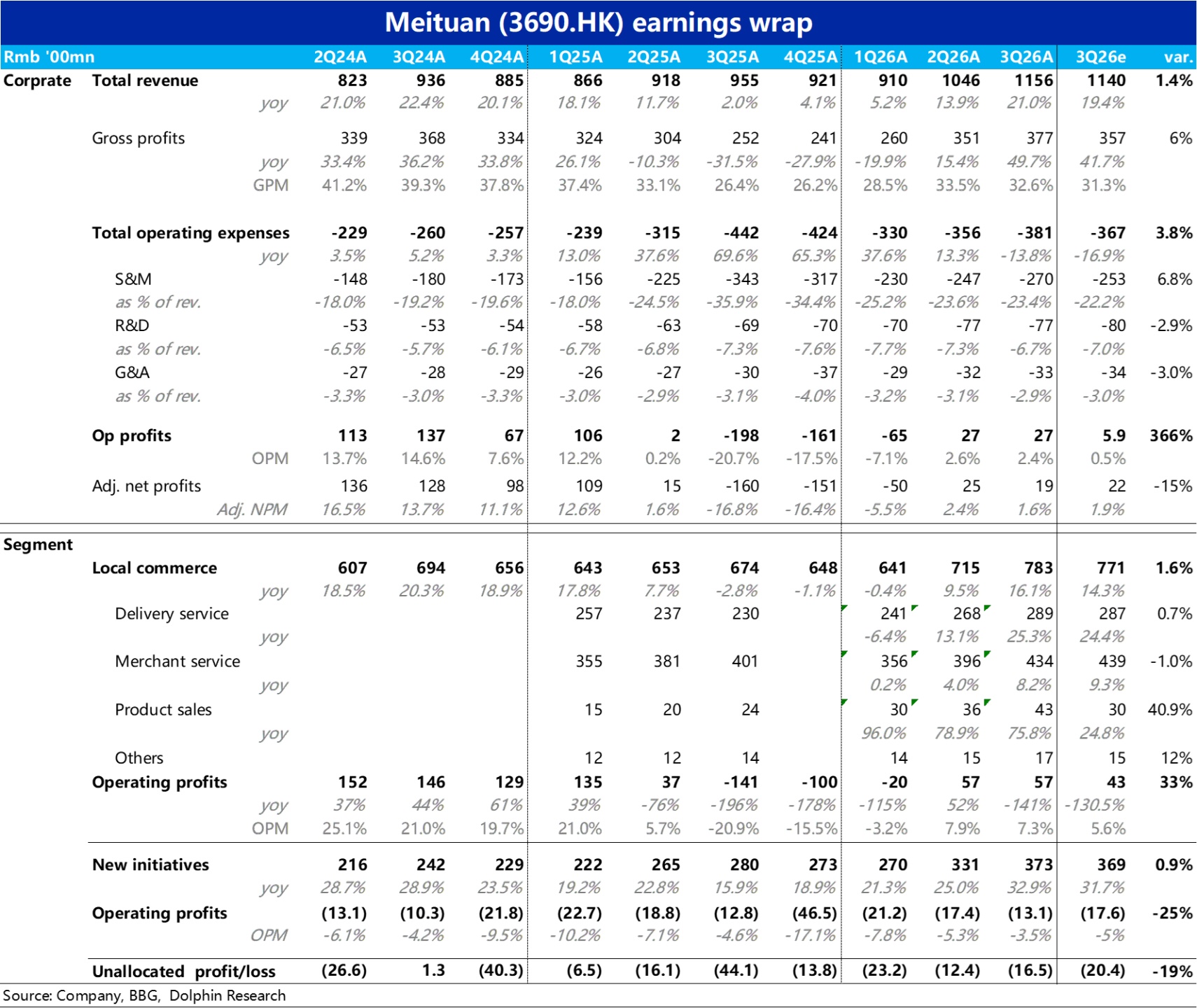
Total revenue reached RMB 115.6bn, with YoY growth recovering to ~22% as the revenue drag from delivery subsidies faded. On the surface, this was roughly RMB 2.0bn above expectations, but most of the upside came from self-operated retail that books revenue on GMV, so the quality of the revenue beat was not high.
2) Core local commerce: delivery UE dipped only slightly, while in-store remains under pressure
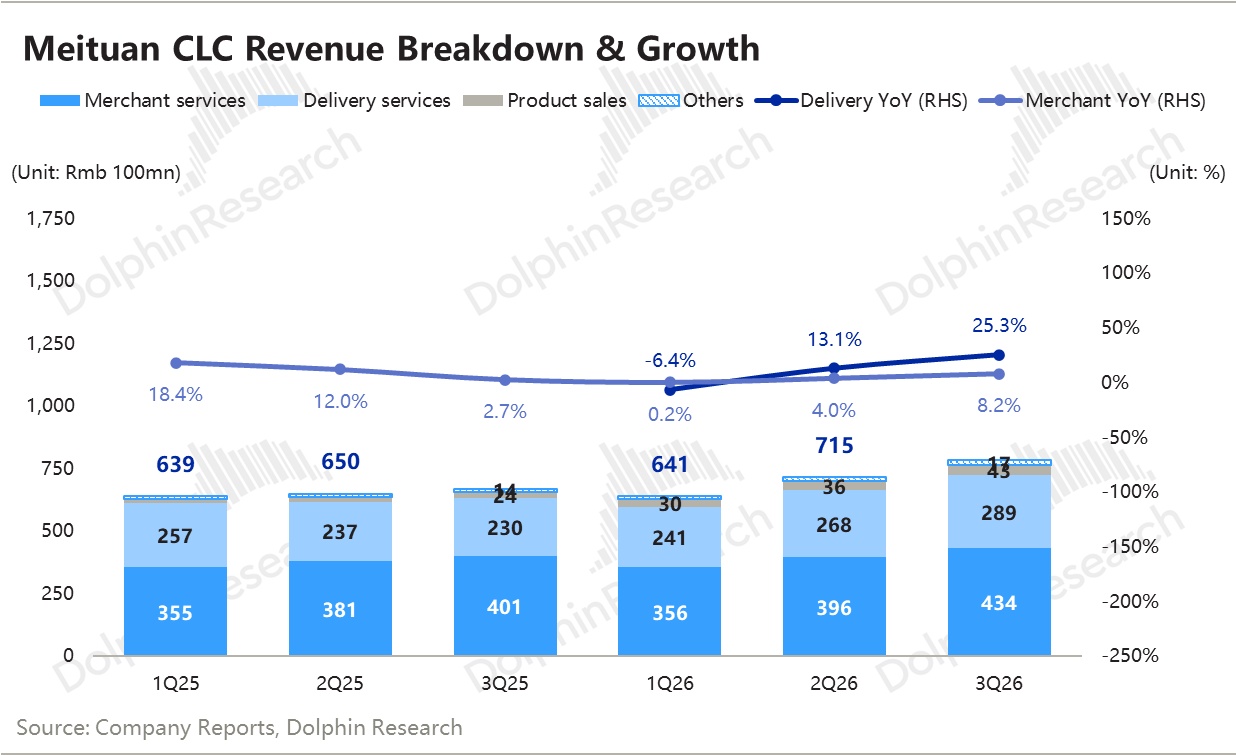
Core local commerce revenue was ~RMB 78.3bn, up ~17% YoY and clearly accelerating vs. Q2. Both fulfillment and merchant services (commission + ads) improved, with fulfillment the main driver and its growth accelerating by ~12ppt QoQ, consistent with better-than-expected delivery profit recovery.
Merchant services revenue growth accelerated by ~4ppt QoQ. This suggests improvement mainly came from a reduced revenue drag from delivery subsidies, while in-store likely continues to face notable pressure.
Management also said delivery is at an ‘inflection point’: AOV rose meaningfully YoY, and post-summer promotions, subsidies became more rational, so on-demand delivery profits beat internal expectations. For in-store, they guided to ‘solid’ growth, implying nothing particularly standout.
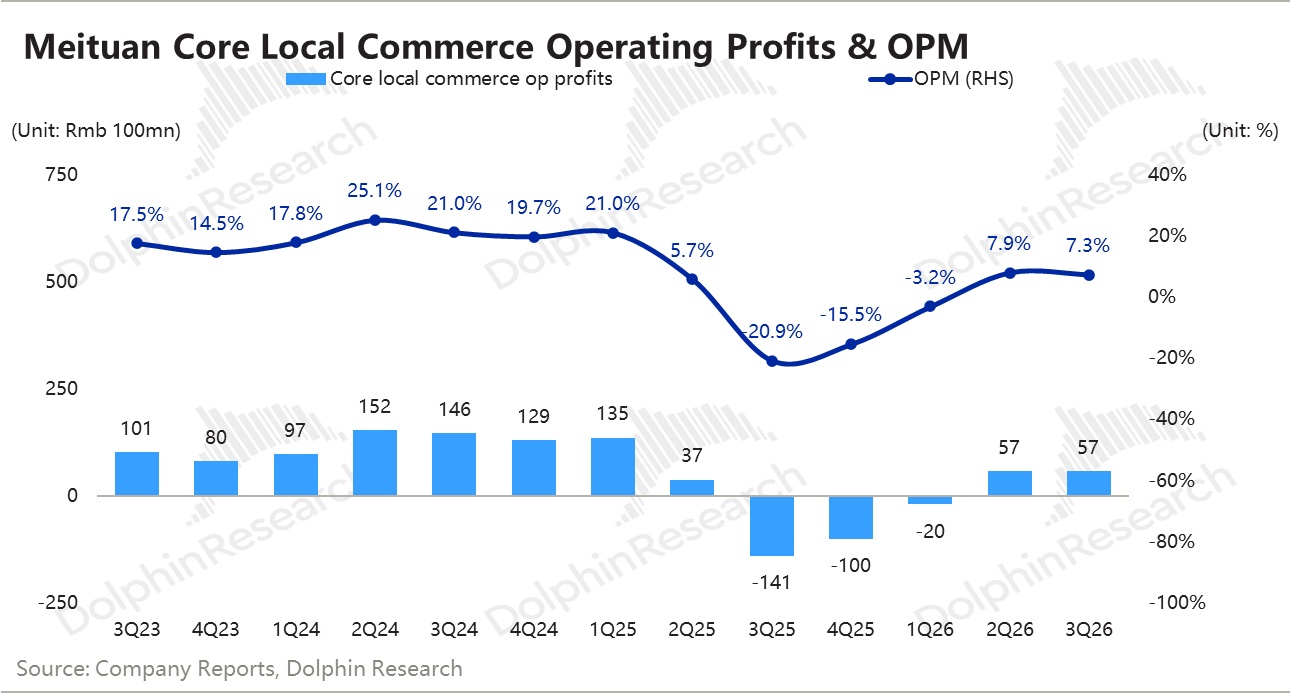
Core local commerce profit was RMB 5.70bn, flat QoQ and ~RMB 1.4bn above consensus. From the call, delivery UE and in-store margin both declined QoQ, though far less than the market feared.
Specifically, delivery UE was slightly below Q2, mainly due to higher summer delivery costs, but it improved through Sep–Oct. On-demand retail (Flash Sales) UE losses narrowed meaningfully QoQ, while in-store stepped up investment in peak season, driving a QoQ margin decline.
3) New biz: better-than-expected loss narrowing; Keeta turned profitable for the full quarter in Saudi
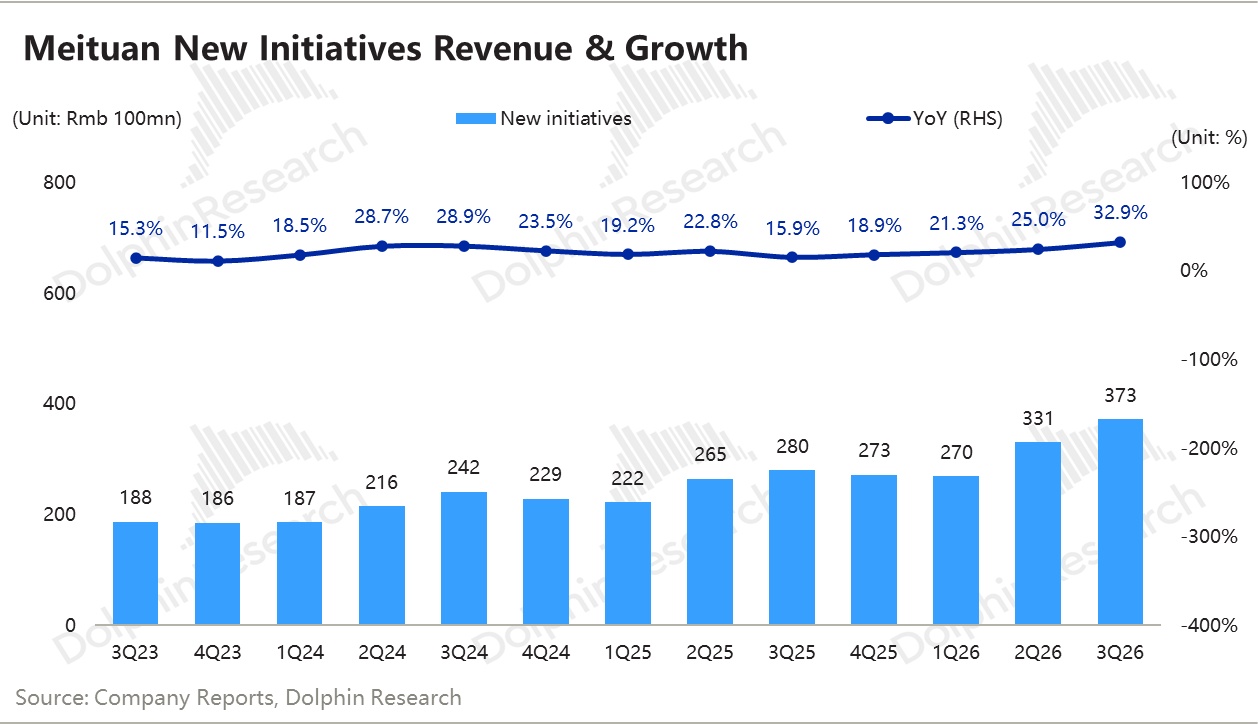
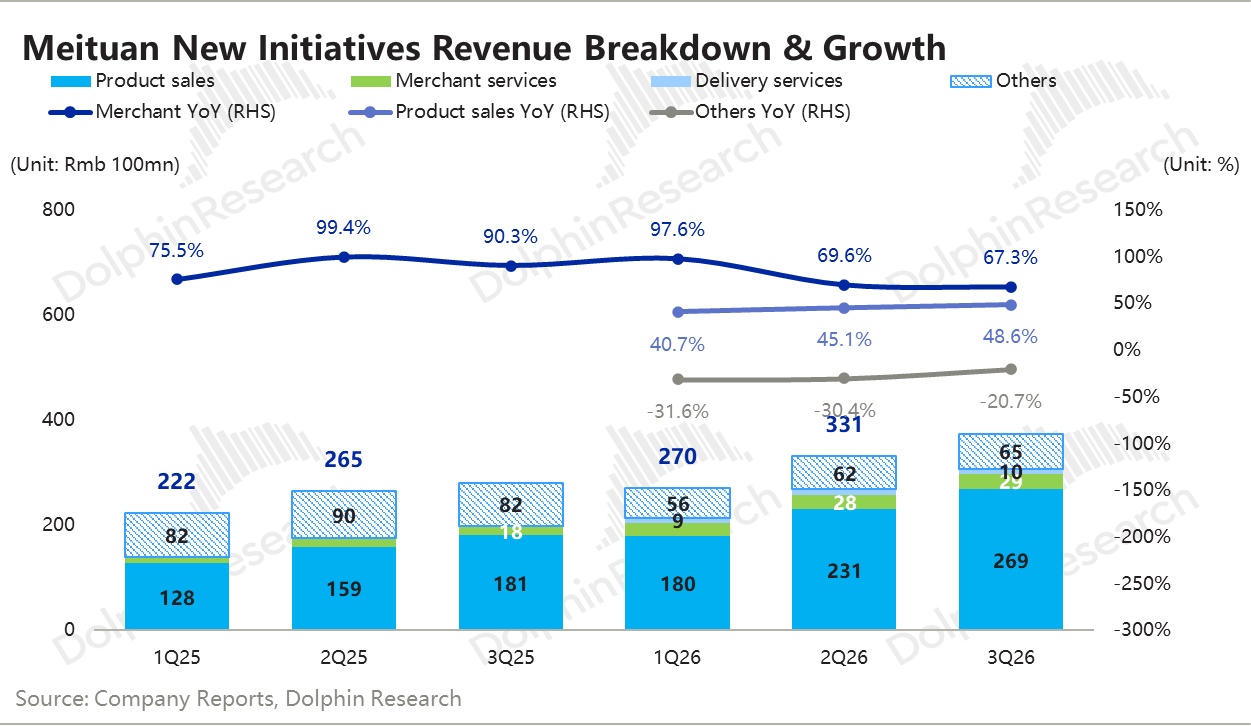
New biz revenue was RMB 37.3bn, with YoY growth accelerating to 33%, broadly in line with consensus. Operating loss was RMB 1.31bn, narrowing by over RMB 0.4bn QoQ and beating expectations.
Management attributed the narrower loss mainly to improved overseas efficiency: Hong Kong margin improved further, Keeta achieved full-quarter profitability in Saudi, and Brazil remains centered on São Paulo. Keeta’s turnaround overseas is progressing well.
Revenue acceleration was driven by strong growth in the largest component, self-operated retail, with growth rising from 45% to nearly 49%. Xiaoxiang Supermarket accelerated city expansion to 85 cities by quarter-end, while the community discount chain ‘Happy Monkey’ continued to open stores.
4) GP and expenses: GPM beat, but was offset by heavier marketing spend
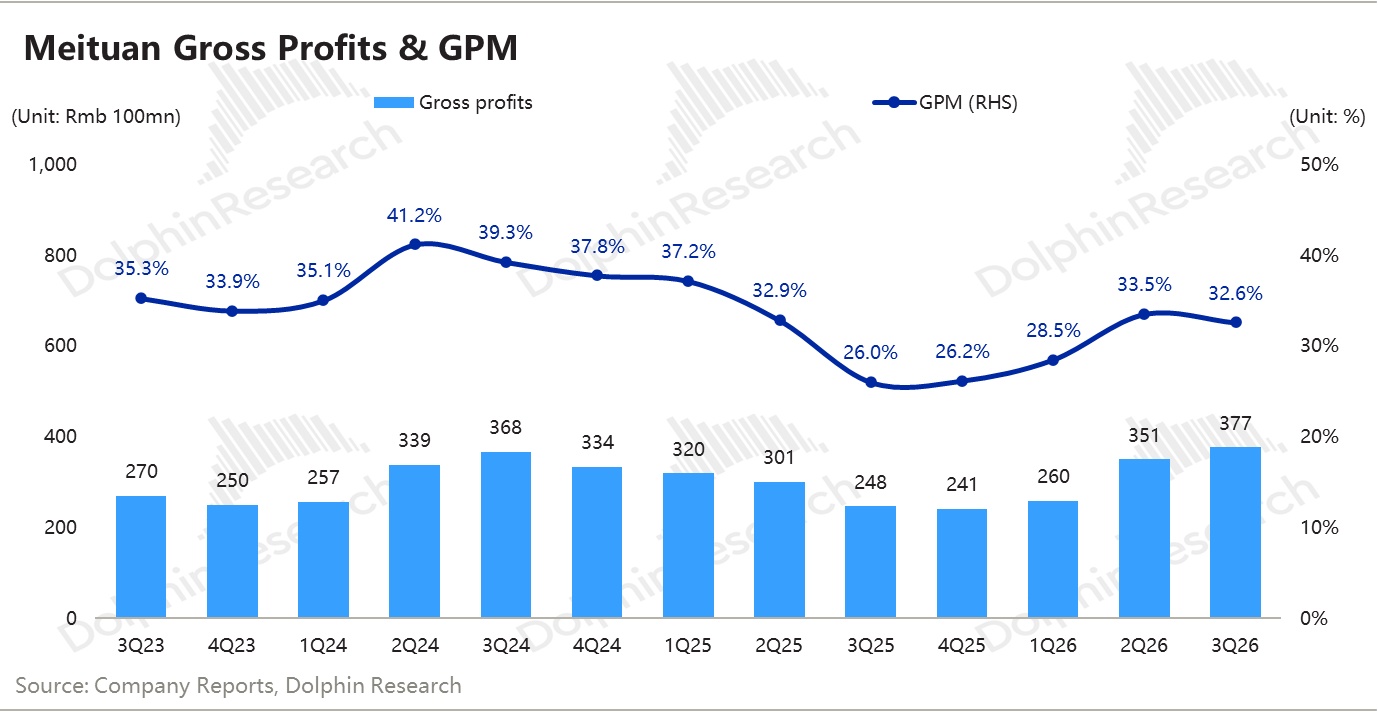
GPM was 32.6%, up 660bps YoY and ahead of the 31.5% consensus. This reflects lower delivery subsidies, higher revenue per order, lower delivery cost per order (more rational competition), and improvement in overseas and Xiaoxiang.
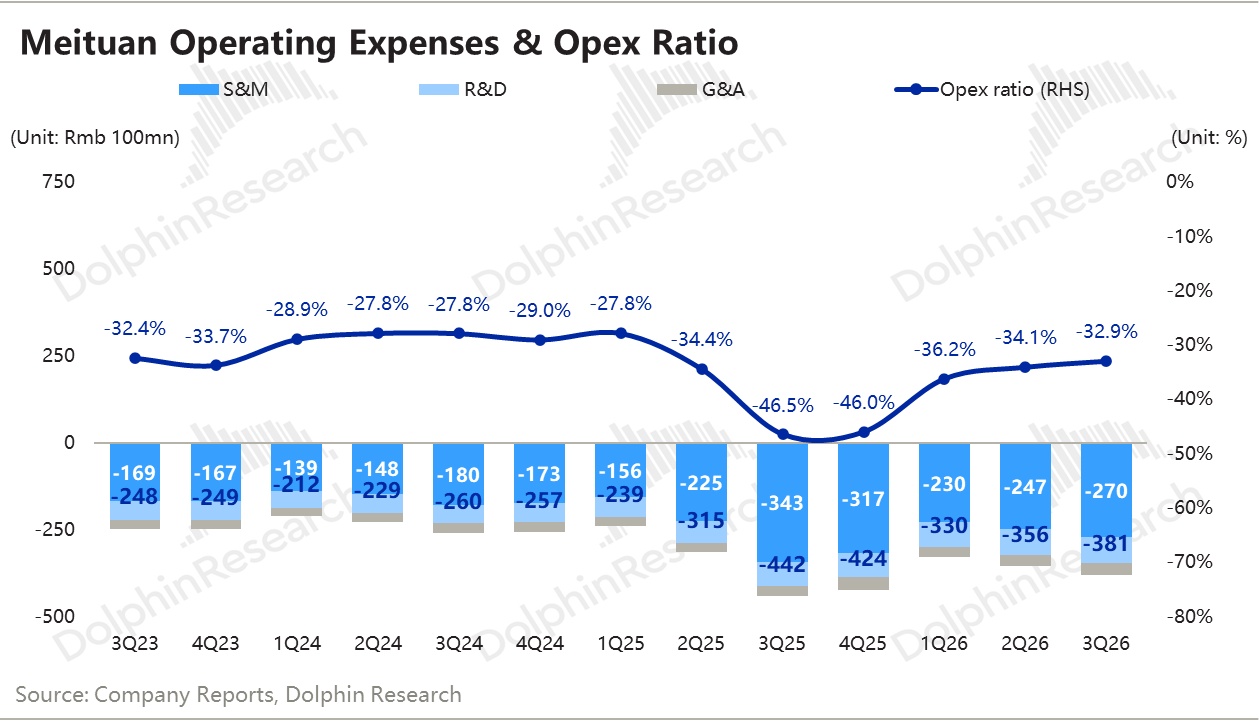
Total GP rose by ~RMB 2.6bn QoQ, better than expected. However, opex ran higher than expected, which explains the continued core operating loss and only modest QoQ improvement.
Marketing expense was RMB 27.0bn, about RMB 1.7bn above consensus and not meaningfully lower. Management cited peak-season marketing and user incentives, as well as Xiaoxiang expansion, while R&D was RMB 7.7bn (+11% YoY) driven by group-level AI investment, and G&A was RMB 3.31bn, roughly in line.
5) Cash flow and shareholder returns: no buyback; new debt issued to refinance old
OCF was a net inflow of RMB 4.78bn. Financing activities saw a net outflow of ~RMB 10.0bn, mainly loan repayments, with net cash of ~RMB 77.6bn ex borrowings and notes.
Despite the share price under pressure, there was no buyback through the announcement date. In Nov, the company issued RMB 8.0bn of notes, primarily to refinance existing offshore debt, implying no shareholder returns and continued borrowing.
While profitability is improving, the core businesses remain under pressure as the company expands into new areas. Even with the stock stuck at low levels for an extended period, there is limited room to return cash to shareholders or support the share price.
6) A snapshot of key results is below; see the earnings call transcript here: link
Dolphin Research view:
1) Core takeaways this quarter:
Core local commerce profit held flat QoQ in peak season, addressing the market’s biggest worry that Q3 UE would fall. Profit did not decline as guided last quarter, likely because delivery subsidies were pulled back faster than expected.
But the beat was primarily against low expectations, and absolute profit quality was only fair. Ex investment and other non-operating gains, core profit still posted a small loss with limited QoQ improvement.
In absolute terms, core local commerce profit was merely flat QoQ, while rivals JD and Alibaba reported improved losses QoQ in their delivery businesses. Loss narrowing in new biz was offset by incremental AI spending.
2) Outlook:
As before, three factors will shape Meituan’s medium/long-term results and share price trajectory: competition with Alibaba in on-demand retail, competition with Douyin in in-store, and Meituan’s own spending on new businesses and AI. These remain the key swing variables.
Near term, management said Q4 delivery costs will face seasonal pressure in winter and year-end. However, delivery UE should improve visibly vs. Q2/Q3 and remain industry leading by 2027, and they also expect in-store margins to trend up over the long run.
Key issue #1: delivery + on-demand retail (Flash Sales) — unlikely back to pre-war highs, but repair to a reasonable level is still likely
Over the long run, Meituan is unlikely to regain its pre-price-war market share and UE. Competition has not disappeared; players are implicitly aligning to cut losses at the current share split.
Based on third-party estimates and company disclosures, delivery market share has stabilized broadly around 5:4:1. A return to Meituan’s prior dominant share looks unlikely.
As Alibaba’s Flash Sales narrows losses per order, the drag on group profitability eases. Taobao’s on-demand retail is moving toward sustainable operations, giving it little reason to cede share.
Even with persistent competition, the low valuation and low bar leave room for Meituan’s delivery earnings and multiples to revert to a more reasonable level. Profit not falling this quarter suggests subsidy pullback is ongoing and peers are also tightening, making the recovery path clearer than last quarter, though not necessarily linear.
Key issue #2: in-store — Meituan is still losing share
Unlike delivery + Flash Sales, where competition is turning rational and Meituan at least defends its No.1 position, the in-store outlook is not fully clear. Some checks suggest Douyin’s in-store GTV is still growing much faster than Meituan, roughly 2x, implying Meituan is still losing share.
The print did not signal clear optimism: merchant services revenue growth only ticked up modestly, management merely guided to ‘solid growth’, and they explicitly stepped up in-store investment in peak season, pressuring margins. All of this points to no easing in in-store competition yet.
That said, with AI consuming significant resources and attention at Douyin, its in-store investment may be more likely to moderate in the medium term. The long-term threat remains, and the end-state is hard to call.
Key issue #3: AI self-development + new biz spend make profit and cash flow look weaker
With both core domestic pillars under pressure, Meituan’s self-built AI model and spending on overseas Keeta and domestic Xiaoxiang make group-level profit look weak even if delivery UE improves materially. Ex investment and other income, the group is still loss-making.
On the call, management said they plan to step up offline retail by 2027. While that offers a new domestic growth curve, offline retail, especially front-warehouse/store-plus-warehouse models, is capital-intensive and tougher than delivery, with less attractive profitability.
The good news is management said some compute capacity has already been secured this year, and AI-related capex in 2027 is expected to be lower than this year. At least the cash flow and profit pressure from AI may ease.
3) Valuation: base case ~HKD 92; current price largely embeds a bearish case
We keep our SOTP approach. In the base case: delivery assumes 2027 daily orders roughly flat vs. 2026 at ~67mn and UE of RMB 1/order (12x PE), Flash Sales assumes 2027 daily orders +15% with UE of RMB 0.4/order (18x), and in-store assumes 2027 revenue of ~RMB 78.3bn with a 28% margin (10x PE).
Sum-of-the-parts is ~HKD 92 (delivery ~48, Flash Sales ~7, in-store ~36), implying ~35% upside vs. the HKD 67.8 close on results day. This suggests meaningful mean reversion if execution stays on track.
In the bearish case — effectively what the current price implies — delivery assumes 2027 daily orders ~3% below 2026 with UE of RMB 0.8/order (10x PE), Flash Sales UE of RMB 0.2/order (16x), and in-store margin trimmed to 27% (9x PE). The SOTP lands at ~HKD 65, slightly below the current price.
In short, similar to many China consumer-internet platforms, structural competition persists, legacy core businesses are mature, and apart from harder overseas expansion, it is difficult to find new businesses that can match the original scale. It is hard to argue for deep long-term intrinsic value.
The setup is more about earnings and multiples having been de-rated too far, with room to revert toward neutral. Meituan appears to be in such a window today.
<End of text>
Risk disclosure and disclaimer: Dolphin Research Disclaimer and General Disclosure
Past Dolphin Research on Meituan
Earnings reviews:
Aug 28, 2026: Have Alibaba and Douyin cooled? Meituan’s anxiety remains
Aug 28, 2026 Trans: Meituan (Trans): delivery UE turned positive, will dip in Q3
Jun 1, 2026: Meituan: AI diverts firepower — time to catch a breath?
Jun 1, 2026 Trans: Meituan (Trans): UE to keep improving in Q2, likely to turn positive
Mar 26, 2026: Meituan: three mountains weigh — can the delivery incumbent rise again?
Mar 26, 2026 Trans: Meituan (Trans): Q1 delivery loss kept narrowing; Douyin is indeed stepping up
Nov 28, 2025 Trans: Meituan (Trans): Q3 loss peaked, but Q4 to remain in the red
Nov 28, 2025: Meituan: nearly RMB 20bn loss — did Alibaba finally succeed in a surprise attack?
Deep dives:
Jun 2, 2023: Against Douyin, Meituan cannot repeat Alibaba’s mistake
Dec 16, 2022: China reopens — can Meituan reclaim the crown?
Sep 22, 2022: Alibaba, Meituan, JD, and PDD accept reality — betting on luck remains
The copyright of this article belongs to the original author/organization.
The views expressed herein are solely those of the author and do not reflect the stance of the platform. The content is intended for investment reference purposes only and shall not be considered as investment advice. Please contact us if you have any questions or suggestions regarding the content services provided by the platform.