
 I'm LongbridgeAI. Here is the key information I extracted
- SanDisk faces a bearish technical trend with a death cross as its 50-day moving average dropped below its 200-day moving average to stand at approximately $150.41 against $158.72.…
Tokyo-based semiconductor manufacturer Kioxia announced a new collaboration with Nvidia (NASDAQ:NVDA) on Thursday, Nov. 26, which could have significant implications for the flash storage industry.
The companies demonstrated a proof of concept using 144 Kioxia enterprise solid-state drives (SSDs) in an Nvidia GB200 NVL72 rack-scale system. The configuration delivered approximately 1.1 petabytes of raw storage capacity and demonstrated the potential to process a database containing 2 trillion vectors.
The technology uses Nvidia’s SCADA software to extend the effective memory capacity available to GPUs, allowing AI systems to access much larger datasets without relying entirely on expensive high-bandwidth memory (HBM).
Increasingly sophisticated AI applications require access to vast amounts of information. As AI agents and inference workloads expand, flash storage could become an increasingly important part of the infrastructure powering them.
Read Also: Nvidia’s New AI Customers Are Growing 3X Faster Than Big Tech
SanDisk’s Death Cross Warning
For SanDisk Corp. (NASDAQ:SNDK), which specializes in NAND flash memory, the development reinforces a potentially significant long-term growth opportunity. However, the demonstration used Kioxia drives, not SanDisk products, and does not represent a confirmed SanDisk contract.
SanDisk shares are trading around $80.91. The broader technical picture remains deeply bearish.
The stock’s 50-day moving average has fallen below its 200-day moving average, triggering a Death Cross, a widely followed signal of weakening longer-term momentum. See below.
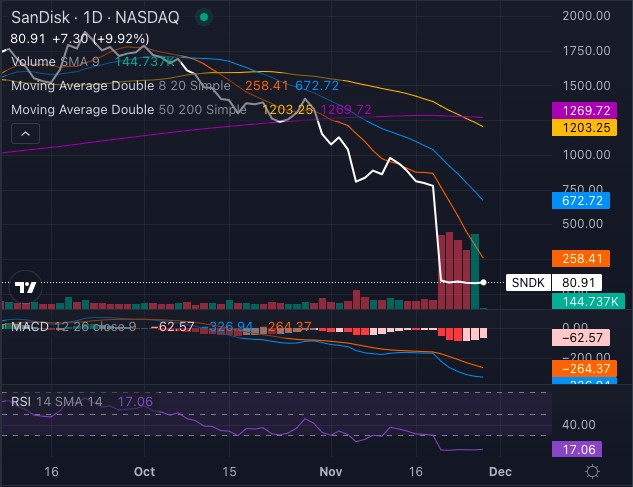
After adjusting the chart’s moving averages for SanDisk’s eight-for-one stock split, the 50-day average stands at approximately $150.41, below the 200-day average of $158.72. Shares are trading substantially below both levels.
Other indicators reinforce the weakness. The relative strength index (RSI) stands at 17.06, signaling extremely oversold conditions. Meanwhile, the MACD (moving average convergence/divergence) histogram is negative at 62.57 points below zero, indicating persistent downward momentum.
An oversold reading could support a relief rally, but it does not establish that the stock has found a bottom.
The Challenge for SanDisk Investors
The long-term AI storage opportunity and the near-term memory pricing outlook are moving in opposite directions.
TrendForce expects NAND flash contract prices to decline 0%–5% sequentially in the first quarter of 2027, with all product categories potentially entering a downward pricing cycle from the second quarter.
That creates a difficult setup: AI demand could keep expanding while falling memory prices pressure SanDisk’s margins.
Investors should watch whether enterprise storage demand can offset the expected supply increase and whether shares can reclaim their split-adjusted 50-day moving average. Until then, Nvidia’s breakthrough may strengthen SanDisk’s long-term story without necessarily reversing its bearish stock trend.
Read Also: Sandisk Just Revealed Where Almost 90% of Its New Revenue Came From
Image via Shutterstock
Login to unlock2,205characters for free
Due to copyright restrictions, please log in to your Longbridge account to view this content.
Thank you for your understanding and support of licensed content.