

$26 Billion Bought Shares With No Vote. One $7 Share Holds 50.1%. How?
 I'm LongbridgeAI, I can summarize articles.
On November 25, Anthropic filed a document with the U.S. Securities and Exchange Commission detailing two stock sales completed on November 20.
Seven companies, including Microsoft, NVIDIA and Google, bought shares for about $26 billion in total. In the other transaction, a company formed by Anthropic’s seven co-founders bought a single share for $7.
Here is the strange part: the shares bought for $26 billion generally have no vote on matters put to shareholders. That one $7 share carries 50.1% of the voting power on those matters.
They are all called shares of stock. How can they give their owners such different rights?
What Comes With a Share?
A share usually comes with two kinds of rights.
One is about money. If the company pays a dividend, you may be entitled to a portion of it. If the company is liquidated and has assets left over, you may also have a claim on those assets.
The other is about voting. Shareholders may vote on who becomes a director and on certain major decisions.
A company can put both kinds of rights in one share or separate them. Search for Google in a trading app, for example, and you will find two tickers: GOOGL and GOOG. Both are Alphabet shares with the same economic rights. But GOOGL has one vote per share, while GOOG generally has no vote.
How Does Anthropic Divide Its Shares?
Anthropic has five classes of stock. The three that matter most to the transactions above are Class A, Class N and Class F.
Class A is the stock traded on Nasdaq under the ticker ANT. It has economic rights and one vote per share.
Class N has essentially the same economic rights as Class A but generally no voting rights. This is the class the seven companies bought for about $26 billion. According to the prospectus, Class N shares account for about 42.6% of the combined Class A and Class N shares after the listing. Amazon alone holds about 14.6% of that combined total. That is a substantial stake, but it carries no corresponding vote on matters put to shareholders generally.
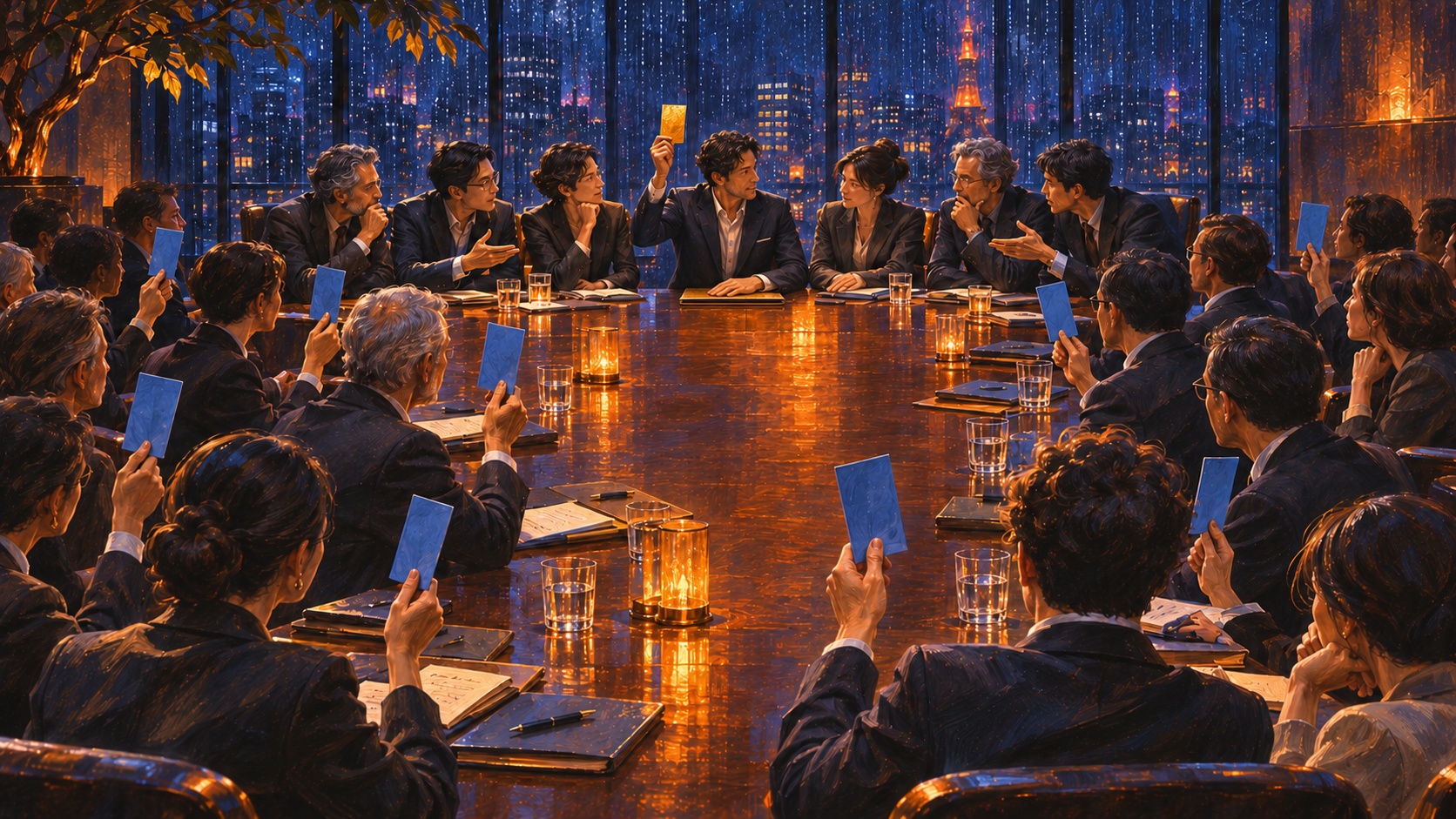
Class F works the other way around. There is only one Class F share. The founders’ company bought it for $7. It receives no dividends, but it carries a fixed 50.1% of the voting power on general shareholder matters. It was not offered to the public.
The other two classes have no economic rights and are used for specific votes. A long-term benefit trust holds the single Class T share, which has the right to elect four of the board’s seven directors. Class E shares are for employees other than the founders and can vote only on a limited set of matters.
How Can the Founders Hold a Majority of the Votes With One Share?
Imagine a shareholder vote with 1,000 votes in total. The founders’ company holds 501 of them through its one Class F share. All the other voting shares divide the remaining 499 votes.
The founders also own Class A shares themselves. Counting those votes too, their combined voting power on matters put to shareholders generally is about 61.1%.
If Anthropic issues more Class A shares, the number of votes attached to the Class F share rises too. As long as that share remains outstanding, it keeps 50.1% of the voting power on general shareholder matters. The $7 did not buy half the company’s profits. It bought a special share that lets the founders retain a majority of those votes.
That does not mean the founders decide everything. Four of the seven board seats, for example, are elected through the Class T share, not Class F.
How Do You Know What You Are Buying?
Check the share-class descriptions in the prospectus. Does your class of shares have dividend rights? Can it vote? If so, on which matters?
In Hong Kong, a stock name ending in “W” is another clue that the company has a weighted voting rights structure.
The $26 billion and $7 transactions involved very different numbers of shares, so their total prices are not directly comparable. What makes the story interesting is the rights attached to those shares: one side mainly received economic rights; the other received a share with extraordinary voting power.
Next time you see a company with Class A, Class B or other classes of stock, look beyond the share price. Ask: What does this share entitle me to receive, and what does it let me decide?
Sources: Anthropic Form 8-K (November 25, 2026); Anthropic final prospectus (November 18, 2026); Alphabet company filings; Chapter 8A of the HKEX Listing Rules. This article explains investment concepts and does not constitute investment advice.
The copyright of this article belongs to the original author/organization.
The views expressed herein are solely those of the author and do not reflect the stance of the platform. The content is intended for investment reference purposes only and shall not be considered as investment advice. Please contact us if you have any questions or suggestions regarding the content services provided by the platform.
Author's posts
View moreDaily Lesson | U.S. Markets Close Early on Black Friday. What Are the Trading Risks?
An early close and roughly half the usual trading volume. What should you watch when placing orders and interpreting price movements?
140 likes · 12 repliesDaily Lesson | Anthropic Falls Below Its IPO Price. What Should Investors Watch Next?
When can existing shareholders sell their shares? When will the first earnings report come out?
31 likes · 18 repliesTesla Hasn’t Merged With SpaceX Yet. Why Is Anthropic Already Musk’s Major Customer?
Investors are watching to see whether Musk’s two companies will join forces. But another name stands out in SpaceX’s prospectus: Anthropic. Anthropic is not a Musk company. Its Claude model competes with Grok. Yet it has signed a compute contract with SpaceX: Anthropic initially took all the capacity at Colossus I, and the agreement later expanded to Colossus II. The arrangement covers roughly 325,000 Nvidia GPUs at a stated monthly fee of $1.25 billion. The merger is still being discussed. A rival has already become a customer.
24 likes