

Daily Lesson | U.S. Markets Close Early on Black Friday. What Are the Trading Risks?
 I'm LongbridgeAI, I can summarize articles.
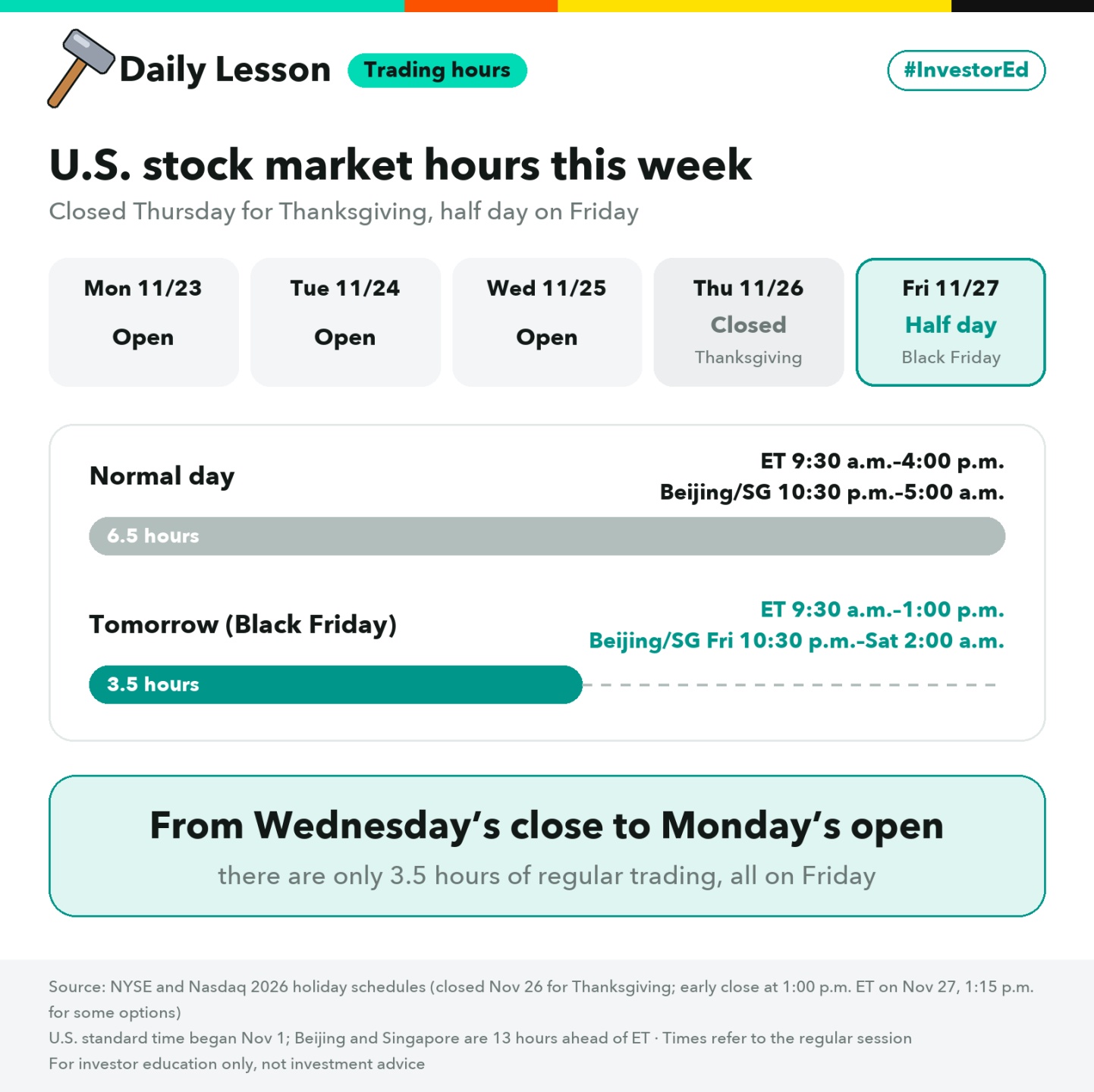
Tomorrow is Black Friday. Stores will be busy with holiday sales, while the U.S. stock market will close early.
According to NYSE and Nasdaq trading schedules:
- November 26 (Thanksgiving): U.S. stock markets are closed;
- November 27 (Black Friday): the market opens at 9:30 a.m. ET and closes early at 1:00 p.m. ET, corresponding to 10:30 p.m. to 2:00 a.m. the following day, Beijing and Singapore time.
A regular U.S. stock market trading session lasts 6.5 hours. On Black Friday, it lasts just 3.5 hours.
Besides the early close, there's another factor investors often overlook around holidays: market liquidity.
What Is Market Liquidity?
Put simply, liquidity refers to how easily you can buy or sell an asset quickly and at a price close to the current market price.
Suppose you own a stock currently trading at $100 and want to sell 1,000 shares.
If many investors are willing to buy at around $100, you may be able to sell your shares quickly.
But if few investors are willing to pay $100 and you want to sell all 1,000 shares at once, you may have to accept a lower price.
In the first case, market liquidity is relatively high. In the second, it is relatively low.
Around holidays, some institutions and investors may trade less. Combined with shorter trading hours, overall trading volume may be lower than usual, and the order books for some stocks may become thinner.
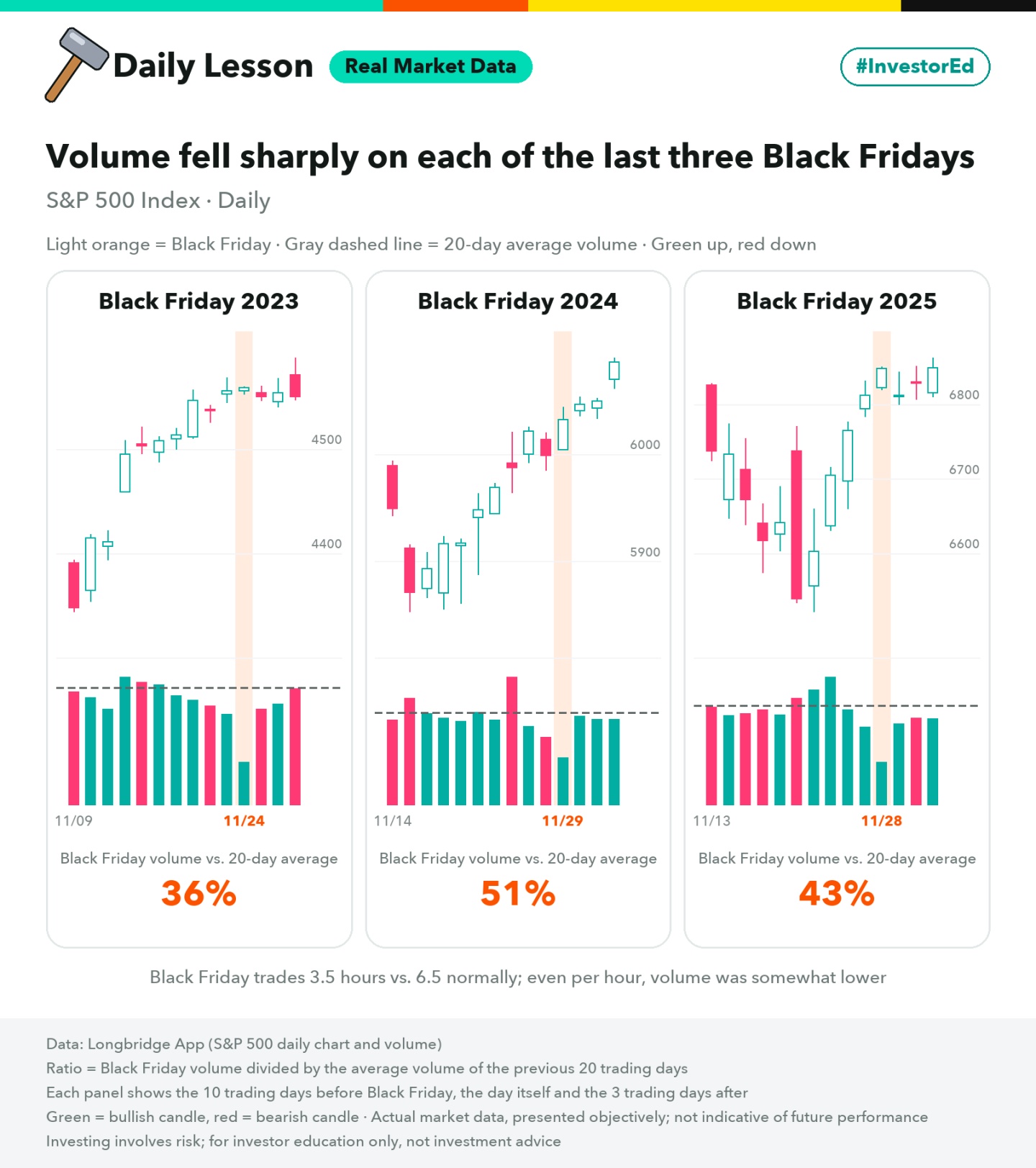
Take the S&P 500 as an example. On each of the past three Black Fridays, the index's daily trading volume was only 36% to 51% of its average over the preceding 20 trading days — roughly a third to half of the usual level. Most of that decline can be attributed to the trading session being only slightly more than half its usual length. Even on a per-hour basis, however, trading volume was still somewhat lower than usual.
What Happens When Liquidity Is Low?
1. The bid-ask spread may widen
On a stock's quote page, you'll usually see two prices:
- Bid: the highest price a buyer is currently willing to pay;
- Ask: the lowest price a seller is currently willing to accept.
The difference between these two prices is called the bid-ask spread.
Let's use the same stock as an example (all prices are hypothetical). When trading is active, the bid might be $99.99 and the ask $100.01, giving a spread of just $0.02. When trading is quieter and there are fewer orders, the bid might fall to $99.90 while the ask rises to $100.10, widening the spread to $0.20.
That means if you place a market order to buy 100 shares at that point, you'll typically pay the ask price of $100.10. If you immediately sell those shares, you'll typically receive the bid price of $99.90. Even though the midpoint between the bid and ask hasn't changed, you've already lost $0.20 per share.
The bid-ask spread may not appear as a separate charge like a commission, but it is still a trading cost investors bear.
2. The price you see isn't necessarily the price you get
Besides the bid-ask spread, low liquidity can lead to another problem: slippage.
Suppose you see an ask price of $100.10 and place a market order to buy 1,000 shares. However, only 200 shares are available at $100.10, another 300 at $100.15, and another 500 at $100.25.
Your order is filled across these price levels, starting with the lowest available price. Your average execution price is approximately $100.19, about $0.09 higher than the ask price you originally saw.
This difference between the expected price and the actual execution price is what we call slippage.
The thinner the order book, the more likely a large order is to be filled across multiple price levels.
Unlike a market order, a limit order allows you to set the maximum price you're willing to pay or the minimum price you're willing to accept. The trade-off is that your order may be filled only partially or may not be filled at all.
FINRA (the Financial Industry Regulatory Authority) makes a similar point when warning investors about the risks of extended-hours trading: with fewer market participants, orders may be filled only partially or not at all. Even if an order is filled, the execution price may be less favorable than during regular trading hours.
Black Friday is still a regular trading session, and liquidity is generally not as limited as during extended-hours trading, but the same principle applies.
3. Does lower trading volume always mean smaller price swings?
Many investors may assume that with fewer people trading around the holidays, the market should be relatively calm.
But lower trading volume doesn't necessarily mean smaller price swings.
Think of it this way: if there are plenty of buy orders, a large sell order may be absorbed quickly without pushing the stock price down much.
But if there are relatively few buy orders to begin with, that same sell order may need to be filled at progressively lower prices. The same principle applies to buy orders.
So fewer market participants don't necessarily mean less risk. When liquidity is low, a single order may have a greater impact on the stock price.
Of course, this doesn't mean the market will necessarily experience sharp price swings on Black Friday. It's simply a reminder that shorter trading hours and lower trading volume don't automatically make the market safer.
⚠️ On a shortened trading day like Black Friday, when trading volume tends to be lower, the key isn't to predict which way prices will move. Know the closing time, pay attention to bid-ask spreads and slippage, and don't mistake low trading volume for low risk.
Today's quiz
Next Question: Suppose you want to sell a stock you own on Black Friday. The current bid is $100, but there are very few buy orders. If the lowest price you're willing to accept is $100, which type of order best meets your needs?
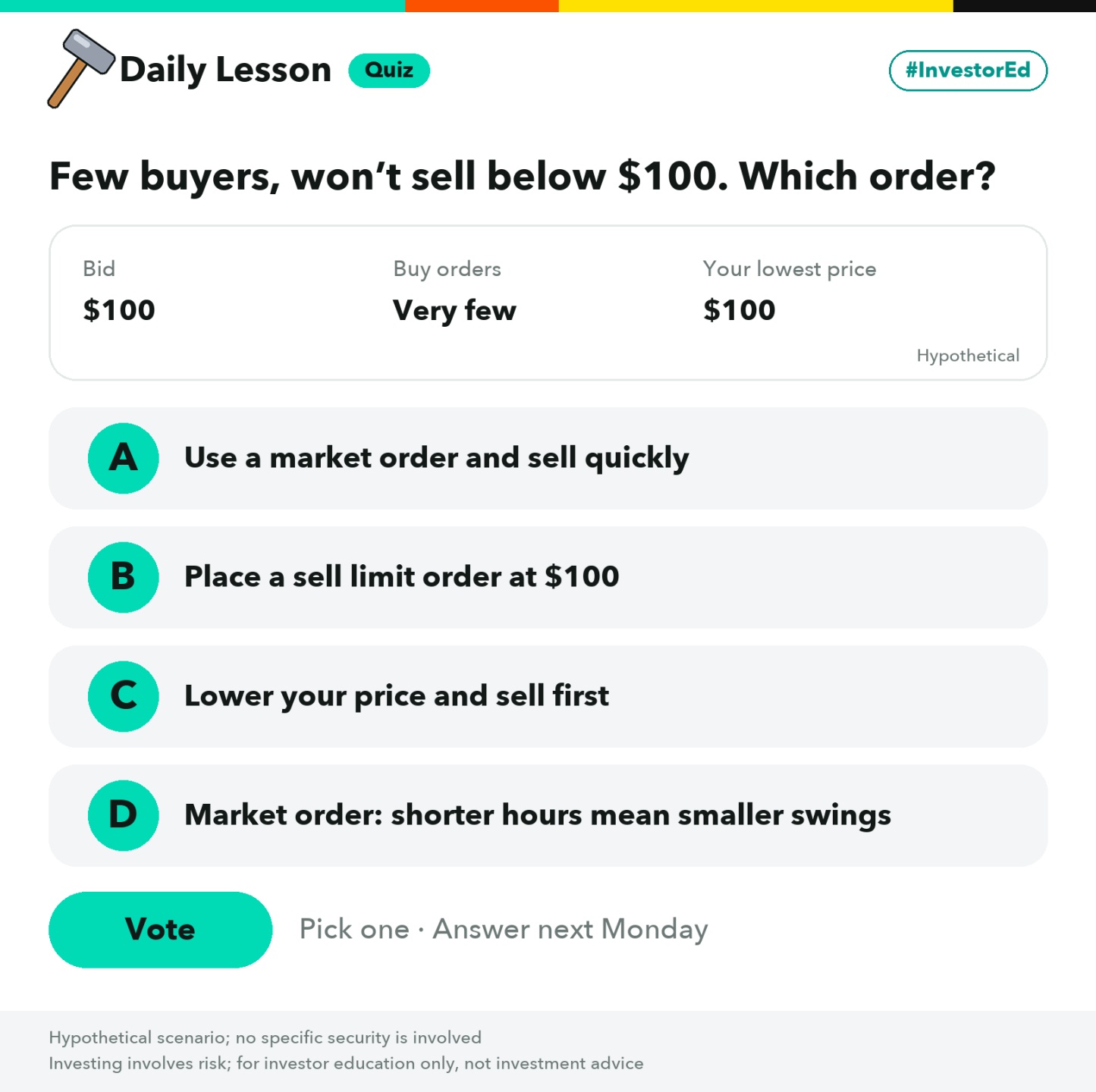
Scroll down to vote. We'll reveal the answer next Monday.
🎁 Vote, comment, earn rewards
- Pick the correct answer in the poll: 88 Task coins
- Pick the correct answer and tell us in the comments: when few people are trading, what would you check first before placing an order, and why? (at least 15 words): 188 Task coins
Poll closes Mon, 30 Nov, 6pm SGT. We'll announce the number of winners together with the answer. Rewards will be credited within 7 working days. One entry per account. Comments must relate to today's topic. T&Cs apply.
Disclaimer: This content is provided for investor education purposes only and does not constitute investment advice, an offer, or a recommendation to buy or sell any security. The index and data mentioned are used only to illustrate concepts and do not indicate future performance. Investing involves risk. Please make investment decisions carefully. The author and publisher accept no liability for any direct or indirect losses arising from reliance on this content.
The copyright of this article belongs to the original author/organization.
The views expressed herein are solely those of the author and do not reflect the stance of the platform. The content is intended for investment reference purposes only and shall not be considered as investment advice. Please contact us if you have any questions or suggestions regarding the content services provided by the platform.
Author's posts
View more$26 Billion Bought Shares With No Vote. One $7 Share Holds 50.1%. How?
At a shareholder meeting, the biggest check doesn’t always get the final say. How does a share separate the right to the money from the right to decide?18 likesDaily Lesson | Anthropic Falls Below Its IPO Price. What Should Investors Watch Next?
When can existing shareholders sell their shares? When will the first earnings report come out?
31 likes · 18 repliesTesla Hasn’t Merged With SpaceX Yet. Why Is Anthropic Already Musk’s Major Customer?
Investors are watching to see whether Musk’s two companies will join forces. But another name stands out in SpaceX’s prospectus: Anthropic. Anthropic is not a Musk company. Its Claude model competes with Grok. Yet it has signed a compute contract with SpaceX: Anthropic initially took all the capacity at Colossus I, and the agreement later expanded to Colossus II. The arrangement covers roughly 325,000 Nvidia GPUs at a stated monthly fee of $1.25 billion. The merger is still being discussed. A rival has already become a customer.
24 likes