

600104

BYD: Price cuts to drive volume at home; is the overseas 'lifeline' failing too?
 I'm LongbridgeAI, I can summarize articles.
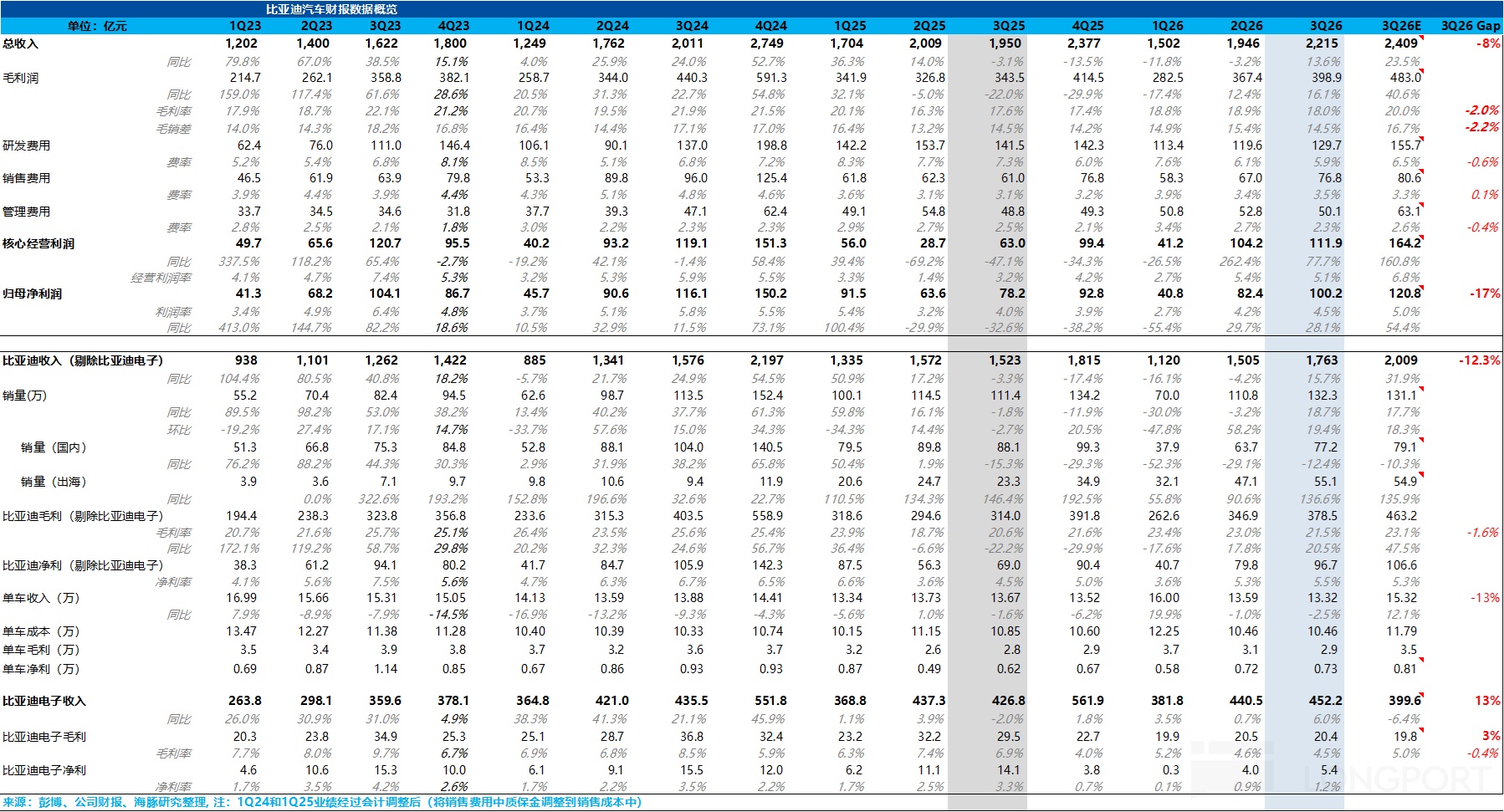
BYD (1211.HK) released its Q3 2026 results after the HK close on Oct 29 Beijing time. Key takeaways:
1) Total revenue materially missed; ASP was the culprit: Q3 revenue was RMB 221.5bn (+13.6% YoY), about 8% below the market’s RMB 240.9bn expectation. The shortfall mainly reflects weaker ASP rather than volume.
2) ASP fell QoQ and missed by RMB 20k: Q3 ASP was RMB 133k, down about RMB 2.7k QoQ and roughly RMB 20k below the market’s RMB 153k expectation. Three factors dragged ASP:
a. Domestic recovery outpaced overseas: the overseas mix fell by ~0.9ppt QoQ to 41.6%, diluting higher-priced exports. b. The domestic price war persists, and premium brands (Denza, Fangchengbao, Yangwang) combined were ~13.7% of mix, flat vs. Q2, so they did not lift blended ASP.
3) Auto GPM fell 160bps QoQ, below estimates: Auto GPM was 21.5% in Q3, down from 23.0% in Q2 and below the ~23% market expectation. Per-car cost held at ~RMB 105k (flat QoQ), so margin compression came entirely from ASP while scale benefits failed to materialize.
4) Profit also missed; per-car net profit flat, supported by opex control: Q3 attributable net profit was RMB 10.02bn (+28% YoY), ~17% below the RMB 12.08bn market expectation. Ex-BYD Electronics, per-car net profit was ~RMB 7.3k, roughly flat vs. Q2’s ~RMB 7.2k.
Stable profit was driven by restrained R&D spending (RMB 13.0bn, -8% YoY) and ~RMB 850mn FV gains. The core per-car OP most indicative of the main biz was ~RMB 8.5k, down ~RMB 900 vs. Q2.
Dolphin Research view:
Overall, BYD’s Q3 missed, with a key issue of volume-price divergence. As Gen-2 Blade battery capacity ramped, domestic sales rose ~21% QoQ and overseas kept scaling, so volume delivered. But ASP fell, pulling GPM down, and profit was underpinned by lower R&D and non-operating gains, with core per-car OP down ~RMB 900, making the profit growth of limited quality.
Domestic first. Industry demand is slumping, and BYD is trading price for volume via fast-charging.
The domestic auto market is in its worst patch this year: Sep passenger retail fell ~28% YoY, the biggest drop YTD. Q3 domestic NEV passenger retail fell 11% YoY, with growth mainly from exports.
BYD’s share is recovering: as Gen-2 Blade battery capacity ramps, backlogged fast-charging BEV orders were delivered, and pure BEV sales rose ~37% QoQ. Domestic share rose ~2.7ppt QoQ to 25.4%.
A gap has emerged between wholesale and retail: in Sep, BYD domestic retail was ~247k vs. wholesale of ~283k, a shortfall of ~36k, implying passive channel restocking. With the price war ongoing and ASP still trending down, BYD is still swapping price for volume domestically rather than lifting both.
Under a neutral assumption, BYD’s 2026 domestic sales are ~2.74mn (-23% YoY; -30% YoY in the first three quarters). This implies Q4 needs ~950k, ~23% QoQ growth, which is not conservative given channel restocking.
Overseas next: volume keeps expanding, but profit is discounted.
Q3 overseas sales were ~550k (+~137% YoY), and YTD Q1–Q3 totaled ~1.34mn, already above full-year 2025. The 1.9–2.0mn full-year target implies Q4 monthly run-rate of ~190–220k, roughly in line with Q3’s ~180k at the lower end, making 1.9mn achievable.
The issue is per-car profit overseas: by Dolphin’s estimate, Q3 overseas per-car net profit was ~RMB 12.5k (range RMB 12–13k), vs. domestic of ~RMB 3–4k. This is well below the prior market assumption of ~RMB 20k.
In Sep, management said overseas per-car profit was ‘basically stable’. But they have now guided down to ~RMB 16k, mainly due to FX swings (about RMB 2.0bn impact), and the gap vs. Dolphin’s estimate (~RMB 3.6k/vehicle) roughly matches RMB 2.0bn spread over ~550k overseas units in Q3.
Bigger pressure looms in 2027, with two policies landing in Oct:
a. Export VAT rebate cut: On Oct 12, the Ministry of Finance announced the export VAT rebate on NEV passenger cars will be reduced from 13% to 9%, effective Apr 1, 2027. At an average declared price of ~RMB 130k in 2026, if OEMs do not raise prices, pre-tax per-car cost rises ~RMB 5,000 and post-tax ~RMB 4,000, which can be absorbed by modest price hikes or localization.
OEMs will likely front-load exports before Apr, with Q1 2027 exports pulled forward and then falling back.
b. EU hybrid quota: China and the EU reached an agreement on hybrid exports on Oct 9; reports suggest the EU will cap China’s hybrid imports at 350k per year starting Dec, rising 6% annually for four years. China’s hybrid exports to the EU were ~377k in the first seven months of this year and could exceed 800k for the full year, so the quota may cut exports by more than half.
BYD is among the leading Chinese OEMs by sales in the EU. Per MarkLines, in Jan–Aug 2026, Chinese brands’ HEV+PHEV retail in the EU was ~280k, with SAIC/ BYD/ Chery/ Geely at 105k/98k/59k/13k, respectively.
By exposure, their EU hybrid retail as a share of global (ex-China) retail was 22%/15%/8%/4%, respectively, with SAIC and BYD more exposed; EU PHEV exports will be directly constrained.
Dolphin expects the quota to impact BYD by ~100–150k units in 2027 (~5–6% of potential overseas volume), mitigated only by price hikes and mix shifts.
Localization is the hedge: the company cited ocean freight per car above RMB 10k and EU tariffs above RMB 40k, so after 1–2 years of stable local operations, profitability should surpass exports. But the Hungary plant will only start assembly in Nov–Dec (design capacity 300k, Phase I 150k), delayed by ~1 year vs. plan, making a full hedge in H1 2027 unlikely.
Valuation overview. Key assumptions below.
Dolphin projects 2026 total sales of ~4.64mn (domestic ~2.74mn, -23% YoY; overseas ~1.90mn, +84% YoY). Per-car net profit from autos (ex-BYD Electronics) was ~RMB 21.7bn for the first three quarters.
Assuming Q4 units of ~1.51mn, overseas mix easing to ~37%, and domestic per-car profit still thin, full-year auto net profit is ~RMB 32.0bn (~RMB 6.9k per car), up ~6% vs. 2025’s ~RMB 30.3bn.
With only two months left in 2026, the valuation anchor shifts to 2027, and overseas per-car net profit is the swing factor. Starting from Q3’s ~RMB 12.5k:
a. Export rebate: ~RMB 4,000 post-tax per car impact, but it only applies for three quarters, and ~20% of localized volume is unaffected. If prices are not raised, overseas per-car net profit dilutes by ~RMB 2.5k; if half is offset by price hikes, the impact is ~RMB 1.3k.
b. EU quota and mix downshift: EU PHEV is the fattest overseas profit pool, and the quota will displace ~100–150k high-margin units. Incremental volume will shift to lower-ASP markets like LatAm and Southeast Asia, and intensified competition from Chinese peers could compress per-car profit by another ~RMB 1.0–1.5k.
c. Localization ramp and FX: Hungary and Turkey will still be ramping in 2027, dragging ~RMB 500–1,000 per car. If FX losses do not recur, ~RMB 2,000 could be recovered.
In aggregate, under a neutral case, 2027 overseas per-car net profit is ~RMB 10k (range RMB 8–12k), down ~20% vs. Q3.
For 2027, Dolphin models total units of ~5.15mn (+11% YoY; domestic ~2.75mn, flattish; overseas ~2.40mn, +26% YoY, after deducting the EU quota impact of ~100–150k). At domestic per-car net profit of ~RMB 3.5k and overseas of ~RMB 10k, 2027 auto net profit is ~RMB 33.6bn (~RMB 6.5k per car), up only ~5% vs. 2026.
With profit roughly flat, assigning 15x PE for 2027 implies auto biz equity value of ~RMB 504bn. Including BYD Electronics at a 65.74% stake and current market cap adds ~RMB 29bn, for a total of ~RMB 533bn, broadly in line with the current H-share market cap of ~RMB 528.3bn, while A-shares at ~RMB 744bn trade at a higher premium.
Overseas per-car net profit is the most sensitive variable: every RMB 1.0k swing changes 2027 profit by ~RMB 2.4bn and equity value by ~6%:
a. Bull case (overseas ~RMB 12k, smooth price hikes, earlier localization profits): auto net profit ~RMB 38.4bn, +20% YoY, at 17–20x PE for 2027 implies total equity value of ~RMB 681.8–797.0bn, +~30%–51%. b. Bear case (overseas ~RMB 8k, no price hikes, EU quota squeezes Europe): auto net profit ~RMB 28.8bn, total equity value ~RMB 461.0bn, -~18%.
Conclusion: In last quarter’s review, Dolphin judged BYD’s upside as limited. Since the Aug report, the stock is down ~22%, largely pricing in discounted overseas profitability in 2027; under the neutral case, the current HK price is largely reflected, and the risk-reward is not compelling.
Near term catalysts are lacking; we need to see Q4 revenue catch up to wholesale, inventories decline, overseas price hikes land in Q1 2027, and smooth ramp at the Hungary plant to validate the quality of overseas scaling. Before overseas per-car profit stabilizes, valuation repair may be slow.
<End here>
Risk disclosure and statement for this article: 海豚研究免责声明及一般披露
The copyright of this article belongs to the original author/organization.
The views expressed herein are solely those of the author and do not reflect the stance of the platform. The content is intended for investment reference purposes only and shall not be considered as investment advice. Please contact us if you have any questions or suggestions regarding the content services provided by the platform.