

Global bond market turmoil: Which asset classes will be affected?
 I'm LongbridgeAI, I can summarize articles.
Global bond yields are surging to multi-year highs across the US, Japan, Europe, and Australia, driven by inflation risks, potential Fed rate hikes, and record sovereign debt levels. Experts attribute this to a supply-demand imbalance and a reassessment of government bonds' risk-free status, signaling a potential end to the low-interest-rate era.
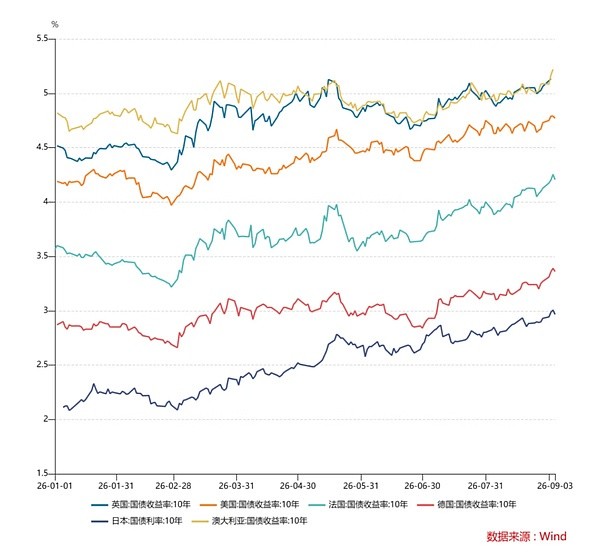
Recently, alarm bells have been ringing in global bond markets. From Washington to Tokyo, from London to Sydney, and then to Berlin and Paris—bond yields are collectively rising, reaching new highs. The yield on the 10-year US Treasury note rose to its highest level since January 2025; the yield on the 10-year Japanese government bond touched 3%, the first time since 1996; the yields on the 10-year Australian and German government bonds both rose to their highest levels since 2011; and the yield on the 10-year French government bond rose to its highest level since 2008. Rising bond yields correspond to falling bond prices. Several experts say that rising inflation risks and expectations of interest rate hikes are a major trigger. On the evening of August 28, Federal Reserve Chairman Kevin Warsh pointed out at the Jackson Hole Economic Symposium that inflation remains above the Fed's 2% target. Therefore, the Fed's primary focus should be on prices. Data from the CME Group's FedWatch Tool shows that as of the afternoon of September 3, the probability of a 25 basis point rate hike by the Fed in September was 60.2%, a significant increase from 35.4% a week earlier. "Currently, a surge in bond supply is flooding the market, while demand has not expanded accordingly. Investors demanding higher risk premiums is a normal market reaction," said Qu Qiang, Vice Dean of the Institute of Regional and Country Studies at Minzu University of China. He also believes that the simultaneous surge in yields on government bonds in the US, Japan, UK, Australia, Germany, France, and other countries is the result of a multi-faceted resonance of fiscal, monetary, geopolitical, and structural forces. The primary driver comes from fiscal pressures on major economies. Debt levels remain high. A report released by the Organization for Economic Cooperation and Development (OECD) in March 2026 shows that outstanding sovereign debt of OECD countries reached a record high of $61 trillion in 2025, up from $55 trillion in 2024, marking the largest annual increase since the pandemic. Part of this increase comes from the pricing effect of the depreciating dollar, pushing up the dollar-denominated debt of non-US economies. Measured as a percentage of GDP, sovereign debt remained stable at 83% in 2024-2025, but is projected to climb to 85% in 2026, the highest level since 2021. Meanwhile, demand has shown signs of reduction. Core buying of US Treasuries is weakening; in the UK, demand for government bonds from long-term investors less sensitive to price changes has declined, and the Bank of England's support for the bond market is less than before. In the Eurozone, central banks' bond holdings have continued to decline, and the demand from stable, price-insensitive investors has narrowed. The Japanese bond market is experiencing a situation where central banks are reducing their holdings while life insurance companies are selling off their bonds. This reversal in supply and demand is reshaping the pricing logic of sovereign bonds. Qu Qiang stated that since 2023, yields on sovereign bonds from major developed economies have barely declined during global geopolitical conflicts. This means the market is beginning to price sovereign bonds based on "credit risk" rather than simply "interest rate risk," and higher term premiums will be embedded in the global financial system for a long time, potentially signaling the end of the low-interest-rate era. The risk-free nature of government bonds is being reassessed. Qu Qiang believes an important signal is that the risk-free asset attribute of government bonds is being reassessed by the market.
U.S. Treasury yields across all maturities surged at one point. On September 1, the yields on 2-year, 5-year, and 10-year U.S. Treasury bonds reached 4.39%, 4.55%, and 4.79%, respectively, all hitting their highest levels since January 2025. While ultra-long-term bonds saw slight fluctuations, they remained generally high; the yields on 20-year and 30-year U.S. Treasury bonds were both at 5.27% on September 1.
Just two weeks prior, on August 17th, both yields reached 5.3% and 5.31% respectively, setting new highs since October 2023 and June 2007. Across the Pacific, Japanese bond yields also repeatedly broke multi-year records. On September 1st, the yield on 2-year Japanese government bonds reached 1.802%, the highest since May 1995; the yield on 10-year government bonds was 2.987%, a new high since September 1996; and the yield on 20-year government bonds reached 3.859%, a new high since July 1996. The European market was not spared either. On September 1st, the yields on UK 2-year, 10-year, and 30-year government bonds were 4.61%, 5.26%, and 5.89% respectively, reaching new highs since February 2024, June 2008, and March 1998. Australian 2-year and 10-year yields were 4.83% and 5.19%, reaching new highs since June and July 2011 respectively. German 2-year, 10-year, and 30-year yields were 2.97%, 3.36%, and 3.84%, with the 2-year yield reaching a new high since June 2024, and the 10-year and 30-year yields both reaching new highs since April 2011. French 1-year and 10-year government bond yields were 2.944% and 4.203%, reaching new highs since September 2024 and November 2008 respectively. The rise in yields corresponds to a decline in bond prices. Professor Hu Jie of the Shanghai Advanced Institute of Finance at Shanghai Jiao Tong University and former senior economist at the Federal Reserve believes that the simultaneous rise in yields on government bonds in many countries, reaching relatively high levels, is primarily driven by the strong rise in US Treasury yields, which has been transmitted to global markets through a pricing anchor effect. Regarding US Treasury bonds themselves, this round of yield increases is driven by multiple factors: rising expectations of Fed rate hikes; increased US debt interest burdens leading to a weakening market assessment of its sovereign creditworthiness and pushing up risk premiums; and competition for funds from AI (artificial intelligence) related industries, whether funds flow into the stock market or real economy financing, creating competition for government bonds. Meanwhile, Hu Jie believes that the debt governance situation in many developed economies is not optimistic, and the market is becoming more cautious about their fiscal sustainability and sovereign creditworthiness risks, further pushing up government bond risk premiums. Against the backdrop of rising global debt, demand in the bond market has shown signs of weakening. Core buying of US Treasuries has weakened. Data from the US Treasury shows that from January to June 2026, major US Treasury holders collectively increased their holdings by $7.7 billion, the lowest increase for the same period since 2023. Japan and China, however, reduced their holdings by $108.6 billion and $61.9 billion respectively, the largest reductions for the same period since 2001 and 2022. Turning to the UK market, the Bank of England's July 2026 Financial Stability Report shows a decline in demand for UK government bonds from long-term investors with lower price sensitivity, such as defined benefit pension funds. At the same time, the Bank of England's support for the bond market has decreased. A report released by the Bank of England on August 4, 2026, showed that the Monetary Policy Committee (MPC) voted to further reduce the stock of UK government bonds held through the Asset Purchase Facility (APF) by £70 billion between October 2025 and September 2026. The APF is the core tool of the Bank of England's quantitative easing program. Regarding the Eurozone, according to the 2026 Eurozone Stability Watch report released in July 2026, the demand for stable and price-insensitive allocations in the Eurozone bond market has narrowed in recent years; over the past five years, the proportion of sovereign bonds held by insurance companies in their total investment assets has fallen from 26% to 20%. Central bank-level support for the bond market has also weakened. In a speech in June 2025, ECB Executive Board member Philip R. Lane mentioned that the Eurozone central bank system's share of the Eurozone government bond market had fallen from a peak of 33% at the end of 2022 to 25% in the first quarter of 2025. Looking at the Japanese market, Qu Qiang believes that the Japanese government bond market is moving away from the "central bank + life insurance" dual-pillar holding model, exhibiting a pattern of central bank reductions and life insurance institutions selling off their holdings. The Public Pension Investment Fund (GPIF) of Japan can only absorb limited supply pressure. The Bank of Japan, as the largest holder of Japanese government bonds, continues to reduce its holdings. The Bank of Japan's "Flow of Funds Statement for the First Quarter of 2026" released in June 2026 shows that in the first quarter of 2026, compared to the fourth quarter of 2025, the Bank of Japan, which accounts for over 42% of the total outstanding government long-term and short-term debt, reduced its holdings by 17.6 trillion yen. The Bank of Japan's August 2026 report also shows that from the end of June 2024 to the end of March 2026, insurance institutions' holdings of Japanese government bonds decreased by a total of 5 trillion yen. What will be the impact on financial assets? The continued rise in global bond yields has rapidly spread, triggering a chain reaction of repricing across various global assets. The equity market, after initially facing pressure, has rebounded. From August 27 to September 1, major US stock indices generally retreated, with the S&P 500 falling over 1.28%, the Nasdaq Composite falling over 1.66%, the Dow Jones Industrial Average falling over 1.49%, and the Philadelphia Semiconductor Index, with stronger growth potential, plummeting over 4.9%. From September 1 to September 3, the S&P 500 rose over 1.52%, the Nasdaq rose over 1.85%, the Dow Jones Industrial Average rose over 1.74%, and the Philadelphia Semiconductor Index rose slightly by 0.56%. Hu Jie's analysis points out that the real yield on government bonds is the risk-free benchmark for global asset pricing, and changes in benchmark interest rates will lead to a revaluation of almost all financial assets. For the equity market, high-valuation growth sectors such as technology, AI, and innovative drugs are highly sensitive to the risk-free discount rate. Rising long-term yields directly increase the cost of asset discounting, compressing the valuation space of growth stocks. External liquidity tightening pressure also spread to emerging and mature stock markets globally. From early August to September 3, many regional stock indices experienced significant adjustments: the Hang Seng Tech Index fell by more than 9.4% cumulatively from August 5 to September 3; the Korea Composite Stock Price Index (KOSPI) fell by more than 5.7% from August 14 to September 3; the Nikkei 225 Index fell by more than 7% from August 17 to September 3; and the CSI 300 Index corrected by about 4% during the same period. The gold market also experienced periodic fluctuations. Under pressure from rising real interest rates, gold prices fell in the short term. From August 24 to September 3, spot gold fell more than 4.2% against the US dollar. Gu Fengda, chief analyst at Guoxin Futures, stated that the core reason for the gold price correction from late August to early September was the short-term tightening of liquidity caused by the systemic repricing of the global bond market. However, this decline is only a temporary market correction and does not signify the end of the long-term bull market for gold. In his view, in the medium to long term, the sharp adjustments in overseas bond markets and the exposure of high global debt risks are continuously eroding the dollar's credit system, further solidifying the medium- to long-term allocation value of safe-haven assets represented by gold. In the foreign exchange market, rising US Treasury yields initially supported a stronger dollar. Wind data shows that from August 19 to September 1, the dollar index rose by more than 0.87%. From September 1 to September 3, the dollar index fell by more than 0.66%. Major non-US currencies weakened slightly at one point. Among them, the euro depreciated by more than 0.45% against the US dollar from August 20 to September 3; the pound sterling depreciated by more than 0.9% against the US dollar from August 25 to September 3; the yen fluctuated sharply, weakening against the US dollar by more than 1.89% from August 3 to September 1. From September 1 to September 3, the yen appreciated by more than 2.7% against the US dollar. The RMB exchange rate has maintained an appreciation trend for a considerable period. From April 9, 2025 to September 3, 2026, the offshore RMB exchange rate against the US dollar has appreciated by nearly 9%, while the onshore RMB exchange rate against the US dollar has appreciated by more than 8.5%. While bond yields in many countries and regions around the world have continued to rise, Chinese government bond yields have continued to decline. Wind data shows that the yield on China's 10-year government bonds has fluctuated and fallen from a high of 4.0518% in January 2018 to 1.6811% on September 3, 2026. Currently, the spread between the 10-year Chinese and US government bond yields is nearly 310 basis points. Hu Jie stated that although the existence of the interest rate differential will put some downward pressure on the RMB exchange rate, the most prominent influencing factor on the current China-US exchange rate is the trade surplus, and the existence of the trade surplus will drive the RMB to appreciate. Data from China's Ministry of Commerce shows that from January to July 2026, China's trade surplus with the US will be approximately US$170.8 billion, an increase compared to approximately US$165.521 billion in the same period of 2025. From August 31 to September 1, 2026, Pan Gongsheng, Governor of the People's Bank of China (PBOC), stated at the G20 Finance Ministers and Central Bank Governors Meeting that China never deliberately pursues a trade surplus. The PBOC will continue to promote the transformation of its monetary policy framework, improve its interest rate system, and continue to implement a moderately loose monetary policy.