

SK Hynix Stock Price Forecast: Can HBM Growth Offset Cost Pressures as ASML Component Prices Rise 10%?
 I'm LongbridgeAI, I can summarize articles.
ASML is raising prices for EUV and DUV lithography replacement parts by 10% starting January 2027, a move accepted by SK Hynix and Samsung. While this may increase maintenance costs, SK Hynix's strong Q2 performance, driven by HBM4 shipments and rising memory prices, has boosted profits significantly. The company aims to offset cost pressures through expanded HBM output and improved yields. Meanwhile, SK Hynix stock dropped 4.05%, breaking below key technical support levels.
TradingKey - According to South Korean semiconductor media outlet The Elec citing industry sources, ASML will implement a uniform 10% price increase on replacement parts for EUV and DUV lithography equipment supplied to the South Korean market, with the new prices applying to parts delivered starting January 2027. Procurement departments at Samsung Electronics and SK Hynix have accepted the price hikes, though the report did not disclose procurement amounts or specific contract terms.
ASML Component Price Hikes May Increase Maintenance Costs
According to a report by The Elec, the price hikes cover replacement parts for EUV and DUV lithography systems supplied to the South Korean market, including regularly purchased consumables and major components replaced due to faults or performance degradation. The new prices will apply to parts delivered starting January 2027.
SK Hynix is expanding its advanced DRAM and HBM production capacity. As equipment deployment and usage increase, demand for related spare parts may rise. The impact of the price hikes on maintenance costs depends on the amount of equipment, component procurement volume, and service contract arrangements.
Depreciation, materials, labor, and energy expenses also affect chip production costs. Due to the current lack of data on relevant procurement amounts and cost proportions, it is not yet possible to quantify the impact of this price hike on SK Hynix's profits.
HBM4 Shipments and Memory Prices to Impact Subsequent Earnings
SK Hynix reported second-quarter revenue of 79.32 trillion won, up 257% year-over-year, and an operating profit of 60.54 trillion won, up 557% year-over-year, bringing its operating margin to approximately 76%. The company stated that rising DRAM and NAND prices, alongside expanded sales of HBM, server DRAM, and enterprise SSDs, jointly drove profit growth.
The company disclosed in July that HBM4 began mass production and shipment in the second quarter, with plans to expand production in the second half of the year; it had previously delivered HBM4E samples to major customers. Going forward, the primary focus will be on HBM4 output volume, yields, and delivery schedules, as well as the progress of HBM4E customer qualifications.
If HBM shipments increase, yields improve, and selling prices remain stable, it will help mitigate rising cost pressures. However, if memory price gains slow or capacity expansion and deliveries fall short of expectations, new depreciation and maintenance expenses could weigh on profit margins, while capital expenditures would add pressure to cash flow. The specific impact of ASML's component price hike still needs to be assessed based on procurement scale and contract terms.
SK Hynix Technical Analysis: Eyes 1.55 Million-1.60 Million Won After Breaking Below 1.69 Million Won
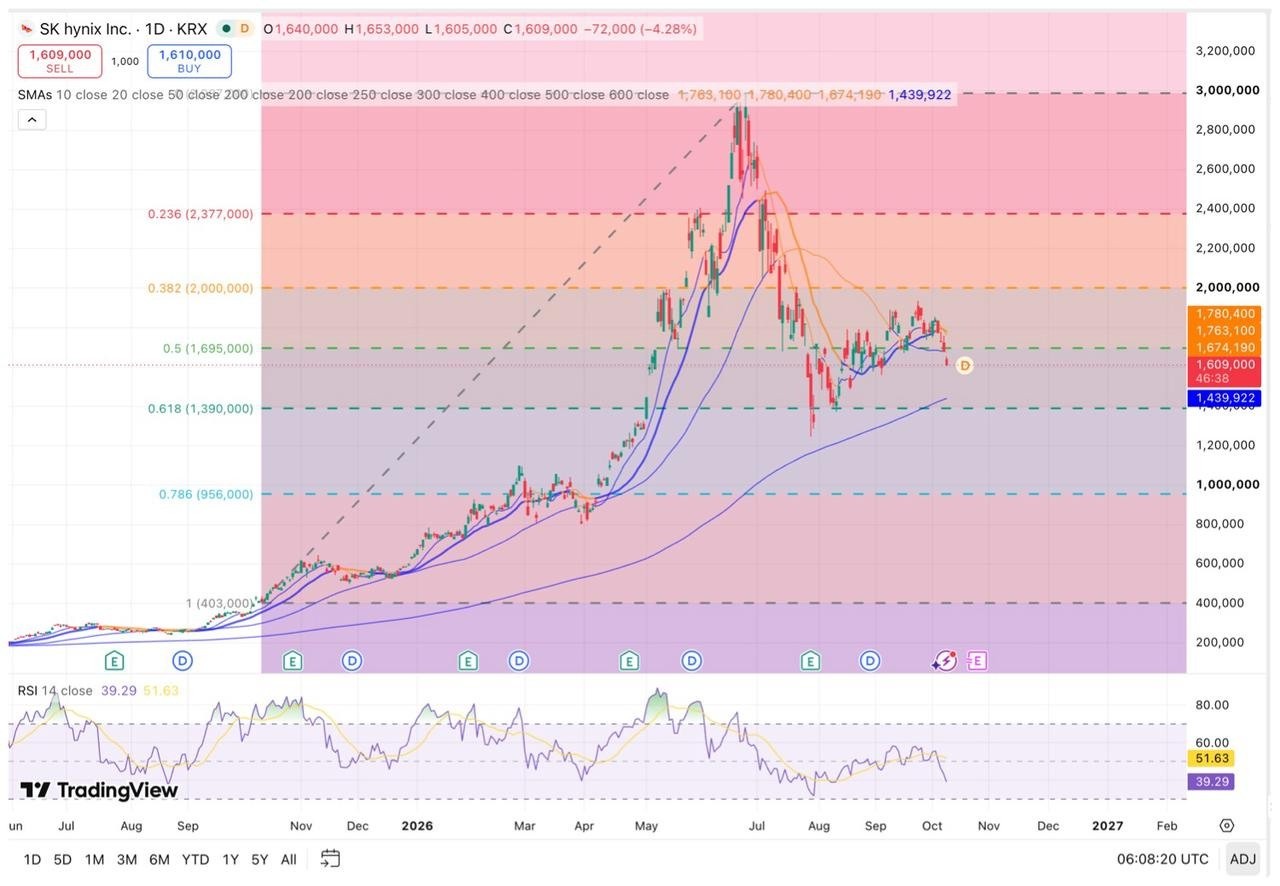
Based on prices adjusted for stock consolidation, using the intraday low of KRW 403,000 on October 13, 2025, to the intraday high of KRW 2.987 million on June 24, 2026, as the reference points, the Fibonacci 0.236, 0.382, 0.500, and 0.618 retracement levels are approximately KRW 2.377 million, 2.000 million, 1.695 million, and 1.390 million, respectively.
[Source: TradingView]
On October 12, SK Hynix fell by as much as around 4% intraday, dropping to near KRW 1.61 million and breaking below the 0.500 retracement level of KRW 1.695 million. At the close on October 8, the 14-day RSI stood at approximately 43.7; as the stock price continued to fall, short-term momentum weakened further.
On the downside, KRW 1.55 million–1.60 million becomes the next support zone. If the daily closing price continues to fall below KRW 1.55 million, the stock price may further retest the 0.618 retracement level of KRW 1.39 million–1.40 million.
On the upside, KRW 1.69 million–1.70 million has turned into the primary resistance zone. If the stock price regains stability above this zone, key levels to watch sequentially are KRW 1.75 million–1.80 million and KRW 1.855 million; after a breakout, the next major resistance level is around KRW 2.00 million.
The short-term trend depends on whether the stock price can reclaim KRW 1.695 million. If it continues to trade below this level, adjustment pressure remains; only after regaining a firm footing will room open up to resume a rebound toward KRW 1.80 million–1.855 million.