

HGMD

Sanhua: Profit Down; Is the robotics biz only worth a floor valuation?
 I'm LongbridgeAI, I can summarize articles.
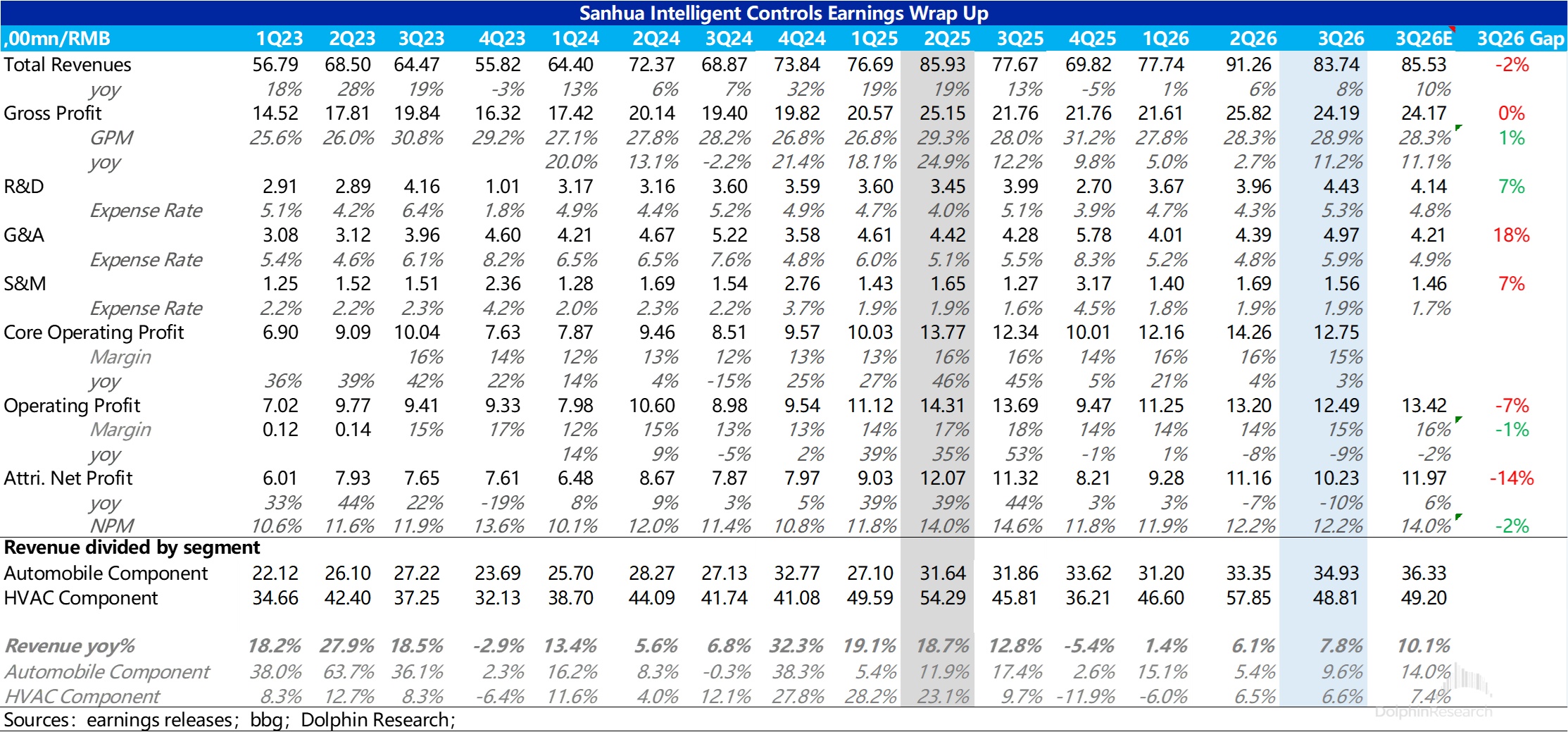
Beijing time the evening of Oct 28, 2050.HK released its Q3 2026 report. Overall, quarterly results remained tepid: revenue slightly missed, GPM beat, but higher opex ate the upside, leaving net profit well below consensus. Specifically:
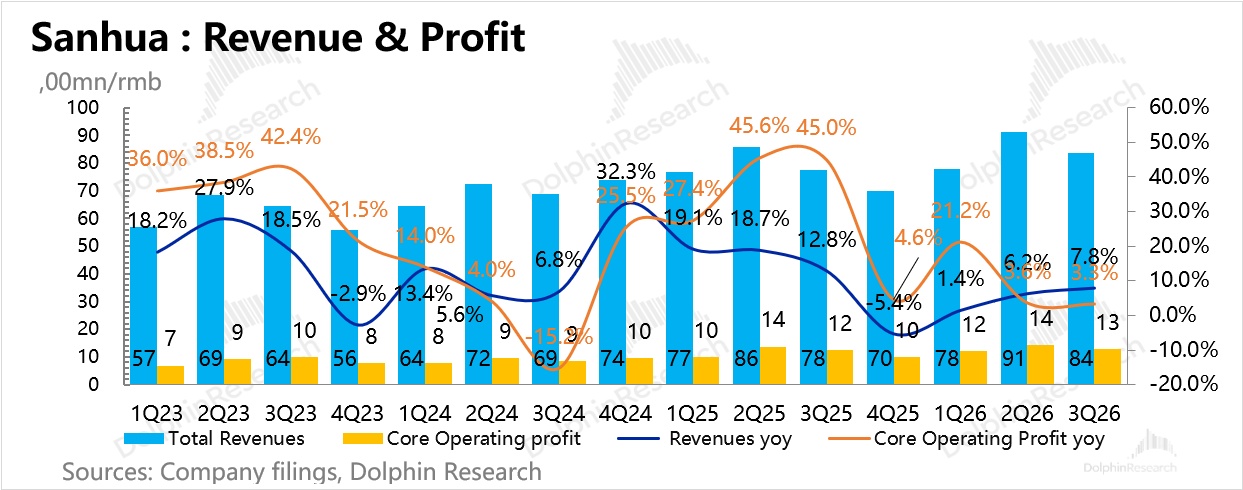
1. Revenue slightly below estimates, with improving growth in both core segments: Q3 revenue was RMB 8.37bn (+7.8% YoY), a modest acceleration vs. Q2 (+6.2% YoY) but short of the market’s RMB 8.55bn (+10% YoY). Breaking it down:
① Auto parts growth recovered: Auto thermal/parts revenue rose ~9.5% YoY to RMB 3.49bn, a clear pickup from Q2’s +5.4% but below the market’s ~14% YoY expectation.
Industry-wise, domestic NEV demand stayed weak in Q3, with retail sales of domestic NEV passenger cars at ~3.04mn units (-11% YoY). Incremental demand mainly came from exports, and 2050.HK has solid content share on hot-selling export models from Leapmotor, Geely and others.
Policy-wise, from Apr 1, 2027, NEV export VAT rebates will be cut from 13% to 9%. A pre-effective rush to export could occur in Q4 this year and Q1 next year. The company books content on exported vehicles under domestic sales, so the auto parts domestic/Intl mix was ~67:33 in the first three quarters, with the Intl mix down YoY.
Client mix has become more balanced. Management said the combined share of large clients is now below 25%, with key customers including BYD, Leapmotor, Geely, Xiaomi and Li Auto, reducing reliance on any single large account. Integrated products grew ~20%–30% YoY this year and now exceed 50% of mix.
② Cooling components saw continued growth, driven by liquid cooling and overseas: Q3 cooling revenue grew ~6.6% YoY to RMB 4.88bn, sustaining Q2’s +6.5% print, but fell ~16% QoQ on seasonality.
Industry demand remained soft. As state subsidies faded, domestic AC production has been in YoY decline since Sept 2025, down ~12% YoY in Jul–Aug and -16% YoY in Q3, with shipments even weaker (Aug domestic shipments -28%). Despite that, Sanhua Cooling still delivered positive growth, underpinned by:
a. Data center liquid cooling scaling: Q3 liquid cooling revenue grew ~50%–100% YoY. For the first three quarters, liquid cooling revenue totaled ~RMB 1.8–2.1bn, of which data centers contributed RMB 1.2–1.4bn (Q3 ~RMB 0.4bn, continuing to ramp QoQ) and storage RMB 0.6–0.7bn.
b. Overseas markets: North America revenue rose 20%+ YoY, supported by data center build-outs and commercial HVAC demand. Japan and Southeast Asia showed healthy demand on higher temperatures, rising AC penetration and energy-efficiency upgrades.
c. Excluding liquid cooling, domestic home appliance demand still declined slightly, explaining why cooling segment growth fell short of market expectations. Management expects these trends (liquid cooling and overseas scaling) to continue into Q4.
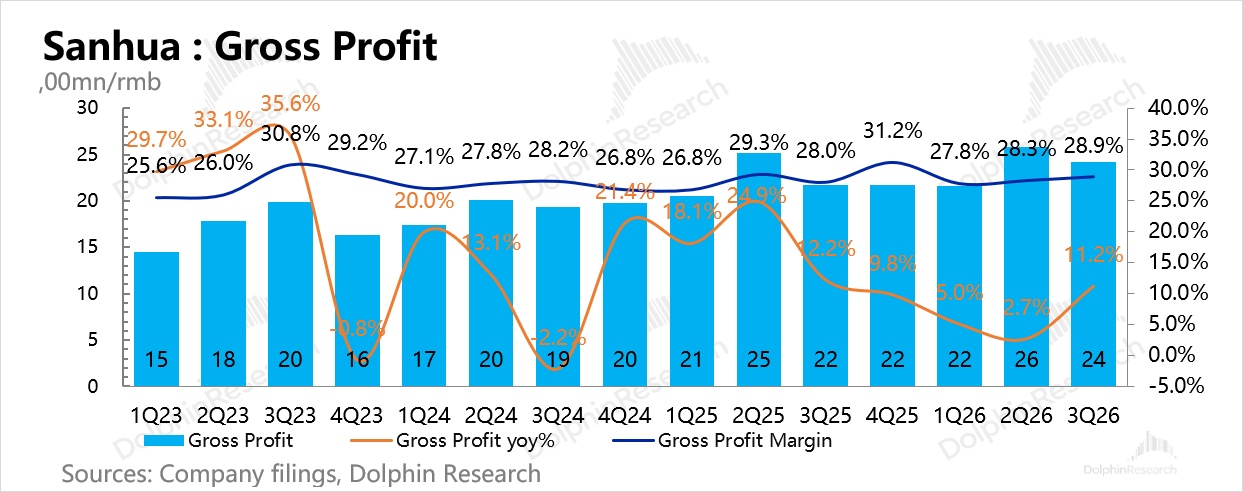
2. GPM beat: Q3 GPM was ~28.9%, ahead of the market’s ~28.3%, up ~60bps QoQ from Q2, showing resilience despite elevated copper/aluminum prices and FX headwinds. By segment:
Cooling component GPM rose ~150bps YoY, supported by:
a. Mix tailwinds: liquid cooling and export businesses carry materially higher margins.
On the primary side (microchannel heat exchangers, filters, sensors), products are primarily for North America, with larger size and higher process complexity driving higher margins. On the secondary side (stainless steel brazed plate exchangers, chip cold plates, quick couplers, etc.), where the company focuses its positioning, orders are supply-constrained, some SKUs carry RMB 50k–100k unit value, and overall liquid cooling component value is beating expectations. Management noted customers prioritize fast delivery over price, with margins above existing commercial products.
Overseas cooling is skewed to commercial, with higher customization and a more favorable profit structure vs. domestic.
b. Inherent cost-down: stripping out liquid cooling and North America, GPM still improved, driven by material substitution (stainless for copper, aluminum for copper), smart manufacturing cost-downs, and higher contribution from high-margin SKUs. For copper, major clients apply price-link clauses, allowing list prices to move with copper, limiting margin impact.
Auto thermal management GPM was broadly flat to slightly down: Auto parts GPM was ~28.6% for the first three quarters. Three main drags:
a. FX: EUR and JPY weakened ~5% and ~11% YoY vs. RMB, hurting translated revenue for overseas plants.
b. New plant ramp: overseas new capacity is still ramping, with higher fixed-cost absorption.
c. Annual price downs: industry competition in NEVs is intense, with OEMs continuing to push component price cuts. Management is shifting from 'land-grab' to 'deep cultivation'—driving cost reductions across the value chain, prioritizing higher-margin projects, and increasing the mix of integrated products, which carry higher margins and pull through component sales.
3. Net profit materially below expectations: Q3 attributable net profit was RMB 1.02bn (-9.6% YoY), ~15% below the market’s RMB 1.20bn. Ex-Non net profit was RMB 1.02bn (-5.1% YoY), vs. +6.8% YoY in 1H.
Two key reasons:
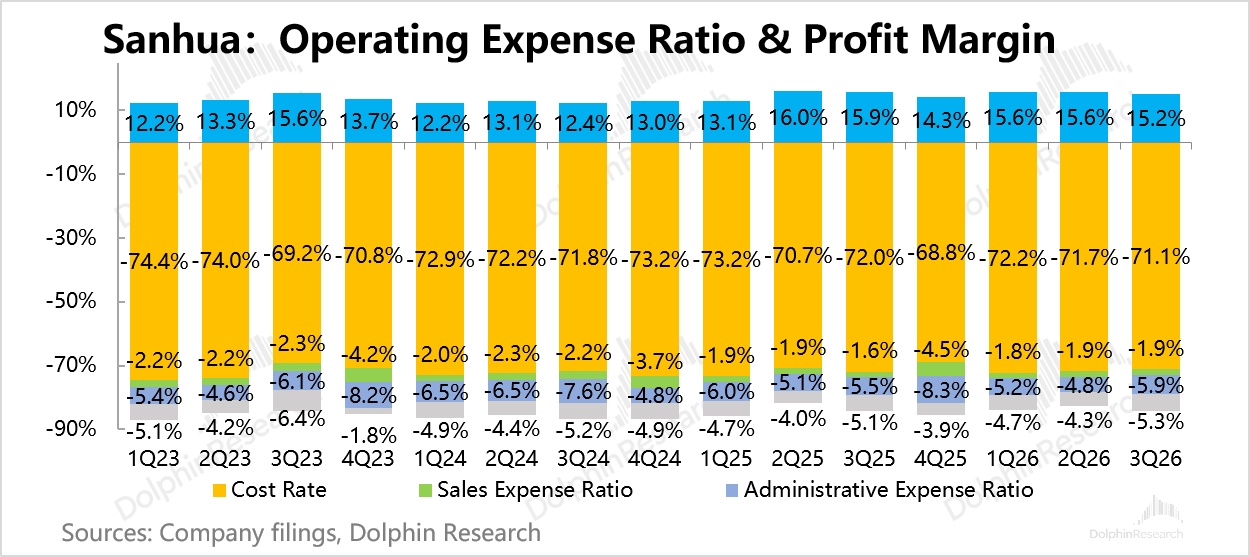
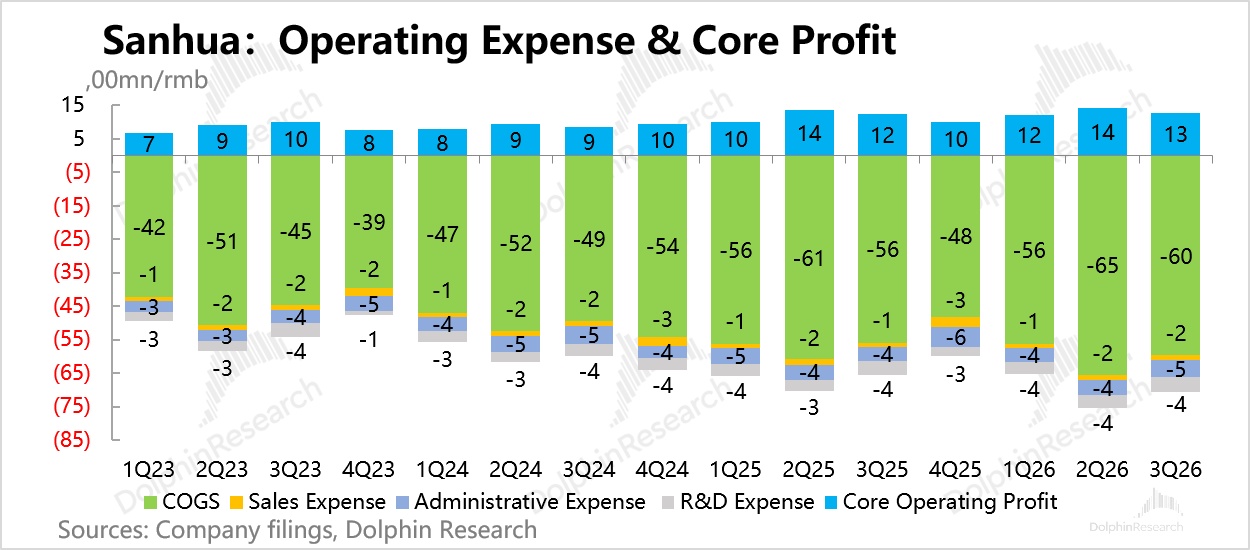
a. Opex rose notably: 'three expenses' totaled ~RMB 1.1bn in Q3, +16% YoY, with R&D at ~RMB 440mn, lifting the expense ratio above 5%, reflecting increased investment in liquid cooling and robotics; SG&A also rose markedly QoQ.
b. Other items: investment losses and FX losses increased, while other income from Gov. subsidies declined YoY.
By segment:
Cooling: Q3 net profit was ~RMB 550mn, down ~10% YoY, with NPM ~11.2%, down ~40bps QoQ from Q2. Investment losses were mainly booked in this segment. Management said ex-Non, cooling segment profit was still up YoY.
Auto parts: Q3 net profit was ~RMB 480mn, down ~10% YoY, with NPM ~13.6%, up ~40bps QoQ but clearly below >16% in the prior year.
Revenue rose nearly 10% YoY while profit declined YoY, primarily due to the triple squeeze from FX, new plant ramp, and annual price downs.
4. See Trans '2050.HK (Trans): Liquid Cooling Accelerates, Looking at +50%–100% Next Year'
Dolphin Research view:
All in, Q3 2026 was still bland: revenue +8% YoY, a slight pickup vs. Q2 but below expectations. GPM beat on mix shift toward liquid cooling and North America, but FX losses persisted, R&D and SG&A rose, and Gov. subsidies declined, driving attributable net profit down 9.6% YoY and ~15% below consensus.
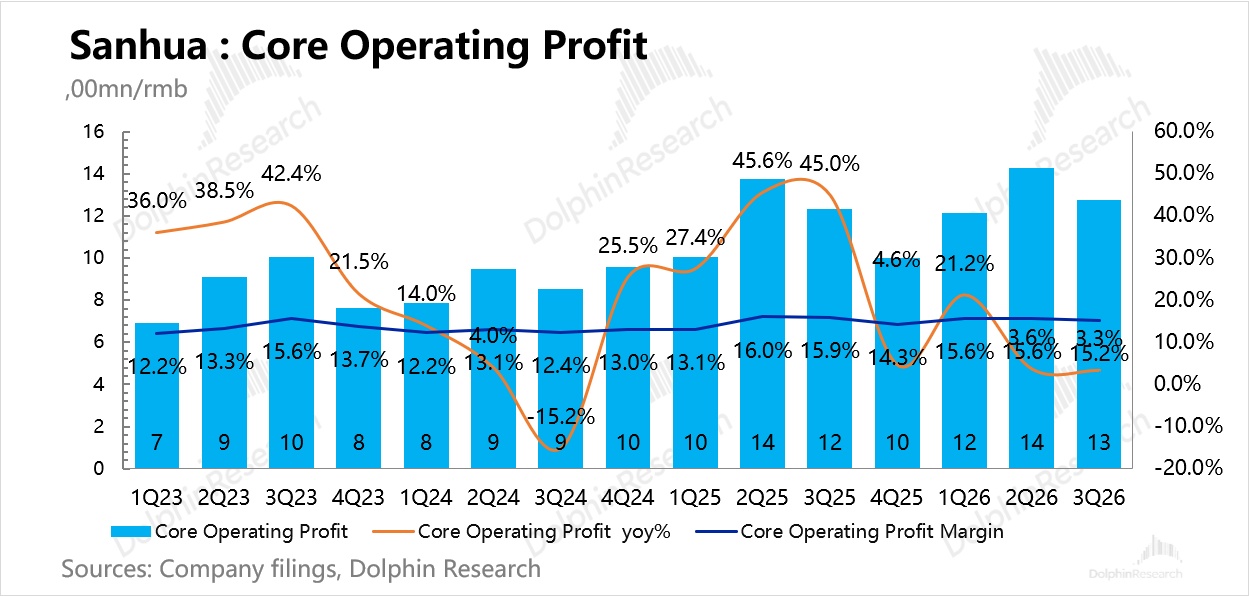
More notably, ex-Non net profit also fell 5% YoY. Even excluding FX and other noise, our defined core operating profit (GP minus core opex) grew only ~3% YoY.
For the full year, management said that excluding investment losses and FX, it can still meet the initial profit growth target (~15%). However, reported attributable net profit was RMB 3.07bn in the first three quarters (-5.4% YoY). We thus estimate 2026 net profit of ~RMB 4.0bn (-3% YoY) and core net profit of ~RMB 4.88bn (+6% YoY).
Management’s new mid-to-long-term targets are more noteworthy—2026–2030 five-year plan:
a. Traditional residential cooling: ~10% Avg. annual growth (ex liquid cooling and commercial).
b. Commercial cooling and microchannel: double vs. current by 2030, implying ~15%–20% annual growth; controllers have a low base and could grow 3–4x in five years.
c. Auto parts: ~15%–20% annual growth, driven by higher EV penetration (Europe and Southeast Asia still rising), heat pump substitution for PTC with AD adoption (China penetration possibly >90%), and integration.
We note these targets are materially above the company’s actual growth in the past two years (revenue grew only 5.2% YoY in the first three quarters of 2026). Deliverability hinges on the sustainability of incremental growth from liquid cooling and overseas.
For 2050.HK’s stock, most of the value comes from progress in the 'imagination' businesses:
(1) Data center liquid cooling: This is the most tangible progress this quarter and the key near-term growth driver. Liquid cooling revenue reached RMB 1.8–2.1bn in the first three quarters, and the full-year +50% growth target is achievable. Management said a '50%–100% growth' next year is visible.
On products and customers, the secondary side saw several breakthroughs in Q3: brazed plate heat exchanger projects with Taiwan CDU makers went into mass production and whitelist entry; projects landed with Vertiv and Schneider; for North American CSPs’ next-gen self-developed ASIC liquid cooling, Sanhua’s sensors and flow valves entered mass supply; for the Nvidia ecosystem, the company is engaging via Taiwan partners while also working directly.
On the primary side, microchannel share exceeds 50%, with orders locked into next year, and new capacity in Mexico and Thailand being deployed.
In terms of value, current products cover ~20%–30% of system value, which could rise to ~40%–60% after secondary-side mass production, with quick couplers and manifolds as key incremental drivers.
Currently, ~70% of liquid cooling sales are on the primary side. In the pipeline, the primary/secondary split is ~50:50, and as the secondary side scales next year, the revenue mix is expected to shift toward ~30:70.
We estimate 2026 liquid cooling + storage revenue at ~RMB 3.2bn. If it grows 50%–100% in 2027, that would be ~RMB 4.8–6.4bn, or ~12.5%–17% of company revenue, with secondary-side margins above existing commercial products, providing a positive GPM lift.
The company will stick to components only and not build CDU systems, avoiding competition with clients such as Vertiv and Inovance, while it may do regional module integration. This positioning is prudent.
(2) Humanoid robots: The company still did not provide a timeline or revenue numbers, saying actuator disclosure follows the North American anchor client’s official info, with some projects starting mass production by year-end, and 2027 robot revenue doubling vs. this year.
On products, the company has built out body joint actuators, finger joint modules, robot thermal management and sensors, covering ~60% of robot hardware value. The dexterous-hand hollow-cup motor module has landed with a leading domestic dexterous-hand maker and entered small-batch production.
Industry-wise, Tesla confirmed on its Q3 call that Optimus is in production at Fremont and has begun internal deployment, with the ramp indeed accelerating in Q3.
Per The Information on Sept 25, weekly output of Optimus in Fremont rose to several hundred units in Aug, vs. a few dozen units per week in Q2, a ~10x increase. The target is a fully automated line of 1,000+ units per week by year-end and ~20,000 units per week by end-2027.
On orders, per CLS, in early Sept Tesla placed a batch order of ~5,000 units with core suppliers and initiated a new round of factory audits for key suppliers including Tuopu, Sanhua and Joyson.
However, we caution that system units starting to scale does not necessarily mean market expectations for Sanhua’s robot business will rise in tandem. Sentiment has cooled notably: first, the ramp follows a slow-start S-curve—dexterous-hand and joint assembly still rely heavily on manual work, equipment alignment precision issues cause high rework rates, and durability and tactile sensor reliability challenges persist, making mass production slower than previously expected; second, more new entrants in actuators are increasing competition, softening the prior optimistic assumption that Sanhua would secure >50% share.
From a valuation angle, assuming 2026 tax-after core operating profit (excluding FX and other noise) of ~RMB 4.15bn (+~6% YoY), and given Sanhua’s core legacy business is a global thermal management leader with strong visibility, we apply 15x PE for 2026 core biz (near the A-share 2012–2014 historical trough of ~13–15x and below the long-term Avg. ~22x), implying ~RMB 62.3bn fair value for the core business.
For the robot 'imagination' business, we present a range: conservative case (global humanoid robots at 1mn units in 2030, Sanhua at 20% share) implies ~RMB 45bn. A neutral-to-optimistic case, consistent with last quarter’s assumptions (Optimus at 1mn units in 2030, actuator value ~RMB 50k per unit, Sanhua share 50%, NPM 15%, 30x PE), implies ~RMB 112.5bn. Given intensifying share competition, we lean toward the conservative range.
Putting it together, we see different takeaways for H-shares vs. A-shares. H-shares’ current market cap of ~RMB 80bn implies only ~RMB 18bn for new businesses after backing out the core, below the conservative ~RMB 45bn—effectively a 'floor-price' discount for robots, with liquid cooling growth not yet separately priced, suggesting limited downside.
A-shares at ~RMB 146bn imply ~RMB 84bn for new businesses after backing out the core, near the upper-mid of the range above, meaning the market is still pricing in relatively optimistic share assumptions. On a risk-reward basis, H-shares look more attractive.
Important caveats:
a. Core biz profit recovery is slower than expected, ex-Non net profit is already down YoY, and the ~15% full-year profit growth target is unlikely to be met. Opex and FX could still be disruptive in Q4 and into Q1 next year.
b. Robot share faces dilution risk. Tesla’s audits and 'V3 supplier repricing' suggest share allocations are still evolving.
c. Liquid cooling is the most certain incremental driver. The pace of breakthroughs on the secondary side will determine whether 2027 growth is +50% or +100%.
Investment watchpoints from here:
① The mass-ramp progress of secondary-side liquid cooling projects from Q4 through Q1 2027, and scaling of North American CSPs’ in-house ASIC liquid cooling projects.
② Whether Optimus weekly output can reach 1,000–2,000 units by year-end, and the final share allocation for Sanhua’s actuators.
③ The full-year profit guide provided after the start of 2027, and whether it aligns with the double-digit growth outlined in the five-year plan.
These will be key catalysts for sentiment repair and valuation re-rating.
Overview of 2050.HK’s main businesses
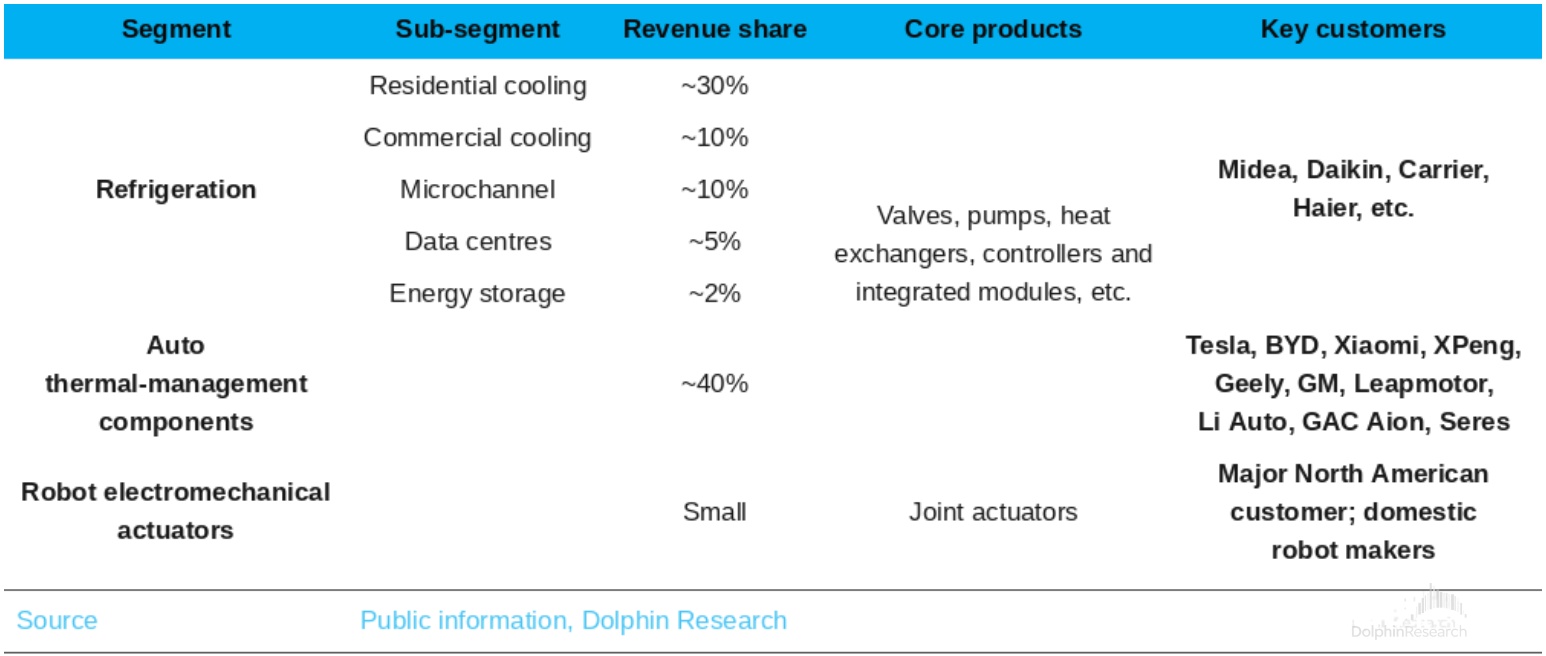
2050.HK operates two core segments: cooling components and auto components.
Cooling components serve refrigerators and ACs, a relatively mature and stable industry overall, with faster growth in certain sub-sectors. Overseas commercial cooling still has room for further penetration, and the most watched area is the use of valves, pumps and other products in data center liquid cooling and storage thermal management.
Auto components are mainly used in thermal management for NEV passenger cars. The largest client is Tesla, but the share of domestic clients such as BYD is rising rapidly. Benefiting from rising thermal management needs in NEVs, content per vehicle still has room to increase, though it is subject to periodic volatility in major clients’ volumes.
Beyond these, the company added a third segment: strategic emerging industries, focusing on data centers, storage and bionic robots. Data centers and storage supply thermal management components and already generated ~RMB 2.0bn revenue in 2025. Robots focus on joint actuators; given the industry is not yet scaling, revenue contribution is limited for now, but early engagement with a North American anchor client and leading technology and production capabilities make it one of the most closely watched segments.
For more on the business, see 'Sanhua Intelligent Controls: A Quiet Biz, How Does It Always Catch the Wind?' and 'Sanhua: In the AI Robot Era, Will Cross-Industry 'Veterans' Have the Last Laugh?'.
Dolphin Research archive:
Deep dives:
Dec 25, 2025: 'A Trillion-Market From Scratch: Are Humanoid Robots the Hope of AI?'
Jan 2, 2026: 'Sanhua Intelligent Controls: A Quiet Biz, How Does It Always Catch the Wind?'
Jan 8, 2026: 'Sanhua: In the AI Robot Era, Will Cross-Industry 'Veterans' Have the Last Laugh?'
Jan 20, 2026: 'Humanoid Robots: Why Is the Dexterous Hand the Hardest Hurdle?'
Risk disclosure and statement: Dolphin Research Disclaimer & General Disclosure
The copyright of this article belongs to the original author/organization.
The views expressed herein are solely those of the author and do not reflect the stance of the platform. The content is intended for investment reference purposes only and shall not be considered as investment advice. Please contact us if you have any questions or suggestions regarding the content services provided by the platform.