

ROBN

HOOD: Meme stock? Trump trade? No, the US retail king is more than that!
 I'm LongbridgeAI, I can summarize articles.
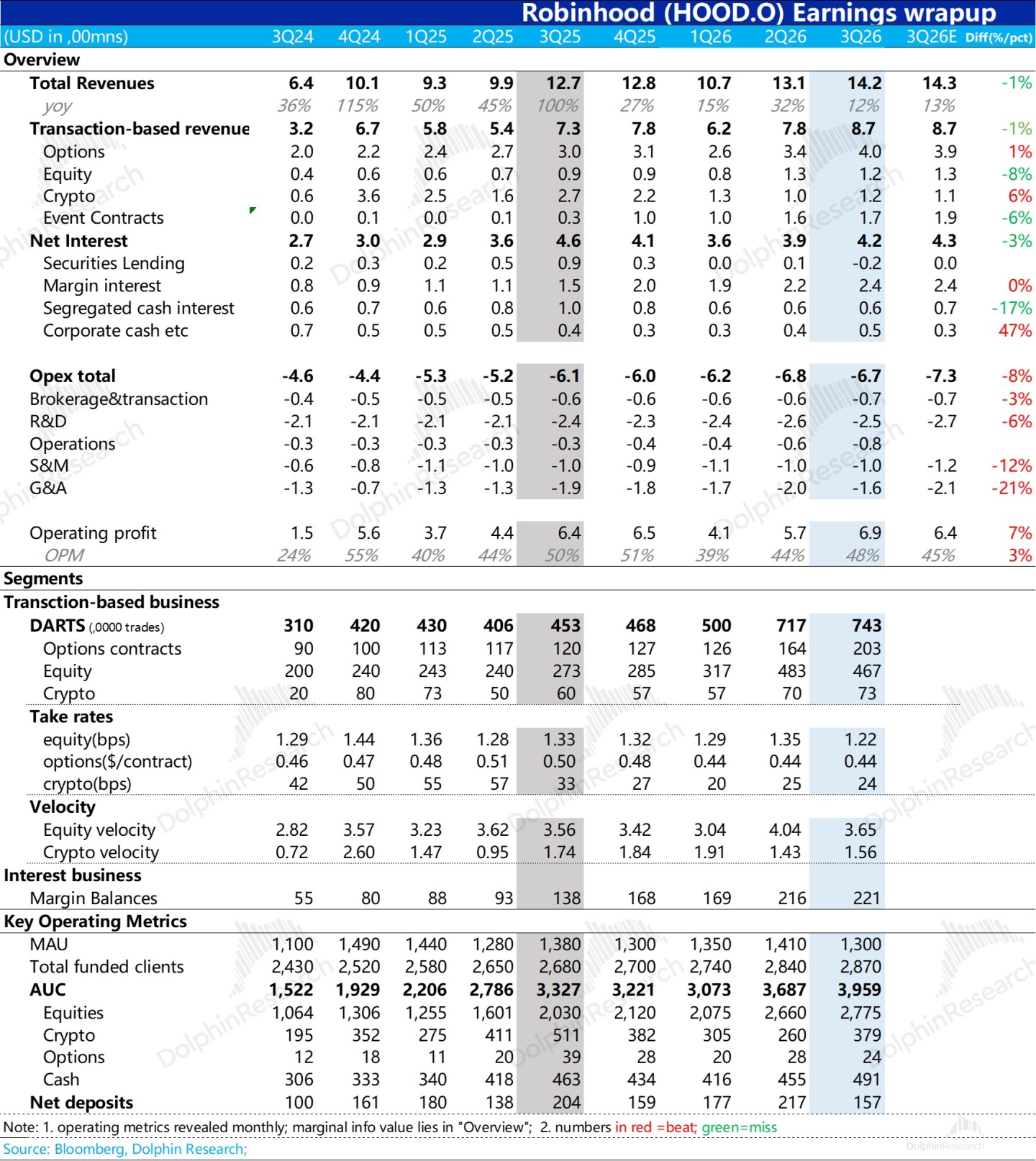
US influencer broker HOOD posted Q3 results; quick takeaways below.
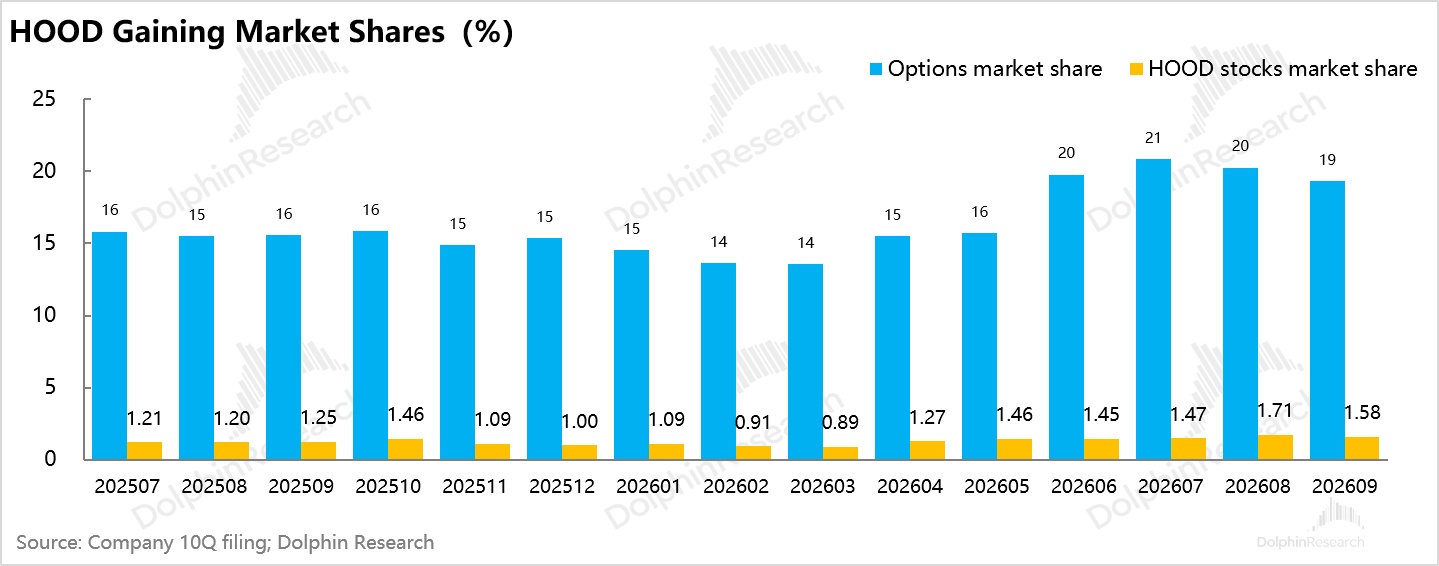
1. Solid ops: Given the Q3 U.S. market backdrop, HOOD’s operating metrics looked strong. Core revenue drivers across equities, options, and event contracts were at or near quarterly highs, and market share expanded.
2. What’s actually good? Revenue was $1.42bn (+12% YoY), which may look like high-multiple, low-growth. But remember last year’s crypto rally set a very tough base for 2026. Delivering this level of growth is not easy.
What filled the growth gap? a. Event contracts, with $170mn in Q2 single-quarter revenue; b. a 'regulatory gift'. PDT rule changes (see end) lifted options contract counts to a higher plateau, jointly offsetting the crypto downturn.
3. Why did shares fall despite good prints? Expectations. The company discloses trading and lending data monthly, and consensus kept moving up ahead of the release. The true miss showed up in conversion rates from volumes and balances into revenue.
Equities and crypto conversion ran light, with the biggest gap in event contracts monetization. Expectations were raised, actual revenue came out average, and money wasn’t pleased.
On top of that, since Oct AI investing has swung from ARR focus to funding stress, with broad market anxiety. Mgmt also said that into Q4 through Oct, operating metrics were soft: DARTs in stocks, options, and crypto were ~5% lower vs. Q3, while the street broadly expects another revenue high on top of Q3.
Setting aside market beta and the expectations game, we value HOOD’s ability to generate alpha in a super-beta environment. Late last year, with the market awarding rich multiples, the key worry was: after a 2025 crypto plus equity bull market and a very high base, where would 2026 growth come from?
On that question, HOOD’s actual delivery this year looks quite good.
1. User and asset growth:
Q3 saw a net add of 300k asset users, taking end-period asset users to 28.7mn. Net client inflows were $15.7bn, and end-period total assets reached $400bn.
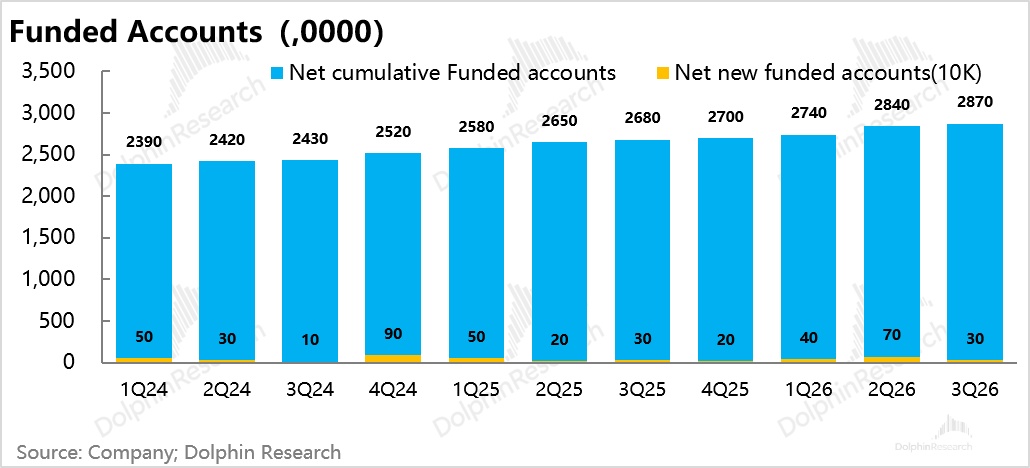
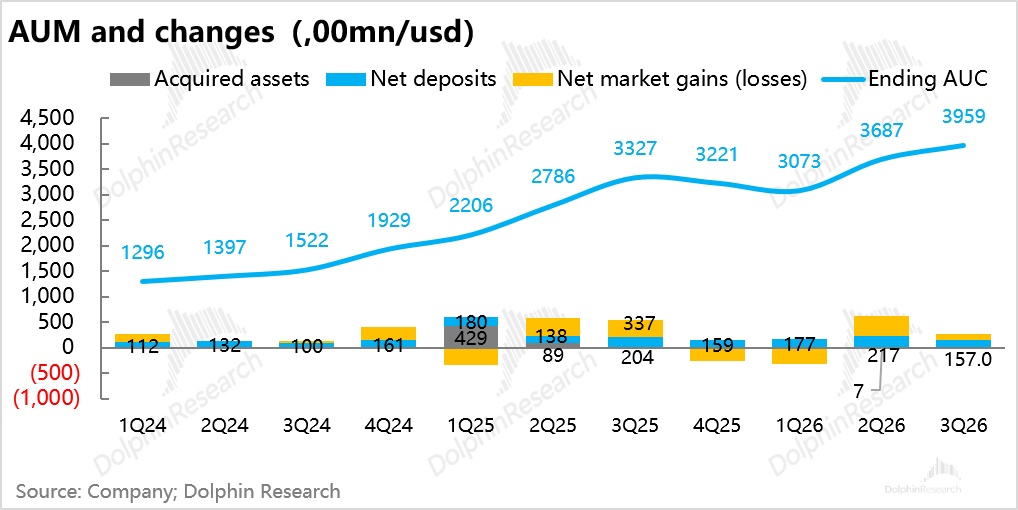
AUM growth was modest in a lukewarm Q3 market and fell short of the company’s ~20% YoY target. New users: with a very large base, a big ramp won’t be easy, so incremental adds likely come from Intl markets, while in the U.S. HOOD aims to acquire at low cost via Trump accounts.
New inflows: wallet share is key. Continuously rolling out new products and services should attract more funds from younger users. HOOD already has the low-friction, low-cost trading appeal to get accounts opened; moving more funds in becomes a function of product innovation, ops, and marketing.
2. Trading monetization – two tailwinds:
A. Options share up structurally under the new PDT framework:
With intraday restrictions relaxed, options volumes jumped; Q3 options contracts rose 17% QoQ. Per-contract monetization stayed at $0.44, and options revenue climbed 31% YoY.
B. Event contracts: revenue was $170mn vs. $30mn YoY, a huge increase. But this was precisely where the miss occurred, as revenue per contract fell to 1.05 cents vs. 1.15+ cents in the prior three quarters.
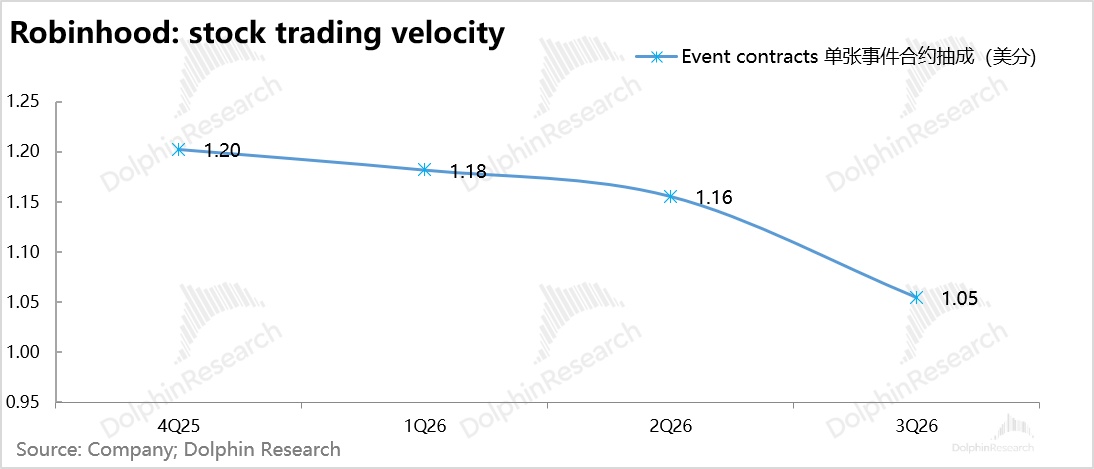
Why lower per-contract fees? Since Jun, HOOD adjusted pricing to boost liquidity in thinly traded contracts; the market assumed no impact on blended pricing, but it did drag.
Pricing comparison:
Each event contract has a fixed $1 notional: correct outcomes pay $1, incorrect outcomes go to zero. The traded price reflects market probability. For example, if 'Team X wins' trades at 35 cents, the market implies ~35% odds; users pay 35 cents plus fees per contract and earn 65 cents per contract if correct.
Before Jun 1, HOOD charged 1 cent per contract as broker commission, and Kalshi plus Rothera took a small clearing fee, for ~1.2 cents total fee per order at HOOD. After Jun 1, to address liquidity issues in ultra-low probability contracts, pricing changed to fee rate * contract price * (1 - contract price); the fee rate is 10% for standard accounts and 5% for Gold members.
There is a 1 cent cap per contract, with exchange fees charged separately. Peers like Kalshi use a similar structure but at a 7% rate.
In practice, HOOD provided fee concessions, driving a notable drop in per-contract revenue. From a competition standpoint, despite the concessions, HOOD’s event contract market share did not rise and even slipped.
In essence, with a rich multiple, scrutiny is harsh; any marginal negative surprise can swing the stock materially.
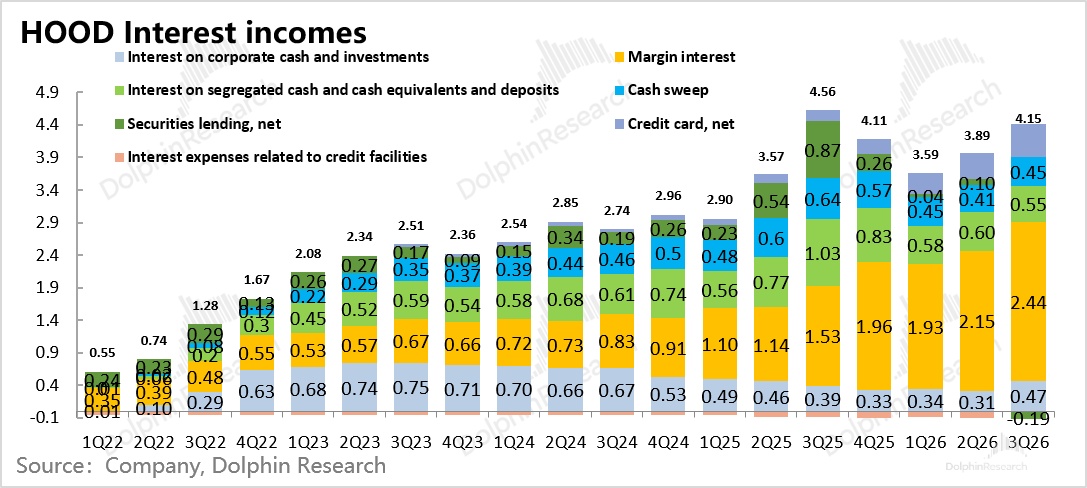
3. Interest-bearing lines: few bright spots.
QoQ growth mainly came from higher margin balances, which were pre-disclosed. On the biz side, the credit card could deliver some incremental growth, while higher rates modestly lifted cash interest.
Securities lending was a material drag this quarter: demand was weak and gross revenue low, but HOOD bears borrowing costs, turning securities lending revenue negative.
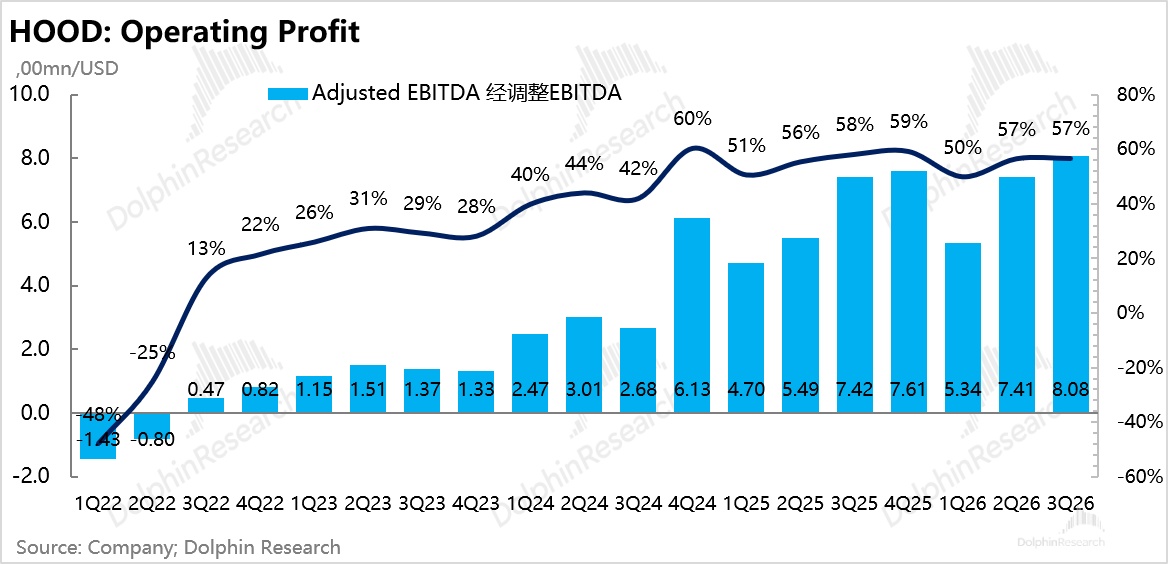
4. Bottom-line was very strong: Adj. OP was $800mn (excluding SBC, one-offs, and D&A), holding at a 57% margin.
G&A and R&D trended lower QoQ, while headcount rose slightly, likely tied to Intl expansion. Two areas of faster expense growth over the past two quarters were ops-related costs and credit loss provisions, as margin plus credit card grew.
5. How much more 'powder' is left?
Even great brokers can’t outrun market beta forever. But in the past two years, HOOD delivered super-growth beyond beta through rapid product innovation and new trading categories, notably crypto and event contracts.
In Q3, it rolled out more products and features: at the Sep 29 summit, it introduced Agents to help users research and place orders, and previously launched Agentic Trading. It also introduced Robinhood Chain (mainly about gas fees), generating ~$26mn in crypto revenue; this early revenue is elevated by liquidity frictions and isn’t normalized.
Other initiatives underway:
A. Product side: beyond desktop Legend, custodial advisory and primary assets Ventures, plus banking services where user withdrawals often go to HOOD’s own bank. B. Intl expansion: Dubai license obtained, Singapore granted in-principle approval; mgmt’s long-term goal is 50%+ revenue from overseas and 50%+ from institutions.
Dolphin Research view:
All in, Q3 disappointed vs. raised expectations, but setting that aside, for a broker to outperform market beta for two straight years via new products is impressive.
The core of brokerage is account acquisition and wallet share. HOOD excels at getting accounts opened; with that traffic capital, product innovation reaches a larger base, raising success odds.
Successful products then attract more client funds, shifting assets into HOOD accounts over time.
HOOD clearly understands its edge and keeps reinforcing its retail-friendly, 'democratize trading' proposition through frequent product launches and communication. That is the fundamental logic for its valuation premium.
The long-term story holds, but as of late 2026, after two years of outsized growth from product expansion and innovation, the pressing question is where 2027’s excess growth will come from.
On the call, HOOD’s answer: Agentic, prediction markets, perpetuals, Trump accounts, Ventures, and tokenization. Legacy brokerage and crypto will be more about taking share.
Agentic is still hard to judge, and sustained quarterly lifts in prediction markets require monitoring. The others won’t easily reach scale within a year; nearer term, with volatile Q4 markets, revenue may not rule out a QoQ decline.
So with 2027 excess growth uncertain, our value take is to buy after the excess premium fades and position for upside optionality from new product breakouts.
If 2027 new products don’t relay strongly, assume $1.5bn quarterly revenue, or $6bn annualized; with a 60% margin and 15% tax rate, net operating profit would be ~$3.1bn. At no premium vs. the S&P 500, a 20–25x PE (vs. ~27x now) implies a $65–75bn equity value and a stock price around $70–84.
Note on PDT (Pattern Day Trader) rule changes
1) Old rules
1. In margin accounts, four or more round-trip intraday trades within five consecutive trading days flagged PDT status. 2. Once flagged, the account must maintain at least $25,000 in equity (positions + cash − margin loan balance); otherwise, only three intraday trades per five days were allowed, with 90-day penalties for violations.
3. Practical workaround: open three accounts across brokers to get nine trades per week.
2) Reform timeline
1. Sep 2025: FINRA BOD approved a full replacement, filed with the SEC on Dec 29. 2. Jan 14, 2026: published in the Federal Register for public comment.
3. Feb 4, 2026: comment period ended with 100+ letters, all supportive except one; Schwab, HOOD, E*TRADE, and SIFMA were among supporters. 4. Apr 14, 2026: SEC granted accelerated approval, and on Apr 20 FINRA issued Regulatory Notice 26-10, effective Jun 4.
6. Brokers may phase system changes over 18 months, through Oct 20, 2027.
3) New rules
The clear impetus was modern intraday trading forms such as 0DTE options (zero-days-to-expiry), which did not exist in 2001. Buying 0DTE means either an in-the-money settlement or a full loss by day end.
The new framework shifts from counting trades to real-time risk. Specifically:
a) PDT labeling is eliminated, intraday trades are no longer counted, and the $25,000 threshold is gone. b) Qualified margin accounts with equity over $2,000 (the legal minimum for leverage) apply.
c) Brokers set intraday buying power based on current positions and maintenance margin requirements. They can either:
1. Monitor real-time margin shortfalls and block trades that create or widen intraday gaps; or 2. Conduct end-of-day checks only.
In essence, supervision moves from static 'account balance' to dynamic 'per-trade or per-day risk'.
4) 0DTE vs. new PDT – the chemistry
① 0DTE products naturally fall into intraday trading. ② 0DTE allows small accounts to amplify moves; as account type constraints loosen, low-AUM users more easily buy options rather than stocks.
③ 0DTE is the fastest-growing retail options category. ④ Post-reform, users who previously split across multiple brokers may consolidate into one account to save costs and simplify taxes; migration to a single account is the rational choice.
<End here>
Dolphin Research archive:
『Robinhood: Is the retail 'Robin Hood' really Trump’s hopeless case?』
『Robinhood: After the hype, what remains for the retail king?』
『Robinhood: 4x in a year, is the retail king really that strong?』
『Robinhood: With stock tokens in hand, will the retail king be unbeatable?』
『Robinhood: Riding Trump’s swings, when can it control its own fate?』
『Robinhood: Trump’s second act brings a comeback for the retail king』
『IBKR: The trading monk with extreme efficiency in its DNA』
Risk disclosure and statement: Dolphin Research disclaimer and general disclosure
The copyright of this article belongs to the original author/organization.
The views expressed herein are solely those of the author and do not reflect the stance of the platform. The content is intended for investment reference purposes only and shall not be considered as investment advice. Please contact us if you have any questions or suggestions regarding the content services provided by the platform.