

SBUX
96.5802.51%
D
Sep 10 at 10:44 AM
SBUX: Retreat from China—Can the Coffee King Rebound on Home Turf?
 I'm LongbridgeAI, I can summarize articles.
In the prior piece, we explained what Starbucks really is: a cash cow underpinned by brand and a 'third place' premium that supports nearly 70% GPM, able to collect stored-value float like a bank, and long reliant on buybacks and dividends to the point of negative equity. But a great company does not automatically mean strong growth or a great asset. $Starbucks(SBUX.US)
This time, Dolphin Research asks a different question: with U.S. comps turning negative in recent years, China 'lost ground,' and growth stalling, what is this cash cow actually worth now?
1) How strong is Starbucks' future growth?
Before discussing growth, we need a core premise: where should we look for it. After the Apr. completion of the China transaction (selling 60% of China to Boyu and shifting nearly 8,000 stores to licensed, off the consolidated statements), Starbucks’ growth map has been rebuilt from the ground up. China is no longer the second growth curve in consolidated terms, now reduced to investment income on a 40% stake plus royalty income based on revenue, effectively a high-margin but low-ceiling cash flow asset.
Other Intl markets are also primarily licensed, contributing stable but inflexible brand fees. In other words, growth quality and valuation optionality now rest on one main battlefield — North America, which contributes roughly three-quarters of revenue and remains predominantly company-operated with a heavy-asset model.
North America’s growth depends on new unit whitespace and comp recovery. Following this logic, Dolphin Research breaks it down as follows:
Growth Logic #1: Smaller formats to unlock U.S. unit growth
Historically, a typical Starbucks store ran over 200 square meters, with demanding build and site requirements, dense on the coasts and sparser in the Midwest.
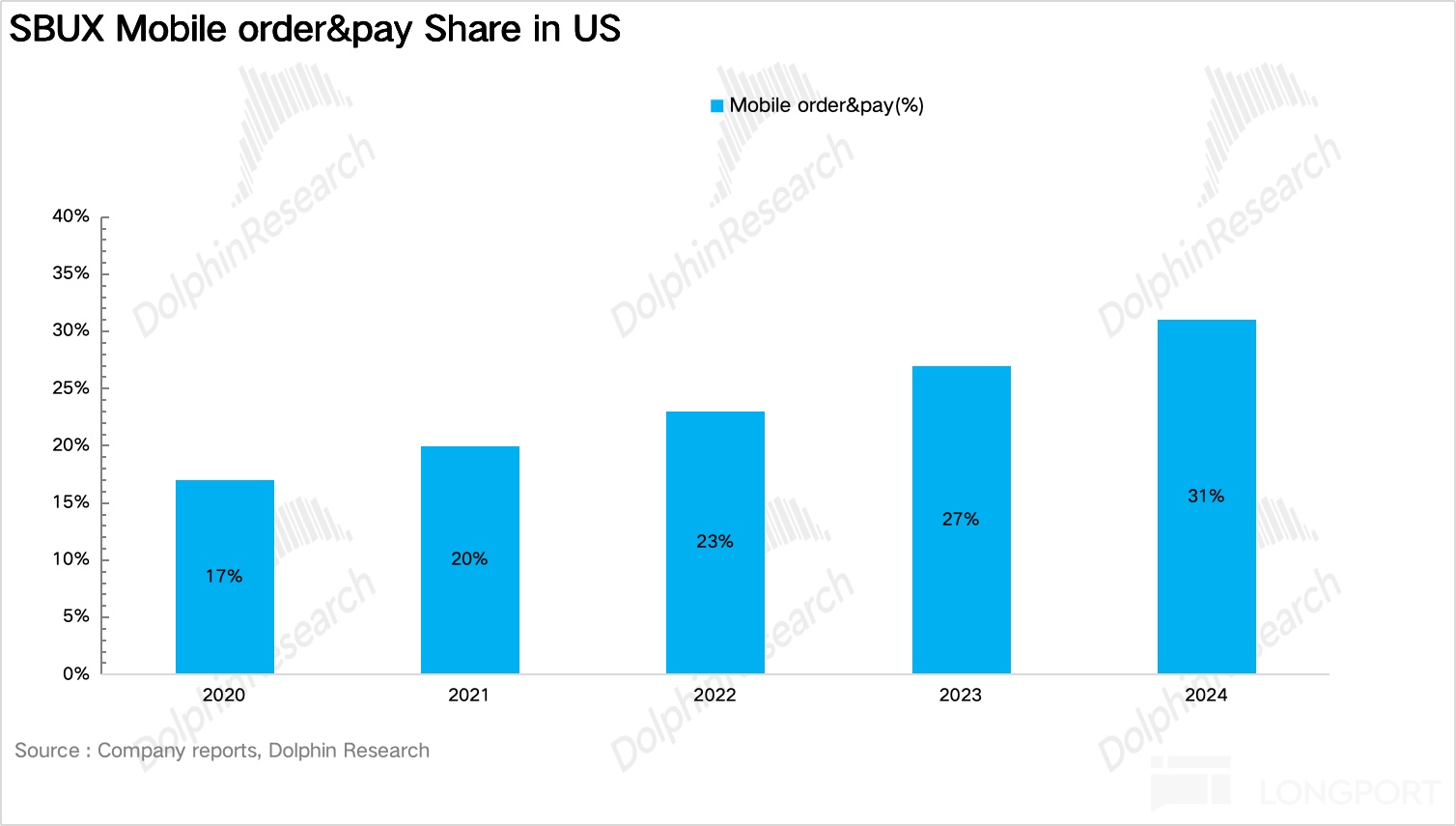
Consumer behavior has shifted meaningfully in recent years. As the chart shows, mobile orders rose from 17% to 31% in five years, nearly doubling.
That makes the traditional 200–300㎡ large box format increasingly redundant in a fast pickup-centric use case.
Against this backdrop, Starbucks is pursuing a dual-track approach — optimize existing stores for experience while making new stores about efficiency.
For the existing fleet, as a core fix under the 'Back to Starbucks' strategy, the company launched the Coffeehouse Uplift program, targeting 1,500 North America light refreshes by end-2026. Refits add sofa seating and power outlets, reinforcing the 'third place' stay factor to counter single-use occasions and to anchor core loyalists.
On the incremental side, Starbucks introduced two lightweight formats for a high share of non-dine-in orders: Starbucks Pickup, which has minimal seating, designed for app pre-orders in dense urban corridors and transit hubs like New York and Chicago; and Double Drive-Thru, aimed at suburbs and highway nodes with compact footprints, dual lanes and a dedicated pickup window for digital orders to maximize car throughput.
Take the next-gen small-box prototype unveiled at Investor Day (32 seats with drive-thru, approx. 125㎡). Build costs are 20%–30% below a standard large store, and the payback shortens from ~4 years to ~3, reopening unit economics for many smaller Midwest towns that previously did not pencil.
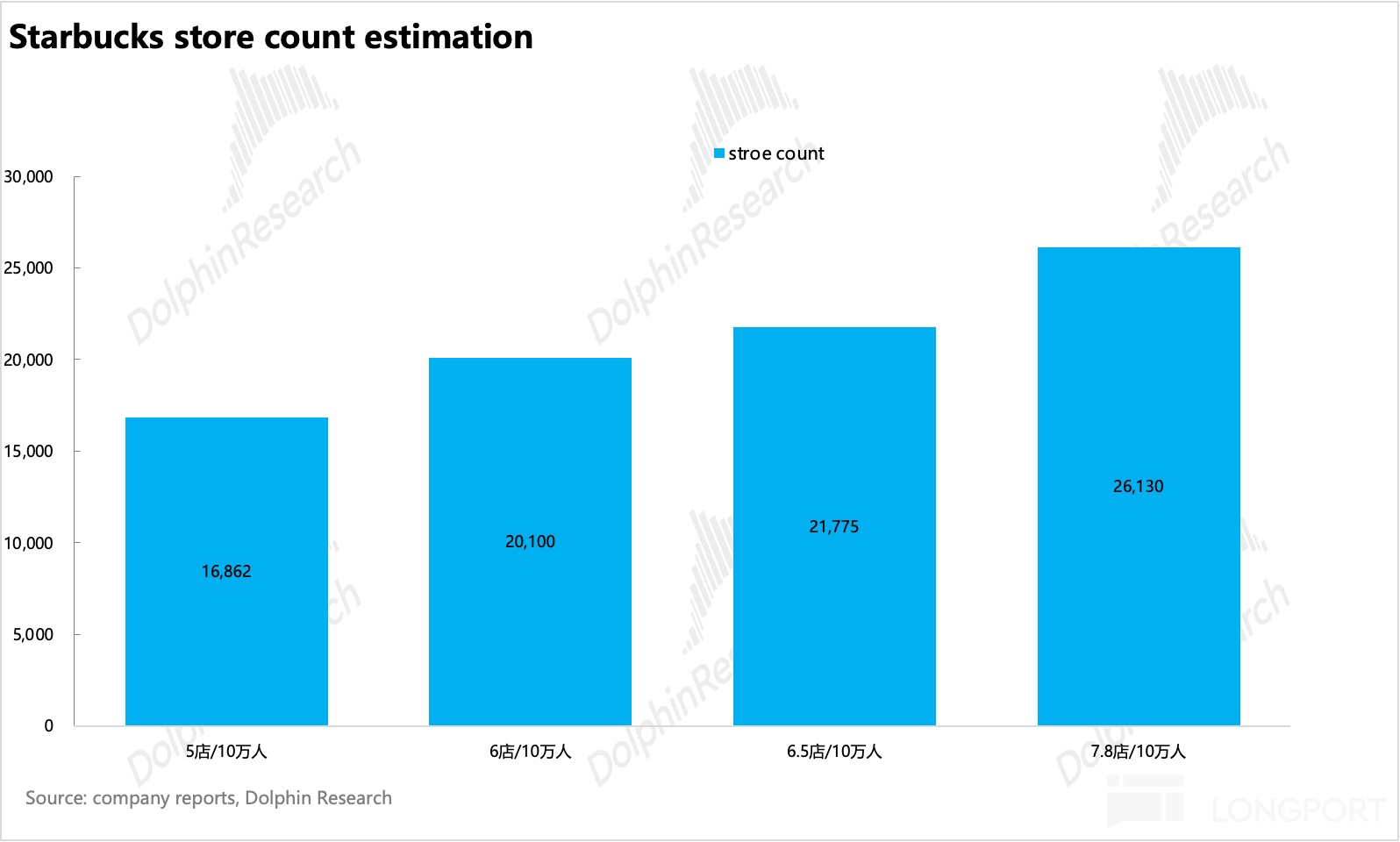
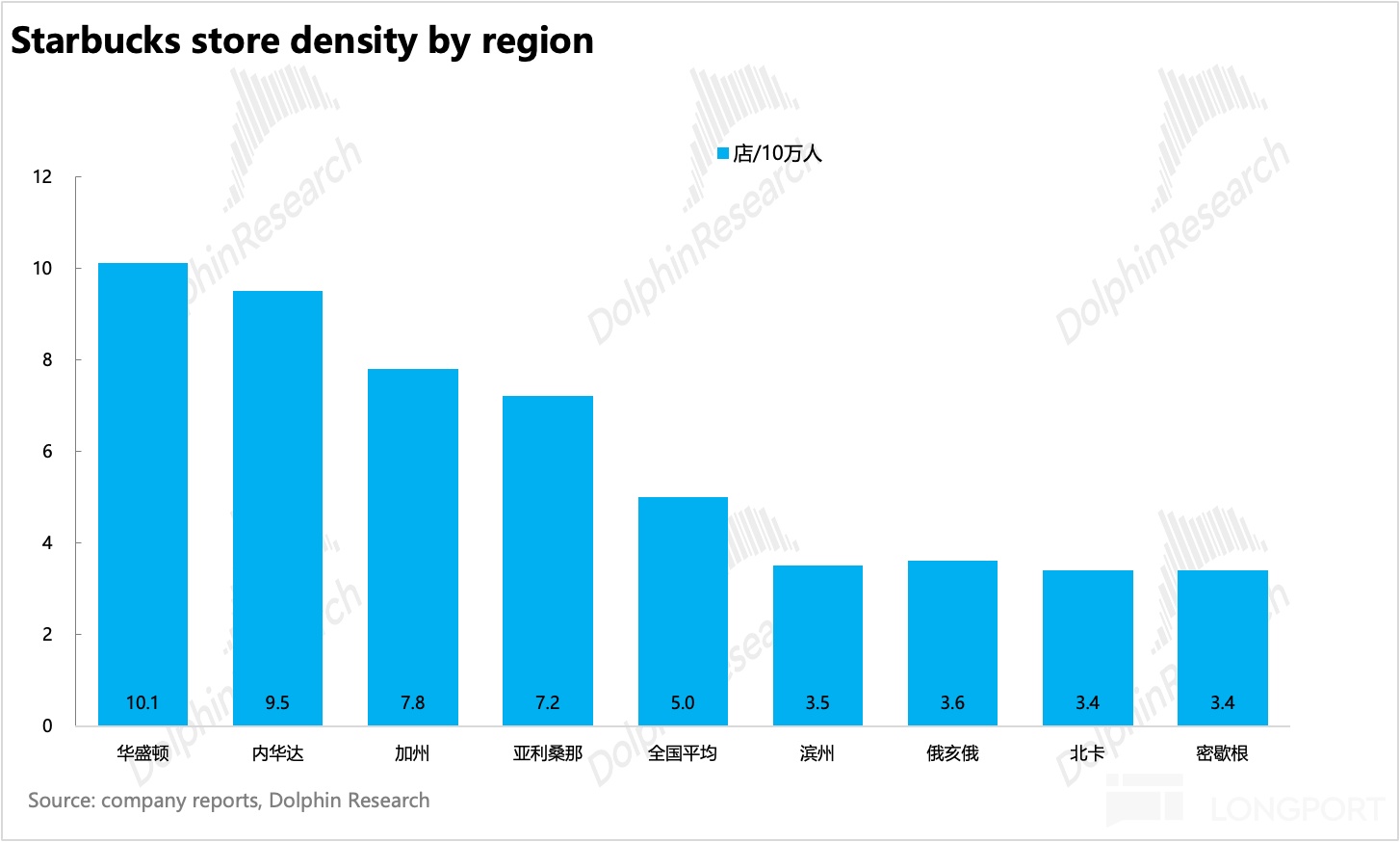
A simple cut by population density shows Starbucks in North America at roughly 5 stores per 100k people. If nationwide density trends toward mid-to-high-density states (6.5 per 100k), total U.S. stores would be ~21,800, or ~+4,900; if benchmarked to California (7.8 per 100k) — with small formats lowering site hurdles materially — the total could be ~26,100, or ~+9,300.
That broadly aligns with management’s bottom-up view — about +5,000 company-operated additions (to ~22k), and up to +10,000 including licensed.
Dolphin Research believes the small-format push is driven by:
a) Lowering capex per store and improving payback: with interest rates and build costs still elevated in North America, Pickup and dual-lane drive-thru formats require smaller footprints and lighter fit-out. Given the same capex envelope, more stores can be deployed, spreading unit investment and improving single-store returns.
b) Higher network density lowers marginal costs for digital and delivery: China has shown that 'mobile pickup + delivery' can drive a high digital order mix.
If the U.S. fills suburban and Midwest gaps with small boxes, mobile pre-order and drive-thru throughput should improve, and broader coverage will better support the Green Apron Service operating standard (discussed later), further lifting beverage production efficiency.
That said, management’s medium-term plan (to 2028) still guides to ~400 net new company-operated stores per year in the U.S. Versus the long-term 5,000–10,000 small-format potential, today’s pace would take more than a decade to realize.
This suggests management is not racing to blanket every potential node, but first proving out Pickup and dual-lane drive-thru economics, refining unit returns, operating processes, and digital fit.
On revenue, ~400 net new U.S. company-operated stores per year, plus ramp curves and inherently lower AUVs for light formats, likely add only ~1%–2% to annual revenue.
So until guidance is raised and expansion accelerates, small-format rollout is more of a medium-term call option and is unlikely to be a near-term earnings driver.
Growth Logic #2: Building a 'second peak' in the afternoon
A recurring structural data point from the company and the industry: about 50% of Starbucks’ business occurs before 10am, and 65% before noon, indicating a saturated morning peak where marginal gains are limited.
It also means that growing the afternoon into a second traffic peak is more 'profitable' per dollar of revenue — staff and equipment are reused without major fixed investment, so incremental orders carry higher margins.
Given caffeine needs skew to mornings, the logical approach is to use new categories to match afternoon demand:
Dolphin Research mapped Starbucks’ afternoon innovations below. The lineup centers on two themes: non-coffee beverages and natural energy supplements.
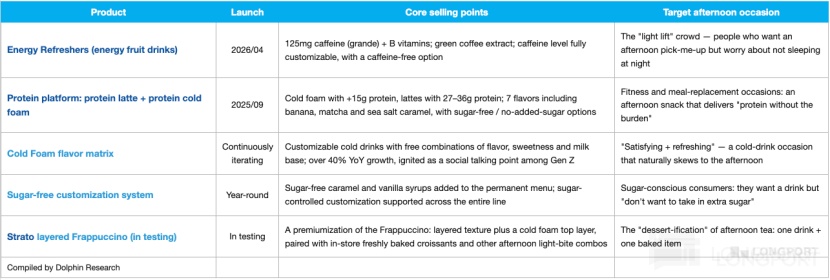
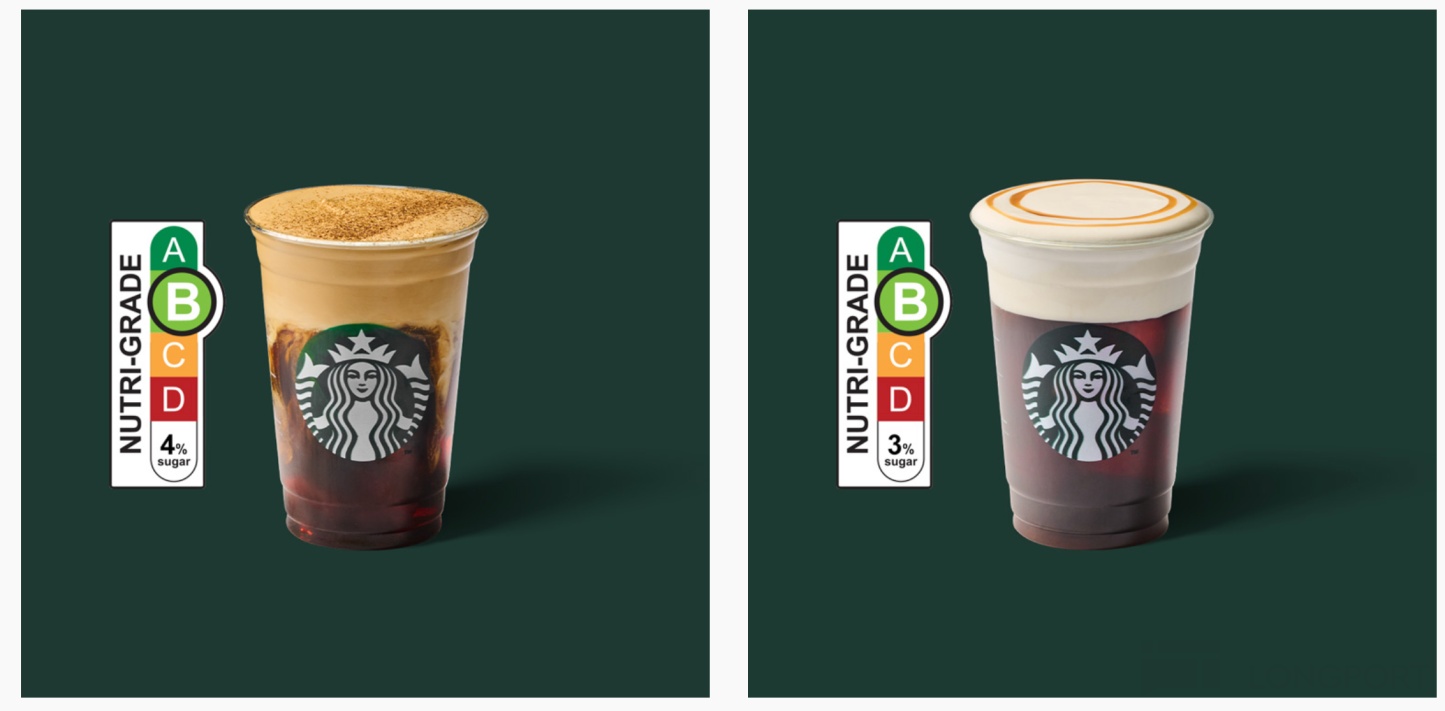
Based on field checks, Refreshers iced fruit beverages (notably the Pink Drink) are growing fast and have become the second-largest platform after traditional coffee.
Building on that, Starbucks launched Energy Refreshers with natural plant extracts and B vitamins, plus matcha specialties. These hit the sweet spot for younger customers who want an afternoon boost but dislike coffee bitterness and worry about caffeine impacting sleep.
The key change is compressing the SKU development cycle from 18 months to 8 months (with a long-term goal of 4). This enables new drops every 3–4 weeks, sustaining novelty in the afternoon daypart, specifically via:
a) Using real-time data and AI instead of annual surveys to pinpoint concepts
Since 2019, Starbucks’ in-house ML platform Deep Brew has processed ~100 mn weekly transactions, tracking trends in taste, ingredients, and dayparts in near real time to spot demand shifts quickly.
In 2024, generative AI was embedded to ideate and filter formula concepts. Development became data-driven rather than purely chef-led, eliminating months of early-stage trial-and-error.
b) Agile redesign of the R&D pipeline:
The Tryer Center in Seattle opened in 2018, but much of the effort was spent on Siri/app voice ordering, testing cold brew equipment, and optimizing delivery packaging, rather than solving the two critical pain points of 'core product innovation' and 'barista pain at peak.'
Even after a week of testing at Tryer, commercial rollout required approvals across marketing, supply chain, regional ops, and compliance, making for long decision cycles.
As former Chipotle CEO, Niccol launched the 'Starting 5' plan post-arrival. Tryer prototypes go straight into five stores for stress tests, rapidly validating beverage stability, labor complexity, and customer acceptance, with results in weeks.
Nationwide rollout follows only after hitting thresholds, doubling test efficiency and filtering weak products early to protect quality. The logic closely mirrors SHEIN’s 'small-batch rapid response' model.
c) A platform architecture plus faster replenishment
Even with faster R&D and testing, frequent launches hinge on supply chain design. Starbucks can compress cycles because the supply chain was rebuilt.
Refreshers, cold foam, and Cake Pop platforms are built on mature, market-proven bases. Most subsequent innovation simply swaps flavors, ingredients, or forms on those bases, avoiding new supply chains, equipment changes, or extensive retraining beyond new recipe parameters.
This also meaningfully lowers innovation risk: with a validated base, a weak new flavor won’t disrupt the entire line, and any miss is limited to that SKU with minimal loss.
Historically, the industry ordered by the case with 72-hour delivery, making nationwide rollouts take weeks and forcing store-level stockpiles. With piece-level replenishment and 24-hour daily delivery, efficiency and flexibility improved markedly.
Once a product is finalized, it can hit nationwide distribution quickly, and launch cadence is no longer constrained by logistics.
From recent calls, afternoon comps in traffic and ticket are both up. Importantly, the incremental volume is almost entirely cold and customized beverages, without crowding out morning coffee capacity.
A simple model: 12:00–17:00 accounts for ~25% of sales. With North America company-operated revenue of ~$27 bn, a 10% lift in afternoon sales adds ~2.5% to total revenue (~$680 mn); a 20% lift adds ~5% (~$1.35 bn), nearly equal to two to three years of net new store contribution — currently the best 'bang-for-buck' lever.
II. How to think about valuation?
1) Comp recovery as the core driver
First, a look at the earnings model.
On new stores, per the earlier analysis and guidance, Dolphin Research assumes North America focuses on refurbishments and single-store ROI repair in 2026–2027, opening 150–200 new stores per year on Avg. From 2028 onward, as the new small-box model scales, the mix shifts to light formats and the pace accelerates, averaging 400–500 new stores per year.
For licensed stores, concentrated in closed or specific venues (e.g., Target, airports/stations, campuses, and hospitals), penetration is near a ceiling nationwide. We assume a small number of high-quality openings offset by closures of low-efficiency sites, resulting in no net growth.
See the cadence below for detail:
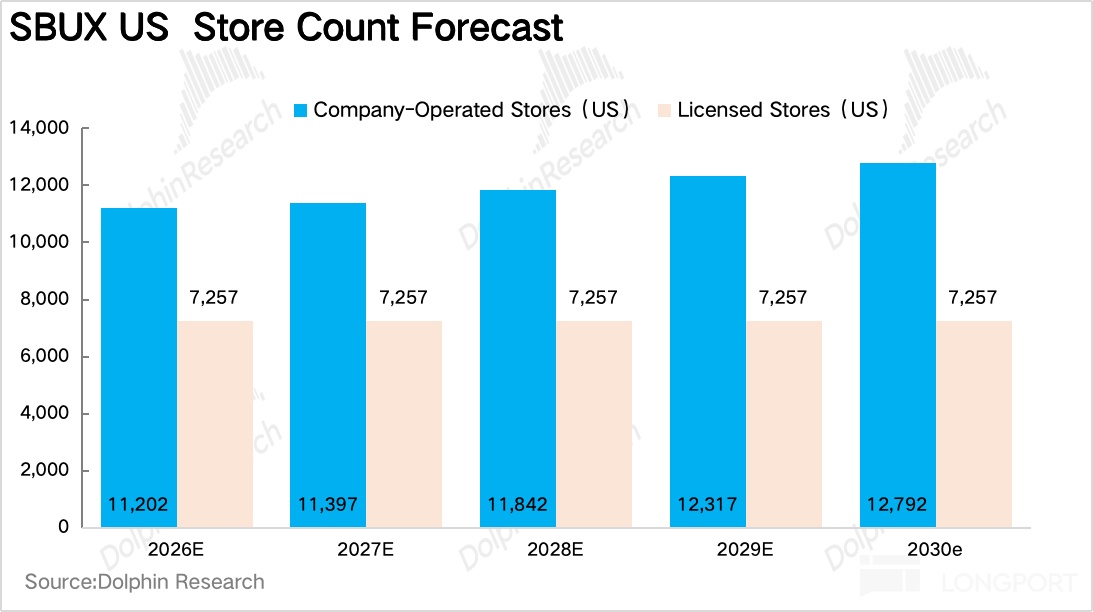
Under these assumptions, by 2030 Starbucks’ North America store count reaches 20,049, about 10% above today.
On comps, high inflation raised value concerns over a 'six-dollar cup,' and mobile order congestion hurt in-store experience, pushing North America comps lower from 2024 for two straight years (FY2024 -1.5%, FY2025 -1.8%, with traffic under pressure for seven consecutive quarters).
In 2025, Starbucks chose a 'tough medicine' path — under new CEO Niccol’s 'Back to Starbucks' strategy, it overhauled ordering algorithms, cut 30% of redundant SKUs, refreshed over a thousand stores, and added labor. North America comps turned positive in Q4 2025 on an easier base, with an early traffic inflection.
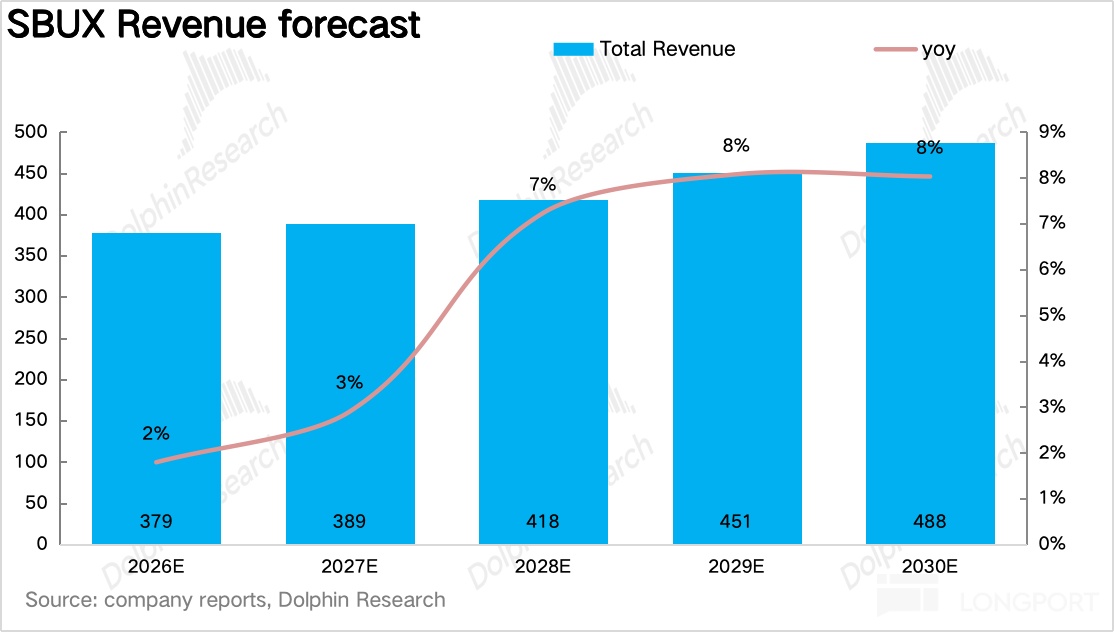
Therefore, we assume a more constructive 2026 North America comp of +5.5% (supported by a two-year down-cycle base and afternoon-led innovation; as noted earlier, a 10% lift in afternoon sales alone adds ~2.5 pts to revenue). From 2027, as base effects fade and refurb/menu optimization normalize, we assume comps ease to +4.5%, and stabilize at ~+4% in FY2028–2030 — in line with historical normals.
Internationally, with China off the consolidated statements and most markets licensed, comps have a much smaller direct impact on reported numbers. We assume low-single-digit growth (EMEA ~+1%–2%, APAC ~+2%–3%), not a key source of earnings optionality.
On this basis, Dolphin Research’s five-year revenue outlook implies a 2026–2030 revenue CAGR of ~6.5%.
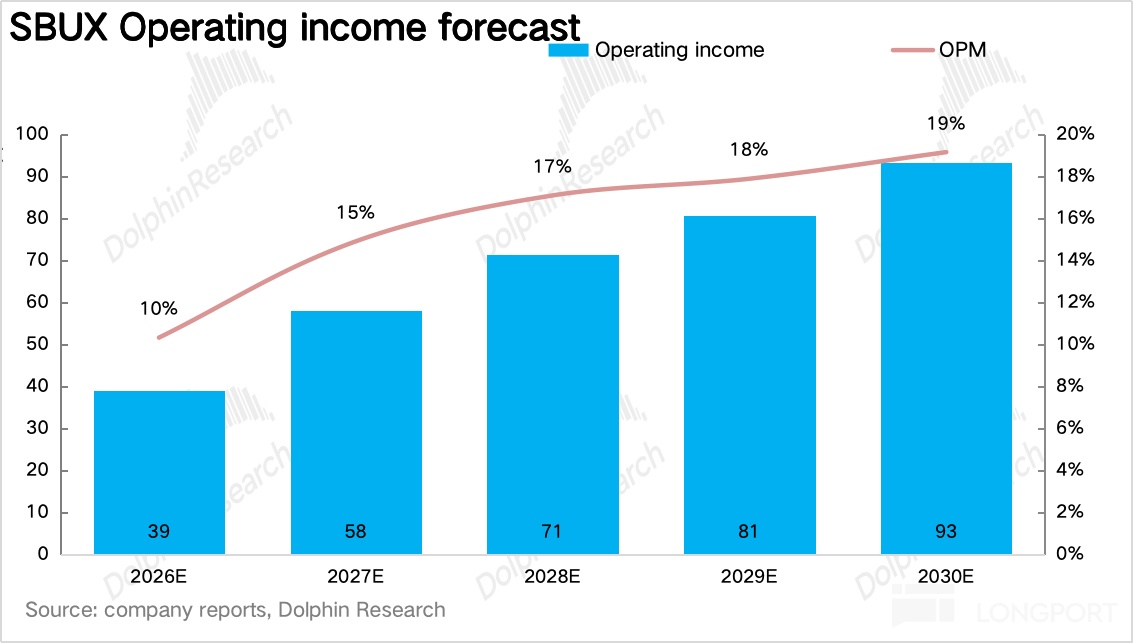
On costs, store ops and G&A are the main lines. Store opex ratio hit a record ~46% in 2025 due to deliberate labor reinvestment under 'Back to Starbucks.' We assume as comps turn positive and operating leverage builds, plus continued gains from Green Apron standardization and labor productivity, store opex falls from 45.9% to 39.8% by 2030, while G&A drops from 7% to 5.1% with org simplification and digital efficiency.
That lifts OPM from a ~10% trough to ~19%, implying a profit CAGR of ~24%.
2) A great company, but the market has already priced margin repair
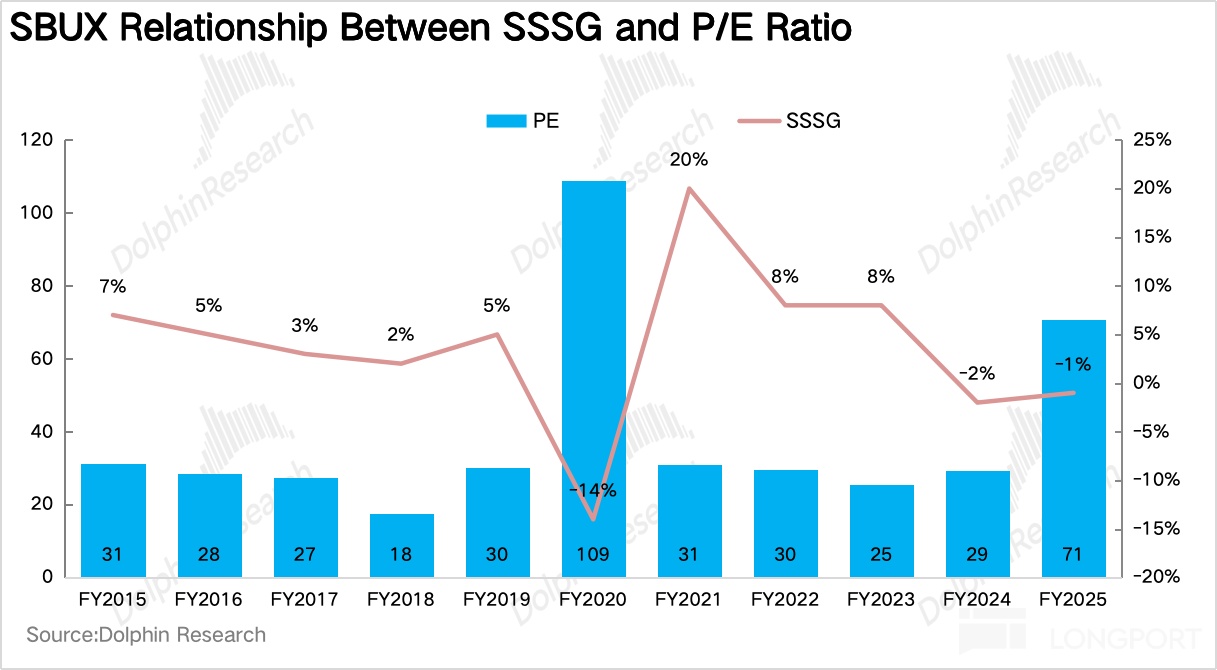
Historically, Starbucks’ multiple tracks comps closely.
Ex-extreme years, PE typically sits at 25x–31x, with a ~28–29x midpoint — about 1.5–1.7x the restaurant median (~18x), reflecting durable leader premium (global No.1 coffee brand, resilient comps, and steady buybacks/dividends).
For valuation, we discount steady-state profits back to today. Based on our forecast, by 2030 profit growth slows to ~15% with margin repair largely done, i.e., steady state. On a 2030 EPS of $5.96 and at 28x, fair value is ~$161; discounting at ~9% WACC back to today yields ~$118, implying ~13% upside vs. spot.
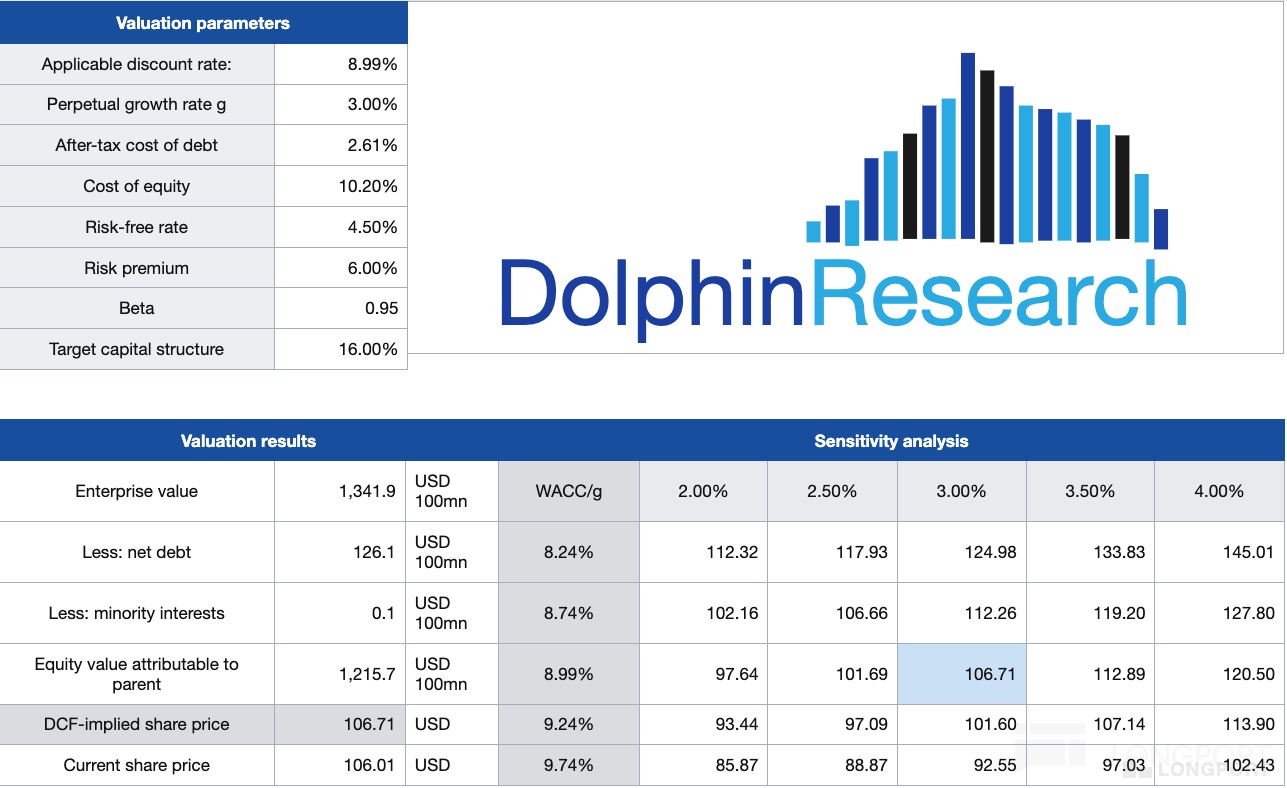
Cross-check via DCF: at 9% WACC and 3% terminal growth, fair value is ~$106.7 per share — almost identical to the current ~$106 stock price.
Net-net, the current price effectively equals the fair value under our relatively constructive case (North America OPM repaired to ~21.6%, slightly above pre-downturn), meaning the market has pre-priced a successful margin repair.
Takeaway: A great company, but not a fat pitch
Across both pieces, Starbucks is evolving from a 'heavy-asset restaurant operator' into a 'North America cash cow + global brand licensing' hybrid. The direction mirrors McDonald’s path to rerating.
Like Chagee in tea, Starbucks in the U.S. balances offense and defense: on defense, refreshed stores and stored-value float underpin the base, plus 4%–5% annual buybacks/dividends. On offense, afternoon comp optionality, small-box unit expansion as a call option, and an asset-light rerating option.
But a great company is not automatically a great entry. With 'full margin repair' already priced, buying here largely bets on upside surprises, while downside entails a double whammy if repair underdelivers.
For investors confident in sustained comp recovery, to preserve a margin of safety, Dolphin Research suggests waiting for the multiple to retreat to the lower bound of the range (25x), or about $89, before stepping in.
<End of text>
Dolphin Research archives on Starbucks:
Earnings Season
Jul. 30, 2026 earnings take: 'Starbucks: Out of the darkest hour, reborn from the ashes?'
Deep Dive
Jul. 21, 2026: 'Starbucks: A 'bank' in coffee clothing — how did it dominate for 40 years?'
Risk disclosure and statement: Dolphin Research Disclaimer and General Disclosure

The copyright of this article belongs to the original author/organization.
The views expressed herein are solely those of the author and do not reflect the stance of the platform. The content is intended for investment reference purposes only and shall not be considered as investment advice. Please contact us if you have any questions or suggestions regarding the content services provided by the platform.