

 Disney Diamond Holder
 Disney
📈 Beginner’s Guide to Investing in Dividend Stocks: OCBC Bank (Part 2)

💰 Understanding Dividend Yield, Valuation & Building Long-Term Wealth
Disclaimer: This article is for educational purposes only and does not constitute financial advice. Investments involve risk. Dividends are not guaranteed, and past performance does not guarantee future returns. Always conduct your own research before making investment decisions.
🌟 Welcome Back!
In Part 1, we learned why OCBC Bank is one of Singapore’s favourite dividend stocks. We explored:
- ✅ What OCBC does
- ✅ Why dividends matter
- ✅ How 100 shares can generate passive income
- ✅ OCBC’s growing dividend history
- ✅ Strong quarterly earnings
- ✅ Why patience is important when investing
Now it’s time to go one step further.
This chapter will teach you how experienced dividend investors decide whether a stock is worth buying instead of simply chasing the highest dividend yield.
💵 What Is Dividend Yield?
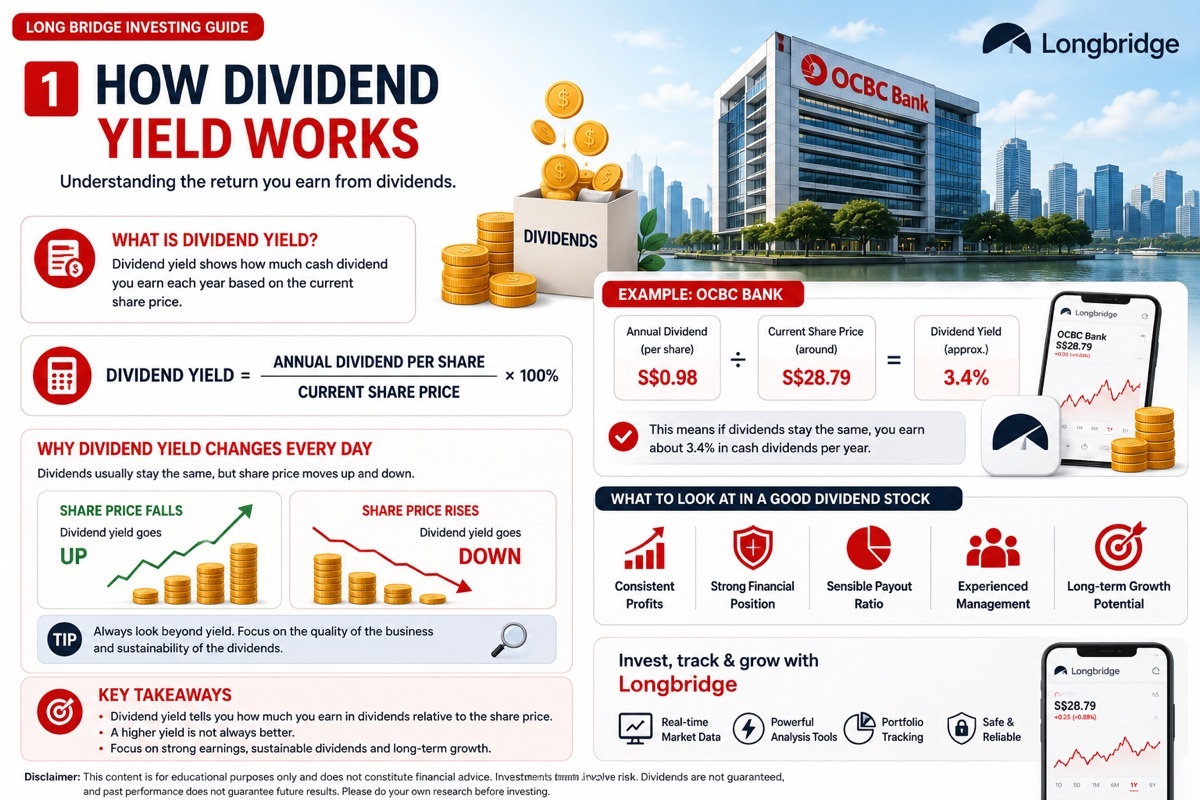
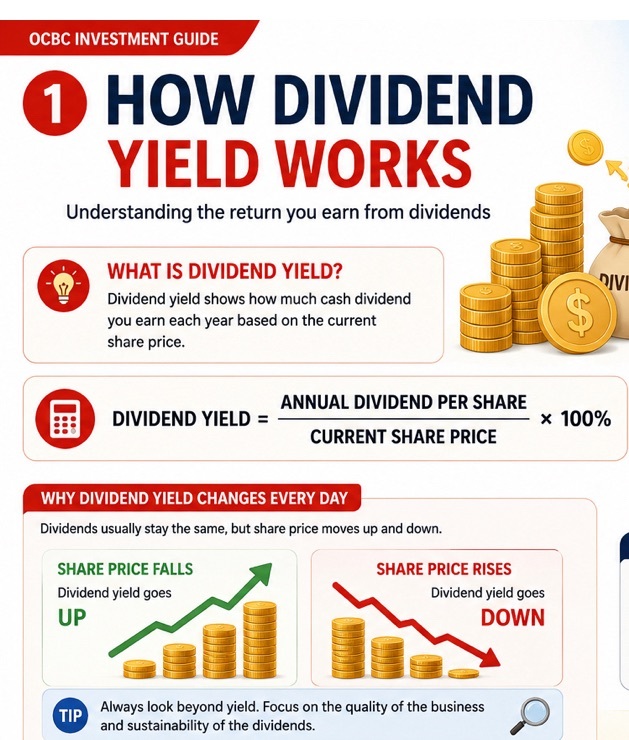
Dividend yield is one of the first numbers many investors notice.
The formula is very simple:
Dividend Yield = Annual Dividend ÷ Share Price × 100%
For example:
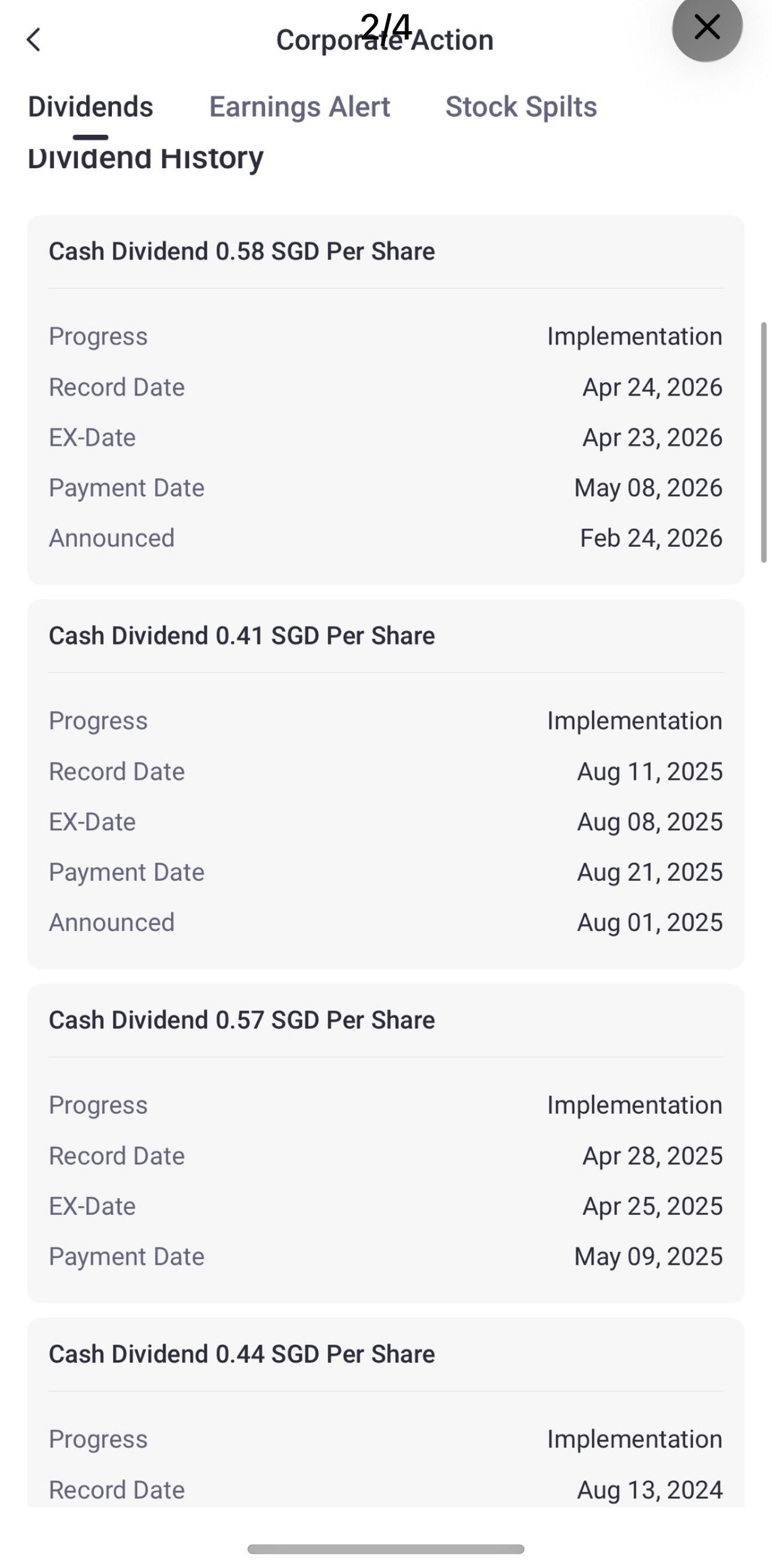
Annual dividend = S$0.98
Current share price = S$28.79
Dividend Yield:
0.98 ÷ 28.79 × 100
≈ 3.4%
This means that if dividends remain unchanged, an investor buying at today’s price would receive roughly 3.4% in annual cash dividends, excluding any future share price gains or losses.
📊 Why Dividend Yield Changes Every Day
Many beginners think the dividend changes every day.
Actually…
The dividend usually stays the same until the company announces a new one.
It is the share price that moves every second.
If the stock price falls…
Dividend yield goes up.
If the stock price rises…
Dividend yield becomes lower.
This is why yield constantly changes.
🚫 Don’t Chase High Dividend Yield
Many beginners make this mistake.
They search:
“Highest dividend stocks.”
Then they buy without understanding the business.
Sometimes a stock offers an 8% or 10% yield because investors expect profits to fall.
A falling share price can make the dividend yield look attractive, but that doesn’t necessarily make it a good investment.
Instead, ask:
- Is the company profitable?
- Can it continue paying dividends?
- Is the balance sheet strong?
- Are earnings growing?
Yield alone never tells the full story.
🏦 Why OCBC’s Dividend Looks Sustainable
Looking at OCBC’s financials, several strengths stand out:
✅ Profitable business
✅ Billions in annual earnings
✅ Conservative dividend payout
✅ Strong capital position
✅ Diversified sources of income
Banks are regulated and generally maintain capital buffers to help withstand economic downturns. While dividends can still be reduced if conditions worsen, OCBC’s consistent profitability has supported regular dividend payments in recent years.
📈 Understanding the Payout Ratio
Your screenshot shows a payout ratio of around 37.84%.
What does this mean?
Imagine the bank earns S$100.
Instead of paying out all S$100 as dividends, it distributes roughly S$38 and retains the remaining S$62.
The retained earnings can be used to:
- Grow the business
- Expand lending
- Invest in technology
- Meet regulatory capital requirements
- Prepare for future uncertainties
A moderate payout ratio generally gives management more flexibility than paying out nearly all profits.
💹 Dollar-Cost Averaging (DCA)
Many beginners worry:
“What if I buy today and the stock drops tomorrow?”
Nobody can consistently predict short-term market movements.
One approach many investors use is Dollar-Cost Averaging (DCA).
Instead of investing everything at once, you invest a fixed amount regularly.
For example:
Month 1:Buy 100 shares
Month 2:Buy another 100 shares if the price declines.
Month 3:Buy again.
Over time, your average purchase price may smooth out market fluctuations.
This approach also reduces the emotional pressure of trying to buy at the perfect moment.
🛒 Lump Sum vs Dollar-Cost Averaging
Both methods have advantages.
💰 Lump Sum
Advantages:
- Your money starts working immediately.
- Can outperform if markets rise steadily.
Disadvantages:
- Short-term price declines may be uncomfortable.
📅 Dollar-Cost Averaging
Advantages:
- Less emotional stress.
- Builds investing discipline.
- Suitable for monthly salaries.
Disadvantages:
- If prices rise continuously, returns may be lower than investing everything earlier.
There is no universal “best” method—it depends on your financial situation, goals, and comfort with market volatility.
🏦 Comparing Singapore’s Three Major Banks
Many investors compare OCBC with DBS and UOB.
Each has its own strengths.
OCBC
- Strong wealth management
- Regional presence
- Insurance business through Great Eastern
- Stable dividend history
DBS
- Largest Singapore bank by market value
- Strong digital banking capabilities
- Broad regional footprint
UOB
- Significant ASEAN exposure
- Commercial banking strength
- Consistent dividend record
Rather than choosing only one, some investors diversify by holding more than one Singapore bank.
⚠️ Risks Every OCBC Investor Should Understand
Even quality companies face risks.
Some examples include:
Interest Rate Changes
If interest rates decline significantly, banks’ net interest income may come under pressure.
Economic Slowdowns
When businesses struggle, loan defaults can increase.
Credit Risk
Banks lend money every day.
Not every borrower repays successfully.
Regulatory Changes
Banking regulations may change over time, affecting profitability or capital requirements.
Market Volatility
Share prices can fluctuate due to economic news, geopolitical events, or investor sentiment—even when the underlying business remains solid.
Understanding these risks helps investors stay prepared instead of reacting emotionally.
🔄 The Power of Reinvesting Dividends
Many long-term investors choose to reinvest the cash dividends they receive.
Instead of spending the dividend:
Receive dividend
↓
Buy more OCBC shares
↓
Own more shares
↓
Receive larger dividends next year
↓
Repeat
This is known as compounding, where your investment has the potential to grow because the returns generate additional returns over time.
🧠 Patience Is an Investor’s Greatest Asset
The stock market moves every day.
Some days are exciting.
Some days are disappointing.
Long-term dividend investors often focus less on daily price movements and more on:
- Company earnings
- Dividend sustainability
- Business quality
- Long-term growth prospects
Checking the share price every few minutes can sometimes create unnecessary stress.
Patience and discipline are often more valuable than trying to predict every short-term movement.
🎯 Final Thoughts (Part 2)
Dividend investing is about more than collecting cash every six months. It is about owning part of a quality business that can generate profits over many years.
OCBC has several characteristics that many long-term investors appreciate:
- 💰 A history of paying regular dividends
- 📈 Strong and consistent profitability
- 🏦 A diversified banking and wealth management business
- 🌏 Exposure to Singapore and the wider ASEAN region
- 📊 Sensible capital management and dividend policy
However, every investment carries risk. Share prices and dividends can change, and no stock is guaranteed to outperform.
The goal is not to become rich overnight—it is to build wealth steadily through disciplined investing, diversification, and a long-term mindset.
📖 Coming in Part 3
In the final part of this beginner’s guide, we’ll cover:
- 💵 How I evaluate whether OCBC is fairly valued
- 📈 Reading OCBC’s financial statements step by step
- 🏦 How interest rates affect bank profits
- 💹 Building a dividend portfolio with Singapore banks
- 📊 Common mistakes new dividend investors make
- 🚀 Creating a long-term passive income strategy using dividend stocks.
The copyright of this article belongs to the original author/organization.
The views expressed herein are solely those of the author and do not reflect the stance of the platform. The content is intended for investment reference purposes only and shall not be considered as investment advice. Please contact us if you have any questions or suggestions regarding the content services provided by the platform.
